Quick Specs
| Process type | Continuous rotary-drum bake-roll (UD05-class) vs. small-batch/pneumatic cycle |
| Optimized SKU-switch time | Under 10 minutes (SMED single-digit target) |
| Unoptimized SKU-switch time | 60–100+ minutes, typical for a manual, undocumented changeover |
| Capex scaling | Batch cost roughly doubles when volume doubles; continuous cost rises only ~20–25% |
| Best-fit SKU count | High-mix, frequent recipe changes → batch or hybrid; low-mix, sustained volume → continuous. |
Continuous vs batch wafer egg roll production refers to the two production-line architectures available for making wafer egg rolls: an unbroken continuous flow versus stopped, discrete batch cycles. In practice, choosing between them is really a question about SKU count and changeover economics, not about which method is inherently better. Buyers researching an automatic wafer egg roll machine often default to comparing labor and price, but the production-architecture choice – continuous flow versus stopped, discrete batches – drives how many product types you can run profitably and how fast you can react to a new flavor order.
Continuous wafer egg roll production runs batter through baking, rolling, and cooling as one unbroken flow. Batch production runs it in stopped, discrete cycles with a pause between runs. The right choice depends on how many recipes you run and how often you switch – not on which architecture is inherently faster.
- Modern continuous mixers can switch minor recipes as fast as batch mixers – the “batch equals flexible” assumption is outdated for a growing share of production-flow equipment.
- An undocumented manual changeover commonly costs 60-100+ minutes of non-production time; SMED-style discipline gets that under 10 minutes, for measurably less downtime.
- Batch equipment cost roughly doubles every time you double throughput; continuous equipment cost rises only about 20-25% for the same doubling – the gap compounds in continuous’s favor as volume grows.
- A true “batch wafer egg roll machine” is a different equipment category (small pneumatic or manual unit), not a mode switch on a continuous rotary-drum line like UDTECH’s UD05.
What “Continuous” and “Batch” Actually Mean on a Wafer Egg Roll Line
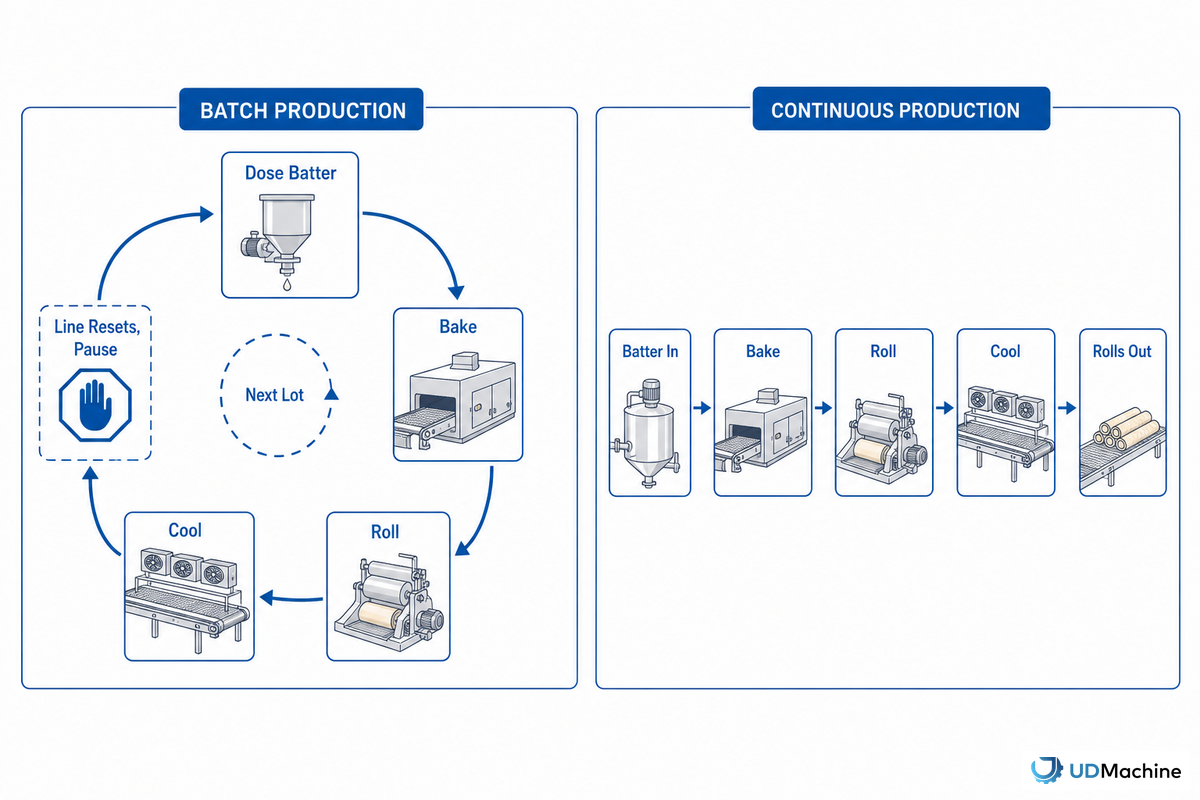
Batch production moves material through the line in discrete, sequential lots with a pause between each: a set amount of batter is dosed, baked, rolled, and cooled before the next lot starts. Continuous production moves material through in one unbroken flow – batter enters at one end and finished wafer rolls exit at the other, without a stop between lots.
A batch process and continuous process are two answers to the same question – how does material move through the line – and understanding batch and continuous processing side by side is what makes the rest of this decision tractable. This split is standard vocabulary for describing manufacturing processes, not something specific to egg rolls; it applies the same way to pharmaceuticals, chemicals, and automotive parts running at much higher volumes than a wafer line typically sees. Compliance frameworks like 21 CFR Part 117 apply equally to both: batch-record documentation and continuous real-time monitoring are both valid preventive-controls compliance paths, so neither architecture has a built-in regulatory advantage.
On a wafer line specifically, the raw-material flow is the tell: in batch manufacturing, a fixed volume of batter enters, gets fully processed, and the line resets before the next batch. In a continuous cycle, batter is metered in as an ongoing stream while finished rolls are metered out on the other end, with no reset in between. For a deeper walkthrough of the actual dosing-bake-roll-cool mechanism, see our breakdown of how an automatic egg roll machine works – this article focuses on the architecture choice, not the mechanics. The risk buyers run into is treating “which architecture” and “how automated is it” as the same question; UDTECH’s own integrated systems lineup makes the distinction concrete, since the UD05 is continuous by design regardless of which automation tier a buyer configures.
Where Real Wafer Equipment Sits on the Continuous-to-Batch Spectrum
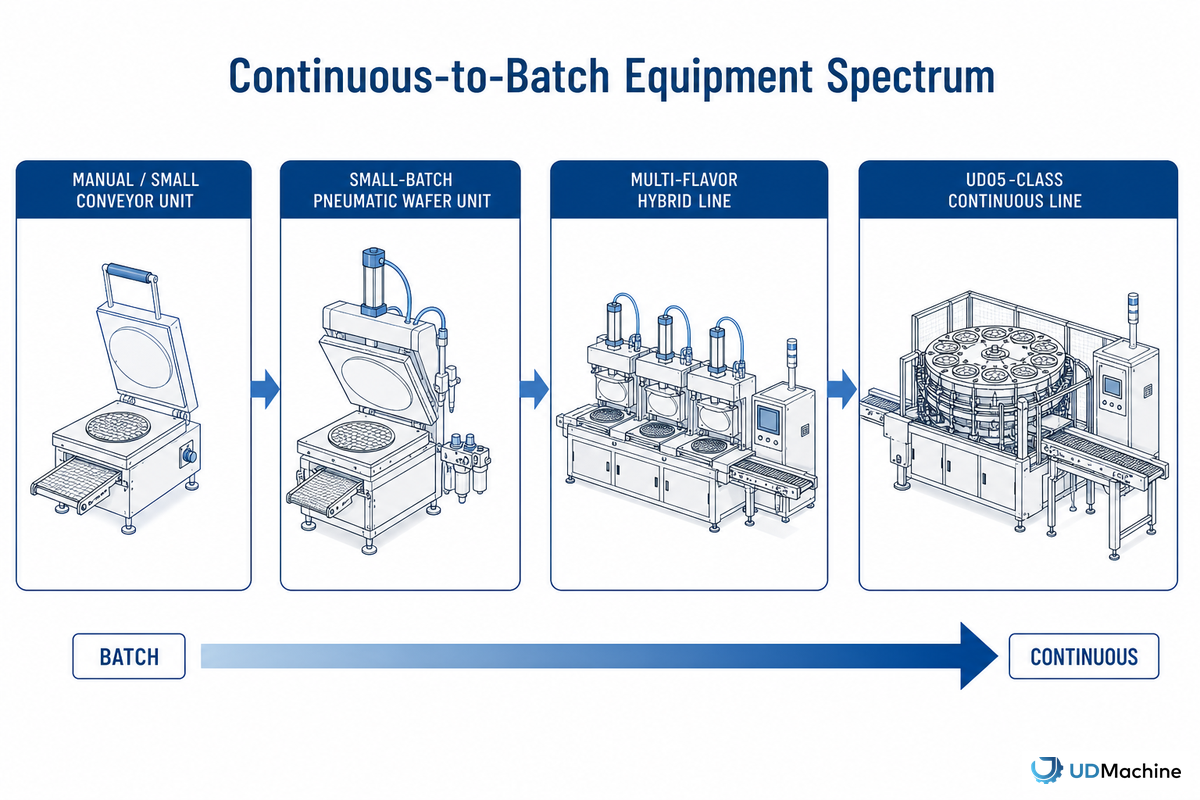
UDTECH’s UD05 wafer egg roll line is continuous by nature: a rotating hot mold bakes batter into a thin disc, and a mandrel rolls the hot product away, all in one continuous cycle, at 220–330 pieces/minute (600–900 kg per 8-hour shift depending on the UD05-2 or UD05-3 configuration). There’s no batch vs continuous process switch in this class of equipment – the rotary-drum mechanism simply runs one continuous flow of products.
What buyers often call a “batch wafer egg roll machine” (or an “American style wafer roll machine”) isn’t a wafer line at all – it’s different equipment running a different production process: a small-batch pneumatic unit with fewer mold cavities, or a manual hand-poured griddle setup. One 2023 U.S. patent for a small conveyor-belt egg roll rolling machine (US11647755B1) demonstrates this end of the spectrum: a single motor turns a belt and a pivoting forming block, but there’s no rotary baking-drum array in sight. This is a “low-throughput” device that has no relation to the continuous line, not a “batch setting” on the same equipment.
| Equipment class | Architecture | Typical throughput |
|---|---|---|
| Manual / small conveyor unit | Single mold or belt-and-block, operator-paced | Operator-limited, low volume |
| Small-batch pneumatic wafer unit | Fewer mold cavities, pneumatic rolling assist, run in discrete lots | Below full industrial-line volume |
| Multi-flavor hybrid line | Multiple mold-clamp stations running in parallel, semi-continuous per station | Several flavors produced per cycle |
| UD05-class continuous line | Rotary heated mold + mandrel, one uninterrupted flow, no batch cycle | 220–330 pcs/min, 600–900 kg/8h shift |
For the full, diverse product taxonomy of equipment categories, and including savory spring-roll equipment and home electric makers, none of which are mechanically connected to wafer lines, please refer to our egg roll machine buying guide and the comparison between wafer and spring-roll machines.
The Flavor-Switch Minutes Ledger: What a SKU Changeover Actually Costs
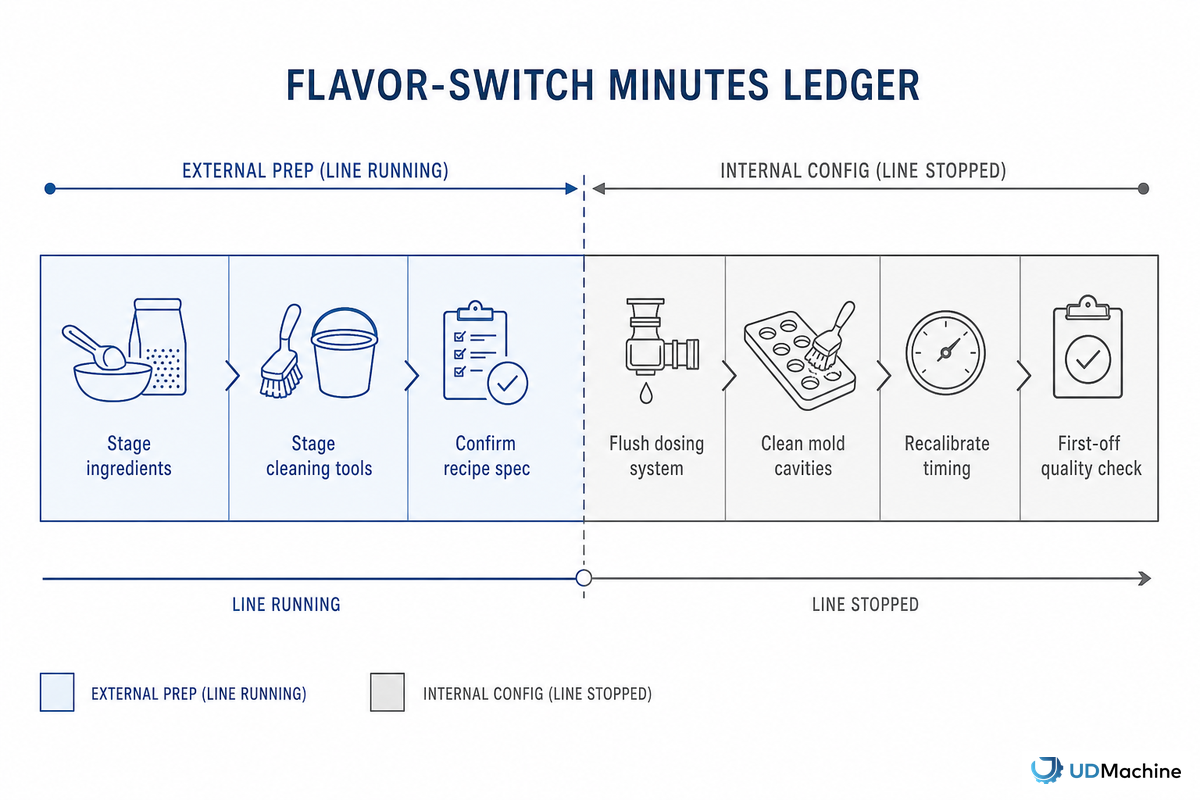
None of the generic “batch vs continuous” explainers that dominate Google search results put a figure on changeover time. That number can make all the difference, because changeover time, rather than raw throughput, often determines whether a multi-flavor wafer producer should run a batch process with minimal campaign changeover or invest in a dedicated line. Every minute of downtime between batches is a direct cost, and that downtime is the true financial nail on the head in this section.
This section uses industrial engineer Shigeo Shingo’s SMED (Single-Minute Exchange of Die) methodology as its benchmark, and SMED is a leading technique in lean manufacturing. SMED divides changeover into: Changeover Time = External Preparation Time + Internal Setup Time. External preparation can occur while the preceding product is on the line (e.g., gathering ingredients, calibrating tools); internal setup requires line stops (e.g., tooling and mold adjustments, cleaning). Its goal is to cut the time required for internal setup to less than 10 minutes, hence the “single-minute” in SMED.
| Stage | Task | Illustrative time |
|---|---|---|
| External prep (line still running) | Stage new batter ingredients and flavoring | 5–10 min |
| Stage cleaning tools and replacement mold parts | 5–10 min | |
| Confirm target weight, color and viscosity spec for the new recipe | 5–10 min | |
| Internal config (line stopped) | Flush and clean the batter dosing system | 10–25 min |
| Clean and sanitize mold cavities | 10–25 min | |
| Recalibrate dose volume, bake time and roll timing | 5–15 min | |
| First-off quality check and reject sort | 5–15 min |
Without the benefit of any SMED training or discipline, a setup like this usually falls between 60-100 minutes, in line with published lean-manufacturing case data: one documented food-mixing-line setup ran to 100 minutes prior to optimization (38 min external, 62 min internal), and a packaging-industry case study by M. Peterman, cited in a Rochester Institute of Technology thesis on SMED programs, documents a line that cut setup time from 86 to 24 minutes with just one pneumatic wrench as capital expense – no larger equipment purchase required. Reading Bakery Systems put this common assumption to the test directly:
“Changeovers that require a washdown before another dough can be made are no more difficult or time-consuming on a continuous mixer than those on a batch mixer.”
Without SMED discipline, it’s common to spend 60-100+ minutes per case of non-productive changeover time per case of the product. Moving as many tasks as you can from internal (down) preparation to external (running) preparation is your best single tool for improving operational efficiency, even before thinking about new equipment.
Throughput and Labor: What Changes, What Doesn’t
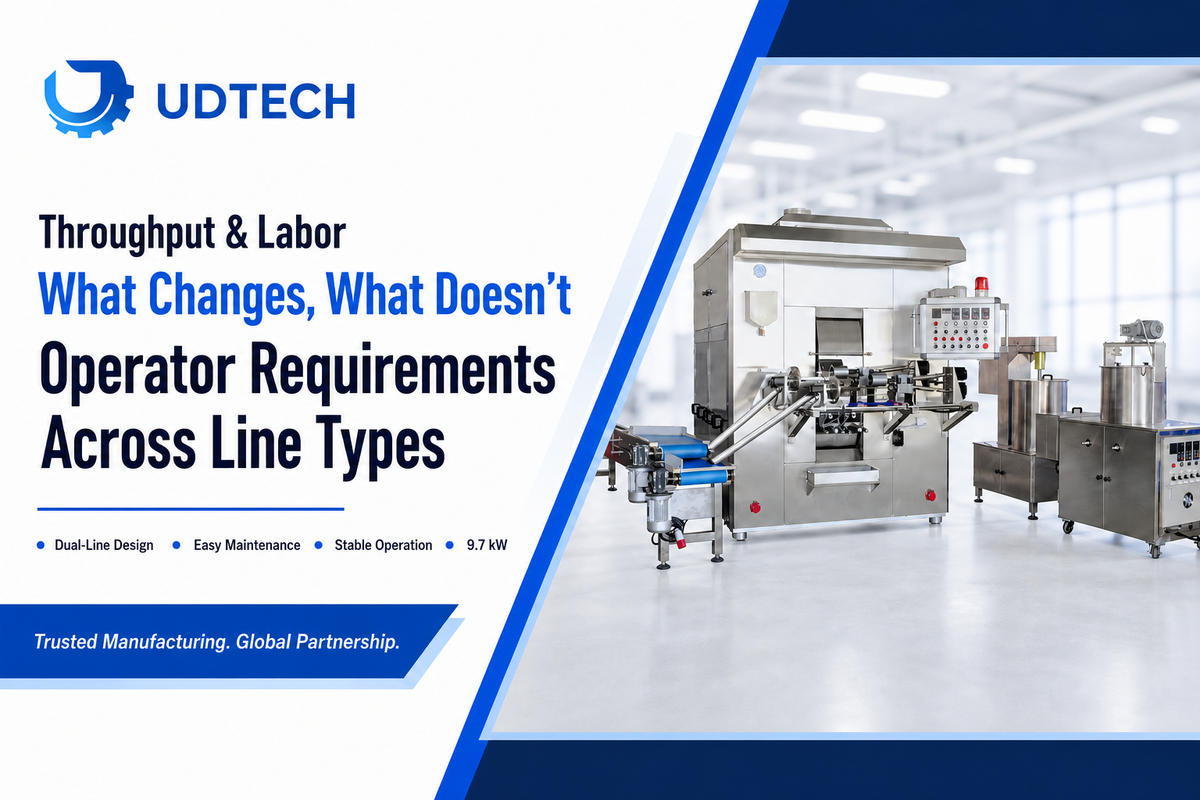
- Fewer operators per line – a continuous mixer typically needs about half an operator’s time regardless of throughput, versus roughly three people per shift, often including a dedicated supervisor, on a comparable high-speed batch line, per Reading Bakery Systems’ published payback analysis
- No per-batch setup or monitoring cycle to staff around, which supports leaner operational goals
- Labor savings only if you’ve consistent high-volume demand, idle continuous capacity doesn’t yield the same savings on a per-unit basis.
- Sector-wide food-manufacturing labor productivity actually dropped 2.1% in 2025, according to U.S. Bureau of Labor Statistics data. That’s a good reminder that automation alone won’t yield a productivity victory at the sector level.
We’re keeping this H2 short on purpose – the complete labor cost and payback calculations (rejection rates, RFQ measurement, sample run data) already live in our manual vs. automatic egg roll machine breakdown. That piece answers “does automation help labor cost?” This one asks a different question: does running continuous versus batch change labor need on its own, independent of automation level. The answer is yes, but the effect is smaller than the manual-to-automatic jump, and it only pays off when you’re running a constant flow at sustained volume.
Product Quality Consistency: Batch-to-Batch Variation vs Steady State
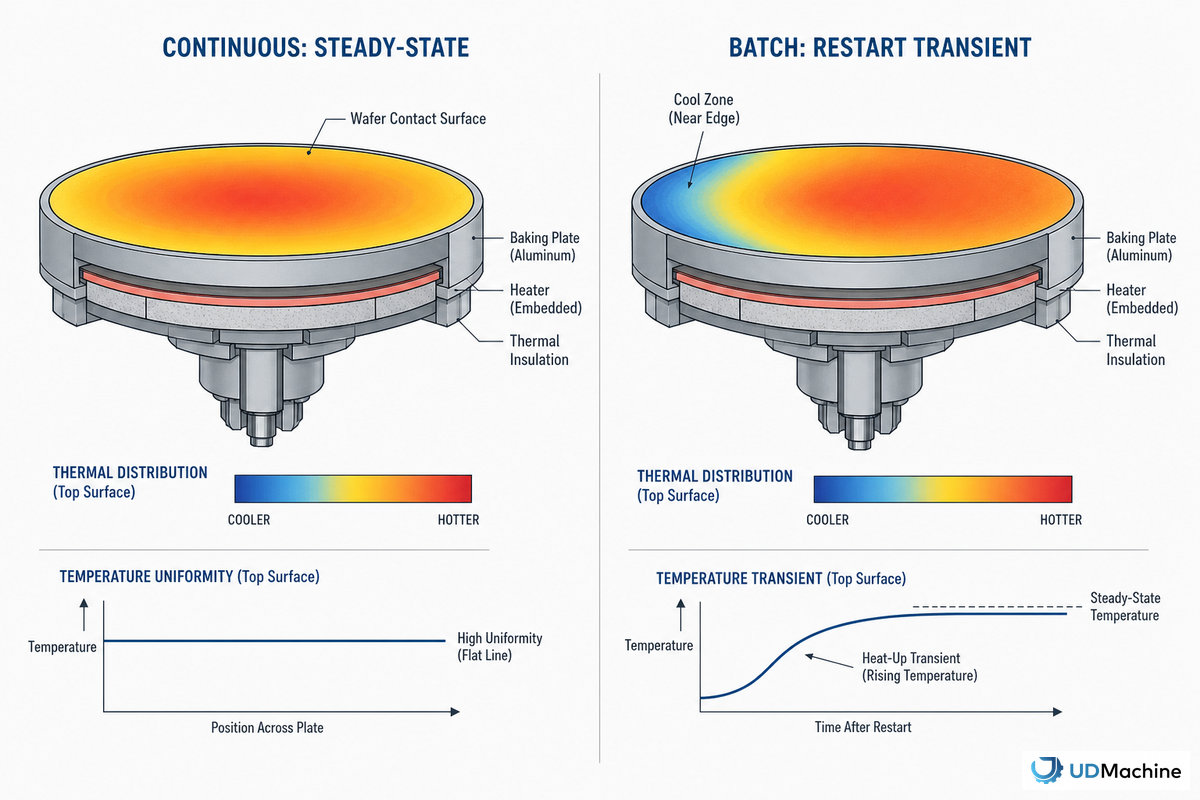
Wafer thickness and color consistency, on either manufacturing method, come down to how evenly the baking plate holds its temperature. A recent peer-reviewed paper in MDPI Applied Sciences (2025) compared different types of materials used in baking plates. That study confirmed that the vermicular cast iron baking plate (GJV-350) created the most consistent heat distribution, most consistent wafer sheet thickness, and most consistent wafer color, compared to plates made of other less uniform materials – the combination that minimizes waste from inconsistent product. Put simply, an uneven temperature on the baking plate means that parts of the same final product bake at different rates.
A continuous manufacturing operation holds one steady state temperature for the duration of the shift, thus this thermal uniformity effect will be present from disc to disc. A batch or small-run line will restart many times during a shift, reintroducing a heat up transient in each, meaning the first few discs post-changeover will bake on a plate which hasn’t yet achieved steady temperature – precisely when thickness and colour variations threaten consistent quality. Therefore the first-off quality check from the changeover ledger table above isn’t just for form’s sake, it’s a quality control checkpoint to catch the specific defect mode described by the thermal research on a batch process or continuous line. This is a legitimate question to put to any UD05-class vendor at the quote stage: what baking-plate material and quality standards for thermal uniformity the machine specifies, and how is that verified plate-to-plate on the production line.
Capital and Flexibility: When NOT to Buy a Dedicated Continuous Line
Operations-management theory gives this trade-off a name – the Hayes-Wheelwright product-process matrix which slots continuous flow on the far-high-volume, standardised product, end of the process selection spectrum which needs significant capital to support consistently high volumes and spread out the fixed cost per unit. Reading Bakery Systems has given numbers to this concept in a published payback white paper, and the curve shape itself matters more than any one price: if you double the throughput demand on a batch system, the equipment cost will roughly double too. Double the throughput demand on a continuous line, however, and cost increases will be closer to 20-25%, since the ingredient metering hardware driving costs doesn’t increase significantly with scale – the core of continuous-line scalability.
| System capacity | System cost | Cost per kg/hr of capacity |
|---|---|---|
| 500 kg/hr | $500,000 | $1,000 |
| 2,000 kg/hr | $750,000 | $375 |
| 15,000 kg/hr | $1,500,000 | $100 |
A batch system matched to the same volumes scales roughly linearly, so the cost-per-unit-capacity difference between the two architectures increases with each increase in throughput requirement – this explains why continuous adoption tends to occur towards the high-volume end of the spectrum, rather than being spread out across the entire market. Energy costs only compound this: one case study comparing simultaneous runs of 8,000 lbs of hamburger bun dough on a continuous vs batch mixer found that the continuous system used 29% less energy during the production run, with 42% lower median energy use, and Reading Bakery Systems estimates overall savings for typical continuous operations at roughly $25,000 per year for every 5,000 lbs of dough produced. This is precisely why continuous adoption occurs primarily with operations running large volumes, like Kwik Trip’s Wisconsin bakery which runs an Exact Mixing continuous mixer on two AMF lines to produce 1,600 buns per minute (96,000/hr) and the plant’s director reports they ‘probably only changeover three or four times based on demand’, or the Domino’s Pizza Group UK site cited for continuous mixing since 2010 to produce 144,000 dough balls per day. Below a volume where these economics take hold, the multi-SKU operation needing frequent flavour changes is generally best served by a batch or a hybrid setup, as per our capacity-planning guide on the demand-side sizing math needed alongside this capex data.
SKU-Count Fit Line: A Decision Framework for Wafer Producers
How do I know when to switch from batch to continuous processing?
Once you understand the differences between batch and continuous production, the deciding factors are three things: the number of SKUs you run, the frequency at which you change over between them, and how quickly your volume is growing. If recipes change on a daily or weekly basis, batch or a hybrid setup will give you manageable changeover cost regardless of demand fluctuation.
If a single recipe is running for weeks at a time, market demand keeps going up, and you need to produce large amounts of food, the capex argument for continuous really is hard to beat – per Reading Bakery Systems’ published payback data cited above, every doubling of throughput about doubles the cost of a batch system, but only increases that of a continuous system by about 20-25%, so continuous gains ground as the operation grows.
- Many SKUs, frequent switches, any volume → batch or hybrid (multi-flavor clamp-station line). Batch process handles the cost per-minute of changeovers, while continuous capex isn’t worth it in this scenario.
- Low SKU count (1-3 recipes), infrequent switches, volume less than 2,000 kg/hr equivalent → Batch or small-batch pneumatic unit. At this level, continuous lines don’t offer enough of a capex savings to justify the extra cost.
- Low SKU count, constant or growing year-over-year volume → Continuous (UD05-class). As volume goes up, cost-per-unit capacity widens for continuous, and any labor/energy savings continue to grow over the course of a long production run.
- Seasonal or promotional SKUs overlaid on top of stable base recipe → Hybrid: continuous line for the core recipe, batch-style campaigns for other recipes.
If your SKU count and volume land close to a boundary between two of these categories, that’s worth a direct conversation rather than a guess – UDTECH’s engineering team, which works with food and beverage manufacturers across SKU ranges, can walk through your specific recipe count, changeover frequency, and target volume before you commit capital to either architecture.
2026 Outlook: The Batch-to-Continuous Blend Zone
Equipment technology is moving faster than the “batch is flexible, continuous is rigid” thinking has caught up with. Modern continuous systems have shifted from manual weighing to simple touchscreen-controlled metering for minor recipe changes; Reading Bakery Systems reports that on today’s equipment, changing a recipe is “a few taps on a touchscreen” instead of the manual-weighing workflow of mixing a new batch by hand. It’s been three decades of continuous mixer design and evolution: from single-purpose, high-volume-only designs in the early 1990s to today’s clamshell-barrel, retractable-shaft, analytics-driven equipment built for quick changeovers and multi-product control and flexibility.
Food-manufacturing automation investment specifically is looking at the space: in its 2026 forecasts, food-manufacturing automation has identified “high variability/high pain areas,” with changeovers and short production-cycle runs at the very top, even ahead of broader connectivity and robotics investment. So if you’re in planning for 2026 for wafer lines, the practical answer for your equipment search is to inquire with each vendor about how its equipment capabilities for recipe changes have been updated in the last 5 years – as opposed to relying on a generic “batch vs. continuous” discussion that suggests recipe changeover time is inherently architecturally limited. Either type of equipment clears regulatory approval fine under 21 CFR 117, so it’s not a deciding factor. That’s the conversation worth having with UDTECH before locking in an architecture: ask what changeover-time improvements are built into the current UD05 generation, not just what it was designed for a decade ago.
FAQ
Q: What is the difference between batch production and continuous production?
View Answer
Q: What is a disadvantage to continuous manufacturing?
View Answer
Q: Which is more efficient for food manufacturing, batch or continuous?
View Answer
That SKU-Count Fit Line earlier in this article explains which environment is best for you.
Q: Does Coca-Cola use batch production?
View Answer
Q: Does batch or continuous processing change food-safety and traceability requirements?
View Answer
Neither method carries an advantage under current regulatory requirements.
See the UDTECH UD05 Continuous Wafer Egg Roll Line →
About This Article
UDTECH makes the UD05 continuous, non-stop wafer egg roll line which this article is analyzing; UDTECH, then, is biased toward portraying the continuous-vs-batch processing approach with a little more nuance and less of a “automation is always best” style of salesmanship. The article’s “changeover-minute” and “capex-tier” numbers were culled from existing, published lean case studies and data gleaned from the bakery equipment manufacturing industry-not UDTECH’s in-house marketing materials. UDTECH’s specifications on throughput and shift-output for the UD05 were developed internally. Reviewed by the Suzhou UDTECH Technology Co., Ltd. technical team.
References & Sources
- 21 CFR Part 117, Current Good Manufacturing Practice, Hazard Analysis, and Risk-Based Preventive Controls for Human Food — U.S. Food and Drug Administration (eCFR)
- Investigation of the Effects of Wafer-Baking Plates on Thermal Distribution, Wafer Thickness and Wafer Color Distribution — MDPI Applied Sciences (peer-reviewed, 2025)
- Eliminating Production Losses in Changeover Operations: A Case Study on a Major European Food Manufacturer — Production Planning & Control, Taylor & Francis (peer-reviewed)
- NAICS 311, Food Manufacturing — U.S. Bureau of Labor Statistics
- SMED (Single-Minute Exchange of Die) — Lean Production
- A Study of a Management-Supported Single Minute Exchange of Die (SMED) Program for the Flexible Packaging Industry — Jared Unterborn, Rochester Institute of Technology (thesis, citing M. Peterman’s case study for the 86-to-24-minute example)
- Hayes-Wheelwright Product-Process Matrix — operations strategy framework
- How Continuous Mixing Supports Efficient and Sustainable Baked Good Production — Food Engineering
- Continuous Mixing vs. Batch Mixing: Payback Considerations — Exact Mixing, a Reading Bakery Systems brand
- Higher Dough Capacities Multiply the Advantages of Continuous Mixing — Exact Mixing, a Reading Bakery Systems brand
- Kwik Trip’s Vertically Integrated Bakery Operation — Baking & Snack (Sosland Publishing)
- 5 Food Manufacturing Strategy Trends Defining 2026 — Food Industry Executive
- US11647755B1, Egg Roll Rolling Machine — USPTO / Google Patents
Related Articles
- Manual vs Automatic Egg Roll Machine — the full labor-cost and payback breakdown for a flexible and efficient line
- Sizing an Egg Roll Line for Peak Demand — demand forecasting, shift planning, and scaling toward higher production
- How an Automatic Egg Roll Machine Works — the 5-stage bake-and-roll mechanism behind an improved product
- Egg Roll Machine Buying Guide — wafer, savory, and home formats compared
- Feuilletine Production Line — a comparable baked-snack line configuration