Updated July 2026 · Reviewed by the Suzhou UDTECH Technology Co., Ltd. technical team
Quick Facts: Phoenix Roll
| Origin | Macau / Hong Kong, Cantonese bakery tradition |
| Type | Rolled biscuit wafer (baked, not fried) |
| Classic filling | Seaweed strip + pork floss (savory-sweet) |
| Texture | Crispy, flaky, buttery |
| Common occasion | Lunar New Year and Mid-Autumn gifting, afternoon tea |
| Not to confuse with | The American sushi roll of the same name (see below) |
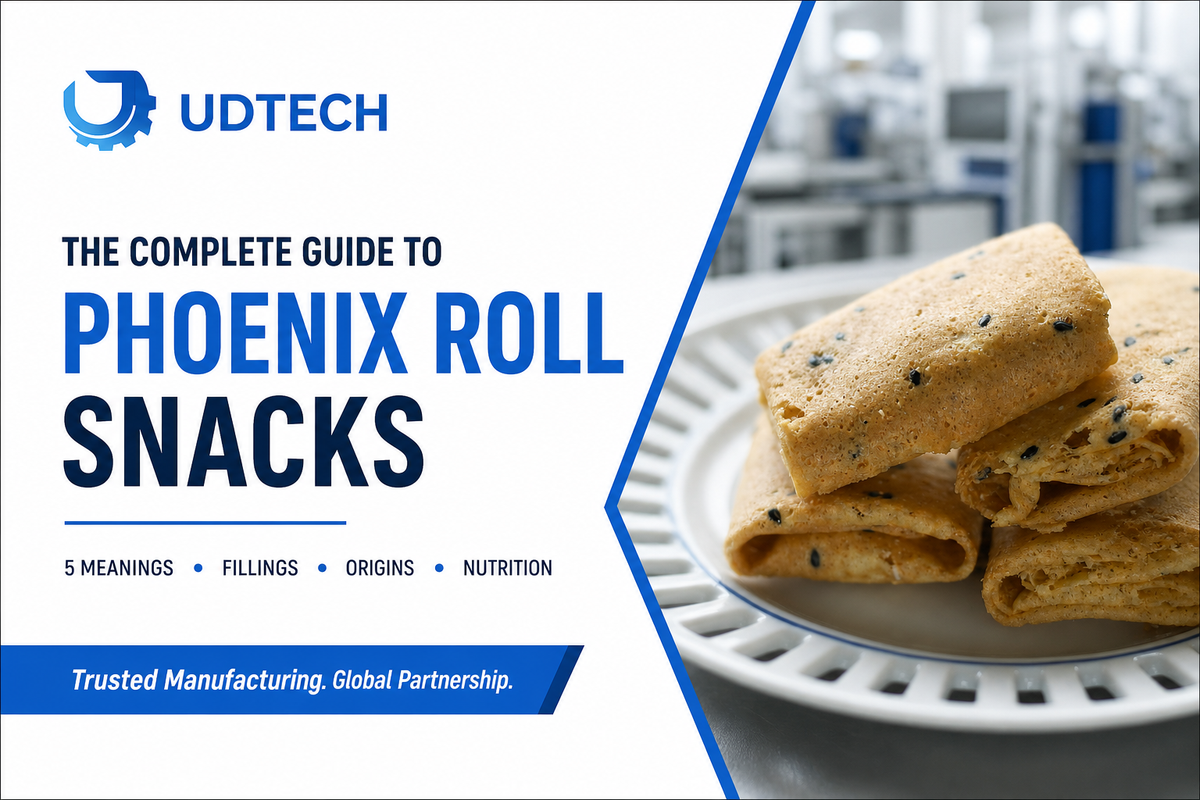
If you googled “what is a phoenix roll snack” and got five different answers, it wasn’t your imagination. A phoenix roll is, most commonly, a crispy Macau and Hong Kong bakery biscuit made from an egg-and-butter batter and rolled around a filling of seaweed and pork floss, but those same three words can also describe at least four completely separate foods. This guide helps you figure out which one you’re actually looking for, then goes deep on the real one: its history, contents, preparation, calorie count, and when people buy it.
- “Phoenix roll” names at least five unrelated foods, not only two.
- Hong Kong’s Kee Wah treats its phoenix roll of sesame and coconut no more specially than the one with pork floss. Neither one can substitute for the other.
- Commercial imports of Chinese meat products currently face U.S. restrictions, which touches how pork-floss phoenix rolls reach American shelves.
- Each one comes in around 30-120 calories depending on the brand and serving size, not nearly the same as a deep fried egg roll at your favorite restaurant.
What Is a Phoenix Roll, Exactly?
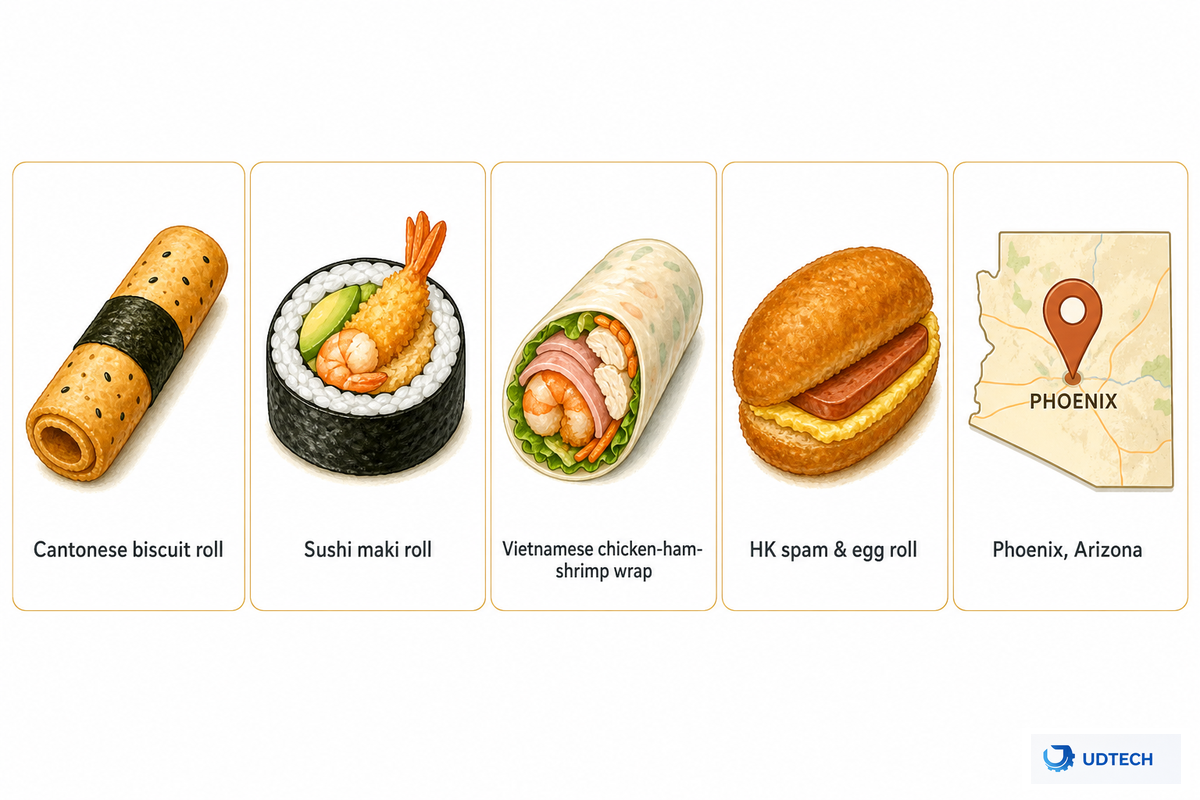
A phoenix roll is a crispy, rolled egg-batter cookie from the bakery culture of Macau and Hong Kong, normally rolled around a strip of seaweed with a core of pork floss, although there are different flavor combinations available depending on brand. Its sweet, buttery, eggy flavour and aroma, along with the wafer-like texture, is a strong characteristic that’s easy to pick out.
Other variations are sold at heritage Cantonese bakeries as phoenix egg rolls, and this is a genuine Macau specialty; it’s one of the more prominent premium variations sold at, for example, Koi Kei which, by 2016, claimed 74.4% of Macau’s pastry-souvenir industry.
But still, those same three English words overlap with four others, and Google’s AI answer engine doesn’t even have a great track record telling them apart at first go.
| Meaning | What it actually is | Where you’ll see it |
|---|---|---|
| 1. This article’s topic | Crispy Cantonese egg-batter biscuit, seaweed + pork floss | Macau/HK bakeries, Asian grocers |
| 2. American sushi roll | Fried tuna/shrimp tempura, eel, avocado, spicy mayo maki | US/UK sushi restaurant menus, nationwide |
| 3. Vietnamese dish | Banh phuong hoang — chicken, ham and shrimp wrap | Vietnamese recipe sites |
| 4. Hong Kong cafe dish | Fried bread roll stuffed with spam, prawn and egg | HK-style cha chaan teng recipe blogs |
| 5. City-name coincidence | Snack brands simply located in Phoenix, Arizona | AI-generated “manufacturer” search results |
The 5-Way Name Collision
Assuming a single Google result settles it is the trap here — ordering the wrong “phoenix roll” is an easy mistake to make, and this collision is so common that even Google’s own AI Overview, in answer to a direct question, equivocates between two of these usages and asks you to choose rather than deciding for you. That’s the gap this guide resolves.
Where the Phoenix Roll Comes From
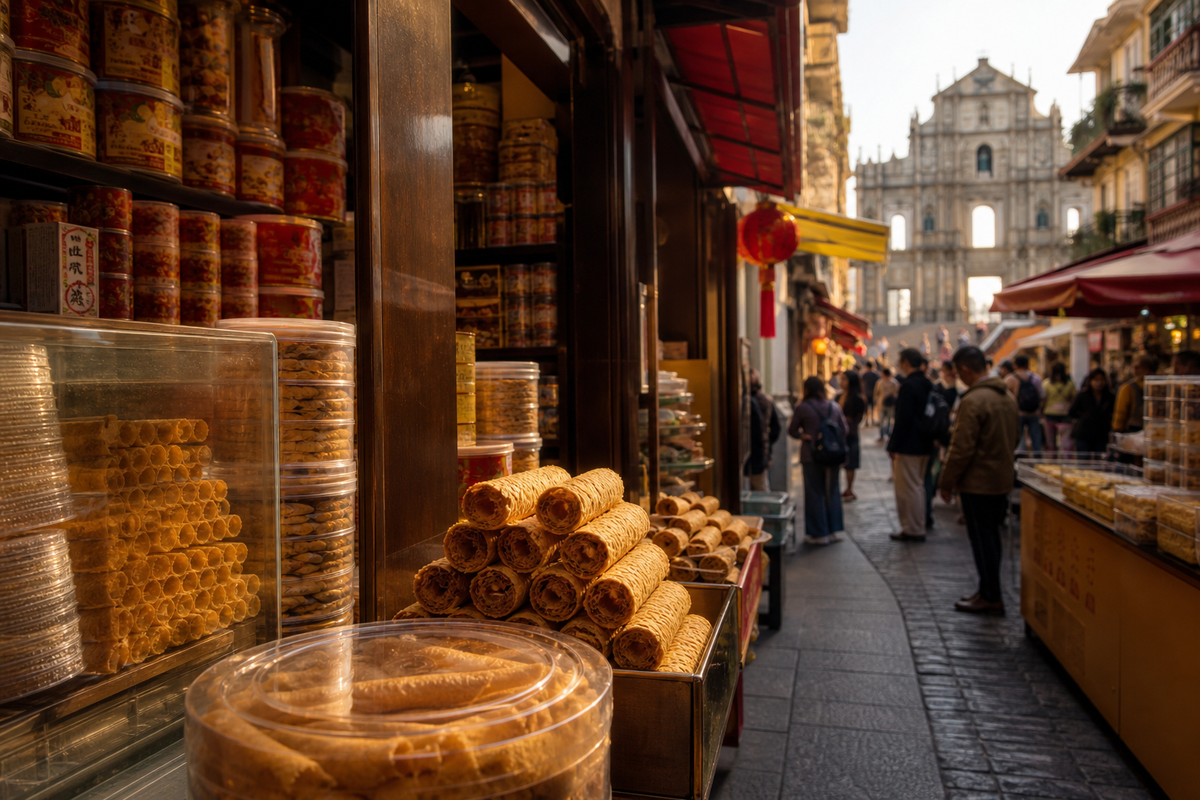
A common mistake is assuming phoenix rolls are a modern invention dreamed up for tourists — the root cause of the naming confusion is actually centuries older. Phoenix rolls fall into a category of crispy rolled wafer biscuits, a Spanish-colonial-derived foodstuff called barquillo, known regionally as egg rolls, biscuit rolls, or “love letters.”
Because “phoenix” (鳳凰) was historically reserved for festive, auspicious foods in Cantonese bakeries, phoenix rolls sit in the same heritage category as almond cookies and other 唐餅 (Cantonese-style pastries) documented in Macau’s own cultural archive as gift products tied to festival occasions.
Bakeries in Hong Kong have kept this tradition going for generations because the recipes were passed down largely unchanged — Hang Heung Cake Shop has been in operation since 1920 and belongs to a lineage of century-old Cantonese bakers that still carry on practices like this today. In Macau, the reason phoenix rolls became a fixture of tourism is structural, not accidental: they’re sold as shou xin (“hand gift” souvenirs) that visitors take home from the bakeries lining the street called Rua da Praia, alongside almond cookies and jerky.
“The egg rolls found in Hong Kong are very different from those in the United States… Egg rolls here are delicate, flaky biscuits… if they cool down, they’ll shatter when you try to shape them.”
What’s Inside a Phoenix Roll? (Fillings & Flavors)
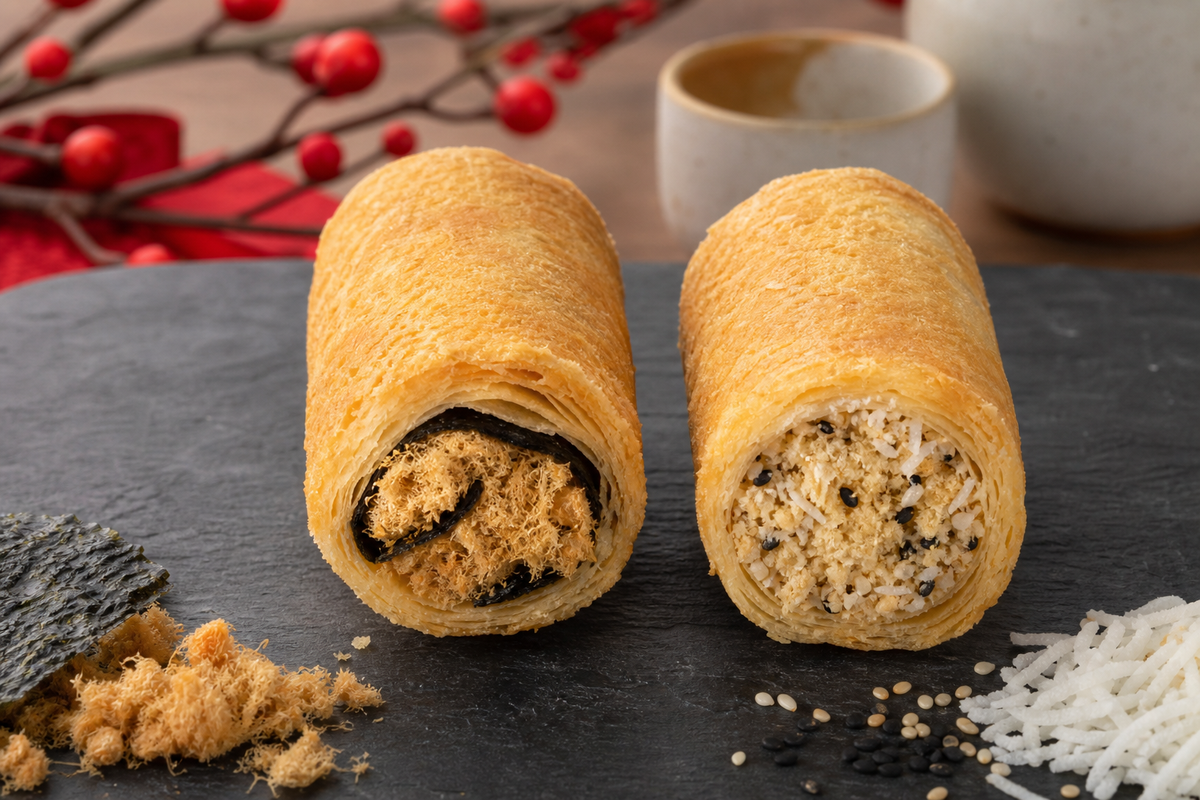
The traditional Macau-style phoenix roll involves a strip of seaweed folded with pork floss into an egg-butter batter, cooked on an iron, then rolled while still soft. Home cooks typically use approximately 60 g butter, 40 g sugar, 75 g egg, 40 g flour, 10 g cornstarch and sea salt, with 3-5g of pork floss folded into the roll as filling; the salt balances the sugar rather than making the wafer taste salty on its own.
What Is Pork Floss?
Pork floss, or dried, sweetened-savory shredded pork pulled into a wispy cotton texture that fits the same class of ingredient that garnishes Chinese bakery buns and congee. Pork floss holds up on its own well beyond the scope of phoenix rolls, and deserves individual consideration: a 100g portion of typical store-bought pork floss is approximately 368 calories and about 26g protein according to nutrition database specs for the item.
Here’s where most articles go wrong: Pork floss isn’t the only, or even default, phoenix roll filling. Kee Wah Bakery (a big name in this particular product type) sells a version of the sweet sesame and desiccated coconut phoenix roll on its own as one of their signature products, sans pork floss or seaweed. This sweet version, rich with roasted sesame seeds and creamy coconut, is a separate, non-pork, non-seaweed product they offer in its own right on their Hong Kong web page, where both are touted as “equally delicious” without indicating one is the other’s alternative.
You can also find other Macau bakeries that sell versions that incorporate almonds (tree nut, beware allergies), salty egg, plain coconut, and one “vegetarian phoenix roll” is sold as its own distinct product in some bakeries located near Macau’s Ruins of St. Paul’s. Reviews from buyers for the seaweed and meat floss version call it a taste with a true crunchy quality to its savory-sweetness and describe no sour notes-just the creamy buttery richness of butter and eggs coming through in the crispy wafer shell, with no dipping sauce needed unlike other fried snacks.
Preparation starts with well-cooked, tender pork, which is then dried and processed into very fine shreds.
The table below summarizes the filling types you’ll be exposed to and both of the name collision entries to eliminate while shopping.
| Type | Flavor | Contains meat? | Where found |
|---|---|---|---|
| Seaweed + pork floss | Savory-sweet | Yes | Kee Wah, Wing Wah, Ching Kee |
| Sesame + desiccated coconut | Sweet, nutty | No | Kee Wah (flagship line) |
| Almond | Sweet, nutty | No (tree-nut allergen) | Various Macau bakeries |
| Salted egg | Savory-sweet | No | Various HK/Macau bakeries |
| Vegetarian (seaweed only) | Ocean-forward, savory | No | October Fifth and others |
| Plain coconut | Sweet | No | Various bakeries |
| Hakka-style (fermented bean curd + fat pork + nuts) | Savory, funky | Yes | Regional Hakka bakeries (different product) |
| Look-alike: Kuih kapit / love letters | Plain sweet | No | Not a phoenix roll — a different snack (see comparison below) |
| Look-alike: American “phoenix roll” sushi | Savory seafood | No (contains shellfish) | Not a bakery item — a different food entirely |
Since both sesame and pork floss versions exist side by side in the marketplace, the matter of allergen labeling is more significant than many shoppers realize. Sesame was declared an FDA mandatory-labeled allergen on January 1, 2023, and the recall of a similar seaweed snack product in 2024 for undeclared sesame indicates that this isn’t just a theoretical risk. Given the ingredients that could be present in a wafer-and-filling snack such as this one (in addition to sesame, think egg, wheat, dairy, soy in the wafer base itself), it’s important to scan the label for any and all allergens if you have food allergies.
How Is a Phoenix Roll Made?
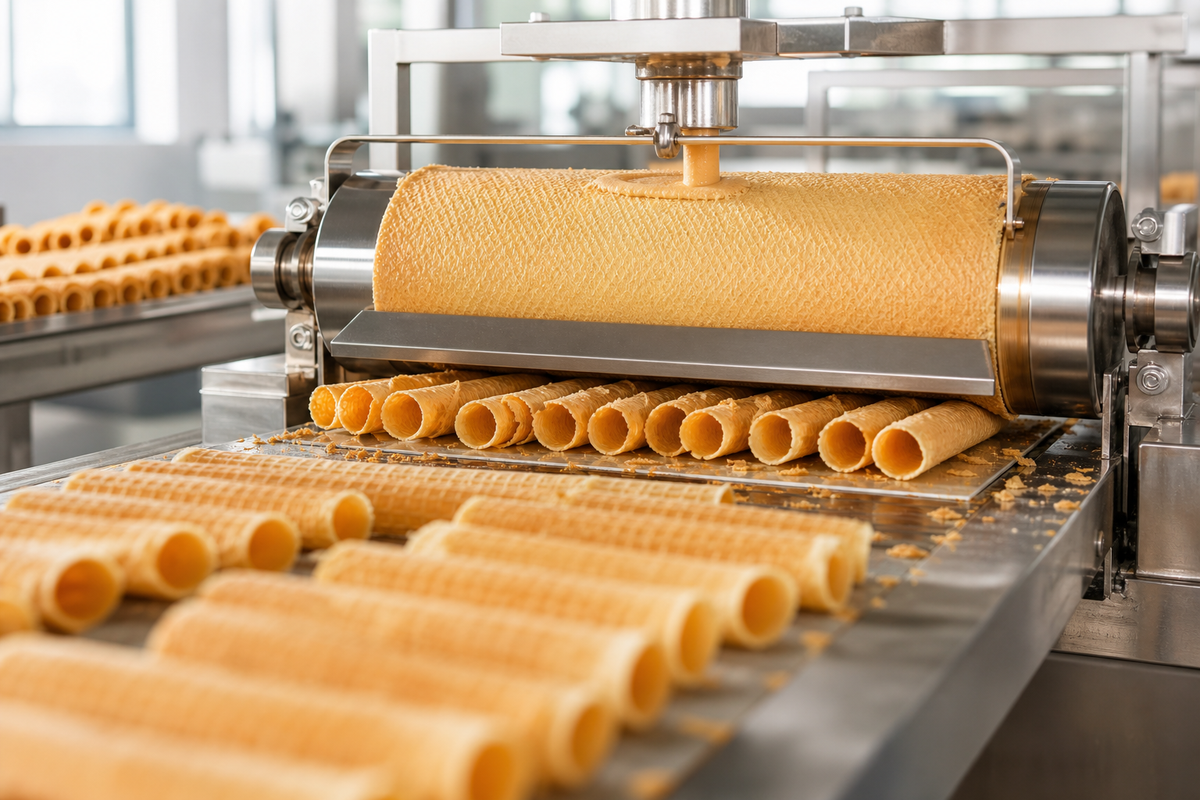
Phoenix rolls are formed by brushing a thin layer of egg-and-butter batter onto both surfaces of a hinged iron mold or griddle, lightly cooking them, and then rolling the wafer around a filling while it’s still hot and flexible. Raw batter is whisked light and fluffy before it hits the griddle, with no steam involved.
Timing matters: when baking a homemade phoenix roll, a good baker may bake each side of the wafer for 3 or 4 “10-second intervals” to achieve a lightly browned crisp. Get it too dark and the roll will crack rather than fold smoothly, and a wafer that cools too long will turn far too brittle and snap like a chip.
Crispness in a cookie or wafer comes as much from food science as from a brand’s claim to “crunch.” According to an Institute of Culinary Education instructor, a cookie’s textural quality is a function of numerous simultaneously occurring chemical and physical changes in baking-protein coagulation, starch gelatinization, fat melting, water evaporation and sugar caramelization-with the type of sugar used having a profound impact on texture: More white sugar results in a crisper cookie, whereas more brown sugar will make a cookie more moist and softer.
The Hand-Iron-to-Heated-Drum Swap distinguishes the home baker from the commercial bakery operator. For most of us, one iron turn out one wafer at a time; after cooling and rolling the first wafer, the second begins. However, commercial automated bake-and-roll machinery (what UDTECH builds, like its automatic phoenix roll production line) deposits batter continuously onto a constantly heated drum and mechanically rolls the cookie, explaining the almost uniform look of the commercially manufactured phoenix roll over one handmade in a kitchen or sold at a bakery cart.
Store cooled phoenix rolls in an airtight container to preserve their crispness. Under moderate humidity, they will stay crisp for a week or more; in a humid kitchen, they can go soft within a day or two, since moisture re-entering the wafer is exactly what reverses the crisping reaction described above. Commercial product packaging typically keeps each roll individually wrapped inside the box for exactly this reason.
Phoenix Roll vs. Its Rolled-Wafer Cousins
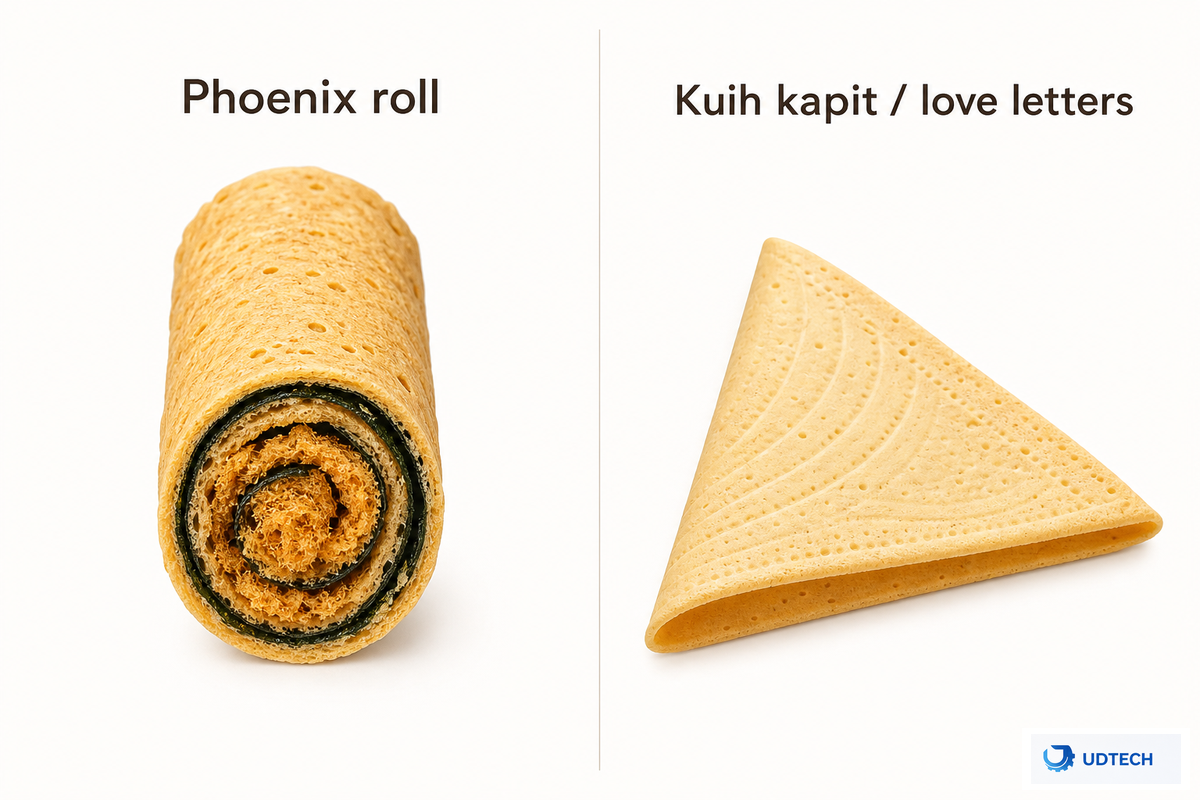
The Filled-vs-Flavored Wafer Divide serves as a helpful differentiator between a phoenix roll and its rolled-wafer cousins from around the world. In Southeast Asia, the wafer kuih kapit, also known as love letters or kue semprong in Indonesia, is baked using a similar egg-and-batter recipe and sandwiched in a hot iron mold. It’s typically a plain sweet wafer without savory fillings, and is either folded into a triangle (sepit) or rolled into a tube (semprong), with a texture that will become soft in humid weather. In contrast, the primary feature of a phoenix roll is what’s on the inside.
| Trait | Phoenix Roll | Kuih Kapit / Love Letters |
|---|---|---|
| Region | Macau / Hong Kong | Malaysia / Singapore / Indonesia |
| Filling | Seaweed + pork floss, or sesame-coconut | Usually unfilled (plain sweet) |
| Flavor profile | Savory-sweet | Sweet, coconut-forward |
| Shape | Rolled tube | Tube or folded triangle |
Both are members of the same worldwide family of Dutch-colonial-influenced egg wafers, but they satisfy different hungers — and neither is to be confused with the unadorned Chinese egg roll cookie (蛋卷) detailed in our guide to Chinese egg roll cookies, which is spiritually closer to kuih kapit than a stuffed phoenix roll. Further afield, Western rolled wafer sticks (the Pirouline-style family) share the tube shape, but with a completely different, cream-filled recipe — further evidence that “rolled wafer” is a shape, not a single snack.
Nutrition: How Many Calories Are in a Phoenix Roll?
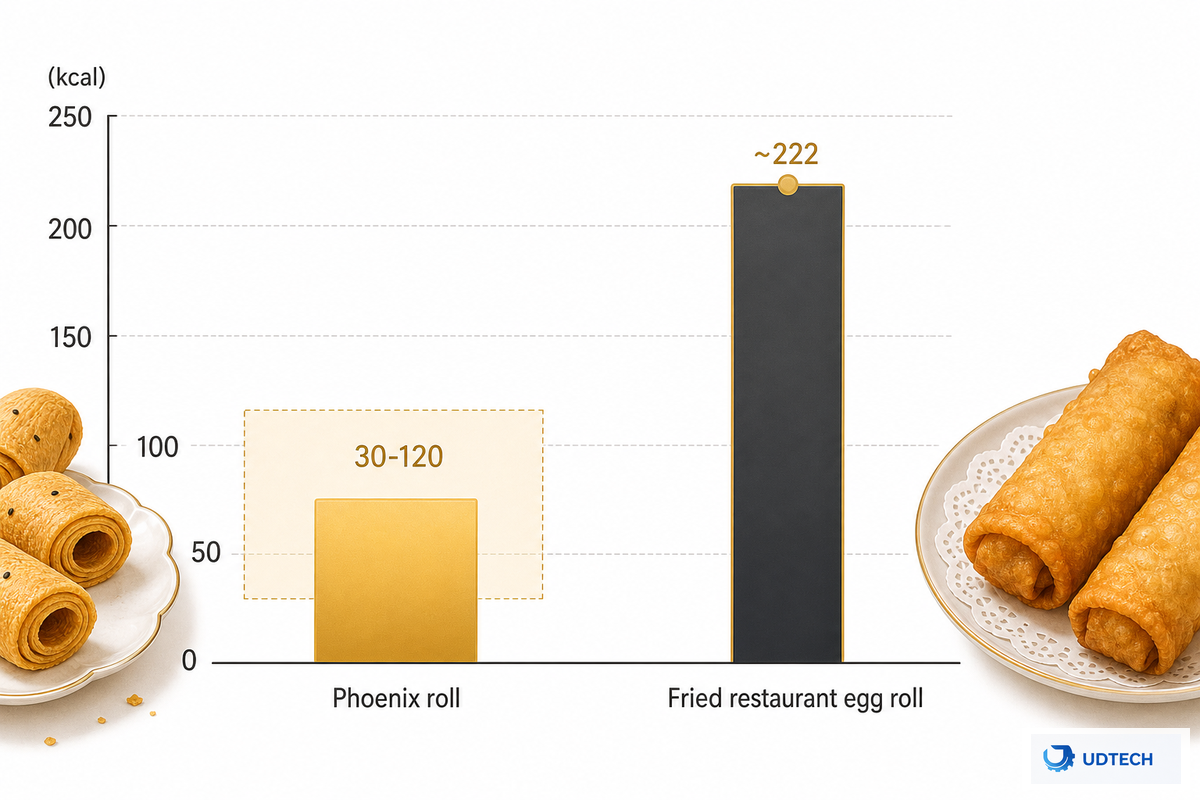
One phoenix roll piece carries a caloric burden somewhere between 30 and 120 calories, depending on the manufacturer and the wafer thickness — there’s no single answer because pack size, brand, and cookie-recipes all vary from bakery to bakery and product to product.
One branded wafer-style product found in a third-party nutritional-database came in at about 32 calories per piece; one roll-recipe that yielded thicker, cookie-style biscuits calculated closer to 120. Think of both as estimates, not exact Nutritional Facts for any given SKU that comes to you.
The Baked-Not-Fried Calorie Surprise deserves to be explicitly laid out: the one that many people think of when someone says “egg roll” is the deep-fried, cabbage-and-meat restaurant appetizer that clocks in at approximately 222 calories for a single, 89-gram portion. By contrast, a phoenix roll is an altogether different product — a crisp, baked (then cooled) wafer-cookie, not an appetizer that has been dipped in frying oil — so it doesn’t come with the heavy, oily calories that a savory egg roll does: the majority come from the butter and sugar in the batter and the flossing and filling (or not) inside, not from frying. That makes for a comparatively low-calorie, delicious snack next to its deep-fried counterparts, but the term “healthy snack” is certainly relative; this isn’t a diet snack.
- Baked/griddled egg-batter wafer
- ~30-120 cal per piece (varies by brand/size)
- Low in cholesterol relative to fried snacks
- Not the ~222-calorie fried restaurant egg roll
- Not a single standardized recipe (varies by bakery)
- Not guaranteed sesame-free (check the label)
Where to Buy Phoenix Rolls
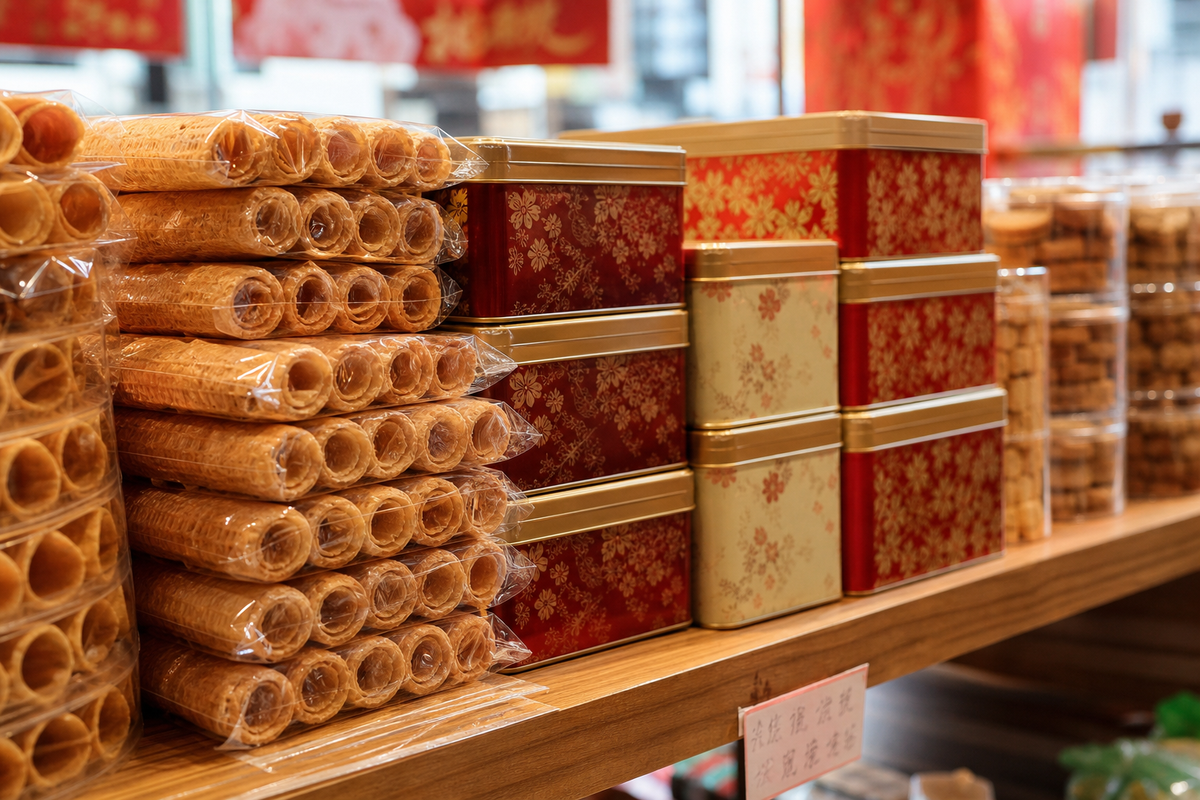
Phoenix rolls are stocked by historic Hong Kong and Macau bakery brands — Kee Wah, Wing Wah, Ching Kee, and Koi Kei among them — through Asian grocery stores, specialty importers, and online Asian-grocery marketplaces. If you compare the availability of this snack to other packaged Asian snack foods produced in similar bake-and-roll lines, what any importer can stock usually dictates the range of flavors available in their area.
A common mistake is assuming any “authentic” pork-floss phoenix roll can simply be imported to order — the root cause of why it’s often harder to find than the sesame-coconut version is regulatory, not a supply gap: the USDA Food Safety and Inspection Service public health alert notes that meat and poultry from China aren’t currently approved for standard commercial import into the US. That’s a commercial-import regulation and doesn’t apply to every potential avenue a foodstuff might find its way to a retail shelf or a traveler’s bag — there are different rules governing personal-quantity gifts, for example, that this guide hasn’t verified — but it’s helpful context as to why the meatless, sesame-and-coconut, or US-produced versions may be more easily found on shelves here than the original pork-floss, imported ones. By way of analogy, Taiwan customs authorities have specifically flagged imported phoenix rolls of the pork-floss variety (though not the sesame-coconut ones) for restriction on similar meat-content grounds.
If you specifically want the seaweed-and-pork-floss version and can’t find it locally, the sesame-and-coconut version from the same bakeries is a legitimate, equally traditional alternative — not a downgrade.
When Phoenix Rolls Are Traditionally Eaten
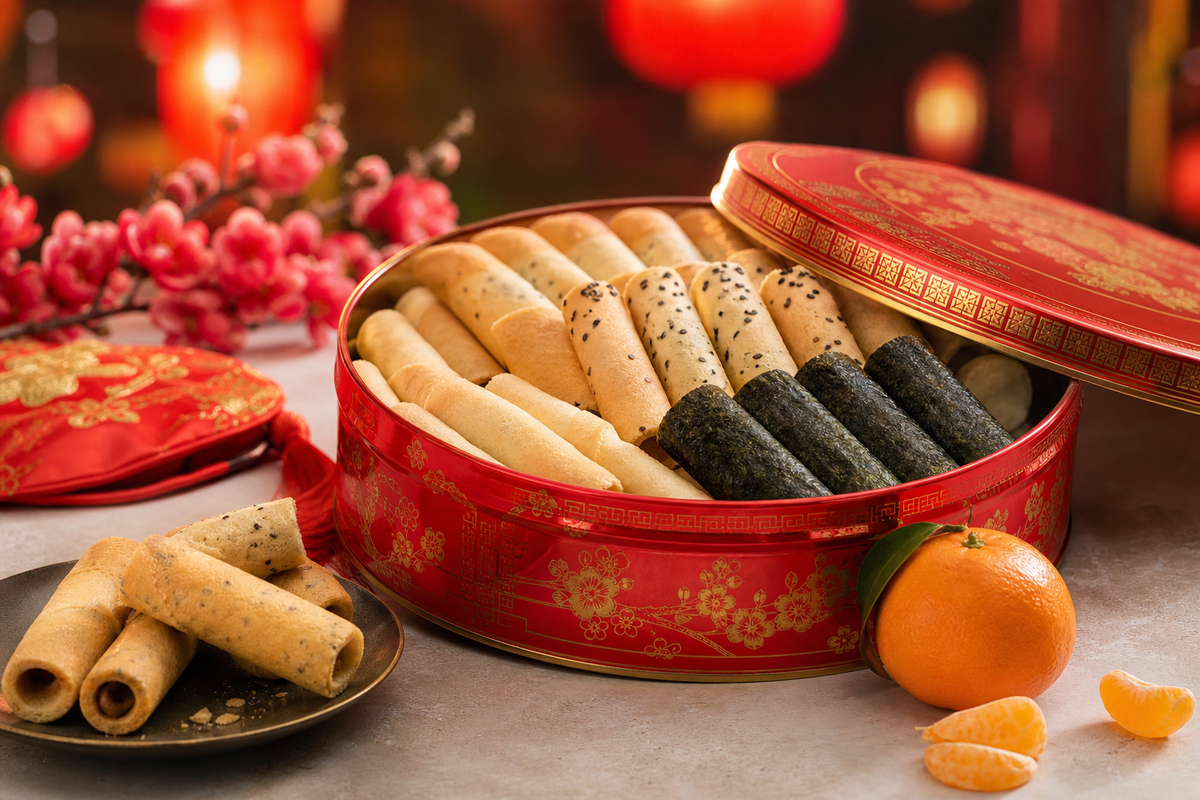
Phoenix rolls see their strongest demand around Lunar New Year gifting season, following a pattern trade media has documented for years. Confectionery and bakery brands release Lunar New Year-themed gift-box items every cycle in a rotating roster, some perennial and others newer each year. Rolled egg biscuits feature prominently alongside gourmet chocolate and spirits in New Year’s gift guides.
For a date-able instance of this pattern in action, see trade coverage of the annual Lunar New Year launch cycle, plus Starbucks Singapore’s announcement on its social media channels of its 2026 Lunar New Year Cookie Collection. Phoenix rolls are listed by name, along with egg rolls and almond cookies, as part of its 2026 gifting offerings. This indicates a more-than-nominal presence for this heritage snack on retail shelves during the holiday in addition to a wider industry trend.
Another point of interest is that in Hong Kong and Macau, phoenix rolls (as well as other Cantonese bakery snacks) are conventionally offered as part of afternoon tea or a dim sum spread – simply as a regular component of bakery culture, not merely a holiday item. Phoenix rolls are also offered alongside mooncakes as a gift-box option during the Mid-Autumn Festival, making the snack eligible for two different seasonal gift-giving windows, not one. These kinds of heritage bakery are part of a wider resurgence of “authentic” brands. Industry analysis of the general bakery market (as opposed to the phoenix rolls segment) has found a 14% increase in new bakery launches featuring traditional claims over the last year, and 42% of consumers now express a strong preference for authentic bread varieties over modern alternatives.
Making Phoenix Rolls at Home vs. Buying Them
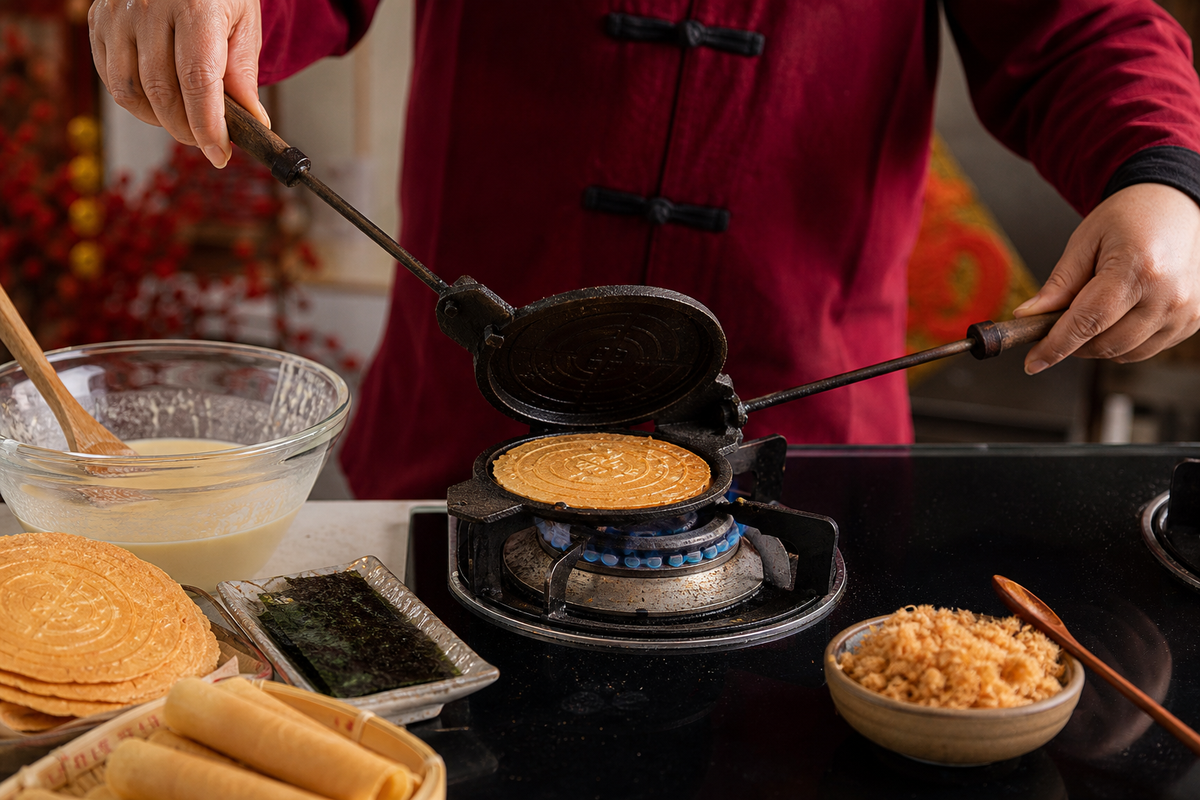
Whether to make phoenix rolls at home or buy a gift box comes down to your available time, kitchen equipment, and tolerance for an imperfect result. The most common mistake first-time home bakers make is walking away from the pan for even a few seconds — because, as bakers note, the wafer sets and turns brittle within moments of leaving the heat, hesitating is the single biggest risk to a clean roll. If you try to make it at home, budget a real trade-off: you’ll need a nonstick pan, egg-waffle iron, or biscuit iron, plus a fair amount of patience while you get the timing right.
| If you… | Choose |
|---|---|
| Have 30+ minutes and an egg-roll or biscuit iron on hand | DIY — fresh, and you control the filling ratio |
| Want a gift-ready box for Lunar New Year or Mid-Autumn | Buy — consistent, shelf-stable, presentation-ready |
| Have dietary restrictions (allergens, meat-free) | Buy a labeled product so you can check the ingredient list |
Quick gut check: if you don’t already have 30 minutes and a nonstick skillet or biscuit iron on hand, buying is quicker than making it — a box of properly sealed cookies should stay crisp for more than a week.
FAQ
Q: What does a phoenix roll have in it?
A phoenix roll’s base is an egg, butter, flour and sugar batter, wrapped around a filling that is most classically seaweed and pork floss, though bakeries also sell several other flavor variants.
Q: Is a phoenix roll the same as an egg roll?
No — a phoenix roll is a specific filled variety within the broader Cantonese “egg roll” biscuit family, and neither is related to the deep-fried American egg roll appetizer.
Q: How many calories are in a phoenix roll?
Roughly 30 to 120 calories per piece depending on brand and size, well below the calorie count of a deep-fried restaurant egg roll, since a phoenix roll is baked rather than fried.
Q: What is a phoenix roll made of?
Egg, butter, flour, sugar and a pinch of salt for the wafer, plus a filling that’s most often seaweed and pork floss or a sesame-coconut combination, depending on the bakery.
Q: Is a phoenix roll vegan or vegetarian?
Not vegan (the batter contains egg and butter), but meat-free vegetarian versions with seaweed or sesame-coconut filling are sold as named products by several established bakeries.
Q: Where can I buy phoenix rolls?
Asian grocery stores, specialty Hong Kong/Macau bakery retailers, and online Asian-grocery marketplaces carry established brands like Kee Wah and Wing Wah, in both the classic and meat-free flavors.
Q: What’s the difference between a phoenix roll and kuih kapit?
A phoenix roll is savory-filled and Cantonese in origin; kuih kapit is a plain, sweet, unfilled wafer from Malaysia, Singapore and Indonesia that softens rather than stays crisp in humidity.
Why We Write This
Suzhou UDTECH Technology Co., Ltd. produces the automatic bake-and-roll production lines that can make snacks like phoenix rolls on a large, industrial scale. UDTECH can build an automatic phoenix roll production line. We don’t make or sell the snacks ourselves. Yet because we design the machines that make the product, we do have a close insight into what purchasers and bakers want in these products, including what the usual filling is and how the wafer gets its crispness.
References & Sources
- Koi Kei Bakery — Wikipedia
- Egg Roll — Wikipedia
- Barquillo — Wikipedia
- Kue Semprong — Wikipedia
- Spot the difference: Hong Kong egg rolls and American egg rolls — South China Morning Post
- Chinese heritage bakery traditions Hong Kong bakers are keeping alive — South China Morning Post
- Understanding the Science of Cookies — Institute of Culinary Education
- FASTER Act: Sesame as the Ninth Major Food Allergen — U.S. Food and Drug Administration
- Wismettac Asian Foods Allergy Alert — U.S. Food and Drug Administration
- Public Health Alert: Ineligible Imported Meat and Poultry Products from China — USDA Food Safety and Inspection Service
- Lunar New Year coverage — Snack Food & Wholesale Bakery
- Bakery Trends 2025 — Innova Market Insights
Related Articles
- Phoenix Roll Machine: Buyer’s Guide (Types, Specs & Cost) — how the equipment behind this snack actually works
- What Are Chinese Egg Roll Cookies? — the plain, unfilled cousin of the phoenix roll
- Seaweed Egg Roll Machine Guide — selecting equipment for seaweed-filled wafer rolls
- Egg Roll Machine: Complete Buyer’s Guide — disambiguating home, savory and industrial egg roll machines