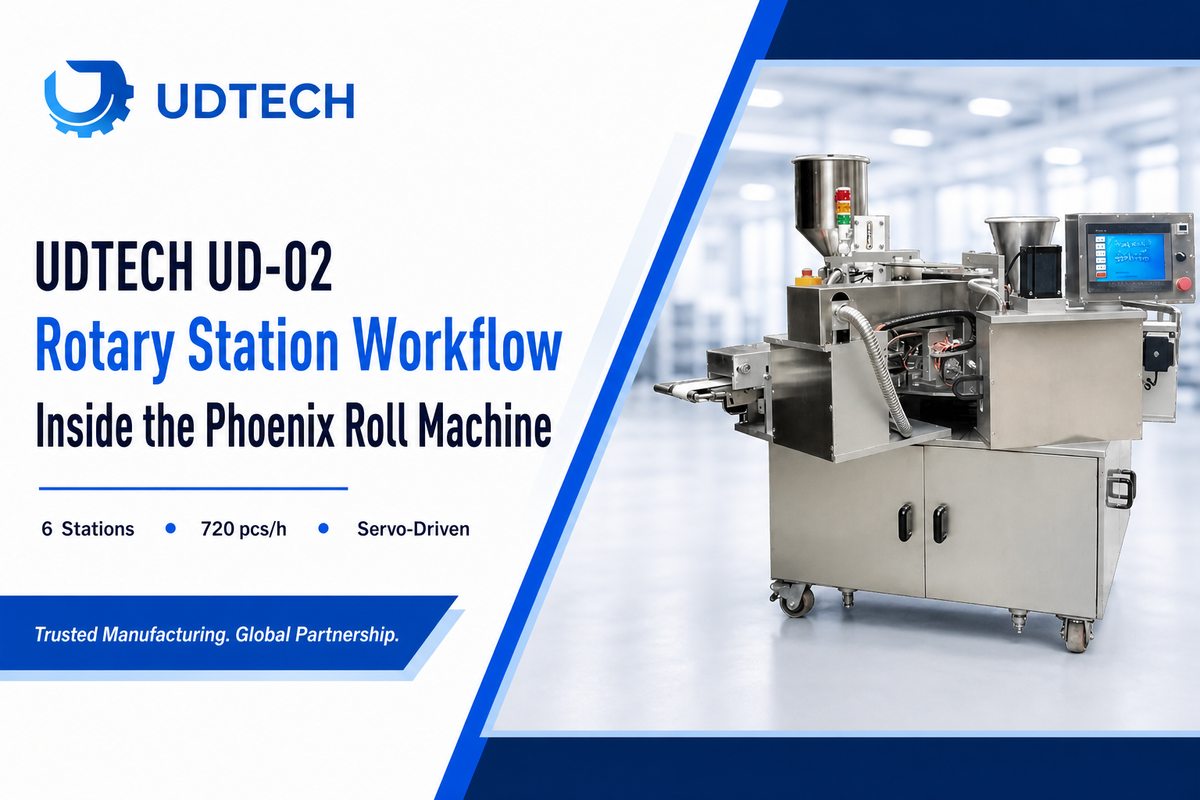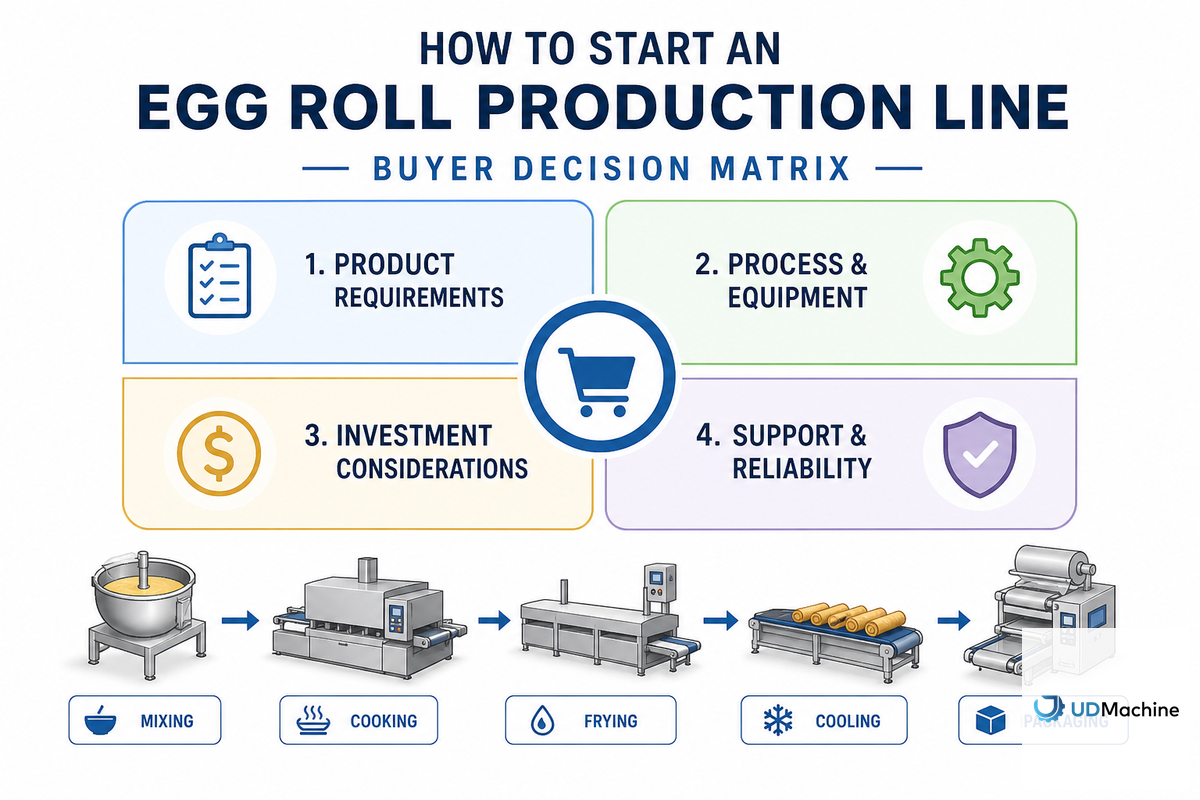
Reviewed by the UD Machine Solution Technology Co., Ltd. engineering & design team
If you were searching “how to start egg roll production line” don’t begin with a machine quote. How to start egg roll production line means choosing the product family, station flow, capacity target, utilities, safety file, and first sellable batch plan before asking for price. Wafer egg roll lines and savory filled egg roll lines are separate projects.
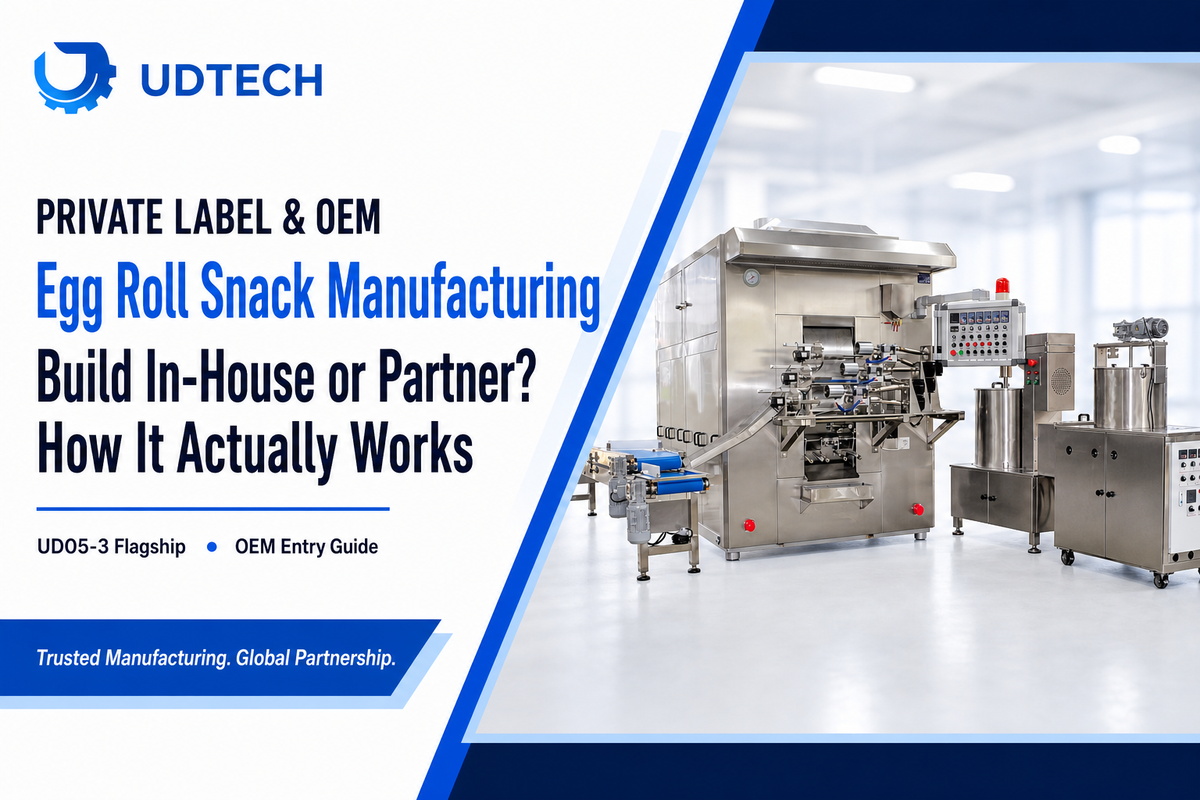
This guide is written for founders, plant managers, quality leads, finance buyers, and procurement folks moving from manual or semi-automatic work toward a real production line. This is centered on the UDTECH wafer egg roll path, with connectors to the baked-and-fried savory egg roll or spring-roll equipment family. Its job is to link the production capacity, factory layout, operator training, and ROI before the quote.
Short answer
To start an egg roll production line, define the product family, trace the station flow from batter or dough makeup to pack, size the capacity in kg per shift and saleable pcs, verify utilities and food safety registers, then run a formal RFQ and commissioning plan prior to first commercial batch.
Start With Product-Family Fit, Not a Machine Quote
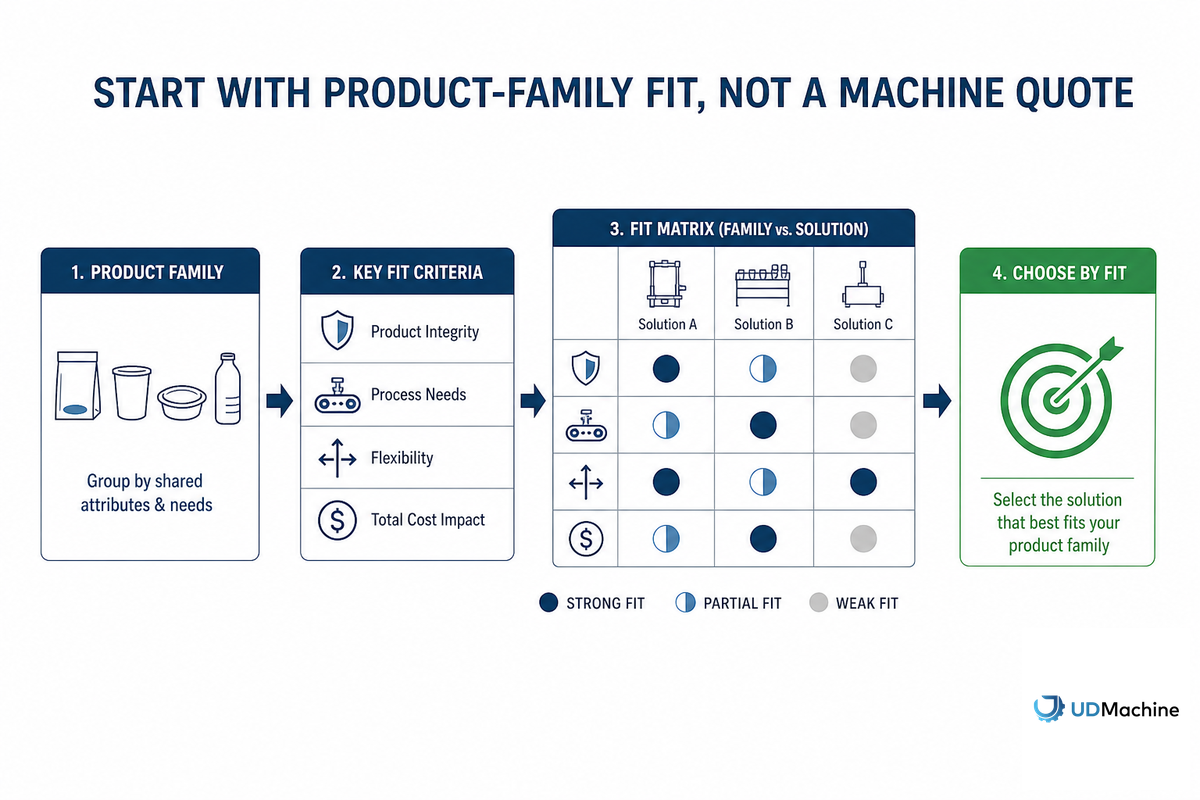
A phrase like “egg roll machine” masks multiple equipment families. UDTECH’s target line is for sweet wafer egg rolls, seaweed egg rolls, phoenix rolls, and similar baked wafer items. ANKO and Hundred Machinery reveal a different path: savory filled egg roll production, prepared with dough sheeters, filling and fold/roll equipment, and usually frying.
Don’t treat these outputs as fungible. Wafer lines require batter spreading, sensor baking plates, rolling station geometry, cool-down, fragile snack handling. Filled egg roll lines require wrapper forming, wet filling management, folding, frying or freezing, and a different food safety file.
Product-Family Branch Matrix
| Product type | Core process | Quote risk |
|---|---|---|
| Sweet wafer egg roll | Batter deposit, bake, roll, cool | Do not compare with savory filling machines |
| Core-filled wafer roll | Baking plus filling or injection | Confirm filling temperature and viscosity |
| Seaweed egg roll | Wafer process with ingredient variation | Confirm batter spread and sheet strength |
| Phoenix roll | Wafer-style roll forming | Confirm roll size, color, and crispness |
| Savory American egg roll | Wrapper, filling, folding, frying | May require USDA/FSIS review if poultry is used |
| Spring roll | Sheeting, filling, folding, frying or freezing | Different equipment from wafer roll baking |
| Lumpia or popiah | Thin wrapper and regional filling formats | Supplier must match wrapper thickness |
| Home countertop maker | Small appliance or manual tool | Not a factory line |
| Snack cone or cigar roll | Batter baking and cone/roll forming | May share heat logic but not always tooling |
Use the Start-Ready Production Ladder Before You Buy
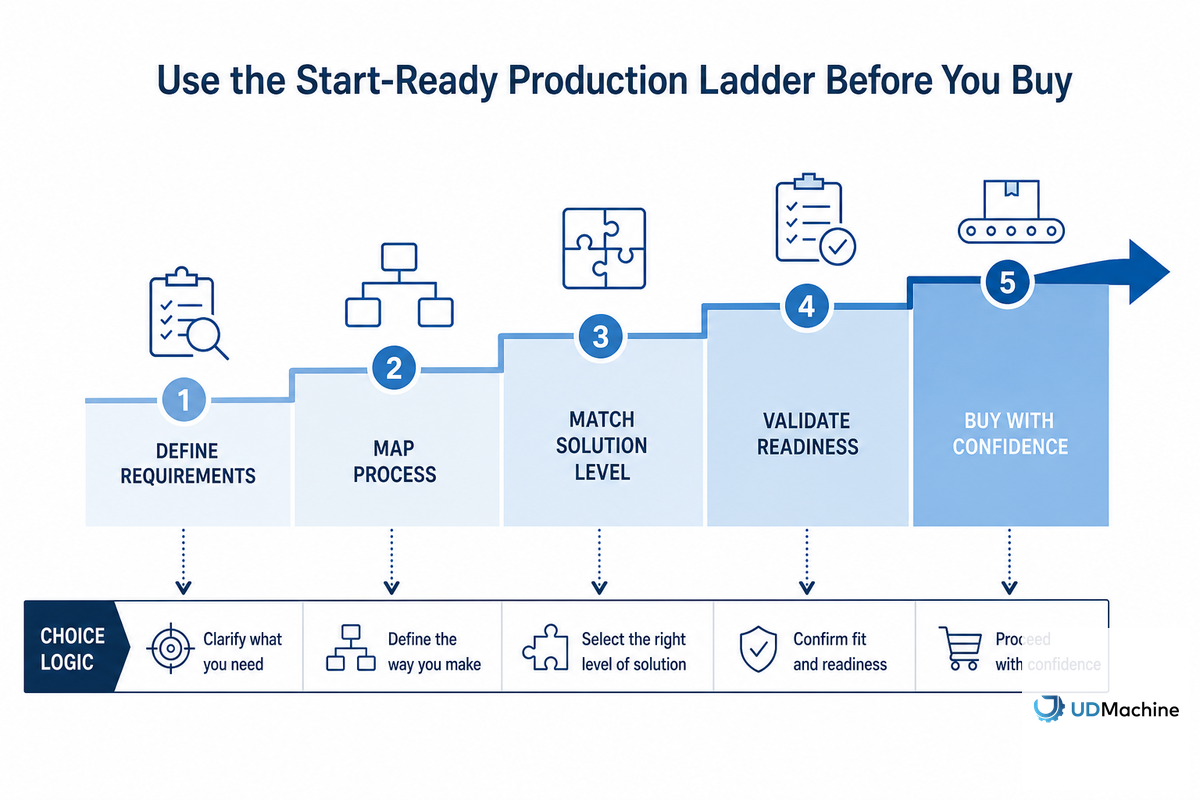
A common buying mistake is requesting “your best machine” before your business has gathered enough facts to properly size a line. Use the Start-Ready Production Ladder to determine whether you’re ready for a formal RFQ or still need product and facility development.
| Stage | Owner | Proof needed | Common failure |
|---|---|---|---|
| 1. Product family | Owner | Wafer or savory branch chosen | Wrong machine family |
| 2. Recipe lock | Product lead | Batter or dough spec with target weight | Commissioning becomes recipe research |
| 3. Demand band | Sales lead | Daily kg and package count target | Oversized machine with low use |
| 4. Facility audit | Plant manager | Power, gas, exhaust, floor, access | Installation delay after shipment |
| 5. Safety file | Quality lead | Food safety plan and allergen review | First audit exposes missing controls |
| 6. Cost model | Finance buyer | Cost per 1,000 sellable rolls | Payback built on full-capacity fantasy |
| 7. Supplier RFQ | Procurement | Output, utilities, compliance, spares | Quote hides assumptions |
| 8. Factory test | Plant and quality | Recipe trial, output, reject log | Only visual demo, no pass criteria |
| 9. First 1,000 gate | Operations | Sellable batch with records signed | Machine runs but product cannot ship |
Map the 6 Stations in an Egg Roll Production Line
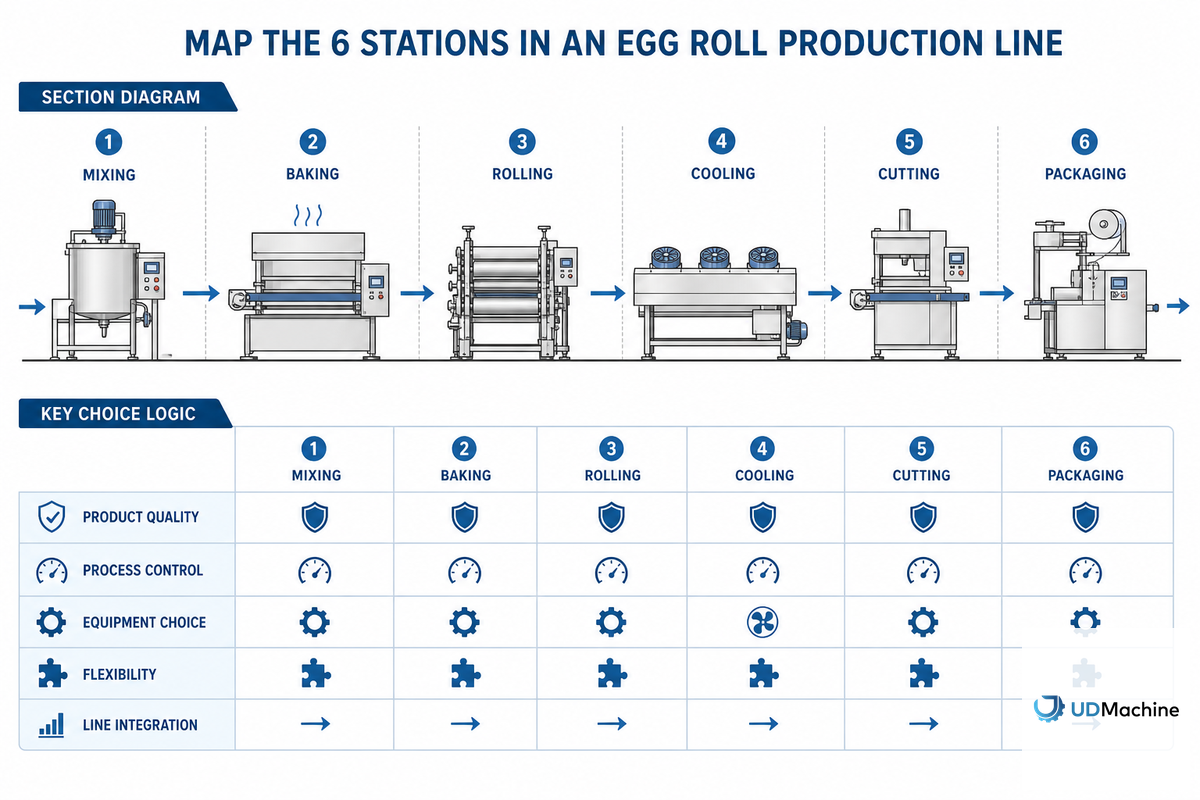
Consider the production line as more than a single machine. ANKO’s filled egg roll evidence shows preparation, forming, frying, sealing, and inspection stations; while UDTECH’s wafer line focuses on batter batching, baking, rolling, cooling, and bagging.
For teams asking “how are egg rolls made in a factory?”, this station map is the commercial quote translation: each station needs an owner, a bottleneck check, and a pass criterion. If your question is how to make commercial eggroll at scale, start with this station list before asking for a single-machine price.
6-Station Egg Roll Line Map
- Ingredient preparation covers weighing, sieving, mixing, and raw-material control.
- Dough or batter preparation can mean wafer batter for UDTECH lines, or dough belting for savory lines.
- Sheet forming or wafer baking is where the heat application and forming method differentiate the equipment category.
- Filling, sealing, or rolling addresses core filling and roll forming for wafer lines, or filling and sealing for savory lines.
- Cooling, frying, or finishing varies by line category: wafer production requires controlled cooling, while savory production may involve frying or freezing.
- Inspection, packing, and printing has to keep pace with the line, or packaging becomes the true bottleneck.
Hidden Bottleneck Map
Before paying your deposit, review recipe formulation, utility availability, packing throughput, equipment access, spare parts, operator training, maintenance requirements, allergen protocols, safety equipment, and the line installation paperwork. These concerns generally emerge post-sale if the RFQ is limited to price and throughput expectations.
Factory note: if a station has no owner, no measurable pass point, or no cleaning access, it is not ready for a production-line quote. Treat it as a process-development risk before a deposit is paid.
Size Capacity in kg per Shift, Pieces per Hour, and Operators
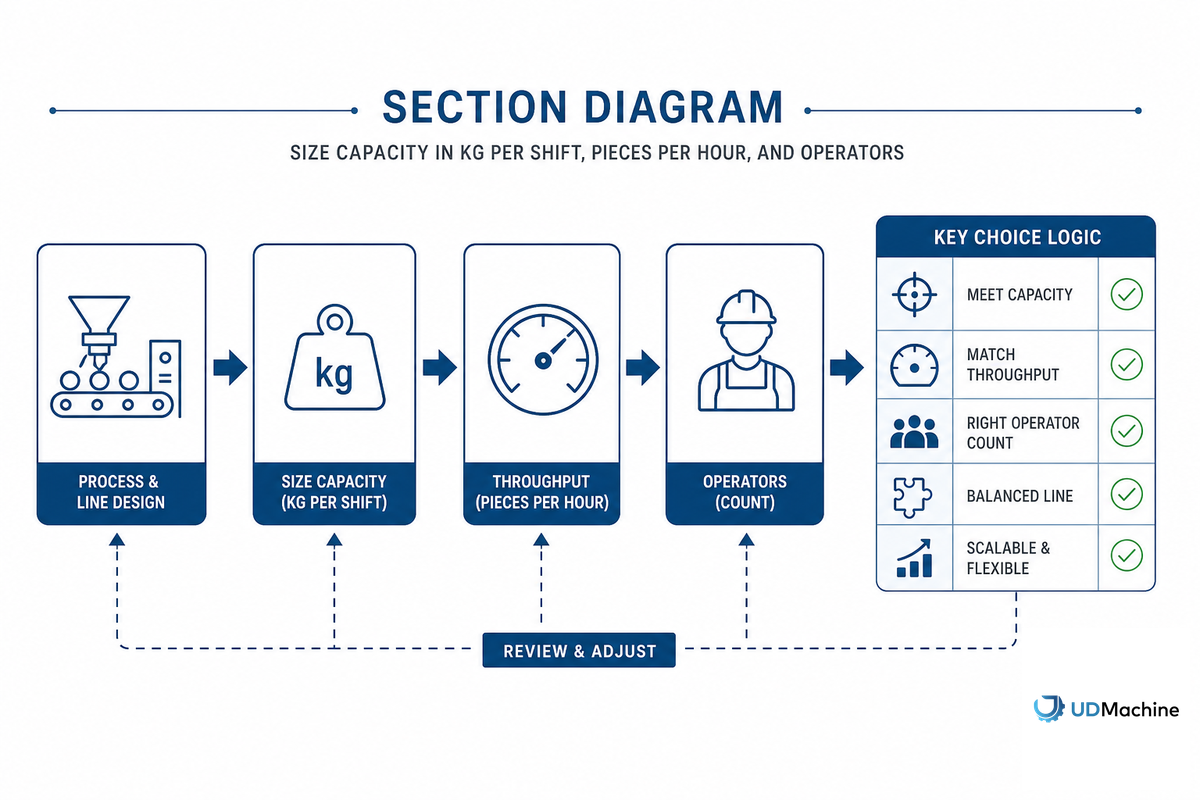
Make sure you look at kg per 8-hour shift, pieces per hour, and sellable output together. UDTECH publishes UD05-2 at 220 pcs/min and 600 kg per 8-hour shift, and UD05-3 at 330 pcs/min and 900 kg per 8-hour shift. UD05-2 has 9.7 kW of power and UD05-3 has 12 kW of power.
Capacity sizing creates a risk when buyers compare only nameplate speed, because a factory can fail at packaging, cooling, or labor before the baker reaches 220 pcs/min. UDTECH quantifies the line with kg per shift and kW, so the evidence should be converted into a first-year utilization scenario before ordering.
| Option | Best use | Published output | Startup caution |
|---|---|---|---|
| Pilot or manual | Recipe proof and small accounts | Buyer-defined | Good for learning, poor for unit cost |
| UD05-2 wafer line | First industrial wafer line | 220 pcs/min, 600 kg/8h | Need enough demand to keep line loaded |
| UD05-3 wafer line | Higher wafer demand | 330 pcs/min, 900 kg/8h | 12 kW power and upstream prep must be ready |
| Savory filled line | American-style egg rolls or spring rolls | Example: ANKO 2,400 pcs/hr | Not comparable with wafer pcs/min |
Don’t buy a larger capacity line simply because the plate speed sounds better. If you’re only going to fill 40% to 60% of the available hours in year one, you may be buying capacity at a capital price with no real unit-cost savings. For a deeper sizing worksheet, use UDTECH’s egg roll machine capacity planning guide.
Build the Cost Model Before You Ask for Price
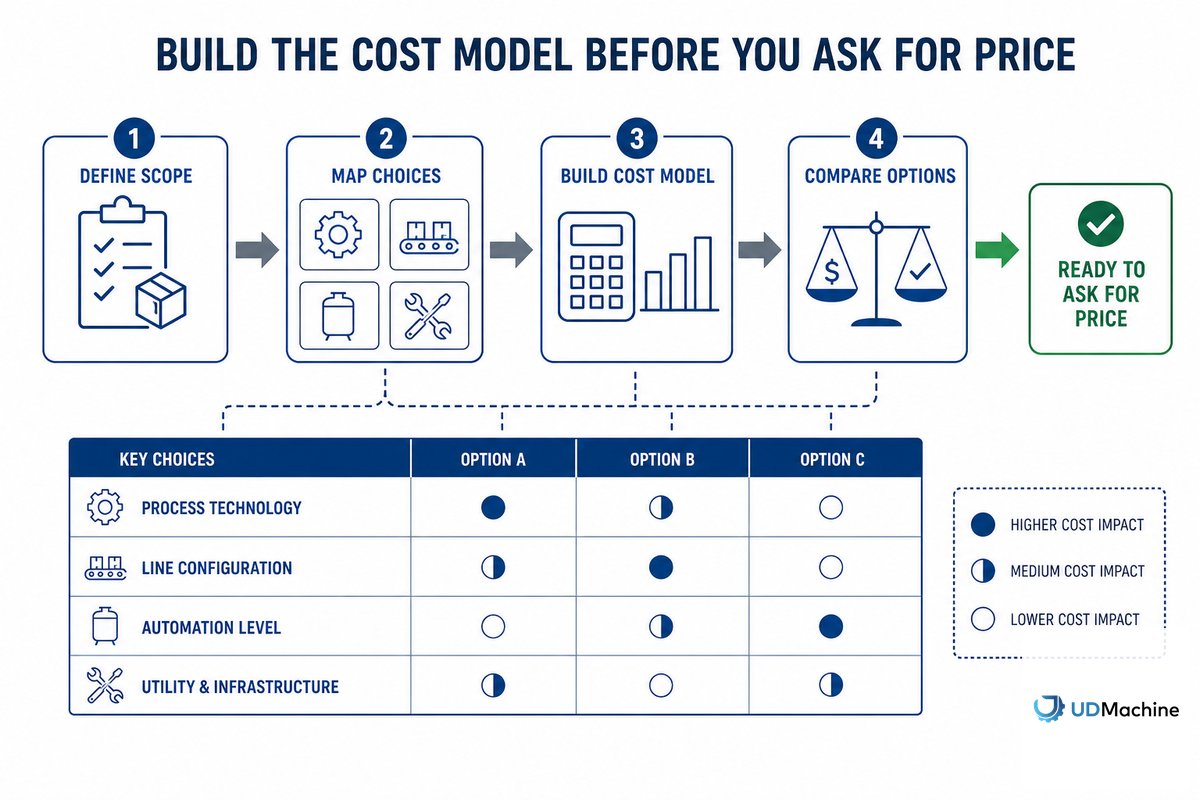
Ask finance to create the total cost per 1000 sellable rolls instead of the cost of the machine alone. Your quote may look good, but without adding in transportation, installation, packing, fuel, trial product waste, parts, and empty time, the file will be missing significant cost drivers.
A cost-model problem appears when a quote looks cheap while an early utilization assumption, freight, duty, and utility work move the actual unit cost. Use landed cost and cost per 1,000 pieces so the finance buyer can test a specific factory scenario instead of approving a brochure price.
| Cost line | What to collect | Why it changes approval |
|---|---|---|
| Machine capital | Quoted model, tooling, options | Sets depreciation per 1,000 rolls |
| Freight and duty | Destination, incoterms, import fees | Often absent from first quotes |
| Fuel | LPG or natural gas price | UD05 models publish fuel options |
| Electricity | 9.7 kW or 12 kW model load | Facility service may need upgrade |
| Labor | Operators, sanitation, packing | Packaging can keep labor high |
| Scrap and rejects | Trial-batch loss and reject rate | Early batches are not mature output |
| Packaging | Film, trays, cartons, coding | Slow pack lines throttle output |
| Maintenance | Spares, cleaning tools, wear parts | Reactive maintenance raises downtime |
| Compliance | Food-safety plan, labels, records | Needed before shipment to market |
Industry claims of paybacks should be considered starting points, not promises. You should have your finance department build a specific worksheet with the current wages, fuel price, planned shifts, packaging speed, and first-year use rate. Deeper costing should reside within UDTECH’s commercial egg roll machine cost guide.
Prepare the Facility, Utilities, and People
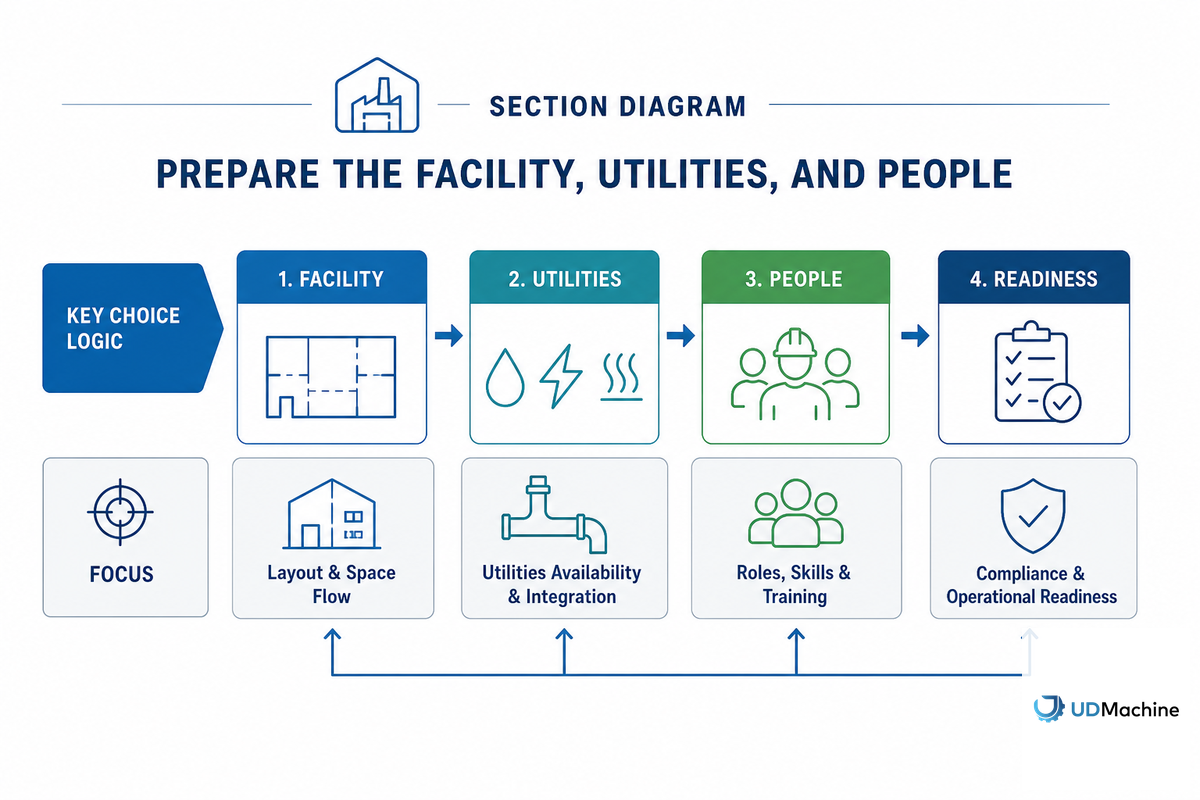
For UDTECH wafer egg roll lines, public data includes these in the starting checklist: footprint is 4.2 x 3.7 m; electrical demand is 9.7 kW for UD05-2 and 12 kW for UD05-3; LPG fuel use is about 6-8 kg/h and natural gas is about 8-10 m3/h depending on model.
Installation delay risk is highest when the factory discovers 9.7 kW or 12 kW electrical demand, gas piping, exhaust, or cleaning access after the machine ships. Because UDTECH publishes these specs before the order, the facility audit can be a real engineering check instead of a delivery surprise.
- Check the voltage, phase, electrical panel capacity, and any applicable local electrical code for your specific machine.
- Fuel selection needs to happen early as gas piping, ventilation requirements and any necessary permits may be on a different time schedule.
- Facility layout and access needs to include 4.2 x 3.7m for the equipment plus room for operator movement, cleaning, and maintenance access.
- Product batter recipe should be final, including correct ratios, target weight, color and final product geometry prior to machine installation.
- Training on start-up should cover both the equipment supplier commission process and any plant-specific procedures for sanitation, allergen control and record keeping.
UDTECH indicates 9-13 weeks for typical delivery, 5-7 days for installation, and 2-3 days for operator and maintenance training. You should add to this your shipping, customs clearance, utilities work, packaging line integration, and trial product production.
Set Food Safety, Machine Safety, and QA Requirements
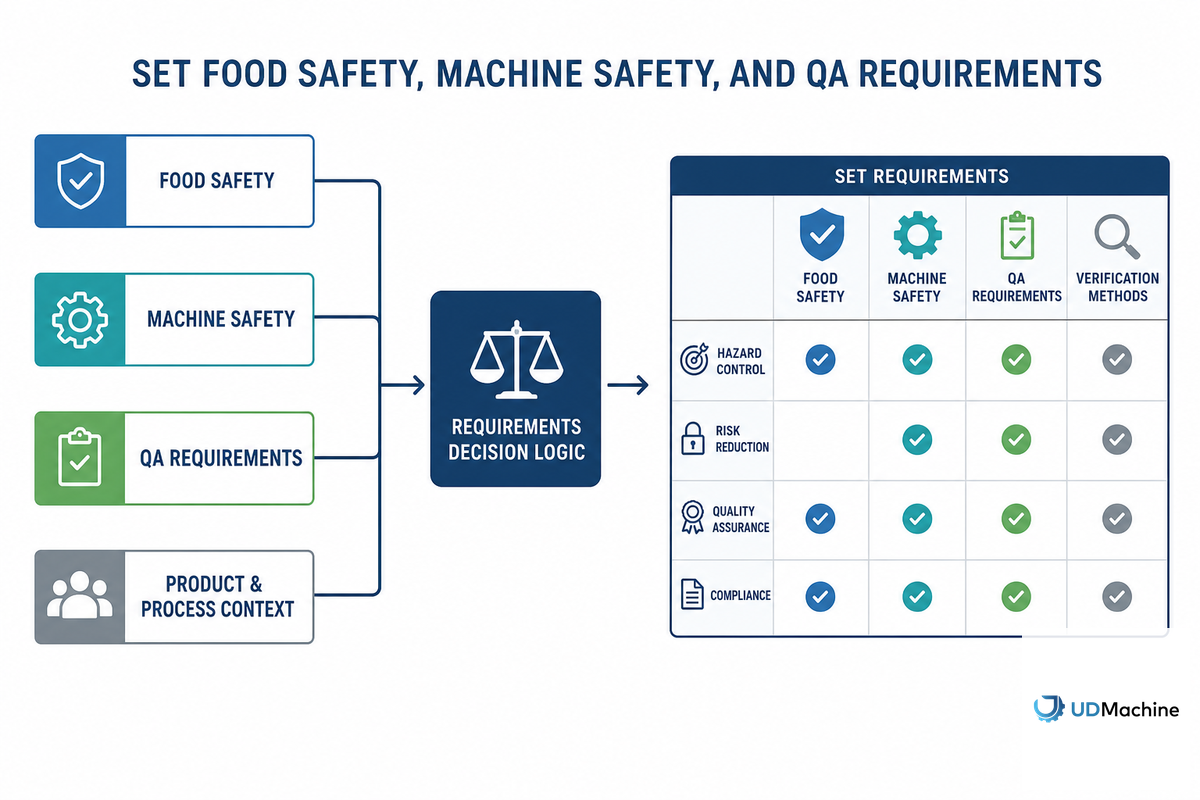
Safety needs to be considered prior to the machine’s arrival, not after. In the United States, FDA 21 CFR Part 117 describes requirements for preventive controls, monitoring, verification and records in human food processing.
Safety risk is not abstract: a failed allergen, guarding, lockout, or poultry-compliance review can delay first shipment even when the machine runs. Because UDTECH’s line is a factory production asset, the buyer should keep FDA, OSHA, and USDA/FSIS evidence in the same startup file as the supplier documents.
Allergen control should also be included in the startup file. There are 9 major food allergens as identified by the FDA, including egg, wheat, soy, sesame, fish, and crustacean shellfish. Both wafer and egg roll recipes often contain several of these ingredients and this information needs to be addressed prior to receiving your first shipment.
Safety issues need to be checked with the manufacturer individually. OSHA 1910.212 deals with general machine guarding (such as point of operation and rotating parts), and OSHA 1910.147 addresses lockout and tagout when the machine is undergoing maintenance and the unexpected starting of a machine could injure workers.
When savory products include meat or poultry fillings, don’t rely on wafer-line compliance assumptions. USDA/FSIS rules could become a concern; 9 CFR Part 381 should be reviewed by a food-safety expert prior to production.
| Checkpoint | Before order | Before first shipment |
|---|---|---|
| Food-contact materials | Request material statement | Keep file with supplier docs |
| Food safety plan | Assign quality owner | Hazard analysis and records active |
| Allergen control | Review recipe and labels | Cleaning and label checks signed |
| Machine guarding | Ask for guard and access drawings | Train operators on safe access |
| Lockout/tagout | List energy sources | Procedure tested during maintenance |
| EU-bound machinery | Ask for conformity documents | Keep declaration and technical file access |
EU Machinery Regulation 2023/1230 is relevant to planning, but so is timing. General application begins 20 January 2027, so a 2026 buyer will want to understand how the supplier’s CE documentation and ISO 14159 hygienic-design reference fit the transition from the old Machinery Directive to the new regulation, instead of assuming every 2026 machine falls under the full scope of the new regime.
Run the RFQ and Commissioning Sequence
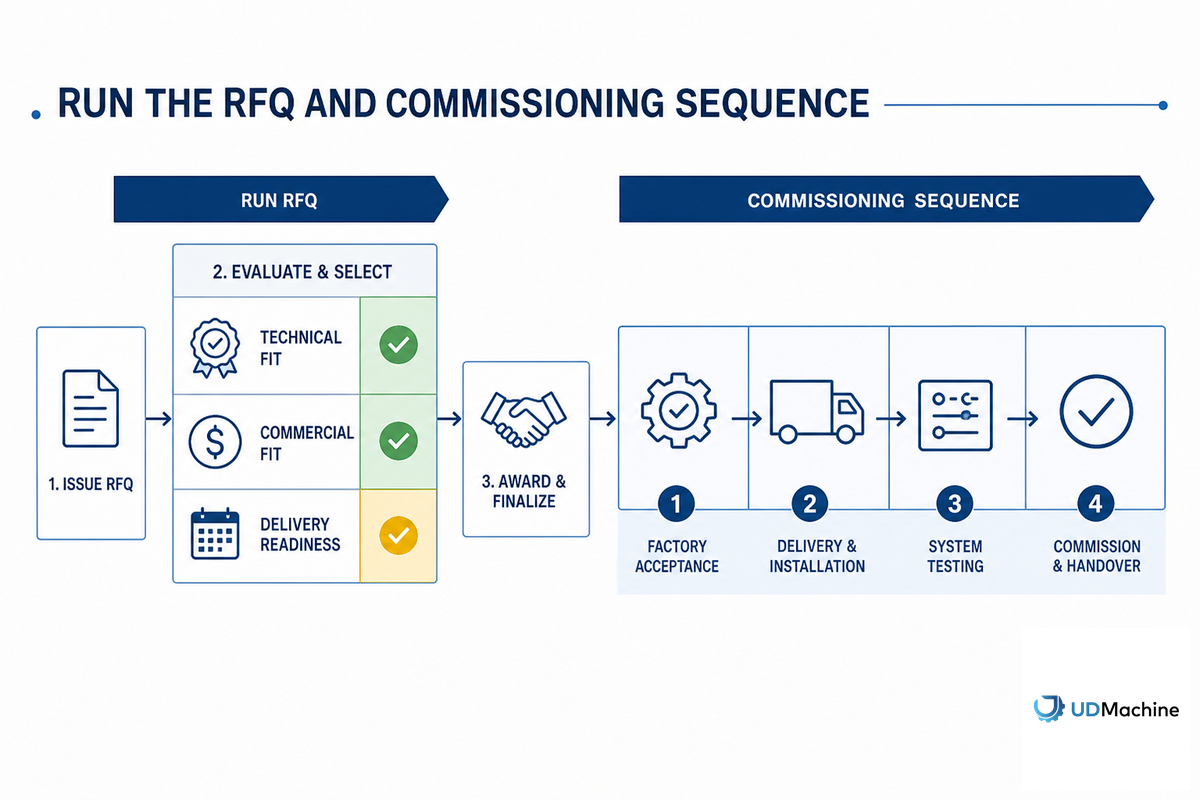
Useful RFQs will specify what product is being made, volume requirements, plant location, available utilities, and the documents needed by the buyer. Poor RFQs will simply ask, “How much does the machine cost?”
RFQ risk is a vague quote that hides assumptions. Because UDTECH lists a 9-13 week delivery window, 5-7 installation days, and 2-3 training days, the buyer should send a specific production scenario and ask which documents, utilities, and factory acceptance test steps can be confirmed before deposit.
First 1,000 Sellable Rolls Gate
| Gate item | Pass evidence | Owner |
|---|---|---|
| Recipe locked | Batter/dough formula version signed | Product lead |
| Roll size set | Length, weight, color, crispness target | Quality lead |
| Output run completed | 1,000 sellable pieces counted | Operations |
| Reject log reviewed | Broken, burnt, under-rolled, underweight defects tagged | Quality lead |
| Packaging synchronized | Pack speed keeps up with line output | Plant manager |
| Cleaning record signed | Pre-op and post-op sanitation record | Sanitation lead |
| Safety check complete | Guarding, emergency stop, energy procedure tested | Maintenance |
| Spares in stock | Wear-part kit and critical consumables on site | Procurement |
| Cost file updated | Actual labor, fuel, scrap, packaging entered | Finance buyer |
| Release decision | Owner, plant, quality, finance sign off | Owner |
2026 Outlook: Regulation, Labor, Fuel, and Lead Time
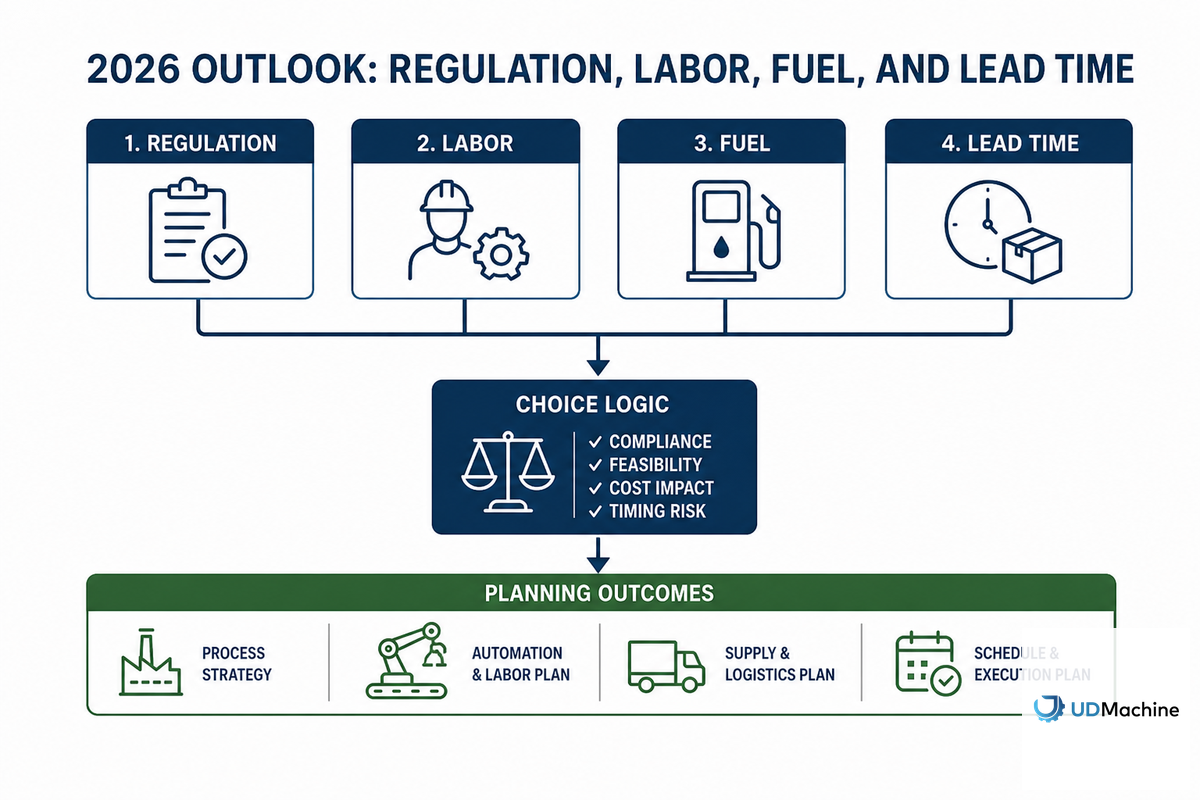
For 2026 planning, the most persuasive reason to get started sooner rather than later isn’t a market analysis; it’s the confluence of facility upgrades, paperwork, workforce management, recipe refinement, shipping timelines, and equipment commissioning. Food Engineering and ProFoodWorld both note increased automation in food plants, but ultimately your company’s internal readiness will determine if the production line can deliver product.
Fuel should be part of the equation as well. UDTECH reports LPG and natural-gas usage for their UD05 models, so buyers should consider local fuel supply and permit availability before deciding on line configuration.
Timing risk is a 30 days expectation in a project that depends on recipe lock, utilities, documents, shipping, quality control, and commissioning. Because those workstreams move in parallel, a startup owner should prepare the RFQ package while recipe, facility, quality control, and finance decisions are still being finalized.
What to Send UDTECH for a Configured Quote
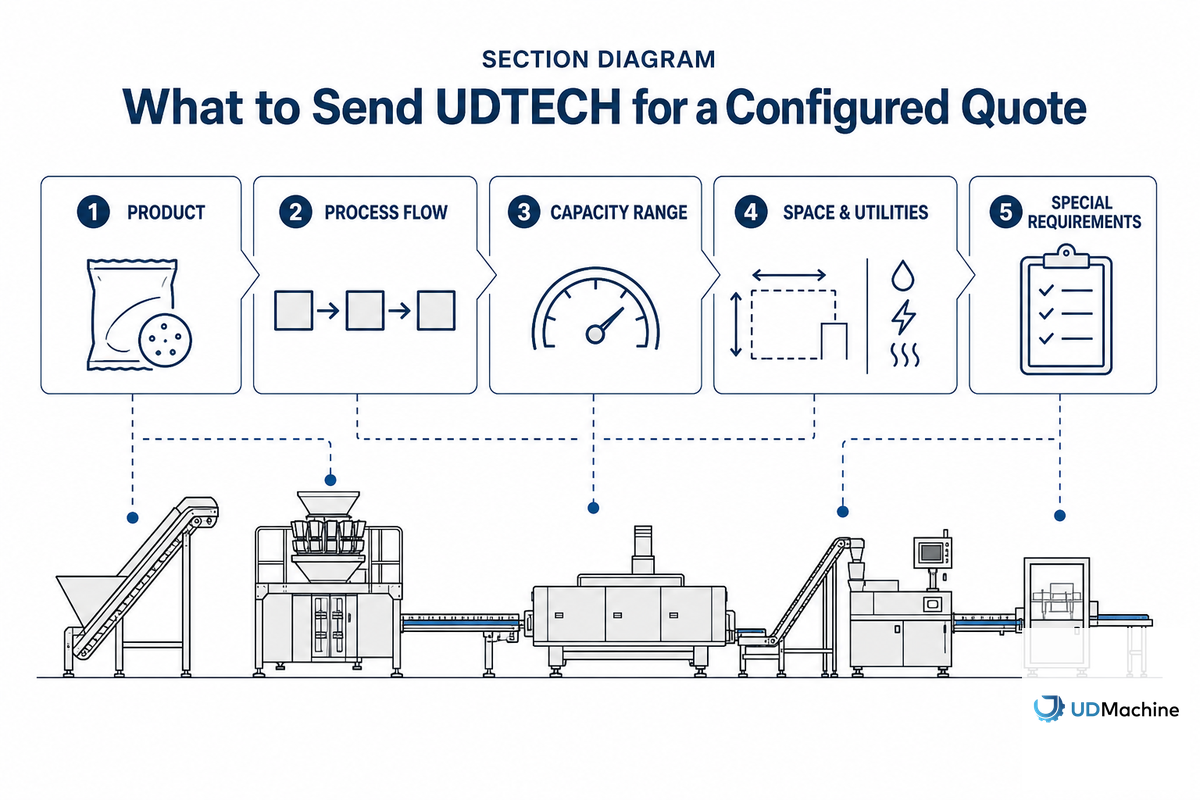
Write a brief and to-the-point description including: product type, photographs or samples, desired piece weight, daily kilogram output goal, number of stock-keeping units (SKUs), packaging style, available floor space, preferred fuel type, electrical voltage, target market, any compliance regulations that need to be met, and the planned launch date.
Wafer egg roll producers can start by examining UDTECH’s automatic wafer egg roll machine. If you’re comparing equipment types, consult the egg roll machine guide and the wafer roll vs spring roll machine comparison prior to requesting a quote.
Request a configured UD05 quote
Share your wafer egg roll recipe, desired production capacity, fuel choice, and facility specifics with UDTECH to determine whether UD05-2 or UD05-3 is the best fit for your first production line.
References
- FDA 21 CFR Part 117: Current Good Manufacturing Practice, Hazard Analysis, and Risk-Based Preventive Controls for Human Food
- FDA food allergy and major allergen guidance
- OSHA 1910.212 general machine guarding requirements
- OSHA 1910.147 lockout/tagout requirements
- USDA/FSIS 9 CFR Part 381 poultry products inspection reference
- Regulation (EU) 2023/1230 on machinery
- ISO 14159 hygienic design of machinery standard page
FAQ
What equipment is needed for an egg roll production line?
Typically, a production line for egg rolls involves equipment for preparing ingredients, mixing batter or dough, forming the product, heating or frying, cooling, inspecting, and packaging. Sweet wafer egg rolls require batter deposition, hot baking surfaces, rolling mechanisms, and cooling. Savory filled egg rolls typically involve sheeting the dough, adding filling, folding, frying or freezing, and packing.
Be sure to document the product family before you begin evaluating potential suppliers.
How much does it cost to start an egg roll production line?
There is no fixed startup cost because quotes vary by product type, capacity, fuel, automation scope, compliance documents, freight, installation, and packaging. Start with a landed cost and cost per 1,000 pieces worksheet that includes machine, duty, utility work, spares, training, labor, fuel, trial waste, and idle capacity. This differs from asking how much does it cost to make homemade egg rolls. Ask suppliers to separate required items from optional items.
How many egg rolls can a production line make per hour?
UDTECH publishes wafer egg roll output for UD05-2 at 220 pieces per minute and UD05-3 at 330 pieces per minute, about 13,200 to 19,800 pieces per hour before losses. Savory filled lines often run lower because filling, folding, frying, and cooling add bottlenecks.
Can one machine make both wafer egg rolls and savory egg rolls?
Generally, no. Wafer lines bake thin batter on hot plates and roll it while pliable. Savory lines sheet dough, add wet filling, fold the wrapper, and may fry or freeze it. Confirm the branch before quoting tooling and cleaning requirements.
What should I prepare before asking for a quote?
Prepare product type, target piece weight, output per shift, SKUs, package format, floor area, fuel options, voltage, target market, compliance needs, and desired launch date. Without those inputs, a supplier must guess, and those guesses can become cost changes or delays.
How long does installation take?
On a configured industrial wafer egg roll line, UDTECH estimates 9-13 weeks for delivery, 5-7 days for installation, and 2-3 days for operator and maintenance training. Add shipping, customs, utility preparation, packaging-line work, recipe calibration, and first sellable batch testing. If the recipe is still changing, commissioning can stretch while temperature, batter flow, rolling pressure, cooling, and packaging are tuned.