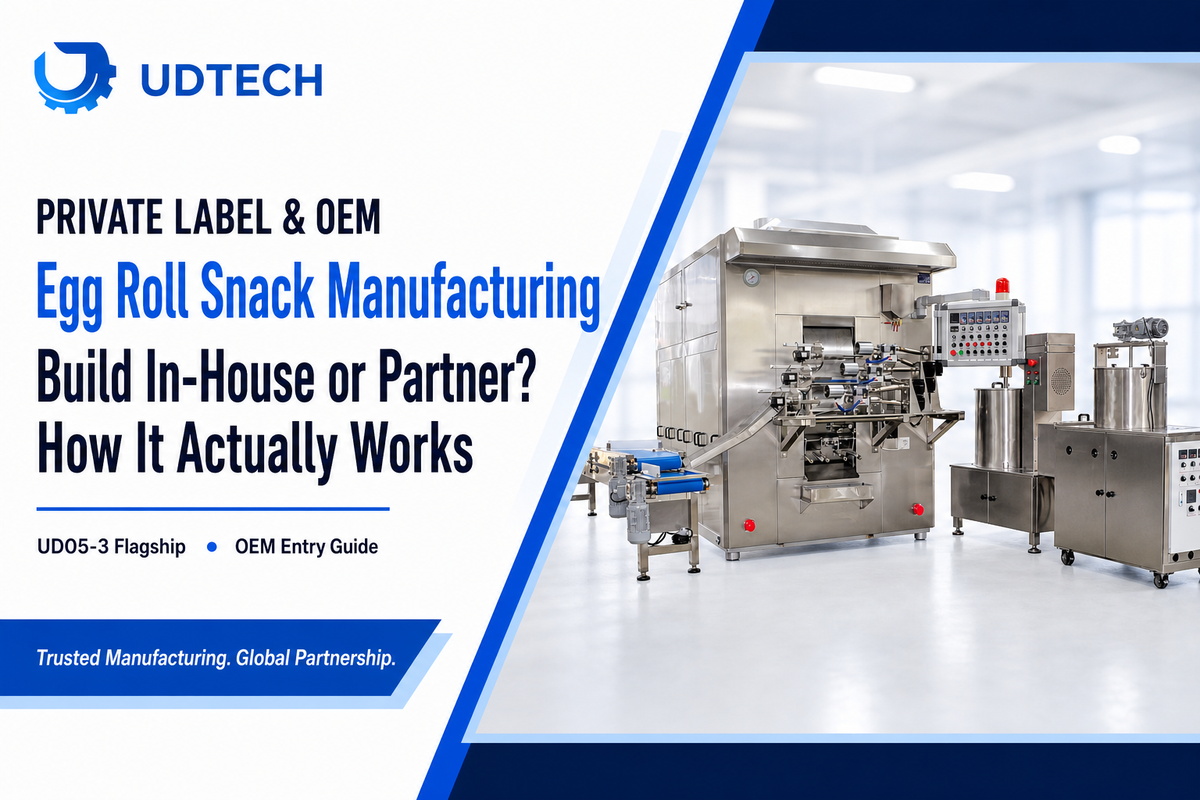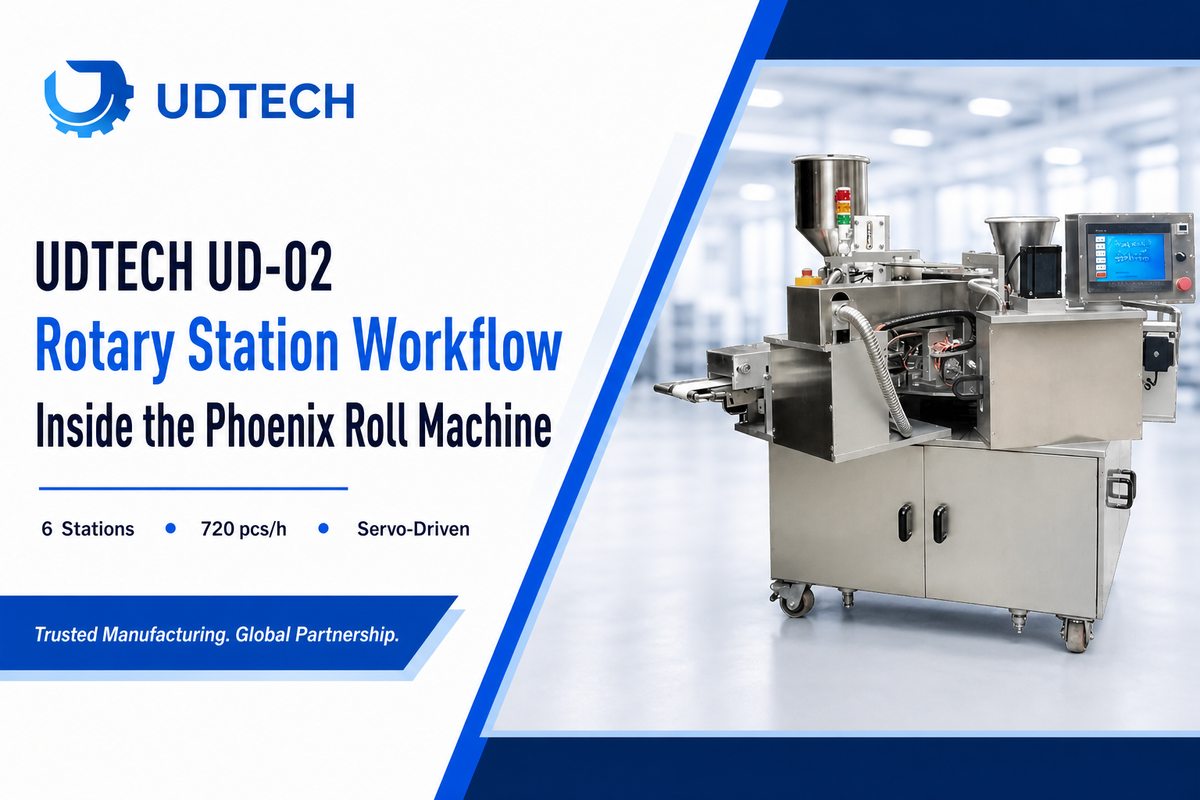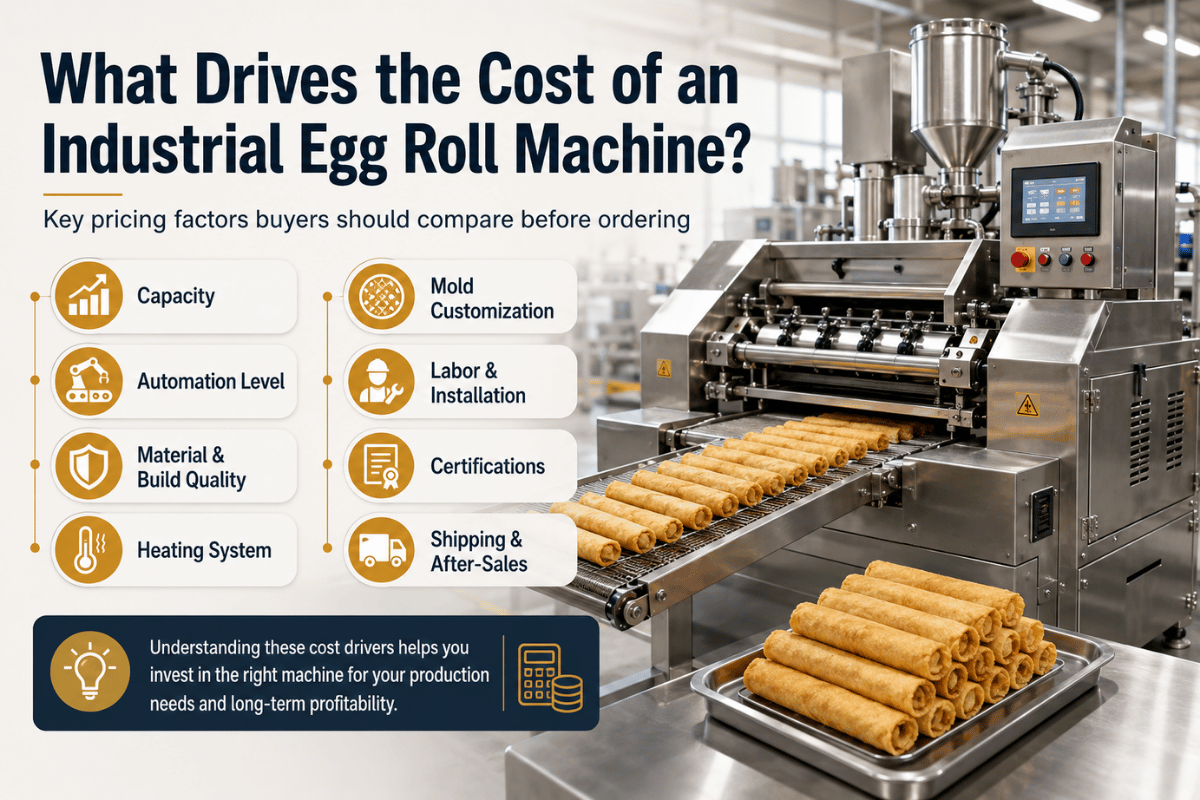
The egg roll machine cost factors that move a quote are rarely the headline sticker price. That same search term — “egg roll machine” — covers a $40 home gadget and a six-figure industrial egg roll production line, because it spans at least three different machine categories. This guide breaks down the nine price drivers that actually change what you pay, from machine category and output capacity to fuel system, certifications, and five-year running cost, so you can read any quote like a buyer who knows where the money go.
In Short
Egg roll machine cost is set mainly by machine category, output capacity, automation level, and fuel system, not brand. A home electric egg roll maker runs $20-$200; a commercial countertop multi-tube unit $300-$3,000; an automatic wafer egg roll line or savory spring roll machine line is a custom quote, typically mid-five to six figures. Across that range, price moves roughly 1,000×, and the cheapest option is often the most expensive over five years.
Key Points
- Buying the highest capacity you can afford is usually a mistake, unused capacity dilutes fixed cost across fewer real units and raises your cost per egg roll.
- Forming method, not motor size, drives energy cost: a wafer baking line draws roughly 0.61 Wh of electricity per piece versus about 16 Wh on a 59 kW spring roll wrapper line.
- Certification scope (FDA food-contact, CE/EU machinery safety) is a real, itemizable line in a quote, not a free extra.
- Purchase price is the tip of the cost stack; labor, energy, waste, and downtime over five years are the mass beneath it.
- At very small volume, a co-packer or shared commercial kitchen can beat buying any machine at all.
Quick Specs: Egg Roll Machine Price & Capacity Tiers
| Home electric egg roll maker | ~$20-$200 · a few pieces per batch · hobby / breakfast use |
| Commercial countertop (multi-tube) | ~$300-$3,000 · 6-10 tubes · street food, cafe, small stall |
| Industrial wafer egg roll line | Custom quote (mid-5 to 6 figures) · 220-330 pcs/min · 600-900 kg per 8 h shift |
| Industrial spring roll machine line | Custom quote · 3,000-4,000+ pcs/hr · savory, cooked fillings, fry/freeze |
| Lead time (line) | ~9-13 weeks standard config vs 16-32 weeks full-custom |
Ranges are indicative and vary by configuration and quote. Line specifications reflect UDTECH UD05 wafer egg roll machine data; tier prices are compiled from market listings.
How Much Does an Egg Roll Machine Cost? Price Tiers at a Glance
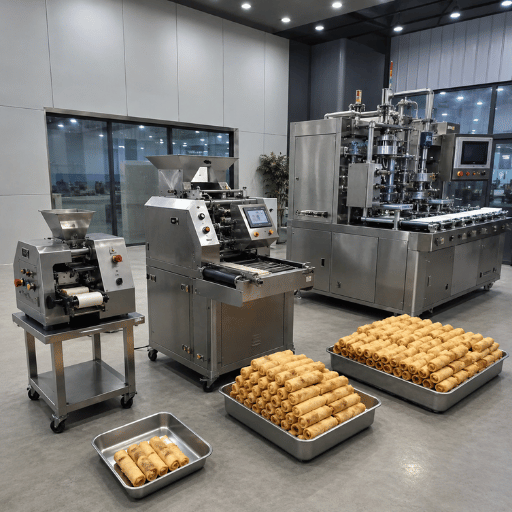
An egg roll machine costs anywhere from about $20 to a six-figure sum because the phrase covers three distinct equipment classes, not one product. Home electric egg roll makers are non-stick household appliances. Commercial countertop units are multi-tube electric egg roll machines for a stall or cafe. The category you actually need sets the order of magnitude; everything else fine-tunes it.
An automatic egg roll making machine for a factory is a full production line with dough belt sheeting, filling, folding and rolling, and baking or frying stages; the baked style follows the warm-sheet rolling method described in USPTO patent US4110482A.
Buyer profile shapes the tier too. Frozen food manufacturers, central kitchens, and American Chinese restaurants moving from manual to automated lines need high-efficiency, commercial-use equipment sized to actual production, not peak ambition. A home cook making a few Chinese egg roll batches a week and an automated food plant running two shifts are reading the same listings for completely different reasons, so anchor every cost question to your real food preparation volume first.
This guide stays narrowly on cost. For the full breakdown of machine types, models, and capacity classes, see our egg roll machine types and capacity guide. Here, every section is a cost driver, a lever that move the number on your quote.
One honest note before the tiers: at tiny volume, the best “machine” may be no machine. On food-business forums, experienced sellers routinely steer newcomers toward a shared commercial kitchen or a co-packer who will run their recipe, rather than buying equipment that sits idle. Buy a line when consistent demand, not enthusiasm, justifies it.
| Cost Factor | Lever Type | Budget-End Choice | Premium-End Choice | Price Impact |
|---|---|---|---|---|
| 1. Machine category | Class selector | Home electric maker | Industrial line | ~1,000× (largest) |
| 2. Product type | Forming type | Savory fried wrapper | Sweet wafer baking | High |
| 3. Output capacity | Throughput tier | Hundreds pcs/hr | Thousands pcs/hr | High |
| 4. Automation level | Labor lever | Manual tubes | Fully automatic line | High |
| 5. Fuel & energy system | Operating-cost type | Single fuel | Multi-fuel switchable | Med capex / high opex |
| 6. Build quality & materials | Compliance class | Basic stainless | Certified 304/316 food-grade | Medium |
| 7. Certification scope | Documentation tier | None stated | FDA + CE/EU + ISO + HACCP | Medium |
| 8. Configuration & integration | Line-scope type | Forming stage only | Turnkey + packaging + X-ray | High |
| 9. Lead time & procurement | Schedule lever | 9-13 wk standard | 16-32 wk full-custom | Low-med (carrying cost) |
| 10. 5-year TCO & support | Ownership class | Bare machine | Lifetime support + spares | Decisive over 5 yr |
Synthesis of the cost drivers detailed in this guide; price-impact ratings are relative, based on UDTECH quote experience.
Cost Factor #1: Machine Category & Product Type
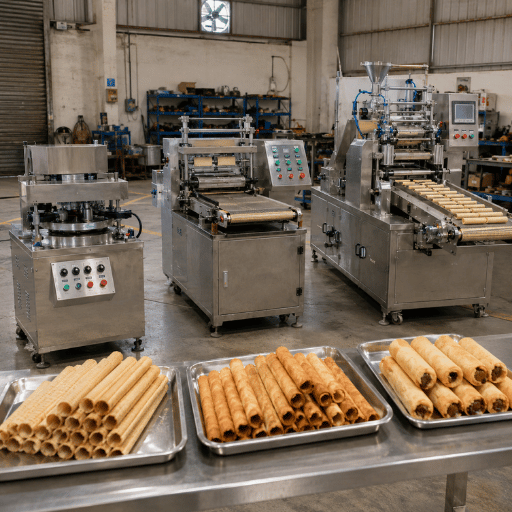
The single biggest price driver is which machine category you’re buying, because a home gadget, a commercial egg roll machine, and an industrial wafer or spring roll line are three different machines that share one name. This is where the 1,000× price spectrum comes from: the home unit and the factory line aren’t competitors, they solve different problems at different scales.
Product type matters just as much as scale. The sweet wafer egg roll (the crisp rolled-cookie style) is made on a baking line: thin batter is baked on heated plates into a pliable sheet, then a rolling machine curls it while warm. Its filled cousin, the savory egg roll or spring roll (the fried kind), uses a wrapper machine plus a filling device that deposits meat fillings or shredded cabbage and vegetable filling, then a folding and rolling stage, then frying or freezing. Wafer baking lines carry the most thermal engineering, which is why it often anchors the top of the quote. For the full split, see wafer roll vs spring roll machine.
A wafer egg roll skin is only about 0.8-1.4 mm thick and is baked, not fried, so the heated plate temperature has to hold within a tight band (roughly ±2-3 °C) across the whole plate or the sheet scorches at the edge before the center sets. USPTO patent US5085138A describes the conveyor of semi-cylindrical mold cups that forms the egg roll skin, and US4110482A covers rolling the warm baked sheet at a roller speed slower than the sheet advances, the mechanical reason wafer lines need precise, costlier forming hardware.
The 1000× Egg Roll Machine Price Spectrum is the mental model to carry into any showroom or quote: identify your category and product type first, because that decision alone explains most of the price gap before you compare a single feature.
Cost Factor #2: Output Capacity & Throughput Tier
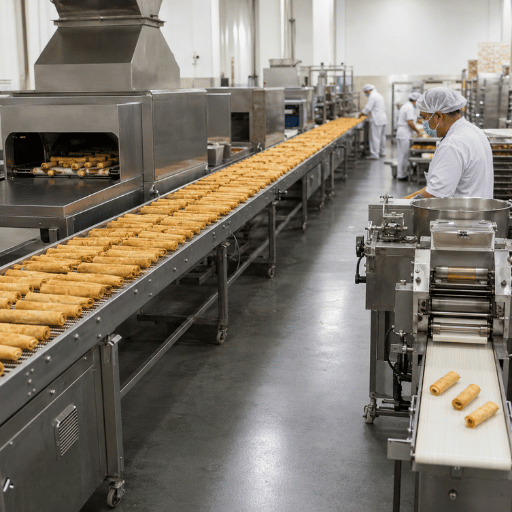
Price scales with output capacity, measured in pieces per hour and kilograms per shift, but more capacity isn’t automatically better. Commercial countertop makers turn out a few hundred pieces per hour; an industrial automatic egg roll machine reaches thousands. Each step up the throughput tier adds motors, longer baking or frying zones, bigger filling devices, and more conveyor, so the line cost more to buy and more to run. Forming hardware itself scales with speed: USPTO patent US5085138A shows the mold-cup conveyor that sets a baked line’s piece rate.
| Machine | Class | Output | Power |
|---|---|---|---|
| UDTECH UD05-2 | Wafer line | 220 pcs/min · 600 kg/8 h | 9.7 kW |
| UDTECH UD05-3 | Wafer line | 330 pcs/min · 900 kg/8 h | 12 kW |
| ANKO ER-24 | Egg roll line | 2,400 pcs/hr (156 kg/hr, 65 g piece) | — |
| Industrial spring roll line | Spring roll machine | 3,000-4,000 pcs/hr | ~59 kW (wrapper part) |
UD05 figures are first-party UDTECH wafer line specifications; ER-24 and spring roll line figures are published manufacturer output specs.
The Capacity-to-Cost Curve. Here’s the contrarian part that catches buyers: capacity utilization, not capacity, is where profit lives. If you buy a 900 kg/shift line but only sell 300 kg, the line’s fixed cost, purchase, financing, floor space, baseline labor, spreads over fewer real units, so your cost per egg roll rises, not falls. Over-specifying is a quiet capex mistake: the bigger line look like a bargain per theoretical piece and turns into the opposite per actual piece. Match the tier to demand you can prove, then leave headroom for one growth step, not three.
Picture a regional frozen-dumpling producer that bought a 900 kg-per-shift line (about 0.9 ton) expecting fast growth. A year into production, real demand held near 300 kg per shift, so two-thirds of the line sat idle while its fixed cost, financing, floor space, and baseline labor, still spread across every case shipped. Because unused capacity dilutes fixed cost, the unit cost per egg roll rose by roughly 30% versus a right-sized 600 kg line, and that over-buying mistake added years to payback. The risk wasn’t the machine; it was buying tomorrow’s volume today. In practice, sizing to proven demand plus one growth step avoid this expensive trap.
Cost Factor #3: Automation Level
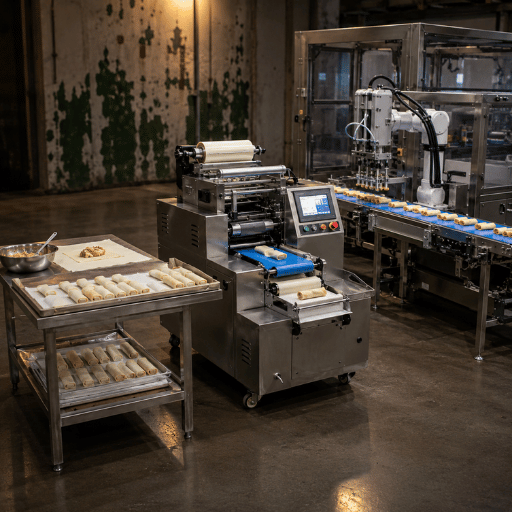
Automation level is the next lever, and it runs on a ladder: manual tubes, then semi-automatic grouting and baking, then a fully automatic egg roll making machine that handles dough belt sheeting, cutting, filling, folding and rolling, and discharge in one pass. Each rung removes a pair of hands and adds hardware cost, so you’re trading capex now for labor savings later.
What machine is used to make egg rolls?
An egg roll is made by a sequence of machines, not a single device, and the automation level decides how many of those stages are joined into one line. Its core chain is: a batter mixer or dough belt making machine prepares the sheet; a baking or sheeting stage forms it; a cutting machine sizes it; a filling device deposits the filling; and an egg roll rolling machine does the folding and rolling.
A frying or freezing stage finishes savory product. A manual setup run these as separate steps; a fully automatic line links them on one conveyor.
That same forming logic powers adjacent snacks, which is why suppliers often quote a shared platform: an egg roll mold and egg roll baking plates make the sweet wafer style, while a wrapper-and-filling machine that can produce egg rolls can usually also handle lumpia, samosa, or feed a dumpling machine and other filled pastry. That cross-compatibility matters for cost, a line bought for making egg rolls that also run two other products spreads its capital over more SKUs and earns its price faster, all while holding the consistent, high quality egg rolls a single-product manual crew struggles to match.
In practice, the jump that pay back fastest is from hand-rolling to a semi-automatic forming machine, because rolling is the slowest, most skill-dependent manual step. An automatic encrusting and forming machine, the encrusting method appears in USPTO patent US4515819A that mimics the handmade fold is what lets a small producer hold quality while output climbs, the same logic behind UDTECH’s UD05 automatic wafer egg roll line.
Cost Factor #4: Fuel & Energy System
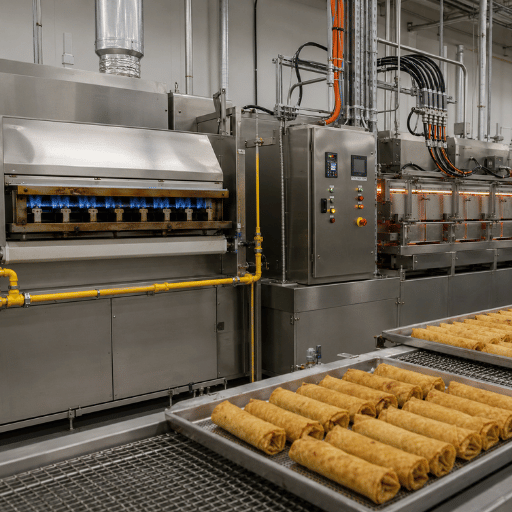
The fuel and energy system drives both purchase price and the bill you pay every shift. Lines run on electricity, gas, or a switchable multi-fuel burner, and the choice is a hedge as much as a spec. United States commercial electricity averaged about 14.18 cents per kWh in March 2026, while industrial natural gas ran near $6.03 per thousand cubic feet in 2025, and the Henry Hub spot price swung between $2.65 and $9.86 per MMBtu during that year. That volatility is exactly why a multi-fuel option earns its cost: it lets you burn whatever is cheaper this quarter.
A UD05-3 wafer line draws 12 kW of electricity at 330 pcs/min, which is 19,800 pieces per hour, about 0.61 Wh of electricity per piece. At $0.14/kWh that’s roughly $1.68 of electricity per hour, or about $0.09 per 1,000 pieces, with baking heat supplied separately by gas at around 8-10 m³ per hour. Now compare an all-electric spring roll wrapper line: 59 kW for 3,000-4,000 pcs/hr works out near 16 Wh per pieceroughly $8.26 per hour, or about $2.36 per 1,000 pieces. Same product family, but the spring roll line’s electric forming draws on the order of ten times the electricity per piece. Forming physics, not the brand on the panel, sets that gap.
For a quote, ask for energy draw per piece, not just installed kW. High headline kW with high throughput can be cheaper to run per egg roll than a smaller, slower machine. Automation suppliers report that tuning energy and scheduling alone can trim 5-10% off running cost, so the energy system is a number worth pushing on before you sign.
One central-kitchen operator running a wafer line on natural gas watched the spot price swing from about $2.65 to $9.86 per MMBtu inside a single year. Because the line had a switchable multi-fuel burner, the plant moved part of its production to off-peak electricity during the worst gas spikes and held energy cost roughly flat, while a neighboring single-fuel producer absorbed the full increase over the same year. Risk for a single-fuel buyer is real but hidden at purchase: the cheaper fixed-fuel machine can become the expensive one the first time prices move. In practice, ask what a fuel switch cost to retrofit later, adding it after the fact is rarely worth the delay.
Cost Factor #5: Build Quality, Materials & Certifications
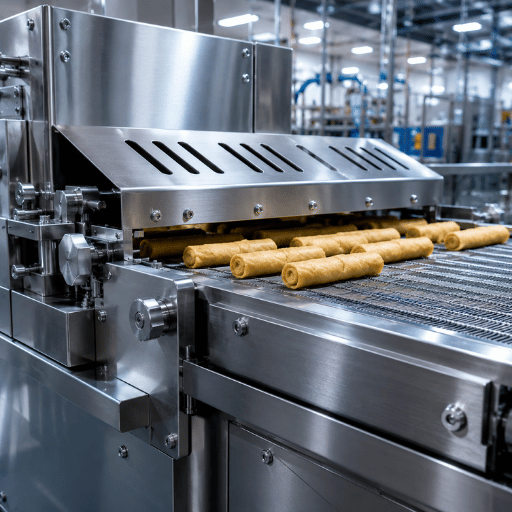
Build quality and certification scope are real cost lines, not marketing gloss. Every food-contact surface should be food-grade stainless steel, austenitic grades such as 304 or 316 carry roughly 16-18% chromium, which gives the corrosion resistance and cleanability that hygienic design demands. In the United States, food-contact coatings fall under FDA 21 CFR 175.300, and the plant operating the machine works under the preventive-controls and cleanability rules of 21 CFR Part 117.
Machinery safety is the other half. For the European market, CE conformity is moving from Directive 2006/42/EC to the new EU Machinery Regulation 2023/1230, which applies from 20 January 2027 and adds fresh documentation and conformity duties. ISO 9001 quality systems and HACCP-style food safety plans round out the paperwork. Each certificate, test report, and documentation package the supplier must produce is billable engineering time, so when one quote is “cheaper,” check whether the certification scope is the same before you compare.
A quote with no named standards is not automatically cheaper — it may simply have left the certification work out. Ask which food-contact and machinery-safety standards the build is documented against, and who pays if a destination market demands a certificate later.
One importer learned the certification lesson the hard way. One line bought purely on low price arrived without documented CE conformity, and because the destination market required it, the equipment was held at the border until a compliance file could be assembled retroactively, a delay of several weeks that added roughly 15% to landed cost and erased the original saving. Food-contact and machinery-safety documentation under FDA 21 CFR 117 and CE rules is not a gap you can close for free after the fact. For a US buyer or an EU buyer alike, confirming certification scope up front is far cheaper than fixing the problem at customs.
Cost Factor #6: Configuration & Line Integration
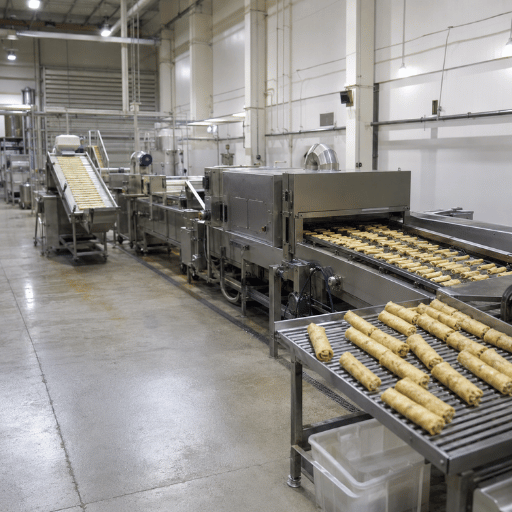
Configuration is where a single base model turns into ten different prices. Two buyers can order the “same” automatic egg roll machine and get quotes that differ by a wide margin, because the line is assembled from choices. These are the levers that move a quote the most.
- Model tier and output capacity (e.g., UD05-2 vs UD05-3)
- Fuel system, electric, gas, or switchable multi-fuel
- Automation depth, semi-auto forming vs fully automatic line
- HMI touch-screen and recipe/control package
- Certification documentation scope (FDA / CE / ISO / HACCP)
- Upstream mixing and downstream packaging integration
Line integration is the quietest cost multiplier. Because cleanable, well-documented food-contact design under FDA 21 CFR Part 117 applies to every stage you bolt on, adding upstream dough belt and mixing, or downstream conveyor, X-ray inspection, and packaging, turns a forming machine into an entire production line, and a turnkey solution priced accordingly. A turnkey supplier folds factory layout and layout design into the deal as a single egg roll production solution, which is convenient but bundles cost you should still itemize, for food manufacturing and food processing operations, that bundling is also where consistency and after-sales value live. If you only need the forming stage today, say so; you can integrate a snack food extruder machine or packaging line later as production needs grow.
Beyond Purchase Price: The 5-Year Total Cost of Ownership
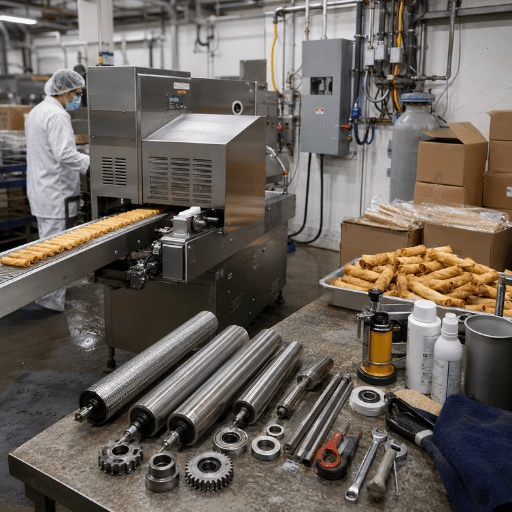
Purchase price is the tip of the cost stack; the mass beneath it’s five years of labor, energy, waste, maintenance, and downtime. Buyers who choose on total cost of ownership rather than unit price consistently report better outcomes, but these figures are industry automation benchmarks, not guarantees, so treat them as direction, not promise.
- Laborthe largest recurring line; automation can cut it sharply, but you trade many operators for fewer technical staff.
- Energyper-piece draw compounds across millions of pieces at prevailing US electricity rates (see the worked example above).
- Waste / yieldautomated lines commonly hold waste low single digits vs higher manual scrap.
- Maintenance & sparesstock critical wear parts; an idle line waiting on a part is pure loss.
- Downtimethe cost of an hour stopped is your hourly throughput value.
- Purchase pricereal, but amortized across the whole stack.
Reported automation paybacks cluster around 18-30 months when the model captures all cost categories rather than only displaced labor. As a benchmark, total-cost buyers describe roughly 40% higher five-year ROI and about 30% fewer production disruptions, with labor reductions reaching the high tens of percent and waste held under a few percent versus 6-8% on manual lines. Again: these are sector benchmarks, not a UDTECH-measured promise, your numbers depend on recipe, volume, and uptime discipline.
“Reduced labor costs tend to be the most obvious ROI. A machine can replace two or three laborers, but it’s not a panacea, you’re going to need people, not as many of them, but different people, a technical staff who knows how to work the controls. Reduced footprint is another consideration; if you can avoid a major plant expansion, that’s huge savings.”
Lead Time, Installation & Hidden Procurement Costs
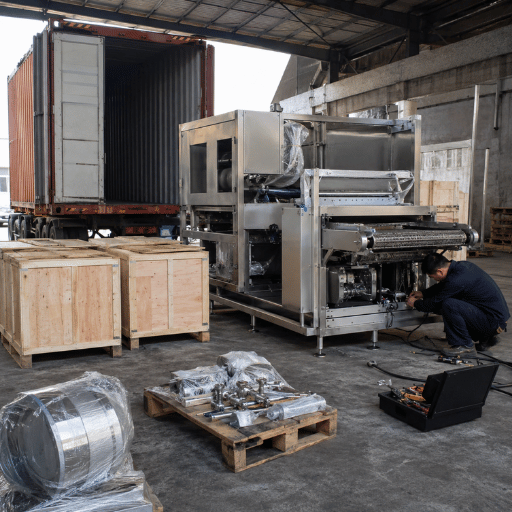
The quoted machine price rarely equals your landed cost. Standard-configuration UD05 lines ship in roughly 9-13 weeks, while a full-custom build can run 16-32 weeks, and that schedule difference is itself a cost if a season or contract is waiting. Lines documented for European conformity under EU Regulation 2023/1230 add compliance paperwork to that timeline, so factor it in early. Plan the procurement line items, not just the machine.
- ✔ On-site commissioning: about 5-7 days
- ✔ Operator training: about 2-3 days
- ✔ Warranty and support: 12-month warranty plus lifetime remote technical support
- ✔ Sea freight and insurance: by destination and incoterm
- ✔ Spare-parts buffer: stock wear parts before go-live, not after the first stoppage
- ✔ Power match: confirm 380V/50Hz or 220V/60Hz to your grid to avoid retrofit cost
A cautionary pattern from import experience: the lowest sticker price often pairs with the thinnest after-sales support and the slowest spare-parts pipeline. When a forming roller or filling device fails and parts ship slowly with no local technical support, the “cheap” line stops earning while you wait, the classic false economy. Price the support, lead time, and spares into the comparison from the start. Traceability-readiness under the FDA’s FSMA 204 rule is one more procurement item to confirm before signing.
How to Match Machine Cost to Your Production Scale
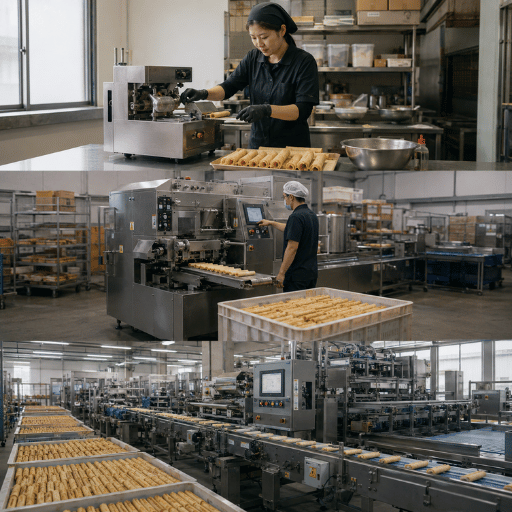
The cheapest correct machine is the one matched to demand you can prove, plus one growth step. Use your monthly output target to pick the tier, then read the budget posture across from it; this is the cost decision most quotes quietly skip.
| If your output target is… | Machine class | Budget posture |
|---|---|---|
| A few hundred pieces/day, testing demand | Co-packer or commercial countertop unit | ~$300-$3,000, or no capex (co-packer) |
| Sweet wafer rolls, 600-900 kg/shift | Industrial wafer line (UD05-2 / UD05-3) | Custom quote; prioritize energy & support |
| Savory filled rolls, 3,000+ pcs/hr | Spring roll machine line + fry/freeze | Custom quote; energy per piece dominates |
| Mixed / growing product range | Modular line, add stages later | Buy core forming now, integrate over time |
Supplier tier also shifts the price: origin, depth of technical support, and spare-parts logistics are part of what you pay for. Specialists that handle factory layout and integrated solutions for a food business cost more upfront than a bare-machine seller, and are usually cheaper across five years, especially once your output triggers the preventive-controls obligations of FDA 21 CFR Part 117. Apply the “crawl, walk, run” rule industry integrators recommend, automate the slowest, most labor-heavy stage first, prove it, then scale.
Take a US buyer weighing two quotes for the same 600 kg-per-shift wafer line. The cheaper quote omitted on-site commissioning and a spare-parts buffer; the dearer one bundled both. Six weeks after go-live a forming roller wore out, and because the budget supplier shipped parts slowly with no local technical support, the line sat idle for 9 days, a delay that cost more in lost production than the entire spares package would have. Here, the question isn’t “which sticker price is lower” but “which total cost, including downtime risk, is lower.” For a regional producer, matching support depth to uptime needs is the call that protect the investment.
What’s Changing in Egg Roll Machine Costs in 2026
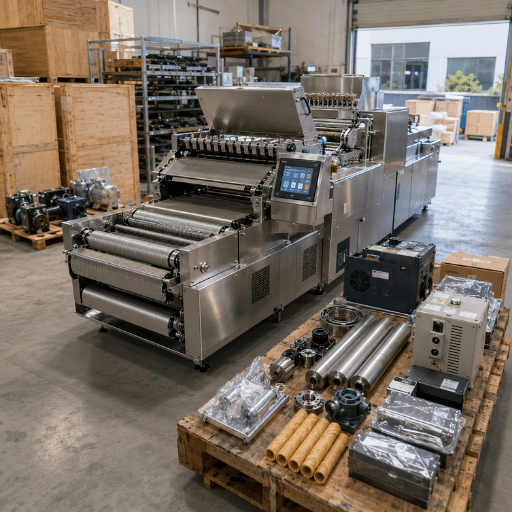
Three forces are reshaping egg roll machine cost in 2026, and all of them reward buyers who weight documentation, energy, and support over the lowest sticker price. First, the compliance baseline is rising: the EU Machinery Regulation 2023/1230 becomes mandatory on 20 January 2027, so any line destined for Europe now carries new conformity work that has to be priced in today.
In the United States, the FDA’s FSMA 204 food traceability rule had its compliance date pushed from January 2026 to 20 July 2028, a reprieve, not a cancellation, so traceability-ready line data is a near-term planning item, not an emergency.
Consider a producer planning a 2026 line for the European market. Any machinery placed on the EU market from 20 January 2027 must meet Regulation 2023/1230 for CE conformity, so a line ordered in 2026 with a 16-32 week lead time lands right at the transition. Because retrofitting conformity after delivery is expensive and slow, the smart move is to specify 2023/1230 compliance in the purchase contract now and avoid the risk of a non-conforming line. For a US buyer with no EU exposure the pressure is lower, but fuel-price risk still rewards a multi-fuel option. In practice, the action is the same either way: price compliance and energy in, not on.
Second, fuel-price volatility is making the energy system a strategic choice rather than a default. With gas spot prices swinging widely through 2025, switchable multi-fuel burners and lower energy-per-piece forming are moving from “nice to have” to a genuine cost hedge. Machine-vision and X-ray inspection, capable of catching contaminants down to fractions of a millimeter, are also becoming a standard, billable layer rather than an option.
Third, labor cost and labor scarcity keep pushing contract bakeries and central kitchens toward automation; the demand driver is people, not machines. Market analysts size the broader food-automation sector in the tens of billions of dollars with steady forecast growth, but treat those figures as background context only, the decision that matters is local: if you’re planning a 2026 line, ask suppliers to quote energy per piece, certification scope, and spare-parts lead time explicitly, because those are the lines that will move your real cost over the machine’s life.
Frequently Asked Questions
Q: How much does a commercial egg roll machine cost?
View Answer
A commercial egg roll machine costs roughly $300 to $3,000 for a countertop multi-tube electric unit suited to a stall, cafe, or small restaurant. A full industrial automatic egg roll line — with dough belt sheeting, filling, and folding and rolling — is a custom quote, typically in the mid-five to six figures, because price scales with output capacity, automation level, fuel system, and certification scope rather than a fixed list price.
Q: Why is there such a huge price range for egg roll machines?
View Answer
The price range spans roughly 1,000× because one search term covers three different machine categories. A home electric egg roll maker is a household appliance; a commercial countertop unit is a multi-tube electric machine; and an industrial egg roll making machine is a full production line with baking or frying, filling, and rolling stages. The category you need sets the order of magnitude, and capacity, automation, and certifications fine-tune it from there.
Q: What’s the cost difference between gas and electric egg roll machines?
View Answer
Gas versus electric is mostly an operating-cost decision. With US commercial electricity near 14 cents per kWh and industrial natural gas around $6 per thousand cubic feet in 2025, gas often heats baking plates more cheaply, while electric simplifies install and venting.
Forming method is the bigger lever: a wafer baking line can draw under 1 Wh of electricity per piece, while a 59 kW spring roll wrapper line runs near 16 Wh per piece. A switchable multi-fuel burner hedges price swings between the two. On a 1,000-pieces-per-hour line, that per-piece gap can move annual energy spend by several thousand dollars, so the fuel choice is worth modeling against your local utility rates before you sign.
Q: Is a more expensive automatic egg roll machine worth it?
View Answer
Often, yes — but only when demand justifies the capacity. Total-cost-of-ownership buyers report meaningfully better five-year ROI and fewer disruptions, with automation paybacks commonly in the 18-30 month range when labor, energy, waste, and downtime are all counted. Over-specifying is the trap: a line bigger than your real output spreads its fixed cost over fewer units and raises cost per egg roll. The “worth it” answer depends on proven volume, not ambition.
Q: What’s the cheapest way to start egg roll production?
View Answer
For testing demand, a co-packer or a shared commercial kitchen usually beats buying any machine, since it avoids capex entirely. If you must own equipment, a commercial countertop multi-tube unit at roughly $300-$3,000 is the lowest entry point that still scales to a small storefront.
Q: How long does it take to receive an industrial egg roll machine?
View Answer
A standard-configuration line typically ships in about 9-13 weeks, while a full-custom build can take 16-32 weeks, plus sea freight, 5-7 days of installation, and 2-3 days of training. Order early, because slot availability and component lead times can stretch these windows during peak demand.
Q: Does the machine price include installation and training?
View Answer
Not always — confirm it in writing. A turnkey supplier usually bundles commissioning, operator training, warranty, and remote support, but a bare-machine seller may quote the line only. Ask what is included, who pays freight and certification, and what spare-parts and after-sales support look like, because those landed-cost items decide your real total.
Want a price built around your actual output, fuel, and certification needs, not a generic list price? UDTECH configures the UD05 wafer egg roll line to your shift target and shows the cost drivers line by line.
About This Cost Analysis
This breakdown of egg roll machine cost factors draws on first-party UD05-2 and UD05-3 wafer line data, output, power draw, lead time, and itemized quote drivers, alongside FDA and EU machinery standards and published US energy prices. Our cross-category energy-per-piece comparison is built from manufacturers’ own kilowatt figures so you can verify it. Reviewed by the UDTECH technical team.
References & Sources
- 21 CFR 175.300, Resinous and Polymeric CoatingsU.S. Electronic Code of Federal Regulations
- 21 CFR Part 117, cGMP & Preventive Controls for Human FoodU.S. eCFR
- Regulation (EU) 2023/1230 on Machinery — EU-OSHA
- Electricity Monthly Update (commercial price per kWh)U.S. Energy Information Administration
- U.S. Natural Gas Industrial PriceU.S. Energy Information Administration
- FSMA 204 Food Traceability Rule, Compliance Date ExtensionU.S. Federal Register
- US5085138A, Food Production Apparatus (egg roll skin forming) — USPTO via Google Patents
- Developments in Automation for Snack and Bakery Companies — Snack Food & Wholesale Bakery
Related Articles
- Egg roll machine types and capacity guide — the full buyer’s overview of models and classes
- Wafer roll vs spring roll machine — which forming method fits your product
- Seaweed egg roll machine — specialty roll production line
- Phoenix roll machine — filled wafer roll equipment
- About UDTECH — food machinery manufacturing background