Updated July 2026.
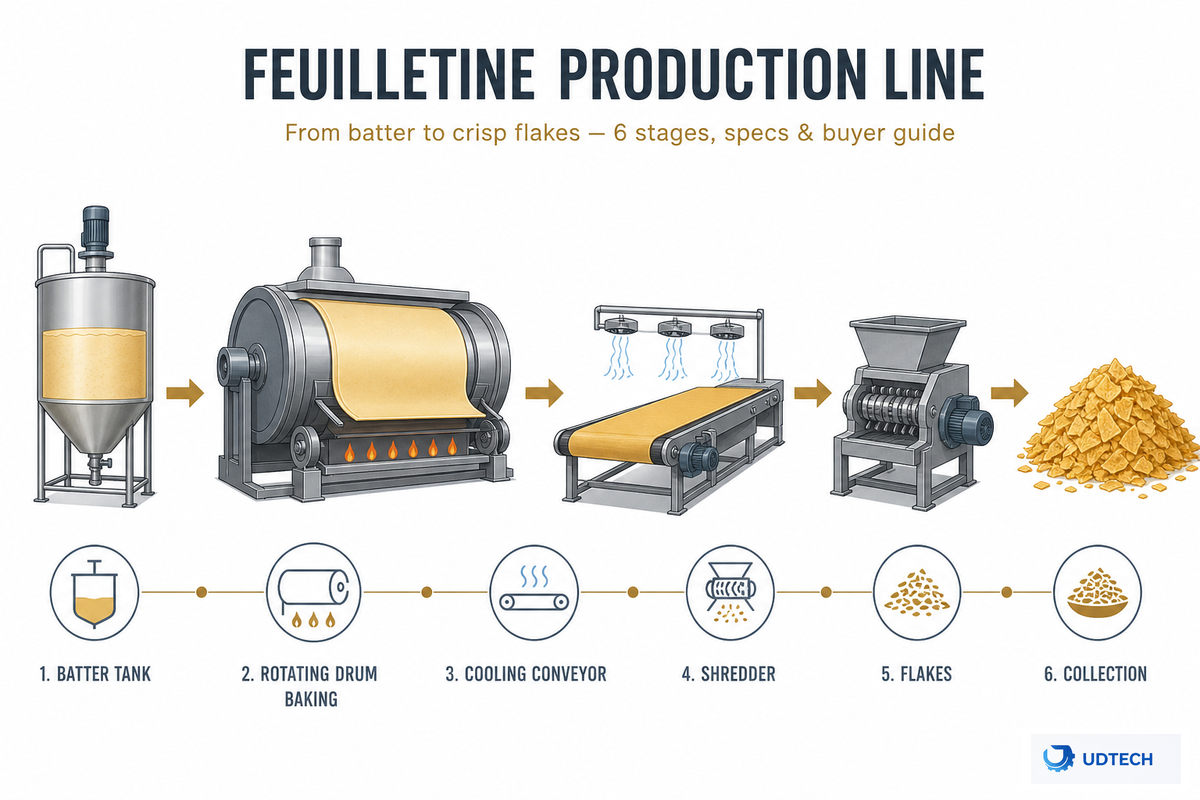
A feuilletine production line is an automated system that bakes thin, sweet crêpe batter on a heated rotating drum, cools it until brittle, and shreds it into crisp flakes. This guide covers the six stages, the five main machines, realistic line capacity and drum specs, formulation and gluten-free control, applications, substitutes, and how to spec and source a line — from a food-machinery engineering view, not a single vendor’s catalog.
Quick Specs: Feuilletine Line at a Glance
| Core process | Batter → drum bake → thin strip → cool → shred → sieve → pack |
| Baking drum diameter | ≈ 570–1,600 mm (industry-typical, vendor-published) |
| Output band | ~400 pc/h (artisan) to ~17,000 pc/h (large multi-drum) — vendor figures, not audited |
| Batter hold / drum control | Batter tank ≈ 5 °C, stirred; drum temperature control to ≈ ±1 °C |
| Heating | Gas or electric |
| Crisp control | Low finished water activity (validate per recipe; maintain through packaging) |
What Is Feuilletine? Crêpe Dentelle, Gavottes & Pailleté Explained
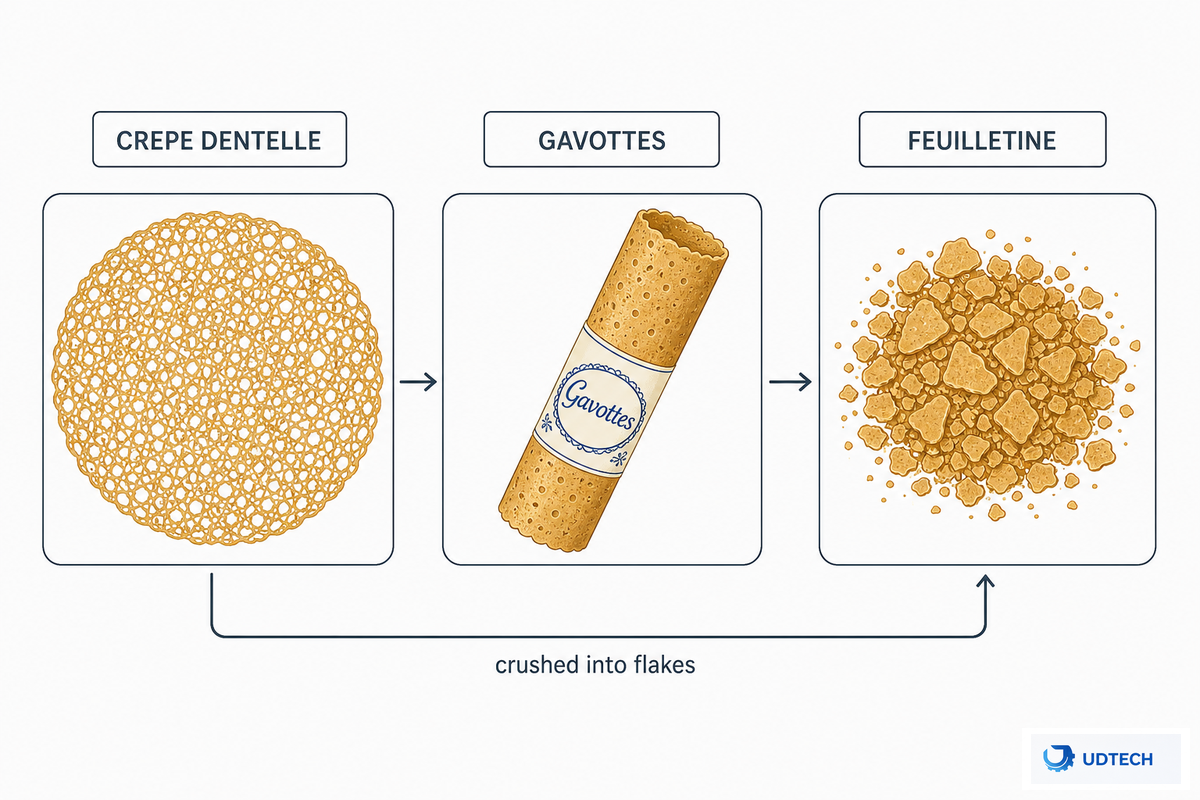
Feuilletine (sometimes spelled pailleté feuilletine, or simply paillete feuilletine) is a French confection of thin, sweet crepes baked until brittle and then shredded into small, crisp flakes. Crepes are baked first; as they cool they become crisp — a firming that food-science work on water activity and the glass transition explains — and once crumbled they become the buttery, decorative pieces that many pastry chefs prize.
Those fragile, lacy wafers before crushing are called crêpes dentelles, or crepe dentelle (lace crêpes), sold under the brand Gavottes — as gavottes crispy crepes or gavotte cookies. Its name comes from the French word for “leaf” (feuille), and the practice was born in France as a pâtisserie trick for using up scraps of crêpe batter. Homemade versions are still common, though feuilletine is now produced commercially at a larger scale.
Confusion is a common issue, so it helps to contrast feuilletine with related items. A feuilletine line is similar in some aspects to the process for baking thin wafers or egg rolls, rather than pancake griddle cooking, where a moist product is the goal.
| Product | Base | Form | Moisture / texture | Primary use |
|---|---|---|---|---|
| Feuilletine | Sweet crêpe strip | Crushed flakes/shards | Dry, brittle, crisp | Crunch inclusion |
| Crêpe dentelle | Sweet crêpe strip | Whole lacy wafer/roll | Dry, crisp | Eaten whole; raw material for feuilletine |
| Gavottes | Crêpe dentelle | Branded rolled wafer | Dry, crisp | Retail biscuit brand |
| Filled wafer | Baked wafer sheet | Layered sheets + cream | Dry shell, soft filling | Confectionery bar |
| Pancake / crêpe | Batter | Soft round sheet | Moist, pliable | Eaten fresh |
Q: Is feuilletine the same as crêpe dentelle?
Not quite, as they’ve a shared recipe but differ in one production step. A crêpe dentelle is the entire wafer, and feuilletine is merely the fractured version. In a production line, the distinction lies in one piece of machinery-the shredder. The production steps that occur before this (batter prep, drum baking, and cooling) are exactly the same, and this is the reason that feuilletine lines and crêpe-dentelle lines share the same basic setup.
How a Feuilletine Production Line Works: Batter to Flake in 6 Stages
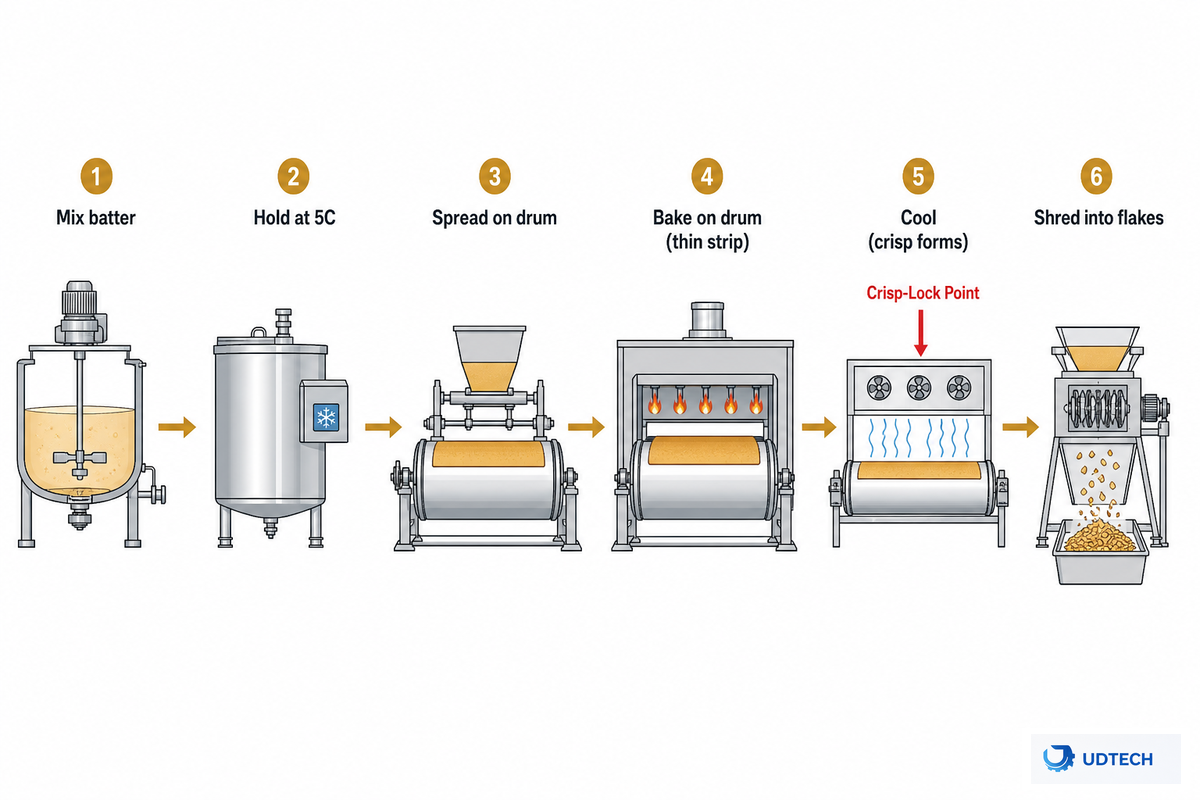
A feuilletine production line — also called a feuilletine cooking line — pours sweetened crepe batter onto a heated, revolving drum, bakes it into a very thin strip, cools it until brittle, then shreds it into fine, crisp flakes that are sifted and packaged.
This production of batter strip, followed by cooling and shredding, is what a cooking line for feuilletine automates; after the strip is crushed, the fragments become feuilletine. Because the preceding operations are shared, much of the production of feuilletine is done on the same line configuration used for a cooking line for crepes. Mechanically it is a continuous drum bake followed by controlled cooling and milling, and the most critical factor is not the oven heat but the point at which the strip turns brittle.
drum baking is a standard industrial process: thermal energy is transferred from the drum through the attached thin film of batter to drive off moisture, and then the dried strip is lifted by a scraper blade, as described in double-drum drying of food slurries by the U.S. National Institutes of Health (PMC). Below is the 6-Stage Feuilletine Line Register listing the stages, equipment at each, process controls, and potential defects.
| Stage | Machine | Function | Key control | Defect it prevents |
|---|---|---|---|---|
| 1. Mix | Batter mixer | Blend flour, sugar, butter, egg white, milk | Fat/sugar ratio, lump-free | No lacy structure |
| 2. Hold | Cooled resting tank | Rest and stabilise batter | ≈ 5 °C, stirred | Uneven spread, phase split |
| 3. Spread | Doser / spreader | Deposit an even film onto the drum | Strip width and thickness | Thick/thin patches |
| 4. Bake | Heated rotating drum | Drive out moisture, set the sheet | Drum temp ≈ ±1 °C, dwell | Under-bake (soggy) / scorch |
| 5. Release | Scraper blade | Lift the dried strip off the drum | Blade angle, drum coating | Tearing, drum build-up |
| 6. Cool | Cooling conveyor | Let the strip turn brittle (crisp forms here) | Air temp/humidity, no stacking warm | Re-absorbed steam, bending |
| 7. Shred | Shredder / mill | Break the sheet into flakes | Screen/rotor for flake size | Dust vs coarse chips |
| 8. Sieve | Sifter / grader | Grade flakes fine to coarse | Mesh sizes | Inconsistent grade |
| 9. Check | Metal detector / X-ray | Remove foreign bodies | Detects down to ≈ 0.4 mm | Contamination recall |
| 10. Pack | Moisture-barrier packer | Seal against humidity | Barrier film, low-humidity room | Sogging on the shelf |
Drum-baking principle after NIH/PMC drum-drying literature; process parameters are industry-typical vendor figures.
feuilletine doesn’t get crisp in the oven – it gets crisp as it cools, when the dried sheet drops below the moisture level at which starch and sugar set into a glassy, brittle state. We call that threshold the Crisp-Lock Point. It is not a single universal number: the U.S. FDA water-activity guidance notes that finished water activity shifts with ingredients and must be maintained through storage. Treat the Crisp-Lock Point as a validated target range (low finished water activity, typically well under aw0.35) that you confirm for your own recipe and then defend with cooling and packaging.
The 5 Core Machines in a Feuilletine Line
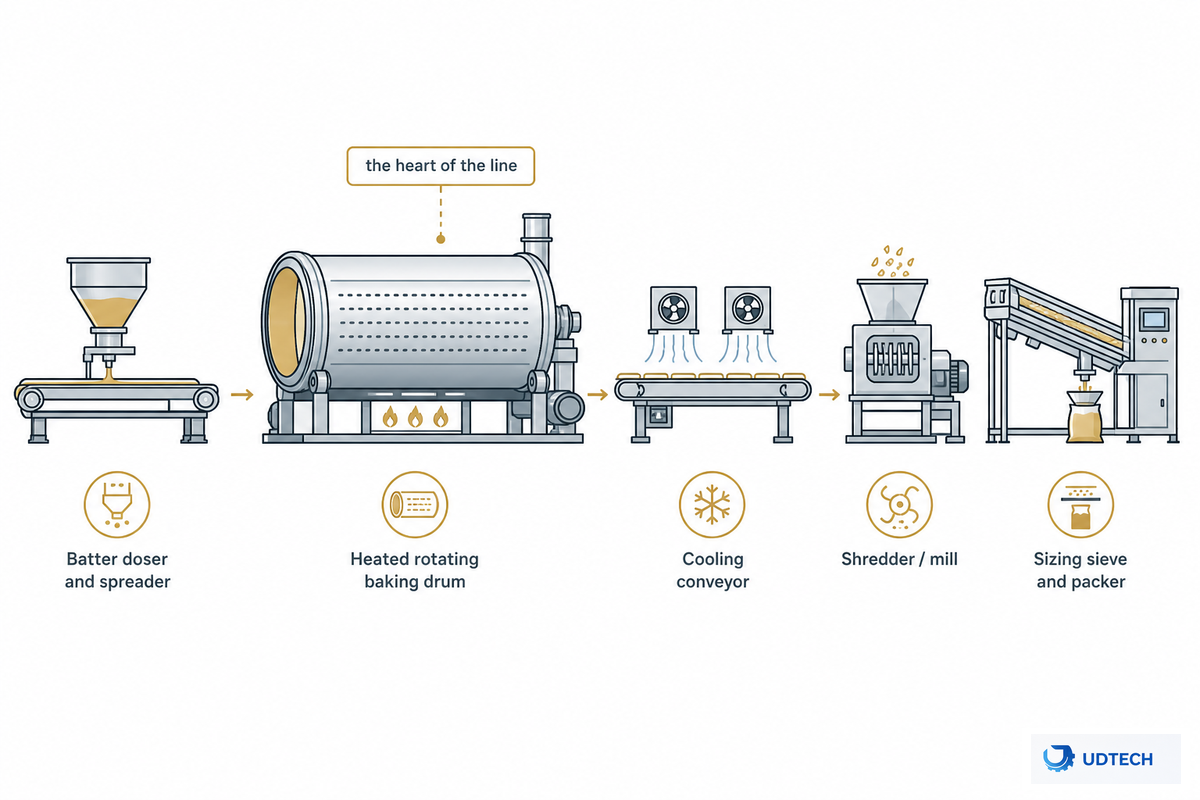
Strip out the conveyors and control and a feuilletine production line reduces to five machines that do the real work. Sizing any line starts with matching these five to your target output and flake grade — with the drum, whose heat and mass transfer drives off the moisture, as the one to get right.
- batter doser / spreader – meters a controlled film onto the drum. It sets strip width and thickness, which drive both output and crisp consistency.
- Heated rotating baking drum – the heart of the line. Cast-iron or stainless, gas- or electric-heated, with close temperature control so every part of the strip bakes to the same low moisture.
- Cooling conveyor – gives the strip time and dry air to reach the Crisp-Lock Point before anything touches it.
- Shredder / mill – breaks the brittle sheet into flakes. Screen and rotor choice sets the grade, from fine “sand” to coarse shards.
- Sizing sieve + moisture-barrier packer – grades the flakes and seals them against humidity so they arrive crisp.
Drum surface and coating matter as much as temperature. A well-conditioned, cleanly-scraped drum releases the strip in one piece; build-up forces a steeper scraper angle that tears the sheet and create dust instead of flakes. Cast iron holds heat evenly; food-grade stainless is easier to clean and to document for compliance and hygiene. A typical strip runs 0.2-0.5mm thick at line speeds of 3-8m/min, and is cooled to below 30C before shredding, targeting a finished moisture near 2-3%.
Feuilletine Line Specs: Drum Size, Capacity, Heating & Power
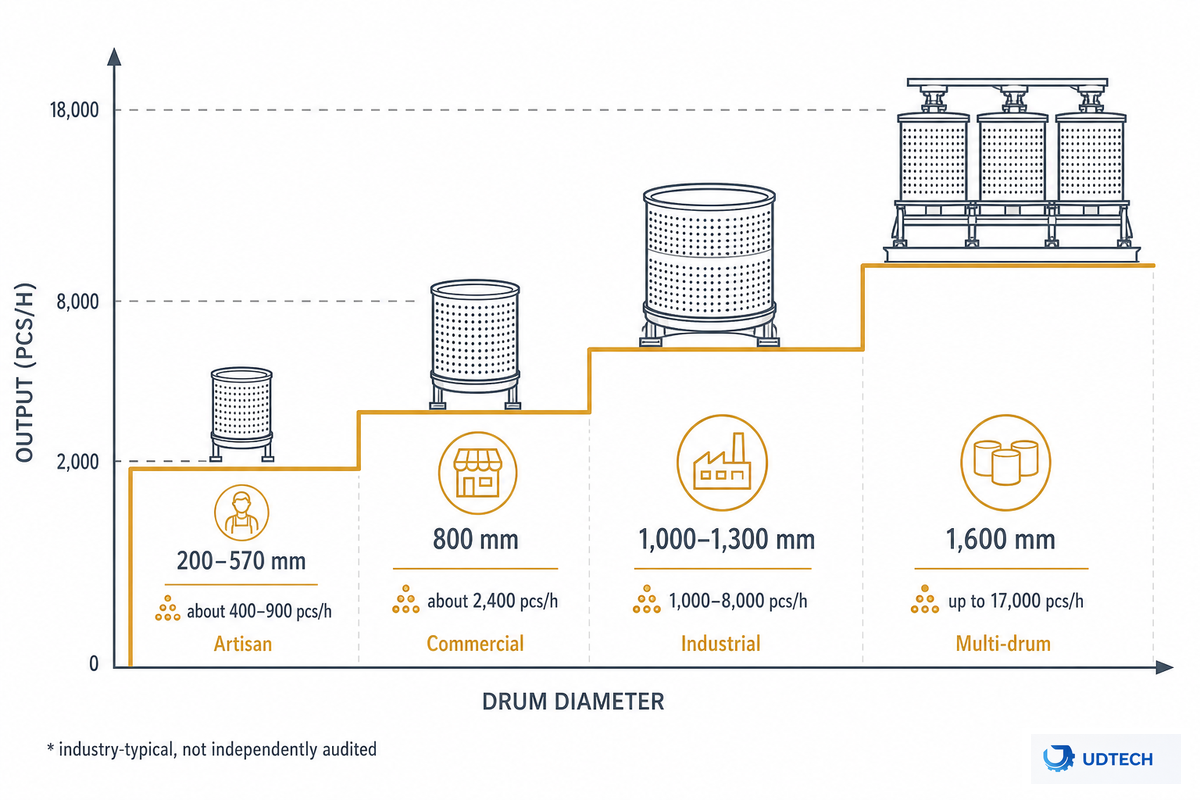
Feuilletine and crêpe-dentelle lines are built around the drum, an established drum-drying unit operation. Published capacities vary widely with drum size, number of strips, and piece weight – and they come almost entirely from equipment vendors, so treat them as industry-typical, not independently audited figures for sizing conversations, not guarantees.
| Scale | Drum Ø | Output (pieces/h) | Heating | Typical buyer |
|---|---|---|---|---|
| Artisan | ≈ 200–570 mm | ~400–900 | Electric | Pâtisserie, R&D |
| Commercial | ≈ 800 mm | ~2,400 (≈ 28 kg/h @ 12 g) | Gas / electric | Central kitchen, co-packer |
| Industrial | ≈ 1,000–1,300 mm | ~1,000–8,000 | Gas | Confectionery factory |
| Large multi-drum | ≈ 1,600 mm | up to ~17,000 | Gas | Ingredient manufacturer |
Q: How much does a feuilletine production line produce per hour?
Output depends on drum width and line speed more than on any single “capacity” number: a 900 mm drum running one 0.45 m strip is a very different machine from a 1,600 mm twin-strip line, even if both are sold as “high capacity”. Rather than trust a headline figure, size the line from geometry using the Drum-Width Output Equation:
Baked-strip output (kg/h) = strip width (m) × line speed (m/min) × 60 × baked areal density (kg/m²). Flake output ≈ baked-strip output × crush yield.
Worked example: a 0.45 m-wide strip at 5 m/min, baked to ≈ 0.10 kg/m², gives 0.45 × 5 × 60 × 0.10 = 13.5 kg/h of baked strip. At a ~92% crush yield that’s ≈ 12.4 kg/h of finished feuilletine. Double the drum to two strips and you roughly double the figure. Plug in your own width, speed and film weight to size a line before you ever ask a vendor for a quote.
Feuilletine Formulation: Ingredients, Gluten-Free & Flavor Variants
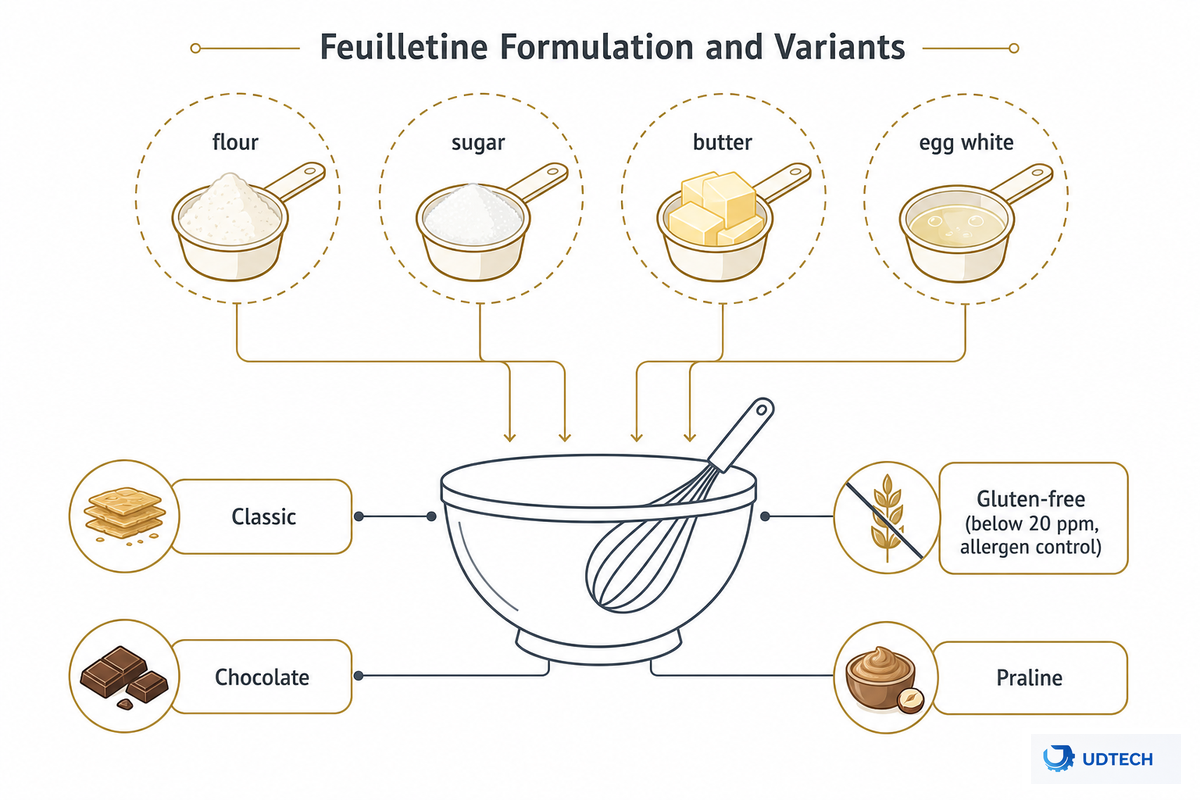
Classic feuilletine is a short list: flour, sugar, butter, egg white and a little milk, in roughly equal parts by weight for the flour, sugar, butter and egg white. Its high butter and sugar content is what gives the baked sheet its lacy, caramelised, brittle structure – the same structure that lets it stay crisp inside a moist dessert — a stability that hinges on finished water activity.
The variant that trips producers up is gluten-free. A frequent mistake is treating it as a simple flour swap: a U.S. “gluten-free” claim means the finished flakes must test below 20 ppm gluten, so the real risk is not the recipe but cross-contact. Picture a plant running wheat crêpe dentelle in the morning and a gluten-free batch after lunch on the same drum — without a validated cleaning changeover or a dedicated line, one wheat-dust carryover can fail a lab test and pull the batch. Plan gluten-free as an allergen-control task with documented cleaning, not a label claim added late.
| Variant | Recipe change | Line / control impact |
|---|---|---|
| Classic | Wheat flour base | Baseline drum and shred settings |
| Gluten-free | Rice / functional starch blend | Allergen control (see below); tweak spread and dwell |
| Chocolate | Cocoa added to batter or flakes coated | Coating adds a step; watch fat migration |
| Praline / hazelnut | Flakes folded into nut paste | Post-line blending, not a bake change |
Q: Is feuilletine gluten-free?
Classic feuilletine isn’t gluten-free — it’s wheat-based. Making it gluten-free is more than a flour swap: a U.S. “gluten-free” claim means the finished flakes must test below 20 ppm gluten, so cross-contact matters. Running wheat crêpe dentelle and a gluten-free batch on one line needs a dedicated line or a validated cleaning changeover. Treat gluten-free as an allergen-control and validation task, planned into the line, rather than a marketing label.
Where Feuilletine Is Used: Praline Layers, Entremets & Coatings
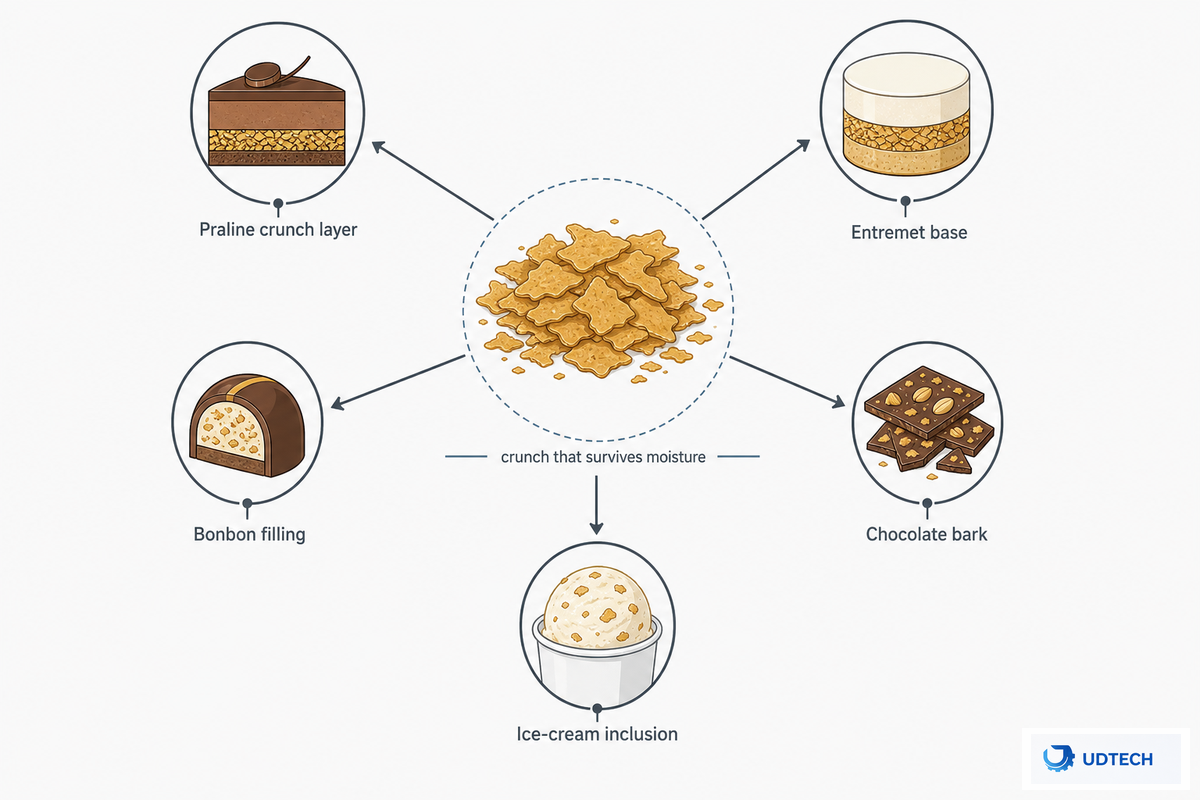
Feuilletine earns its place because of one job: the feuilletine crunch survives contact with cream, ganache and chocolate, resisting the moisture-driven softening that defeats other inclusions. That is why chefs reach for it in praline layers, entremet bases, bonbon fillings, chocolate bark and ice cream — anywhere a crisp texture has to survive contact with something moist.
“These crisp, thin wafer flakes hold their snap inside ganache, bark, and bonbon fillings, where most crispy inclusions go soft.”
Cacao Barry, on pailleté feuilletine
| Application | Typical use | Format |
|---|---|---|
| Praline crunch layer (croustillant) | Folded into praline / hazelnut paste | Cake / entremet insert |
| Cake / entremet base | Bound with melted chocolate | Crisp bottom layer |
| Bonbon / bar filling | Mixed into gianduja | Textured centre |
| Chocolate bark | Scattered on tempered chocolate | Surface crunch |
| Ice-cream inclusion | Folded in or as a coating | Frozen crunch |
Feuilletine Substitutes & When to Make It In-House
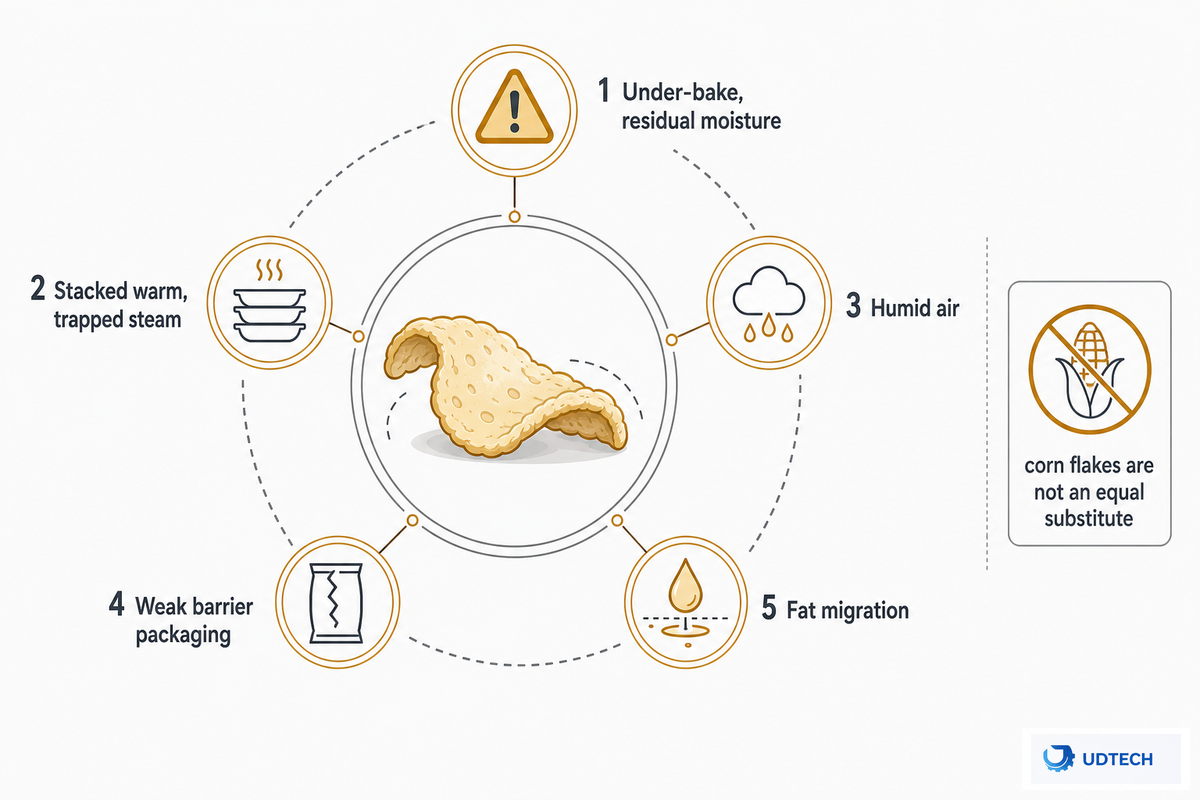
The most common shortcut – and the most common disappointment – is treating crushed corn flakes as a drop-in feuilletine substitute. It’s a reasonable stand-in for a home cook, but for a manufacturer it usually falls short: corn flakes are thicker, aren’t caramelised into a lacy sheet, and pick up moisture faster, so they soften first in exactly the high-moisture matrices where feuilletine is prized. Water uptake driving loss of crispness in cereal-type products is well documented; feuilletine’s thin, low-moisture structure is precisely what resists it.
These are the 5 Crisp-Killers – the recurring reasons feuilletine (or a substitute) turns soft. The table extends them into a line-side troubleshooting guide.
| Crisp-killer type | Root cause | Line stage | Fix |
|---|---|---|---|
| 1. Residual moisture | Under-baked strip | Bake | Raise dwell / drum temp to hit the Crisp-Lock range |
| 2. Steam trap | Stacked while warm | Cool | Full cooling before any contact; no warm bins |
| 3. Humid air | High room humidity | Cool / pack | Condition the room; dehumidify the pack area |
| 4. Weak barrier | Poor moisture-barrier film | Pack | High-barrier film; seal integrity checks |
| 5. Fat migration | Praline/chocolate oil creeps in | Post-line use | Coat flakes or add near assembly |
| 6. No lacy structure | Fat/sugar ratio too low | Mix | Restore butter/sugar balance |
| 7. Toughened strip | Shredding delayed too long | Shred | Mill soon after cooling |
| 8. Wrong grade | Dust or oversized chips | Sieve | Match mesh to the application |
| 9. Wrong substitute | Corn flakes / thick wafer swap | Formulation | Use true feuilletine where crunch must survive |
- Under ~50 kg/month: buy bulk paillete feuilletine – a line won’t pay back.
- Steady, growing volume or a signature texture: an in-house line gives you recipe control, gluten-free options and fresher crunch.
- You already bake wafers, egg rolls or snacks: a drum-baking + shredding line reuses skills and floor you’ve.
How to Spec & Source a Feuilletine Production Line
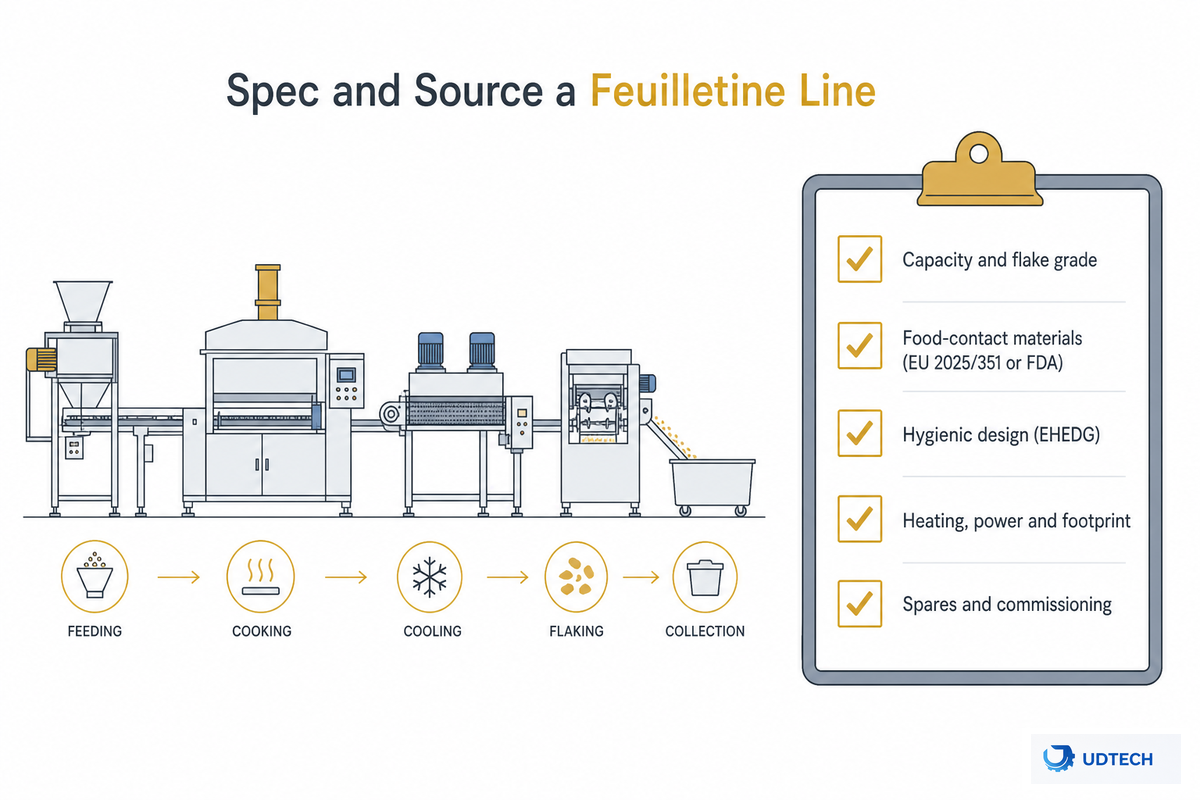
Because the focus keyword’s search results are dominated by vendor product pages, it’s easy to shop on throughput alone. Capacity matters, but a compliant, cleanable line matters more – a point the specs sheet rarely leads with. Use this checklist to spec a feuilletine production line before you compare quotes.
- Capacity and flake grade – kg/h at your piece weight, plus the mesh range you actually sell.
- Food-contact materials – drums, scrapers, belts and coatings must be documented food-contact grade, according to EU food-contact rules (updated 2025/351 in 2025) or FDA 21 CFR.
- Hygienic design & cleaning – seek hygienic design and cleanability according to EHEDG guidelines (bakery-equipment is directly relevant), especially with allergen changeovers.
- Heating and utilities – gas vs. electric, installed power and footprint on the floor.
- Spares, commissioning and training – lead time for drum and scraper wear parts, and who commissions the line.
feuilletine is a family member to thin-wafer and automatic egg-roll/wafer machines: batter is baked thin on a heated surface, then formed or shredded. A builder of food processing lines who already manufactures drum and plate baking, cooling and cutting can spec and build to your capacity a batter-baking-plus-shredding line for you – a turnkey solution equipped with the processing tools a professional operation require to produce quality, consistent products – much the same as it would build you a corn-flake or snack line.
Industry Outlook: Why Feuilletine Demand Is Rising
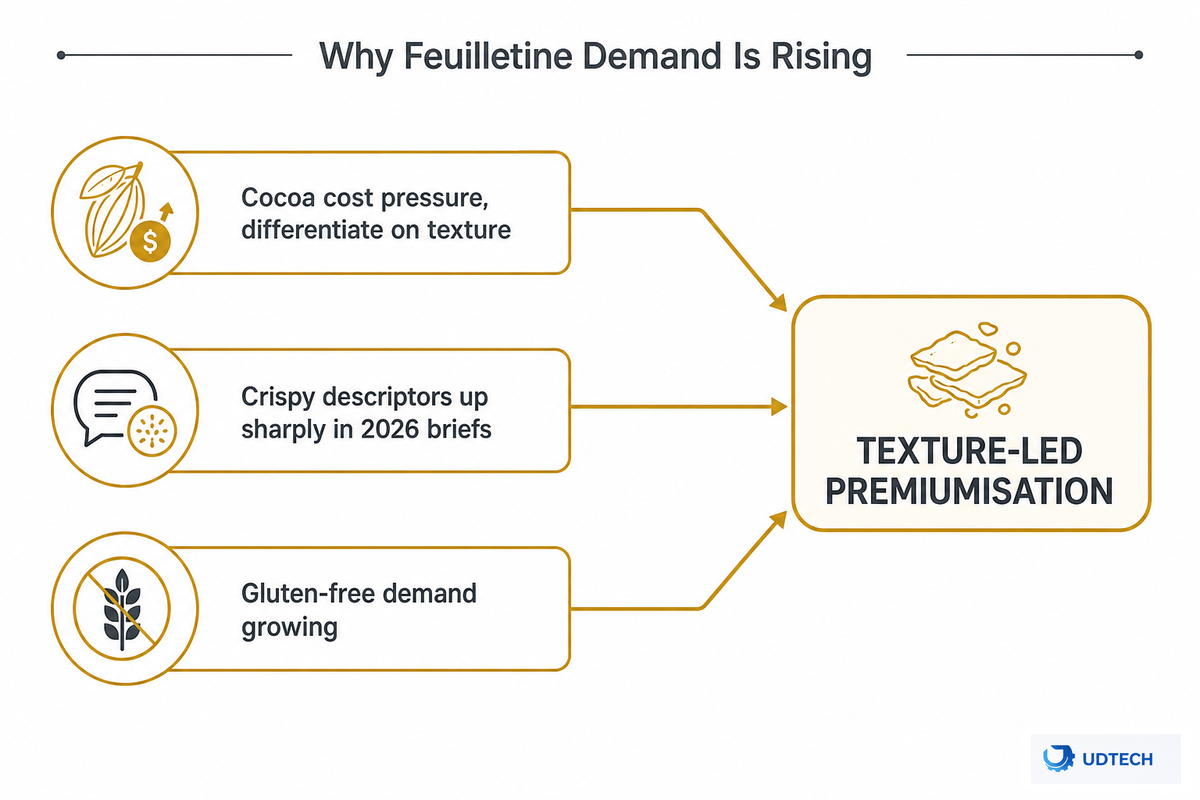
What is driving feuilletine interest is not a bigger dessert market — it is a shift in what buyers compete on. Picture a mid-size chocolatier watching cocoa prices climb: cutting chocolate content risks the brand, so the practical move is to differentiate on texture and premium format instead of price, and crunch does the heavy lifting. Bakery-ingredient makers report that mouthfeel now leads product briefs, with “crispy” descriptors up sharply year over year. Feuilletine answers that brief directly — a crunch that survives inside the creamy, high-moisture desserts at the centre of premiumisation.
Two nearer-term signals reinforce it. Gluten-free demand keeps climbing, pushing producers toward validated gluten-free crunch inclusions; and food-contact and hygienic-design rules tightened in 2025, so a line specified now should be built to the current standard from day one — retrofitting a non-compliant line a year later is the expensive mistake to avoid. Search interest tracks the same story: queries for feuilletine and feuilletine flakes have both risen over the past year. If texture-led premiumisation is your 2026 plan, securing a compliant, flexible feuilletine capability is a move to make before the next season, not after it. (Market-size figures here are directional background, not the basis for the recommendation.)
Feuilletine Production Line FAQ
Q: What is a feuilletine production line?
View Answer
Q: How is feuilletine made?
View Answer
Q: What is the difference between feuilletine and crêpe dentelle?
View Answer
Q: Is feuilletine gluten-free?
View Answer
Q: What can I use as a feuilletine substitute?
View Answer
Q: How much does a feuilletine production line produce and cost?
View Answer
Q: How long does feuilletine stay crisp?
View Answer
Related Articles
- Egg Roll Machine Guide, thin-wafer baking, savory vs wafer, home vs industrial
- Egg Roll Machine Capacity Planning, sizing a baking line to real output
- Phoenix Roll Machine Buying Guide, the bake-and-roll cycle
- Corn Flakes Production Line, the closest food-machinery neighbour
- Snack Food Extruder Machine, extruded crunch inclusions
Share your target kg/h, flake grade, and heating choice to get a layout, capacity estimate or quote from food processing and baking line builders.
About This Guide
This guide is written from the food-machinery-engineering point of view regarding drum-baked, shredded crêpe-flake lines. The underlying food-science process (drum drying, water activity, crispness) come from public food-science and regulatory documents; the capacity and drum numbers are industry standard values reported by vendors and are for discussion and sizing purposes, not tested benchmarks. Verified by the Suzhou UDTECH Technology Co., Ltd. technical team.
References & Sources
- Water Activity (aw) in FoodsU.S. Food and Drug Administration
- Performance Evaluation of a Double Drum Dryer for Potato FlakeU.S. National Institutes of Health (PMC)
- Cereal and Confectionary Packaging: crispness and moistureU.S. National Institutes of Health (PMC)
- Moisture and Shelf Life in Sugar ConfectionsTexas A&M University (Talcott Lab)
- Food Contact Materials Legislation (incl. Regulation (EU) 2025/351)European Commission
- Hygienic Design Guidelines (incl. bakery equipment)European Hygienic Engineering & Design Group (EHEDG)