Private label egg roll snack manufacturing refers to producing frozen egg roll snacks under a retailer’s or brand owner’s name rather than the maker’s own.
Quick Specs: Private Label vs. OEM vs. Co-Packing
| Private label | Product made under a retailer’s or brand owner’s name, not the manufacturer’s own label |
| OEM | Manufacturer builds the product to the buyer’s specification (formula, packaging) |
| Co-packing | The service relationship — hiring an existing food company to produce and package the product |
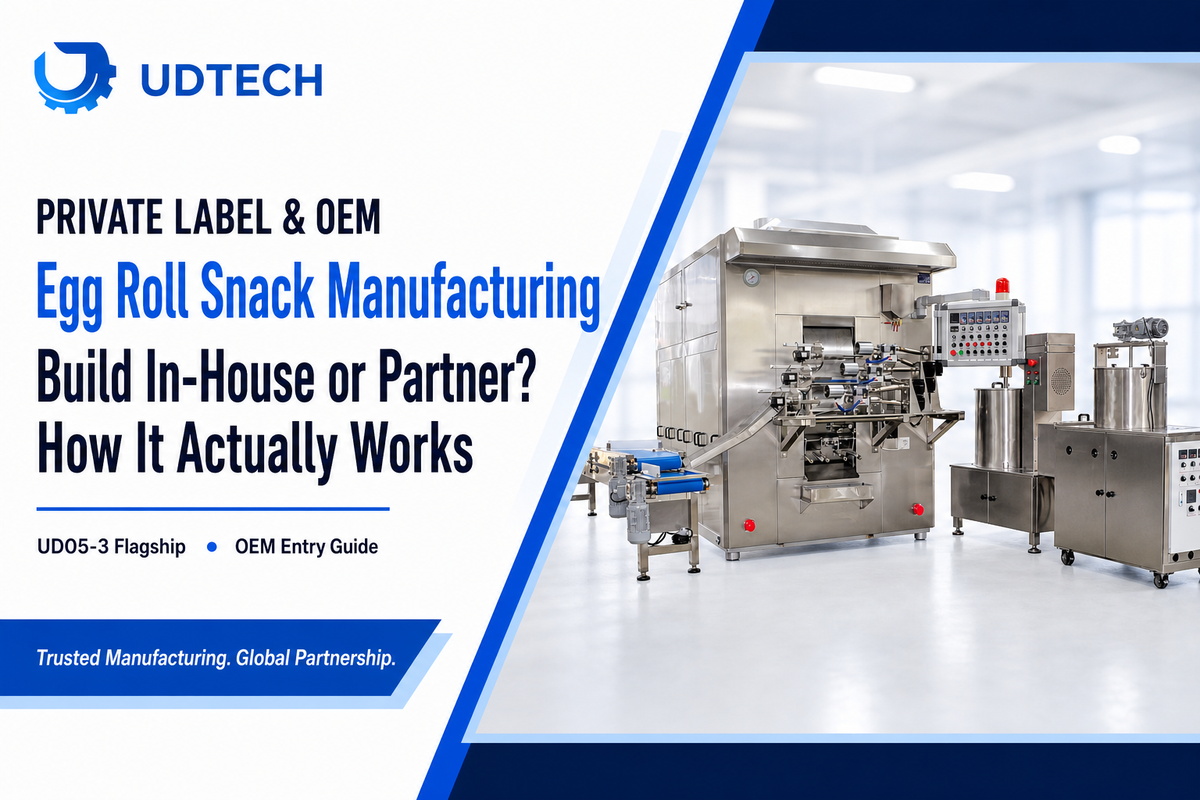
| UD05-2 capacity | 220 pcs/min, 600 kg per 8-hour shift (dual-line) |
| UD05-3 capacity | 330 pcs/min, 900 kg per 8-hour shift (three-line, flagship) |
| Equipment MOQ | 1 production line |
| Equipment lead time | 9-13 weeks (vs. 16-32 weeks for industry custom builds) |
| Bulk co-pack fee | Industry sources commonly cite the low-single-digit dollars per kilogram range — not independently verified, treat as directional |
Private label egg roll snack manufacturing sits at a decision point most guides skip: should a contract baker, foodservice supplier, caterer, or brand owner hire an outside co-packer, or build the production capability in-house?
Search results for this exact question are dominated by co-packer directories and marketplace listings – useful once you already know you want to outsource, but silent on what it actually takes to run the equipment side of this business. This guide covers both paths: how private label, OEM, and co-packing differ as commercial arrangements; what a real build-versus-outsource comparison looks like; the equipment, capacity, and certification requirements for running production in-house; and a decision framework for picking a route that matches your volume and control needs.
Private label egg roll snack manufacturing produces frozen egg roll snacks sold under a retailer’s name, not the maker’s own. Buyers reach that outcome by hiring a co-packer or running an in-house line like the UD05 series. Order volume, formulation control needs, and changeover speed determine which path fits.
- Search demand for “finding a co-packer” fell 18-32% year-over-year across most terms tracked, even as private-label retail share hit a record 23.8% by units in 2026 – buyers appear to be sourcing capacity through existing relationships, not search engines.
- Three realistic entry routes exist – pure co-pack, a hybrid line, or a full in-house build – and MOQ, capital, and margin capture diverge sharply between them.
- Facility-level food-safety certifications (SQF, USDA/FDA registration) and equipment-level certifications (CE, FDA 21 CFR 175.300, ISO 9001) answer different questions – checking only one leaves a real compliance gap.
- Bulk co-pack fees are commonly quoted in the low-single-digit dollars per kilogram range, but that figure has no independently published methodology – treat quoted ranges as directional.
- Adjustable roll length (7-14 cm) and wrapper thickness (0.8-1.4 mm) on equipment like the UD05 series determine how fast a line switches between SKUs without a full changeover.
What “Private Label,” “OEM,” and “Co-Packing” Actually Mean in Egg Roll Manufacturing
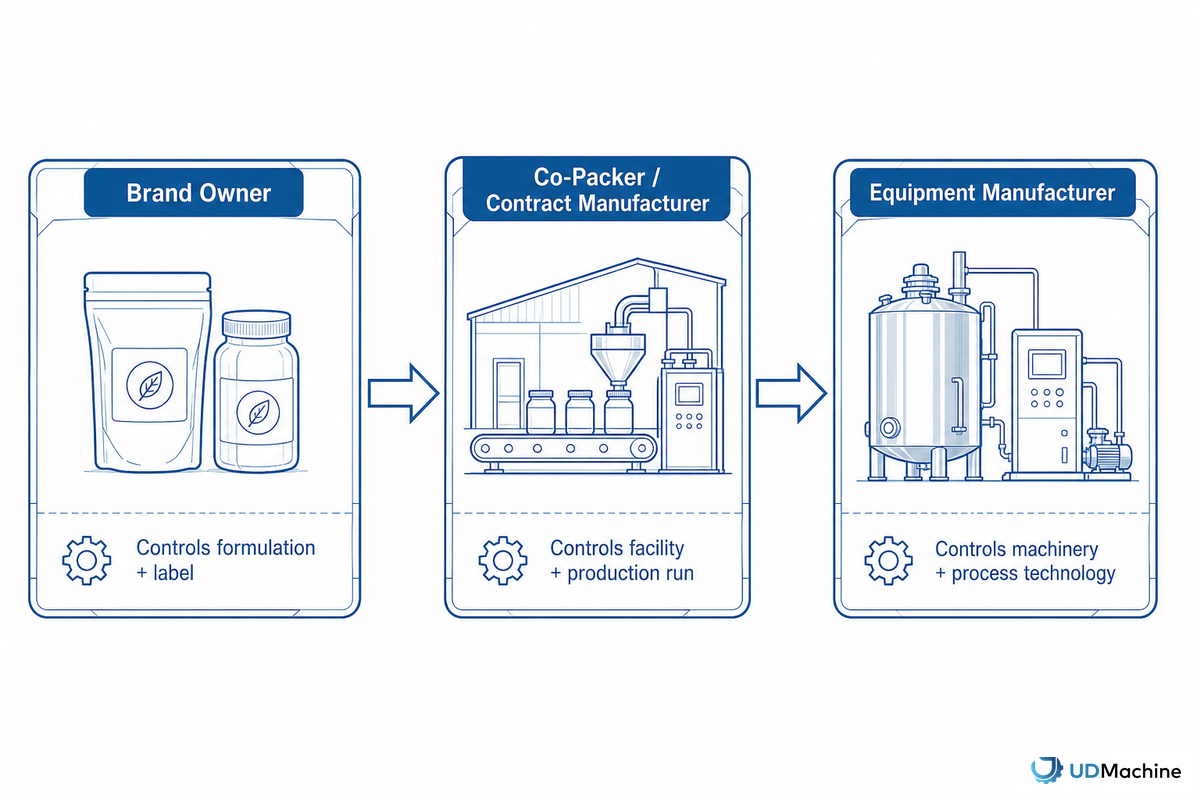
Private label egg roll manufacturing means a facility produce frozen egg roll snacks that ship under a retailer’s or brand owner’s name, not the maker’s own.
OEM (original equipment/formula manufacturing) gets used almost interchangeably in this category, though it more precisely describes the arrangement where the manufacturer builds the product to the buyer’s exact specification. Co-packing is the service relationship itself – hiring an existing food company to produce and package a product someone else designed.
Frozen egg rolls occupy their own special niche in the frozen food aisle – generally stored as a frozen appetizer along side spring rolls and other hand-held snacks, as part of the broader snack food category alongside other frozen food products – which helps explain why private label buyers in this category, whether grocery retailers or specialty food distributors, pay as much attention to a crispy wrapper texture and fry/bake performance as they do to flavor. A frozen egg roll that blisters unevenly or leaks filling when reheated will fail a retail quality audit, regardless of how well the recipe tastes.
These three terms are thrown around casually across the industry, but commercial lines can become meaningful when a contract is signed. A brand owner with a co-manufacturer is still obligated to conduct supply chain verification according to Part 117 Subpart G-that is, ensuring the co-packer controls the hazards associated with that food product-even if their name never touches the factory floor. Many state and university food safety extension programs can explain this framework in clearer terms, and a food facility’s registration status with the FDA-regardless of the brand owner of record for that food product-determines its compliance obligations under Part 117, both North Carolina State University Extension and the Texas Department of State Health Services attest.
“A co-packer, or co-manufacturer, is an established food company that processes and packages your product… You are out of the kitchen… However, costs are higher and there are a limited number of co-packers.”
Luke LaBorde, Ph.D., Penn State Extension food science
For an illustration of how those lines can play out on a commercial level: The established food manufacturing company Schwan’s, in 2017, divided its business into a specialized private label operation and a separate co-packing operation-treating “produce it under a retailer’s brand” and “package somebody else’s finished product” as two distinct private label services with different margin profiles, even within a single firm. Regarding costs, buyers sourcing bulk co-pack production will typically be presented with ranges from low-single-digit dollars per kilogram for egg roll and similar frozen appetizer production, which comes from aggregated marketplace data without a stated methodology, and therefore should be taken as indicative rather than concrete.
Key takeaway: while Private label, OEM, and Co-packing refer to overlapping relationships, they differ legally, and the Supply Chain Verification responsibility under Part 117 Subpart G applies to the Brand Owner regardless of which term is used.
Build In-House or Outsource to a Co-Packer?
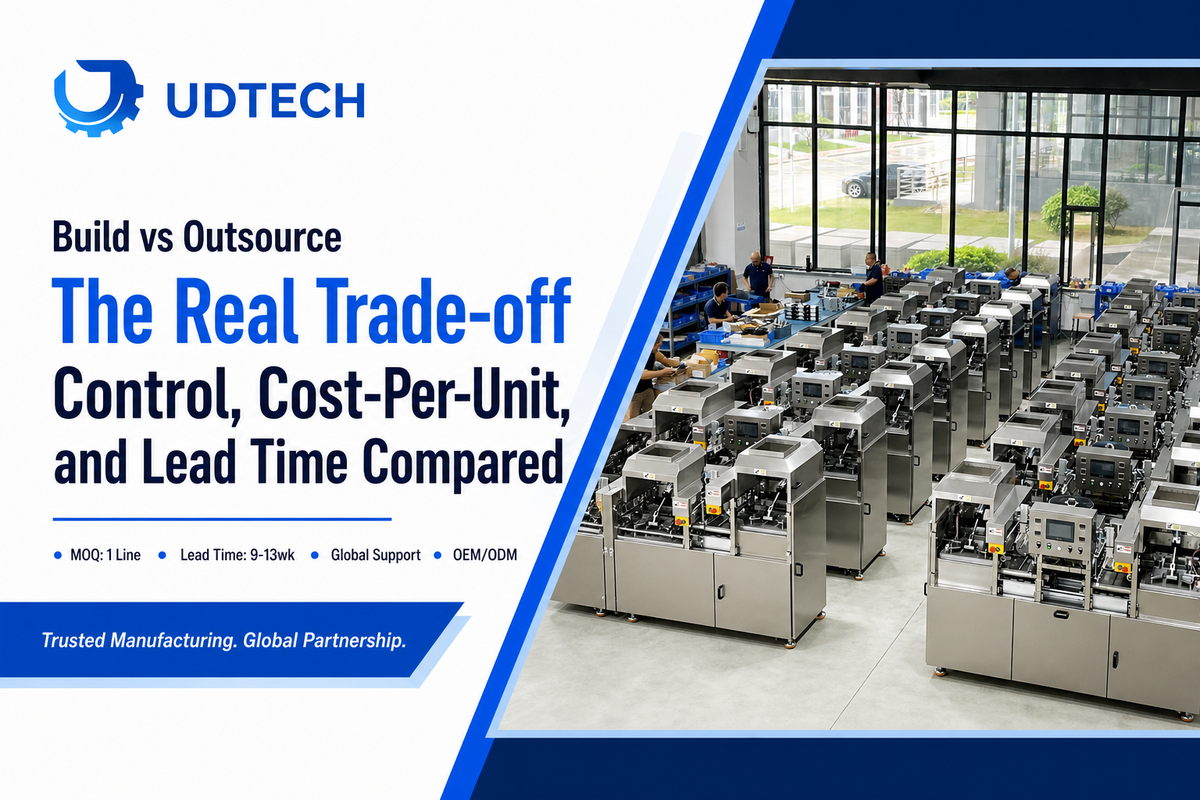
Contracting with a co-packer isn’t inherently the cheaper or quicker option; it’s an exchange of initial investment for per-unit costs, ownership of a formulation for speed to market, and complete control of a process for access to production capacity. Which side wins depends on volume, desired SKU variation, and the longevity of the relationship.
For this decision, the vast majority of sourcing platforms push one side of the story: directories for co-packers and listings for marketplaces portray outsourcing as the status quo and rarely mention the alternative of building out your own line at all. The primary research you’ll likely encounter as you’re looking to identify egg roll manufacturing providers will be these kinds of directories. There’s definitely established capacity across the food industry, with vendors that specialize in manufacturing egg roll and appetizer SKUs for consumer brands; real food manufacturers working in this space as contract manufacturers include Pegasus Food Group, Amy Food Inc., and The Fillo Factory, along with numerous others listed on directories that claim to rank the best egg roll manufacturers by capacity and certification. What they’ll likely omit is the cost of not owning the line.
| Factor | Build In-House (e.g., UD05 line) | Outsource to a Co-Packer |
|---|---|---|
| MOQ | 1 production line; no per-SKU order minimum once installed | Commonly reported 10,000-25,000 units per SKU (industry-cited range, not independently verified) |
| Formulation control | Full control — recipe, packaging, and process stay in-house | Shared with the co-packer; IP terms must be negotiated (see H2-6) |
| Upfront capital | Equipment cost + 9-13 week lead time + installation | Little to no equipment capital; pay per unit produced |
| Lead time to first run | 9-13 weeks equipment lead time + 5-7 days install + 2-3 days training | Can be faster with open co-packer capacity; slower if queued behind existing clients |
| Margin captured per unit | Producer keeps the full private-label margin premium | Co-packer’s fee is subtracted from that margin before it reaches the brand |
- Full formulation and packaging control
- No per-unit co-packer fee once running
- Quick changeovers on flexible equipment (0.8-1.4 mm thickness, 7-14 cm roll length)
- Captures the full private-label margin premium
- Requires equipment lead time (9-13 weeks) before first production
- Buyer now needs their own facility-level food-safety certification (SQF/USDA/FDA)
- Upfront capital commitment vs. a co-packer’s pay-per-unit model
- Idle capacity risk if demand doesn’t materialize as expected
Cost isn’t always cheaper for outsourcing, new data shows. In Deloitte’s 2024 Global Outsourcing Survey, cost reduction as the leading driver for outsourcing dropped from approximately 70% around 2020 to just 34% in 2024, and 70% of companies reported bringing a portion of their previously outsourced scope in-house over the previous five years, even when satisfied with the relationship overall. A UC Berkeley IRLE working paper focused on outsourced food service (related, but not the same as food manufacturing) found no clear evidence of reduced costs and highlighted an instance in which the state of New York recovered $20 million in rebates from a food service outsourcer in 2010. An earlier survey of 115 food and beverage manufacturers indicated that 25% of companies who had outsourced production cited “higher-than-expected costs” as their top complaint; that said, the survey data is from around 15 years ago and should be viewed as historical context, not current best practice.
One founder exploring a potential alt-protein snack product explained in due diligence that white-labeling through a co-packer generally meant a very thin margin once their fee was taken from the selling price, and that it realistically took three to nine months from initial sampling to full production – rather than the few weeks first budgeted for.
If you currently have order volumes below the minimum of a co-packer and are expecting to operate one to two SKUs for the next year, then outsourcing is typically the faster path to market. If you’re already rejecting orders from your current co-packer or are planning to run three or more formulations over a day, the economics increasingly shift toward a full or partial in-house production model. (See decision framework in H2-7.)
Equipment and Capacity Requirements for In-House Private-Label Production
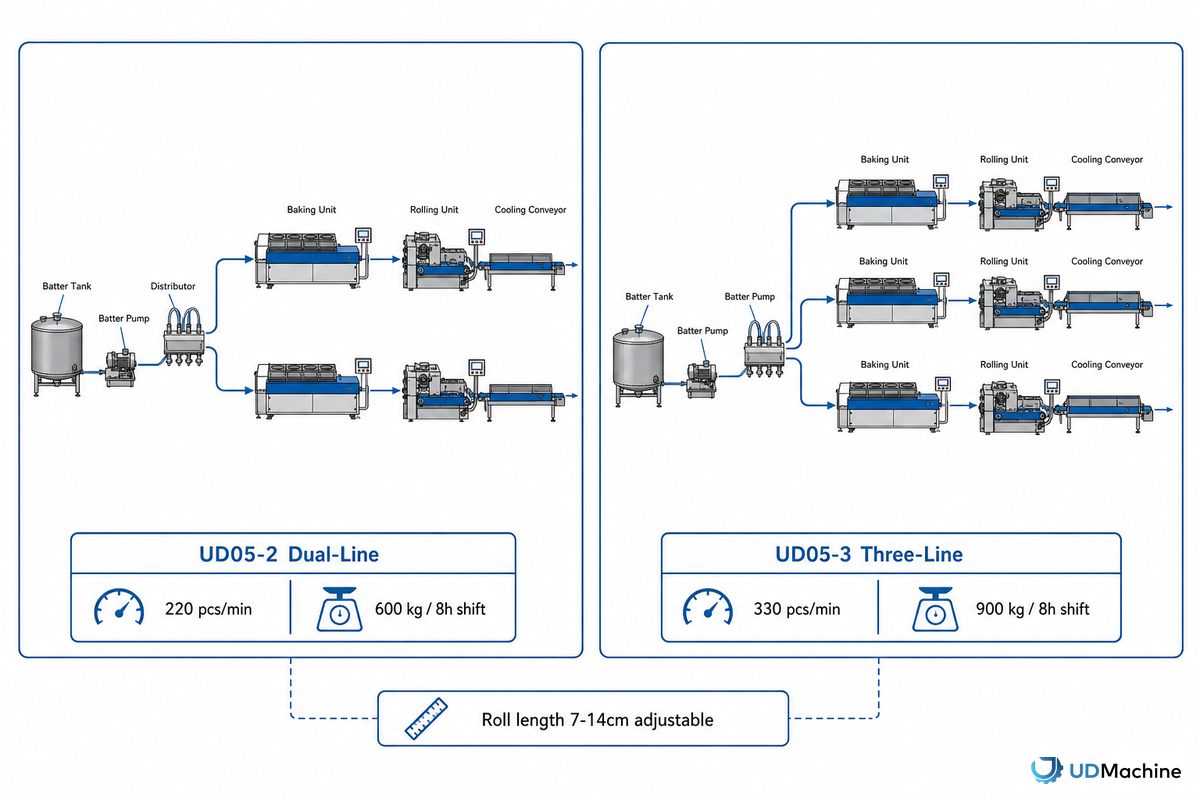
To make private label egg rolls on your own equipment, the equipment needs to be sized not for the highest throughput you can achieve, but to meet the capacity demand for your specific SKUs at your desired daily output. Our UD05 line – described in full on our automatic egg roll machine page – has been designed with that calculation at the center of two configurations: the dual-line UD05-2 and the triple-line UD05-3. Buyers comparing options in this category will find everything from small workshops to state-of-the-art facilities running dedicated production facilities built solely for private-label runs, and the equipment on the floor is usually what separates the two.
| Parameter | UD05-2 | UD05-3 |
|---|---|---|
| Configuration | Dual-line | Three-line (flagship) |
| Output capacity | 220 pcs/min | 330 pcs/min |
| Daily output (8-hour shift) | 600 kg | 900 kg |
| Power draw | 9.7 kW | 12 kW |
| LPG consumption | 6 kg/h | 8 kg/h |
| Natural gas consumption | 8 m³/h | 10 m³/h |
| Equipment weight | 4,300 kg | 4,500 kg |
| Footprint | 15.5 m² (4.2 x 3.7 m) — both models | |
| Wrapper thickness range | 0.8-1.4 mm, adjustable — both models | |
| Roll length range | 7-14 cm, adjustable — both models | |
| Pan temperature uniformity | ±2-3°C — both models | |
| MOQ / lead time | 1 line / 9-13 weeks — both models | |
| Installation / training | 5-7 days on-site / 2-3 days — both models | |
| Warranty | 12 months on main components + lifetime remote support | |
| Electrical | 380V/50Hz standard, 220V/60Hz optional | |
The UD05’s adjustable roll length and wrapper thickness aren’t merely sales claims; they’re indicative of active mechanical engineering efforts within the equipment class. Recent patent applications reveal a focus among various manufacturers on solving the problem of running a single machine line with multiple product formats, without a full changeover. For instance, one 2024 utility patent (CN221749493U) features a wrapper thickness control along with a synchronizing, multi-blade slitter that transforms a single sheet of dough into three narrow strips.
The same year, patent CN223515609U was filed for a nine-mold rotating turret where each mold can be individually adjusted, enabling a single machine to create various roll lengths without hardware adjustments. Filed in 2025, TWI908099B describes a linked, multi-station indexing system that produces several rolls concurrently during each cycle. While these patents don’t specifically refer to the UD05 line, they clearly indicate that the ability to adapt to different formats-an attribute essential for private label producers needing to run multiple SKUs on one machine-is a real and developing area in equipment design.
A contract baker operating a single-format line who gains a new private label client with a different roll-length specification faces a significant decision: decline the work or shut down the line for a mechanical changeover that might take a full shift or longer. A line that allows for both roll-length and wrapper thickness to be set at the forming station turn this same new account into a quick changeover, taking only minutes.
For businesses still evaluating the economics of automation at their current volumes, check out our guides on how to start an egg roll production line, the pros and cons of automatic versus manual egg roll machines, how to compare continuous versus batch production, and the facilities and electrical requirements to integrate a line.
Key takeaway: while the UD05-2 and UD05-3 vary in terms of output (220 vs. 330 pieces per minute) and gas usage, they both feature the same versatile roll length and wrapper thickness ranges, making multi-SKU private label production on a single line a reality.
Cost Structure and Margins in Private-Label Egg Roll Manufacturing
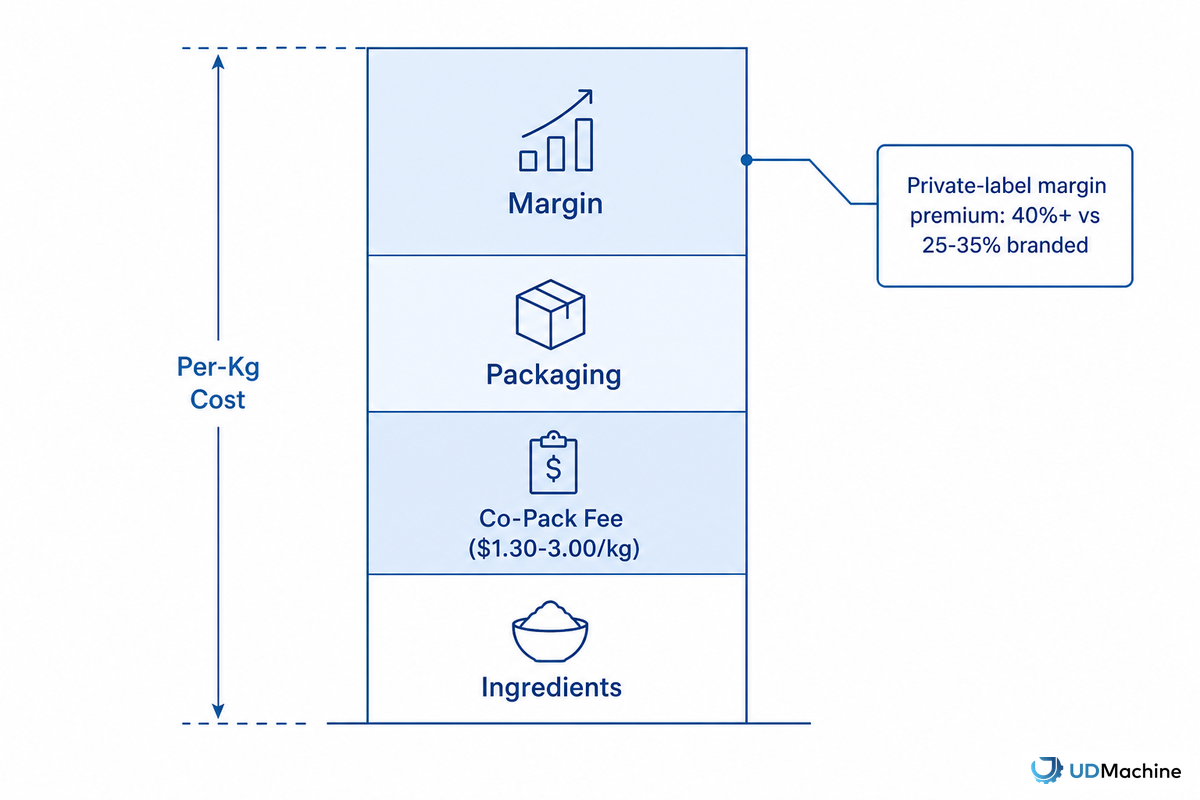
Private label egg roll costs involve two factors that many people conflate: how much a co-packer will charge per kilogram to make a frozen egg roll appetizer, and the margin captured by the brand or retailer once the product is on the shelf.
Industry figures for co-packing are generally in the low-single-digit dollars per kilogram for frozen egg rolls, though these are without an independently published methodology and should be considered only rough estimates.
Why Per Unit Costs Decline as the Size of the Batch Increases Even without a confirmed headline number, there’s a straightforward explanation why per-unit costs decline with the batch size: A co-packer’s setup and changeover costs for a given run are to a large degree fixed whether the run is large or small, so by distributing those fixed costs over a larger number of units, you decrease the portion of fixed costs for each unit. Smaller runs in the low thousands carry a far greater fixed cost per unit than would the same setup costs distributed over 10,000+ units – which is why pilot runs and trial runs of fewer than a co-packer’s minimum normally command a higher price per unit.
The driver for building vs outsourcing, however, lies not on the co-pack fee, but rather the spread between brand owners and retailers, who earn margin. UDTECH’s own look at the private-label snacks (the focus of our detailed market trends report for egg roll snacks) saw common margins of 40%+, relative to 25-35% in national brands. (We don’t duplicate the UDTECH calculation here.) This spread, and the ability to control production line, represents why H2-2 “build” is relevant not only to operations, but to bottom line.
How big is the total market?
You can use this as an indicator of how much capacity is at play. The global food contract manufacturing market size was estimated to be USD 404.47 billion in 2025, and it is expected to reach USD 692.35 billion by 2034, registering a compound annual growth rate (CAGR) of 6.22%. Remember, this is total market size, not cost per unit, and not a justification for a particular co-pack cost figure.
Those buyers who want to decide whether the private label margin premium warrants in-house production will also be interested in our breakdown of automation payback economics.
Request setup fees and per unit production costs separately, instead of asking for a blended price quote from a co-packer. This ensures that when you request a trial batch run, you aren’t just overpaying for what amounts to a small portion of the cost to set up equipment for a production run.
Food-Safety Certifications and Compliance Buyers Actually Check
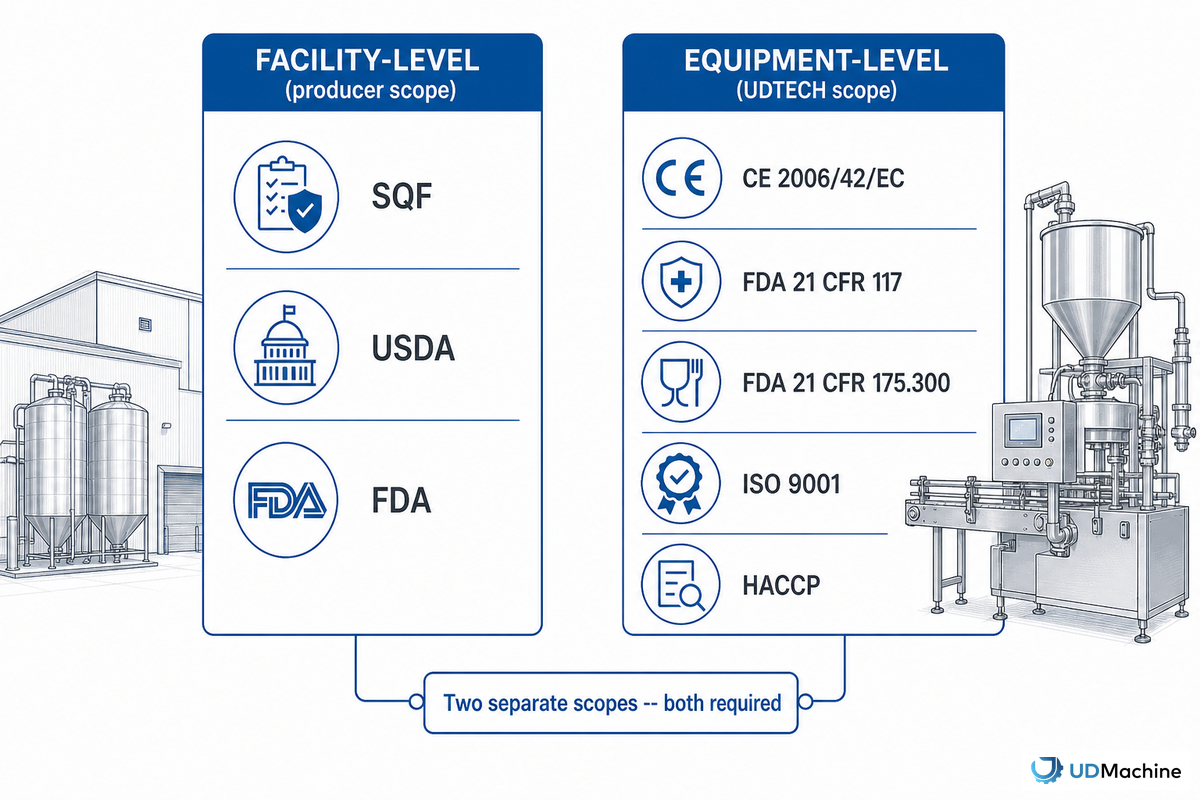
Food safety at facility level versus food safety at equipment level tell different food safety stories. Private-label food-buyers who look only at the former or only at the latter, will be missing real risks of food safety non-compliance against prevailing standards. Facility certifications (SQF, USDA/FDA registration) speak to a facility’s control of hazards under a documented overall food safety plan – an SQF certified facility is certified against food safety and quality standards on a facility-wide level. Equipment certifications (CE, FDA 21 CFR 175.300, ISO 9001) speak to a piece of equipment that touches food – you may have an SQF certified facility that has food forming equipment in it that isn’t carrying food contact material certifications a food-safety auditor would look for.
| Certification | Scope | Applies to |
|---|---|---|
| SQF Edition 9 (current) | Facility food-safety management system | Producing plant |
| USDA / FDA facility registration | Facility regulatory registration | Producing plant |
| 21 CFR 117 Subpart B/C | Facility GMP + hazard analysis | Producing plant |
| 21 CFR 117 Subpart G | Brand owner’s supply-chain verification of the co-packer | Contractual relationship |
| CE 2006/42/EC | Equipment machinery safety (transitioning to EU 2023/1230, effective 2027-01-20) | Individual machine |
| FDA 21 CFR 175.300 | Food-contact material (GRAS stainless, >16% chromium) | Machine’s food-contact surfaces |
| ISO 9001 | Quality management system | Equipment manufacturer |
| GMP / HACCP (Codex-aligned) | Process hygiene / hazard control | Producing plant or equipment design standard |
UD05 line has been designed to be delivered with machinery-safety certification CE 2006/42/EC (with the replacement EU Machinery Regulation 2023/1230 becoming active Jan 20 2027), food-contact compliance FDA 21 CFR 117, GRAS-stainless certification on food-contact surfaces (FDA 21 CFR 175.300 – this requires >16% Chromium) and manufacturer’s own quality system certificate (ISO 9001). None of these replace the need for the manufacturing facility to have its own SQF, USDA, or FDA registration – the buyer using UD05 line still needs facility-level registration on their own account, since equipment-level and facility-level programs are both quality and safety systems that check different things.
Take the example of a private-label buyer auditing an prospective co-packer, where the facility has current facility-level credentials, an SQF Edition 9 certificate and a clean USDA registration. What’s absent is an understanding of what food-contact material(s) have been used on forming or molding equipment, as well as relevant machinery-safety documents for that equipment. A buyer that fail to go beyond the facility certification alone risks passing their own internal supplier audits while subsequently failing the audit of a customer for failing to have detailed, equipment-level food-contact information on file for that product’s manufacturing.
Two regulations may be important when launching a private-label production today: the USDA’s new Strengthening Organic Enforcement rule became effective on March 19, 2024 and, among other things, expands the definition of who “handles” an organic product. This pulls a number of previously uncovered private-label packers and repackers into the organic certification framework. Also, SQF Edition 9 is the currently active version of the GFSI-benchmarked standard; Edition 10 audits aren’t expected to begin until Jan 2027 (pending GFSI benchmarking and at least a six-month grace period), so a facility operating to Edition 9 is in good standing currently.
Certification type isn’t the whole compliance picture, either – the recipe itself decides which federal agency has jurisdiction over the label. Egg rolls built around meat, poultry, or processed egg-product fillings (pork, chicken, or egg-based versions) fall under USDA’s Food Safety and Inspection Service, while vegetable-only formulations stay under FDA oversight instead. That split carries real weight before a product ever ships: a Congressional Research Service report on meat, poultry, and egg product labeling confirms FSIS requires prior approval for meat, poultry, and egg product labels before these products may be marketed to consumers – a review step FDA-regulated foods simply don’t go through the same way. A buyer switching a co-packer’s chicken or pork egg roll SKU to a new vendor, or adding a vegetable line next to an existing meat formulation, isn’t just changing suppliers. They may be changing which agency’s label-approval process the product has to clear first.
Allergen Labeling and the Cost of Getting It Wrong
Formulation control carries allergen risk that goes well beyond a gluten-free wrapper claim. FDA recognizes nine major food allergens that must appear on the label: milk, eggs, fish, crustacean shellfish (crab, lobster, and shrimp among them), tree nuts, peanuts, wheat, soybeans, and – as of January 1, 2023 – sesame. Shrimp and other shellfish are a genuine cross-contamination risk on any line that also runs pork or vegetable egg rolls, and missing one isn’t a hypothetical problem. FSIS’s own recall record includes a 2016 case where a New York producer pulled roughly 1,710 pounds of egg roll product after boxes labeled “pork egg rolls” turned out to contain undeclared shrimp. Two problems stacked in that one product: an allergen the label never disclosed, and a filling that didn’t match what the box claimed it was. Either failure alone is enough to trigger a Class I recall.
Formulation Control, Packaging Customization, and Who Owns the Recipe
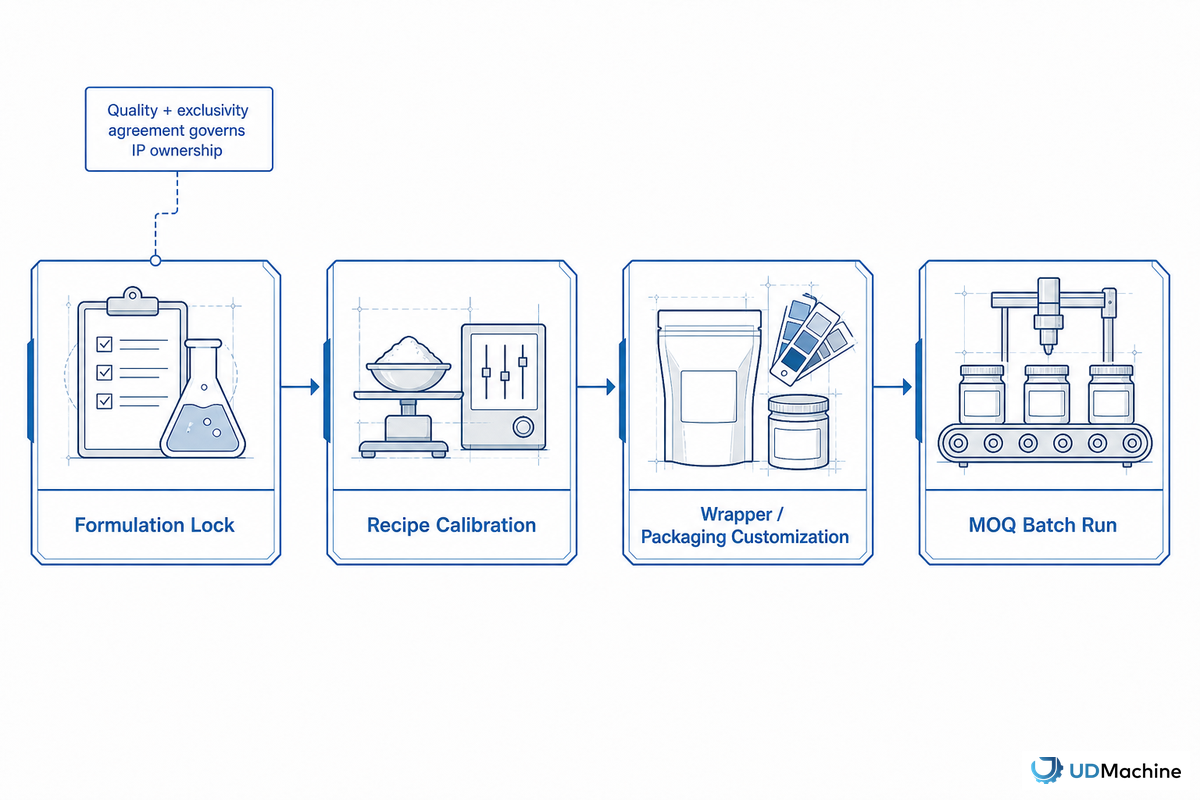
The decisions around private label egg roll manufacturing formula are threefold: the ingredient mixture that goes into the wrapper, the people permitted to adjust that mix, and who gets to own the finished formulation once it’s developed. When buyers switch from co-packer to an in-house line, they frequently find that none of these decisions were put into writing, leading to costs when a product proves successful and a competitor want to copy the recipe.
The ingredient mix for private label egg roll varieties typically spans savory chicken egg rolls, pork egg rolls, and vegetable egg rolls; dessert-style and gourmet egg roll varieties aimed at the premium frozen retail space; and sometimes specialty wrappers for dietary needs such as gluten-free and allergen-adjusted offerings. While seasoning blends are a quick and inexpensive tweak for flavor adjustments, recipe changes impacting wrapper texture typically become set when a production line is established, as wrapper texturing is closely linked to equipment setup and wrapper thickness rather than the specific spices used (see H2-3).
Do not rely on a verbal agreement concerning exclusive use of formulation. Include the exclusivity clause in the same document that specifies your minimum order quantities and prices, rather than treating it as a separate conversation.
Are MOQs for private label egg roll production flexible for new SKU launches?
New SKU Minimum Order Quantity. Most minimum order quantities from co-packers are far more negotiable than you may think. However, how negotiable that minimum is has much more to do with tooling and changeover costs, not just good intentions. Open capacity on a manufacturer’s side is often the deciding factor, especially for test runs.
While data is sparse for egg roll contract manufacturing specifically, discussions in adjacent contract-manufacturing categories put new-format tooling costs around $10,000-$50,000 per tool. For example, on a fully owned UD05-series line, a new egg roll size isn’t a tooling issue at all – different roll lengths (7-14 cm) and wrapper thickness (0.8-1.4 mm) are managed on the same machine – it’s a changeover (see H2-8).
Who owns the formulation IP in a private-label arrangement?
Formulation intellectual property (IP) ownership is generally a two-way street and is determined by the terms in the manufacturing agreement. Unsurprisingly, many brands that don’t codify ownership in writing often realize after the fact that their co-packer considers a collaboratively developed recipe as partially theirs.
We’ve heard of Food Safety professionals describing brand disputes wherein co-packers refuse to even reveal the location of their private-label facilities, to prevent potential partners from cutting them out entirely. Given how sensitive formulations and sourcing information becomes when a brand is successful, it’s essential to address and formalize IP ownership, exclusivity and co-development contribution in writing prior to the first production run.
“Securing a co-manufacturer is often a key challenge… your co-packer situation is going to evolve with your brand.”
Danny Stepper, co-founder, L.A. Libations
The majority of brands, for valid reasons, never get to the point of a fully owned manufacturing line. Based on Beverage sector data for contract manufacturing, it’s estimated only about 2% of private-label brands ultimately end up owning their production lines-reflecting the significant capital investment and product formula certainty required for such an undertaking (see H2-7 for an analysis of when this strategy make sense).
Getting Started: A Decision Framework for Choosing Your Production Path
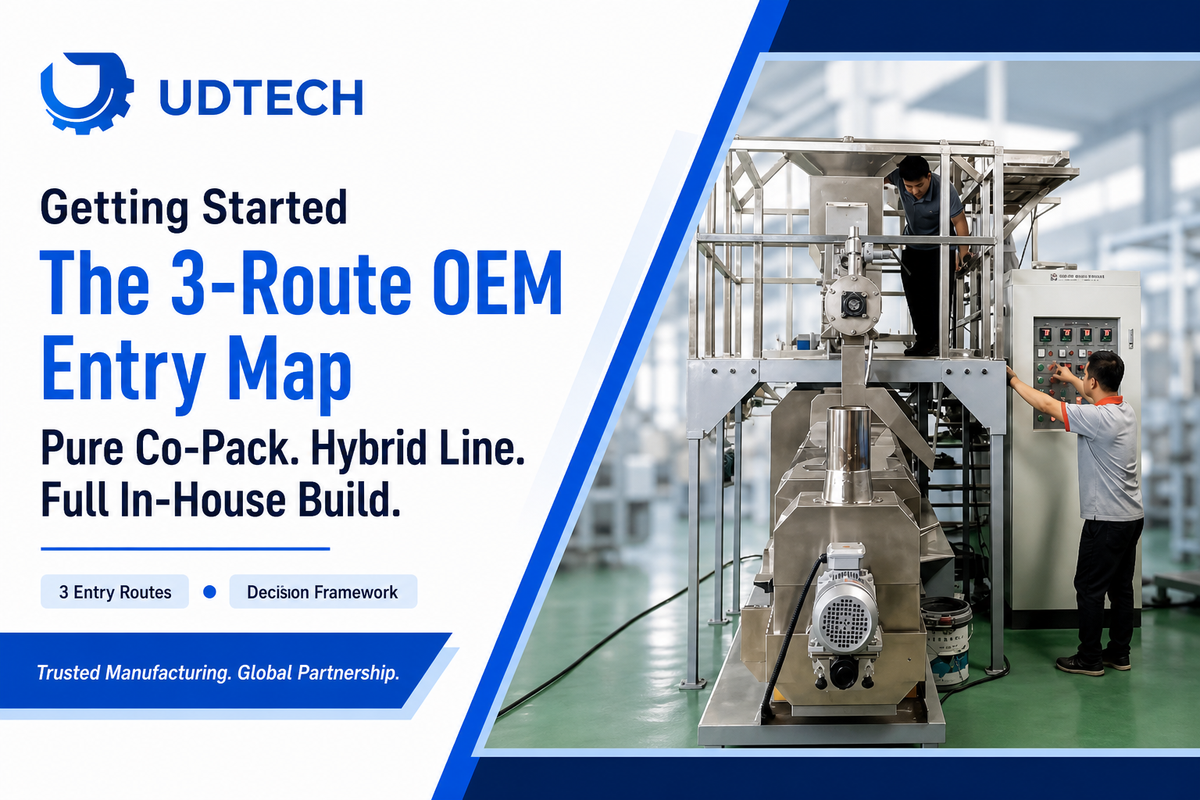
For private label egg rolls, there are really three viable paths to production rather than just a buy-or-build dichotomy: fully outsourced (working with a co-packer), hybrid (owning certain production capacity and outsourcing overflow), or fully in-house (building your own production line). We’ve formalized this process as The 3-Route OEM Entry Map, which is a condition-to-recommendation chart matching current volumes, SKU mix and control needs to the best path.
| Criterion | Pure Co-Pack | Hybrid Line | Full In-House Build |
|---|---|---|---|
| Typical order volume | Below a co-packer’s stated MOQ threshold | Growing past 1 co-packer’s capacity or adding SKUs | High enough to justify dedicated equipment |
| Capital outlay | Near zero (pay per unit) | Partial — 1 line (e.g., UD05-2) plus retained co-pack capacity | Full — 1+ line (e.g., UD05-3) sized to daily output need |
| Formulation control | Shared, must be contracted (see H2-6) | Full for in-house volume, shared for overflow | Full control |
| Time to first production run | Fastest, if a co-packer has open capacity | 9-13 weeks equipment lead time for the owned portion | 9-13 weeks lead time + 5-7 day install + 2-3 day training |
| Margin captured per unit | Lowest — co-pack fee subtracted | Mixed — higher on in-house volume, lower on outsourced overflow | Highest |
| Multi-SKU changeover flexibility | Depends entirely on the co-packer’s own equipment | High for in-house volume (adjustable roll length/thickness) | High |
| Facility certification burden | None — inherited from the co-packer | Partial — buyer now needs facility-level certs for owned volume | Full — buyer needs SQF/USDA/FDA facility certs plus equipment certs |
| Exit / switching cost | Low to moderate — re-qualify a new co-packer | Moderate | High — equipment is a sunk cost, but so is the margin it captures |
| Best-fit buyer profile | New brand testing demand before committing capital | Established brand outgrowing 1 co-packer relationship | Contract baker or industrial producer supplying private labels at scale |
If buyers are choosing the hybrid or full in-house route, the UD05-2 and UD05-3 specs on our automatic egg roll machine page are where a line for that route would start, and the pillar page’s own buyer guide for the UD05-3 suggests an industrial snack producer, or contract baker doing private labels, with high volume needs to maintain output levels is a great fit – right along the lines of our Full In-House Build row.
Industry Outlook: What’s Actually Changing in Private-Label Egg Roll Demand (Updated July 2026)
The loudest signal in the private-label egg roll market right now is not a growth number – it’s a divergence.
While search volume for terms relating to finding a co-packer or private label provider declined between 18-32% Y/Y in the period across most tracked terms (more on this trend in our market trends analysis), private label share in retail reached an all time high in the same timeframe. The combined signal of these two trends:Buyers with existing private label programs are accessing new capacity through established connections, trade shows and referrals instead of seeking a new partner – consolidating the category around proven producers rather than expanding the pool of buyers in the market. For buyers looking to add capacity, this makes it more about being ready to scale a production run for a existing client than winning the first run of a new one.
We can see this trend in action on the shelf – grocery stores prioritize shelf fill based as much on reliability as on cost, and the broader food and beverage industry’s move towards private label and co-packing for record unit share is fundamentally a narrative about the egg roll producers best positioned to keep shelves stocked.
This we call The Changeover-to-Margin Trade, which is the private label producers’ ability to toggle quickly between SKUs on a single line (see UD05-3’s adjustable roll length and wrapper thickness) that directly impacts the amount of the private label margin premium (40% plus compared to 25%-35% on national brands, see H2-4) that can be realised.
If a line need a complete re-tool between SKUs, it can limit the number of private label clients the operation can serve while still being profitable, whereas a line built for fast changeovers spreads that fixed changeover time across a higher number of SKUs and realises more of the margin premium on each.
The retail data behind that record share is worth reading carefully, because the headline number hides a more specific story. PLMA-reported data through mid-2026 puts private-label unit share at a record 23.8%, with dollar share at 21.2% – but industry reporting on the same data notes that national-brand dollar sales grew 2.2% year-over-year over the same period while private-label dollar sales stayed roughly flat. In other words, 2026’s record is a units story, not yet a dollars story – private label is selling more units without clearly capturing more revenue per unit, which is consistent with margin being driven more by production economics (changeover speed, cost per unit) than by retail pricing power alone.
For context, the global food contract manufacturing market was reported at $404.47 billion in 2025 (see H2-4), and industry data puts total 2025 U.S. private-label dollar sales at $282.8 billion, up 3.3%, with private-label’s five-year dollar share climbing from 19.1% to 21.3%. These are directional market-size figures offered as background, not a substitute for the unit-vs-dollar divergence above – if you’re planning 2027 capacity, the changeover-speed argument matters more to your margin than the market-size number does.
Frequently Asked Questions
Q: Are MOQs for private label egg roll manufacturing flexible for new SKU launches?
View Answer
Q: Who owns the formulation IP in a private-label egg roll arrangement?
View Answer
Q: What certifications should a private-label egg roll producer have?
View Answer
Q: What does private label egg roll manufacturing cost?
View Answer
Q: What’s the difference between OEM and private label?
View Answer
Q: Is demand for private label egg roll manufacturing growing?
View Answer
Sizing a Private-Label Egg Roll Line for Your Volume?
The UD05-2 and UD05-3 provide speed options between 220-330 pcs/min, adjustable roll length, and wrapper thickness options, catering to a wide variety of multi-SKU private label requirements. Visit their product page for complete specifications, certification, and lead time before committing to a production line.
About This Analysis
This guide cover co-packing and private label arrangements for egg roll products, drawing on U.S. federal food-safety regulation (21 CFR Part 117), PLMA’s mid-2026 private-label share data, three 2024-2025 egg-roll and wafer-forming equipment patents, and UD05-2/UD05-3 specifications published on UDTECH’s own product page. Where a widely quoted figure, like the per-kilogram bulk co-pack fee, couldn’t be independently verified against a primary source, we said so instead of presenting it as confirmed. Reviewed by the Suzhou UDTECH Technology Co., Ltd. technical team.
References & Sources
- 21 CFR Part 117, Current Good Manufacturing Practice, Hazard Analysis, and Risk-Based Preventive ControlsCornell Legal Information Institute
- Preventive Control Rule (21 CFR 117) OverviewTexas Department of State Health Services
- Preventive Controls for Human FoodNC State University Extension
- List of Co-Packers in Pennsylvania and BeyondPenn State Extension
- Schwan’s Creates Private-Label, Contract-Packaging BusinessJust Food
- 2024 Global Outsourcing SurveyDeloitte
- Financial Drivers of Domestic OutsourcingUC Berkeley Institute for Research on Labor and Employment
- Production Operations Survey Shows Mixed Feelings on OutsourcingFood Processing
- Beverage Business Basics with Danny Stepper of L.A. LibationsFoodNavigator-USA
- Strengthening Organic Enforcement, FAQUSDA Agricultural Marketing Service
- What Food Safety Leaders Need to Know About SQF Edition 10SQF Institute
- Private Label Retail Share DataPrivate Label Manufacturers Association
- Private Label Widens Lead Over National Brands in 2026 Grocery Unit SalesFoodNavigator-USA
- Private Label Sales Reach Record HighFood Business News
- Food Contract Manufacturing MarketFortune Business Insights
- CN221749493U, Wrapper Thickness Control and Multi-Blade Slitting MechanismGoogle Patents
- CN223515609U, 9-Mold Adjustable Rotating TurntableGoogle Patents
- TWI908099B, Multi-Station Linked Indexing MechanismGoogle Patents
- Meat, Poultry, and Egg Product Labeling (R48427)Congressional Research Service, Library of Congress
- The FASTER Act: Sesame Is the Ninth Major Food AllergenU.S. Food and Drug Administration
Related Articles
- Seaweed Egg Roll Machinenori-format lines for buyers diversifying SKUs beyond the wafer format
- What Is a Phoenix Roll Snack?background on a related snack format sold through the same private-label channels