
CM to inches is a length conversion from the metric system to inch-based measurement units: divide the centimeter value by exactly 2.54.
inches = centimeters ÷ 2.54
As an example, 10 cm ÷ 2.54 = 3.937007… in, normally displayed as 3.94 in. Keep the unrounded result through the calculation, then choose a display precision that fits the source measurement and the decision.
Converters can return decimal inches immediately. They cannot tell you whether a fraction is only approximate, whether a three-number product size kept the same axis order, or whether the displayed decimals imply precision the source never had. Those details matter when a dimension moves from a product page into a quotation, layout drawing, shipping plan, or supplier email.
This guide gives you the exact formula and a practical cm-to-inches chart, then adds three controls for industrial use: the Source–Exact–Display Register, the Dimension-Order Lock, and the Three-Line Unit Audit.
CM to inches converter
Convert dimensions between centimeters and inches using the exact relationship 1 inch = 2.54 centimeters.
Decimal results are rounded to four places for display.
If you came here searching for a cm to inches converter, the formula and conversion table below handle the same inch conversion transparently. The centimeter is a metric unit of length; 100 centimeters equal one meter. In United States customary measurement, 12 inches equal one foot. Searchers often call the latter system “imperial,” although U.S. customary is the more precise label for American use. Since the international agreement of 1959, one inch has been defined as exactly 25.4 metric millimeters, or 2.54 centimeters.
The formal definition is rooted in the International System of Units: the prefix centi- means one hundredth, so a centimeter is one hundredth of a meter. For centimeters to inches conversion, the equivalent inch value comes from the exact factor, not from comparing marks on a ruler. That distinction keeps length conversions reproducible across measurement systems.
Unit labels can vary by country and document. Europe, Canada, Japan, and the United States all encounter mixed-unit product records even when their controlling conventions differ. The 1959 international yard agreement fixed the inch through the yard, while phrases such as “customary systems of measurement” describe the surrounding inch-foot convention. Whatever the market, write 12 inches in a foot and keep the source system visible.
| Conversion format: exact relationship | 1 in = 2.54 cm |
| CM to inches | cm ÷ 2.54 |
| Inches to cm | in × 2.54 |
| Fast estimate only | cm ÷ 2.5 |
| Nearest tape fraction | Declare the increment, such as nearest 1/16 in |
| 1 cm reference | 0.3937 in |
| 10 cm reference | 3.9370 in |
| 100 cm reference | 39.3701 in |
| Area or volume | Use the squared or cubed factor, not 2.54 alone |
CM to Inches, the Quick Answer
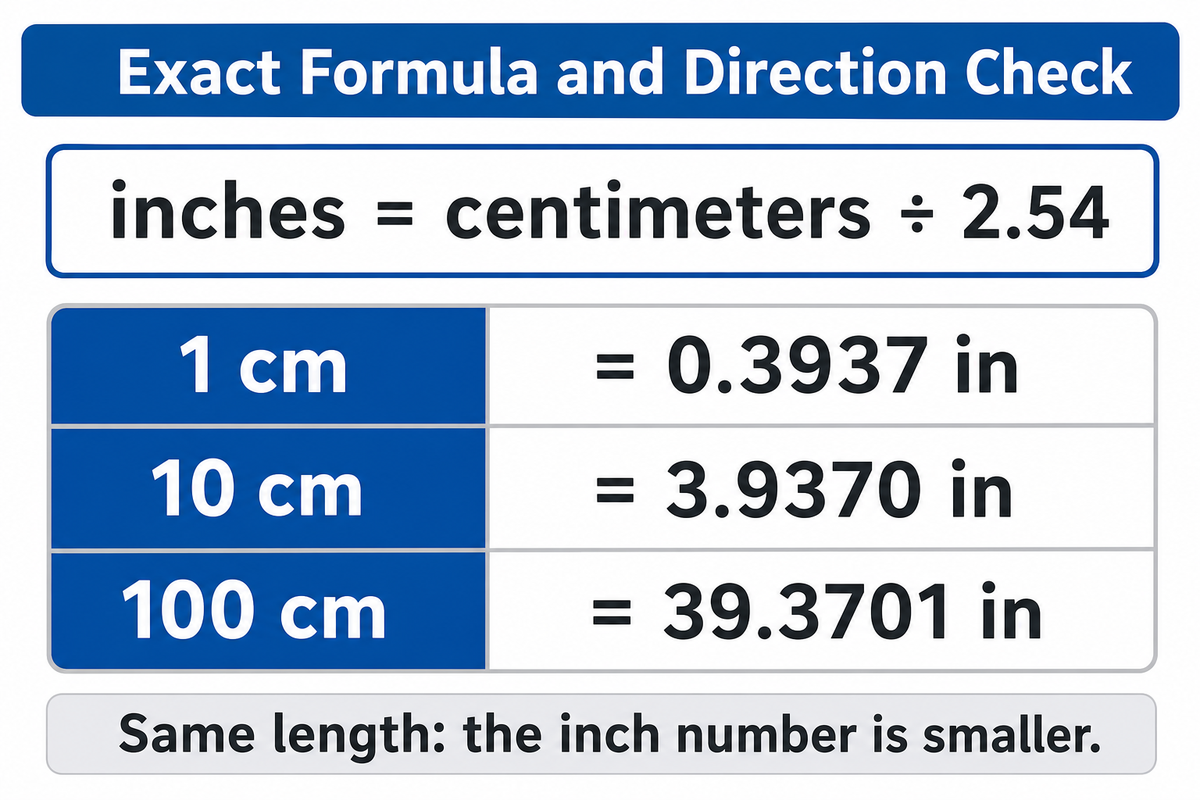
The NIST unit-conversion process uses exact factors: one inch equals exactly 2.54 centimeters. Therefore, divide centimeters by 2.54 to get inches. The factor is exact; the displayed answer may be rounded.
- 1 cm = 0.3937007874… in
- 2.54 cm = 1 in exactly
- 10 cm = 3.937007874… in, usually 3.94 in
- 100 cm = 39.37007874… in, usually 39.37 in
The 2.54 Direction Check is simple: an inch is longer than a centimeter, so the number of inches should be smaller than the number of centimeters for the same positive length. If 75 cm becomes 190.5 in, the formula was reversed; 190.5 is the centimeter result for 75 inches.
As a rough estimate, dividing by 2.5 is convenient: 50 cm ÷ 2.5 = 20 in, compared with the exact 19.685 in. The estimate runs high because 2.5 is smaller than 2.54. Use it as a reasonableness check, not as an input to a drawing or purchase specification. Reliable workflows separate estimation from the recorded conversion.
The reverse check is equally valuable. Multiply the displayed inch amount by 2.54 and compare it to the original source. Rounded displays won’t always return the original source exactly, but a big discrepancy reveals a swapped digit, incorrect direction, or incorrect unit label.
Is 4 cm equal to 1 inch?
No. Four centimeters equals about 1.5748 inches. One inch is exactly 2.54 cm, so 4 cm is roughly 1 9/16 in when rounded to the nearest 1/16 in. The fraction is only a tape-measure display; retain 1.5748 in or the original 4 cm when the difference can affect fit.
How to Convert Centimeters to Inches Without Reversing the Formula
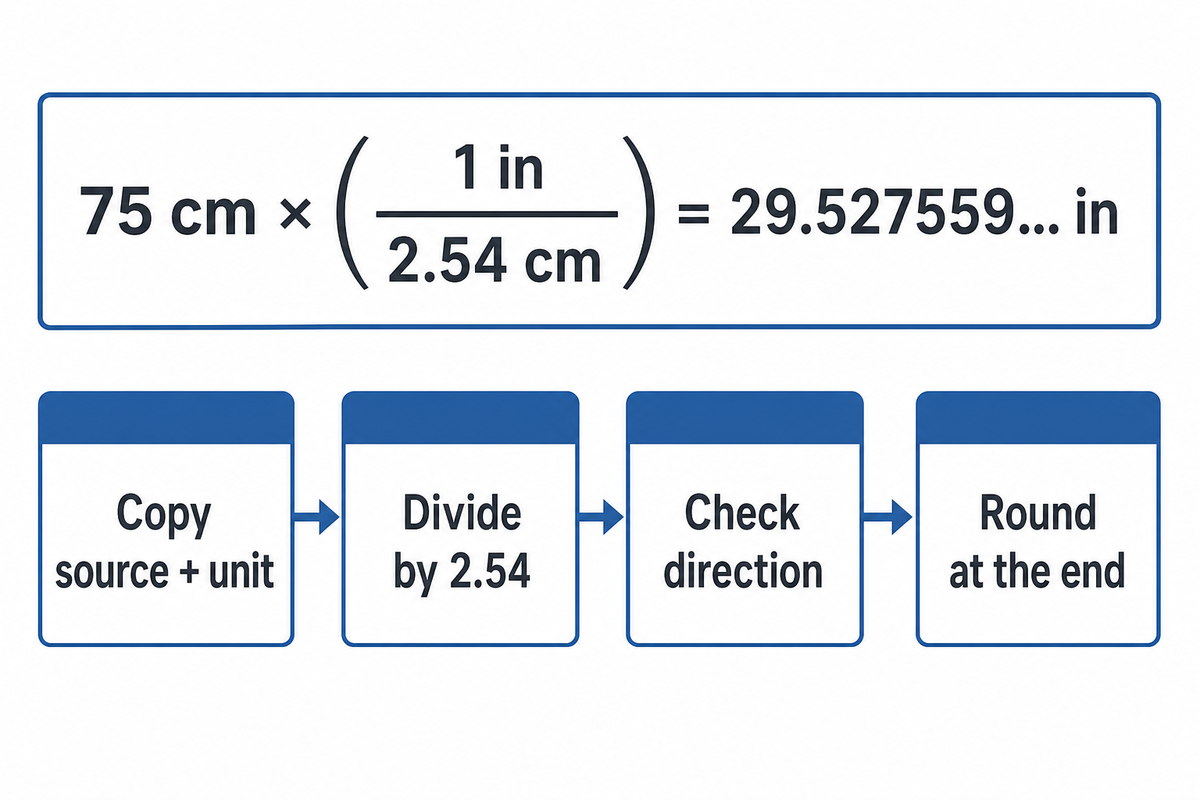
Building on that exact relationship, use unit cancellation when you want a calculation that’s easy to review. Write the centimeter value next to a ratio that places centimeters in the denominator:
75 cm × (1 in / 2.54 cm) = 29.527559… in
The centimeter units cancel, leaving inches. This method makes the direction clear and follows the conversion process set out by the National Institute of Standards and Technology: identify the initial unit, identify the target unit, select the factor, perform the calculation, and check whether the answer is reasonable.
- Copy the source value and its unit; do not convert a bare number.
- Divide by 2.54 and keep several guard digits.
- Check direction: the inch number should be smaller.
- Round once, at the end, and record the display rule.
| Source | Exact-factor calculation | Display |
|---|---|---|
| 25 cm | 25 ÷ 2.54 = 9.842519… | 9.84 in |
| 40 cm | 40 ÷ 2.54 = 15.748031… | 15.75 in |
| 180 cm | 180 ÷ 2.54 = 70.866141… | 70.87 in |
Avoid double rounding. If 40 cm is first rounded to 15.75 in and then rounded again to one decimal, it becomes 15.8 in. Directly rounding the unrounded result to one decimal gives 15.7 in. Keep the original calculation until the final display rule is known.
In a spreadsheet, keep one source column and one formula column. The cell =A2/2.54 should reference the original centimeter value, not a copied value that was already rounded in another document. Apply number formatting to control what the sheet shows while leaving the underlying result intact. If the display policy changes from two decimals to one, the sheet can regenerate the output without recalculating from a shortened number.
Also keep the unit in the column heading and the record itself. “40” is ambiguous; “40 cm” provides the information needed to choose the factor. This small discipline prevents a common tenfold error when 40 mm is copied as 40 cm and then converted with otherwise correct arithmetic.
CM to Inches Chart for Common Product Dimensions
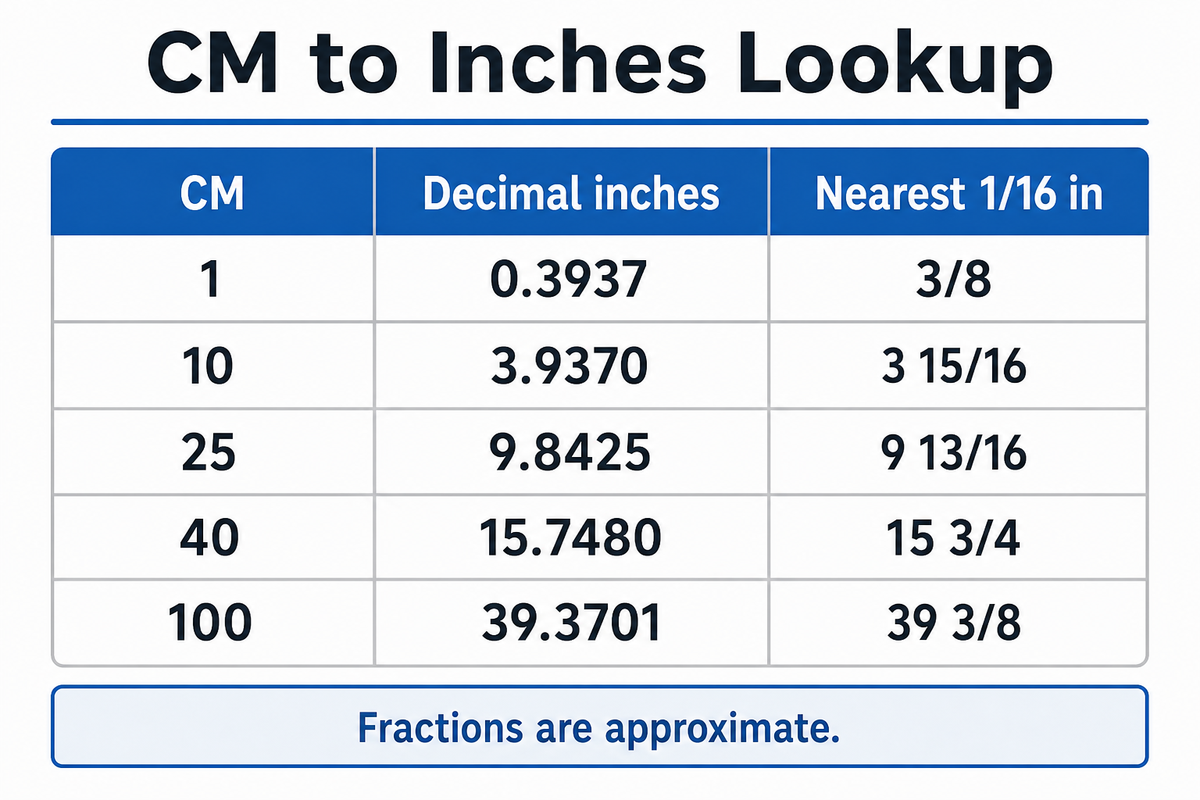
Using the same division rule, the chart below shows decimal inches to four places so you can choose an appropriate final display. The factor follows the NIST metric-to-U.S. customary conversion table. Fractions are approximate and use the nearest 1/16 in.
| Scale value (cm) | Decimal inches | Nearest 1/16 in | Scale value (cm) | Decimal inches | Nearest 1/16 in |
|---|---|---|---|---|---|
| 1 | 0.3937 | 3/8 | 25 | 9.8425 | 9 13/16 |
| 2.5 | 0.9843 | 1 | 25.4 | 10.0000 | 10 |
| 2.54 | 1.0000 | 1 | 30 | 11.8110 | 11 13/16 |
| 5 | 1.9685 | 1 15/16 | 40 | 15.7480 | 15 3/4 |
| 10 | 3.9370 | 3 15/16 | 50 | 19.6850 | 19 11/16 |
| 20 | 7.8740 | 7 7/8 | 75 | 29.5276 | 29 1/2 |
| 24 | 9.4488 | 9 7/16 | 100 | 39.3701 | 39 3/8 |
| 50.8 | 20.0000 | 20 | 180 | 70.8661 | 70 7/8 |
| 76.2 | 30.0000 | 30 | 200 | 78.7402 | 78 3/4 |
Use the chart for lookup and reasonableness checks. Recalculate from the source value when a dimension affects clearance, fit, packaging, or acceptance. Charts can’t know the source resolution or controlling tolerance.
Values such as 2.54, 25.4, 50.8, and 76.2 cm land on whole inches because they’re exact multiples of 2.54. Other rows need rounding. Whole-inch results aren’t automatically more accurate; they may simply be convenient mathematical multiples.
How Many Decimal Places Should a Converted Dimension Keep?

An exact conversion factor doesn’t make the original measurement exact. A source written as 75 cm may represent a rounded product envelope, while 75.00 cm may come from a more precise record. Extra decimal places in the inch result don’t create additional knowledge.
NIST Special Publication 811 Appendix B ties the converted display to the information carried by the unconverted value and advises against rounding intermediate quantities. Those two rules lead to the Source–Exact–Display Register.
| Source cm | Calculated inches | Public display | Display residual |
|---|---|---|---|
| 75 | 29.527559… | 29.5 | −0.0276 in |
| 37 | 14.566929… | 14.6 | +0.0331 in |
| 76 | 29.921260… | 29.9 | −0.0213 in |
The paired values appear on UDTECH’s 30 W fiber laser marking machine page. They illustrate one-decimal product communication. The page doesn’t state a dimensional tolerance, so the display residuals can’t be treated as acceptance limits.
On UDTECH’s public 30 W laser marking machine page, the first axis is published as 75 cm and 29.5 in; the second axis is published as 37 cm and 14.6 in; the third axis is published as 76 cm and 29.9 in. The same UDTECH page publishes another first axis as 40 cm and 15.8 in; another second axis as 34 cm and 13.4 in; another third axis as 54 cm and 21.3 in. The latter first value shows why the calculation record matters: 40 ÷ 2.54 = 15.748031…, which rounds directly to 15.7 at one decimal but becomes 15.8 after first rounding to 15.75. Treat 15.8 as a published display to confirm, not as proof of a direct-rounding rule.
For a quotation or drawing handoff, store four fields: source value and unit, unrounded calculated value, selected display value, and the reason for that display. If the source accuracy or tolerance is unknown, say so. “Shown to one decimal for comparison” is safer than implying that the product is controlled to 0.1 in.
Three situations call for different treatment. A product-card envelope can use a compact display when the number helps a buyer estimate space. A layout drawing may need enough digits to keep accumulated clearance error visible. A controlled manufacturing drawing must follow its own dimension and tolerance rules. The conversion formula is the same in all three cases; the evidence supporting the display precision is not.
Don’t derive tolerance from the number of printed decimals. A dimension shown as 29.5 in doesn’t, by itself, mean ±0.05 in or ±0.1 in. Tolerance must come from an explicit source such as the controlling drawing, specification, or supplier confirmation. Conversion changes the unit representation; it doesn’t add an acceptance rule.
A converted display is a communication layer, not a new manufacturing requirement. Keep the source dimension and its governing tolerance visible whenever the value can affect fit, inspection, or acceptance.
How to Convert Decimal Inches to Fractional Inches
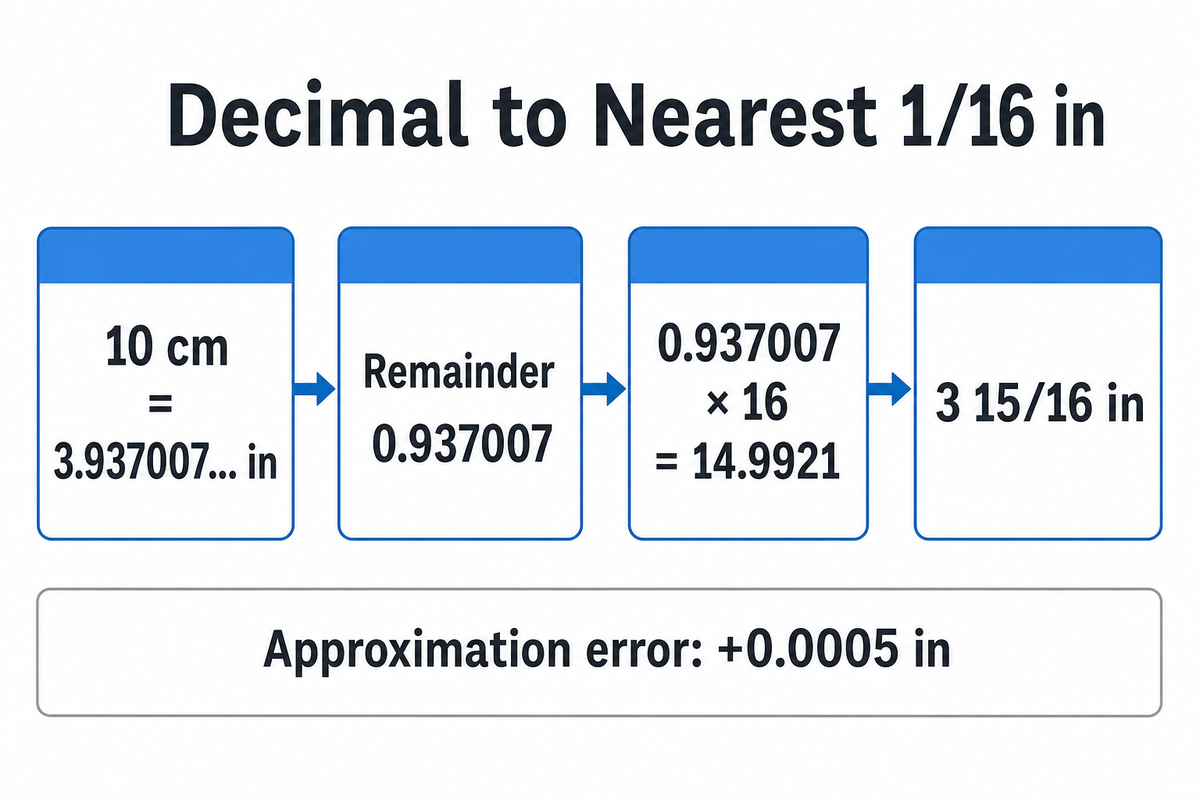
A fraction needs an increment. “Nearest fraction” is incomplete because nearest 1/8, 1/16, and 1/32 in can produce different results. The choice still has to respect the source-information and final-rounding guidance in NIST Special Publication 811 Appendix B. For a tape measure marked in sixteenths, use the nearest 1/16 in:
- Keep the whole inches.
- Multiply the decimal remainder by 16.
- Round that number to the nearest whole numerator using the declared tie rule.
- Reduce the fraction and record its error from the decimal result.
For 10 cm, the decimal result is 3.937007… in. The remainder is 0.937007; multiplied by 16, it becomes 14.9921. That rounds to 15, giving 3 15/16 in. The fraction equals 3.9375 in, only about +0.0005 in above the exact result.
| CM | Decimal in | Nearest 1/16 in | Fraction minus decimal |
|---|---|---|---|
| 10 | 3.9370 | 3 15/16 | +0.0005 in |
| 25 | 9.8425 | 9 13/16 | −0.0300 in |
| 40 | 15.7480 | 15 3/4 | +0.0020 in |
A tape-measure fraction is a communication aid, not an automatic substitute for a controlling decimal dimension. Keep the decimal or original centimeter value in a specification unless the governing document explicitly permits the fractional increment and its error.
Select the denominator from the tool and use case. A tape marked in sixteenths can’t honestly support a nearest-1/32 reading. A machinist’s rule may offer finer marks, but a finer fraction still doesn’t prove the source was measured that precisely. If the value falls exactly halfway between two increments, document the tie convention rather than leaving it implicit.
Is 2.5 cm equal to 1 inch?
No. 2.5 cm equals about 0.9843 in, which is about 0.0157 in short of 1 in. It can be rounded to 1 in for a nearest-1/16 display, but it isn’t exactly 1 in. Keep the original value for any fit or tolerance decision.
Convert Length × Width × Height Without Swapping an Axis

After choosing the fractional display, keep the same NIST conversion sequence when three dimensions appear together. Three correct calculations can still describe the wrong physical sides if length becomes height or width becomes depth. Confirm what the source order means before calculating; L × W × H and W × D × H aren’t interchangeable labels.
The Dimension-Order Lock begins only after axis identity is confirmed:
- Write the declared source convention above the values.
- Attach an axis label to every number.
- Convert each labeled value independently.
- Copy the labels with the results and verify the sequence once more.
| Declared order | Source cm | Independent calculation | One-decimal display |
|---|---|---|---|
| Axis 1 × Axis 2 × Axis 3 | 75 × 37 × 76 | 29.5276 × 14.5669 × 29.9213 | 29.5 × 14.6 × 29.9 in |
| Axis 1 × Axis 2 × Axis 3 | 40 × 34 × 54 | 15.7480 × 13.3858 × 21.2598 | 15.7 × 13.4 × 21.3 in |
The table intentionally uses neutral axis labels because a public size row doesn’t, by itself, prove which physical direction a buyer calls length, width, height, or depth. Confirm the convention with the supplier before using the converted values in a floor plan, crate design, or clearance check.
A practical handoff keeps the labels on both sides: “Axis 1 / source 75 cm / display 29.5 in.” If the buyer later decides that Axis 1 is depth rather than length, the number remains attached to the same physical direction. Relabeling happens as a separate decision instead of silently rearranging the converted sequence.
Orientation can also change what a team calls height. A machine may ship on its side, stand upright in operation, and enter a doorway in a third orientation. The Dimension-Order Lock preserves source identity, but clearance planning still needs the installation orientation and any detachable components.
This Formula Is for Length, Not Area or Volume
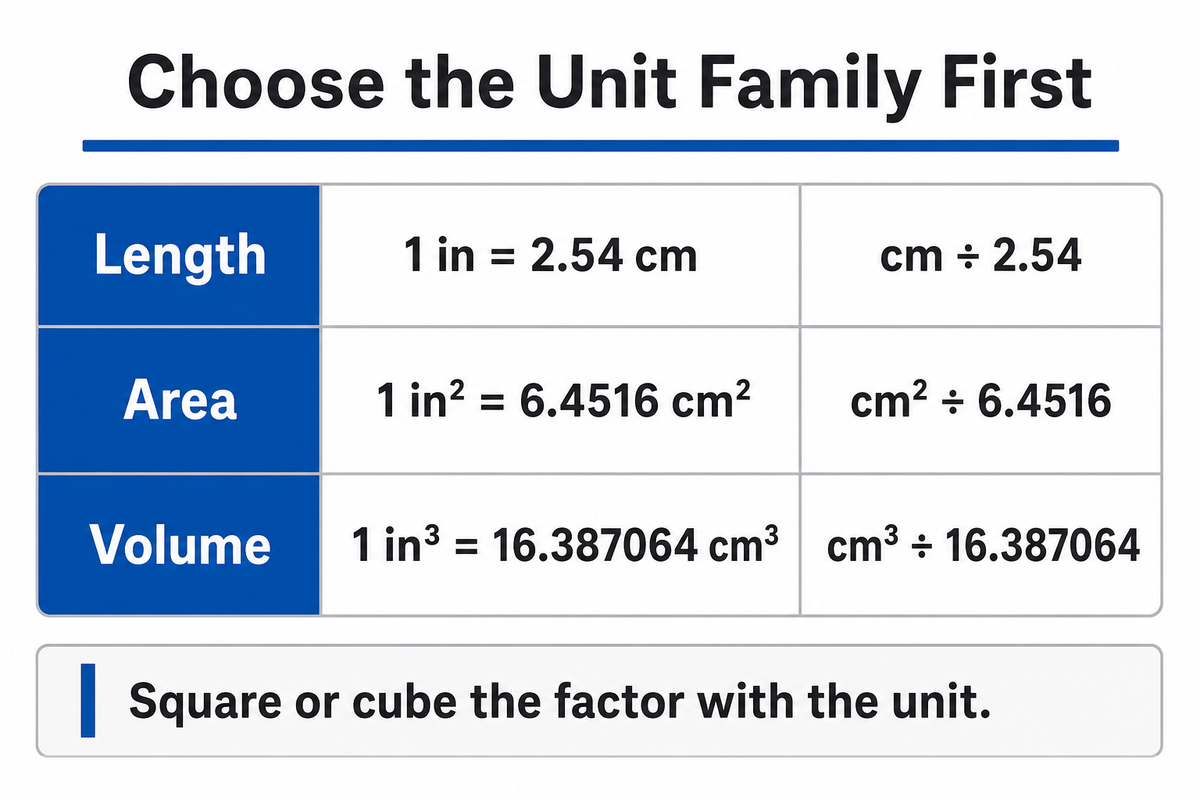
Once axis identity is locked, distinguish individual lengths from the area or volume derived from them. The 2.54 relationship converts one-dimensional length. For area, square the factor; for volume, cube it. Dividing square centimeters by 2.54 or cubic centimeters by 2.54 produces a unit-family error.
| Quantity | Exact relationship | CM-based value to inch-based value |
|---|---|---|
| Length | 1 in = 2.54 cm | cm ÷ 2.54 |
| Area | 1 in² = 6.4516 cm² | cm² ÷ 6.4516 |
| Volume | 1 in³ = 16.387064 cm³ | cm³ ÷ 16.387064 |
If your task starts with a complete package volume rather than three separate lengths, use the volume factor or route the dimensions through a suitable tool such as UDTECH’s cubic-feet calculator.
For example, 100 cm² ÷ 6.4516 = about 15.5000 in². For volume, 1,000 cm³ ÷ 16.387064 = about 61.0237 in³. The numerical factors grow because area contains two length dimensions and volume contains three. Write the superscript unit before selecting the factor; it’s the fastest way to prevent a linear conversion from entering an area or volume calculation.
The Three-Line Unit Audit for Specifications and Supplier Quotes

With the correct unit family established, check three lines before a converted dimension enters a quotation, specification, or approval email. This audit catches a wrong unit family, a reversed factor, and a display that implies unsupported precision.
- Unit family: Is the source length, area, or volume? Does every number carry the correct unit symbol?
- Factor direction: For positive length, did the cm number become a smaller inch number? Can the units cancel on paper?
- Final display: Was rounding performed once, from the unrounded result? Is the chosen decimal or fraction justified and labeled?
For a three-axis size, add the declared axis order at the top of the audit. For a fraction, add the denominator increment and residual error. For a critical dimension, retain the original value and ask the supplier which drawing and tolerance govern acceptance.
| Observed result | Likely problem | Correction |
|---|---|---|
| 50 cm becomes 127 in | Multiplied instead of divided | 50 ÷ 2.54 = 19.685 in |
| 10 cm becomes 0.394 in | Centimeters were treated as millimeters | 10 cm = 100 mm = 3.937 in |
| 40 cm shown as 15.8 in | Possible double rounding | Round 15.748031… directly for the final display |
| A fraction has no increment | Approximation rule is incomplete | State nearest 1/8, 1/16, or 1/32 in |
Industry drawing guidance also cautions against guessing a unit convention from appearance alone. Confirm the source units and axis meaning. If a converted value affects fit, access, or procurement, use UDTECH’s contact channel to confirm the controlling dimension before approval.
Consider a quotation that lists an enclosure as 120 × 80 × 75 cm. First, record the supplier’s declared axis order. Second, divide each labeled value by 2.54, giving approximately 47.2441 × 31.4961 × 29.5276 in. Third, decide whether the quote needs two decimals, one decimal, or retained source units with a comparison column. The audit is complete only when the display policy and axis labels are visible to the reviewer.
If an acceptance decision is involved, the safest quote line carries both systems: “120 × 80 × 75 cm (calculated display: 47.24 × 31.50 × 29.53 in); source metric dimensions govern.” That wording prevents the rounded inch column from becoming an unintended replacement specification.
When to Use MM, Inches, or Feet and Inches Instead
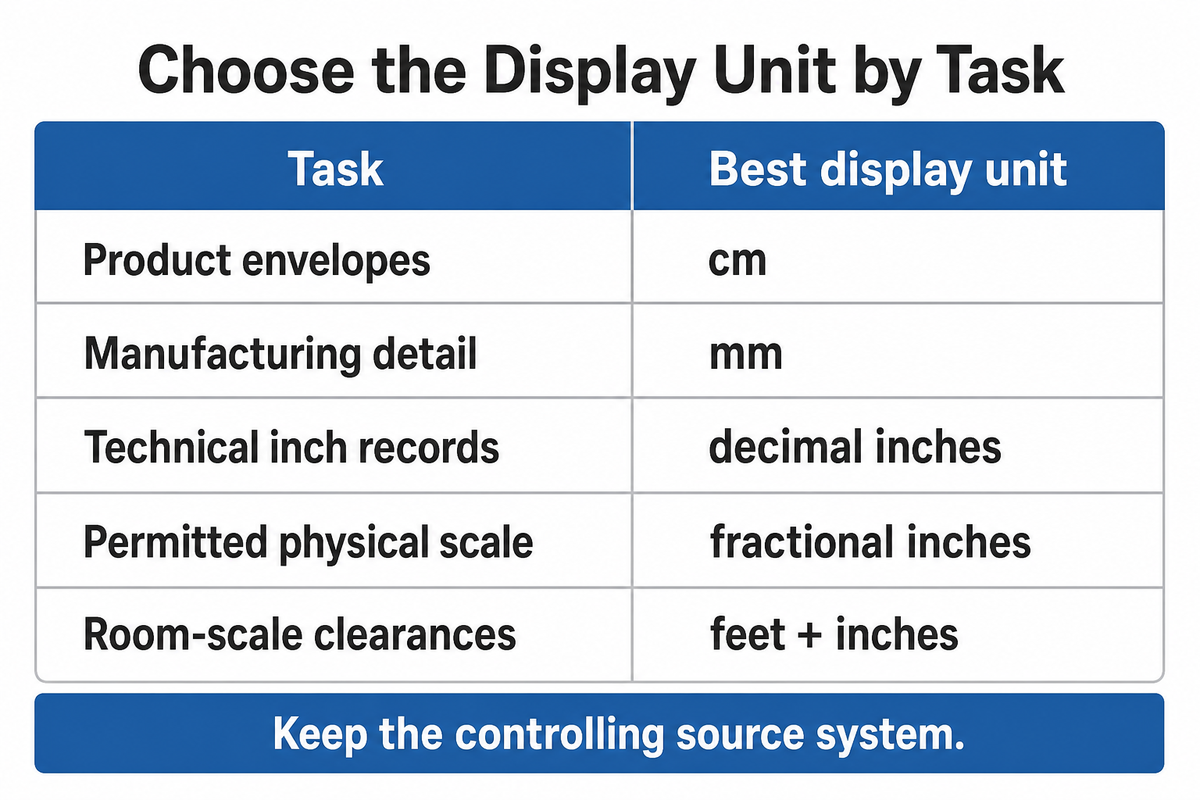
Centimeters work well for product envelopes, packaging sizes, and general buyer communication. Millimeters are usually clearer for manufacturing dimensions, small features, and tolerances because they avoid long decimal-centimeter values. Decimal inches fit spreadsheets and technical documents that use inch units. Feet and inches are useful for room-scale or installation communication when the audience expects that format.
- Use cm for general product dimensions and international descriptions.
- Use mm for precision-manufacturing dimensions and tolerance work.
- Use decimal inches for technical inch-based records and calculations.
- Use fractional inches only when a permitted physical scale or convention requires them.
- Use feet and inches for large clearances or room layouts, while retaining the source dimension.
In millimeter-native work, use the mm-to-inches converter. For the reverse precision route, see the inches-to-mm guide. These pages keep manufacturing-intent conversions separate from the centimeter product-dimension workflow covered here.
UDTECH already publishes that inches-to-mm blog and mm-to-inches utility. To keep a measurable distinction between these content lanes, this article uses product-dimension examples and named audit hooks instead of duplicating converter content; that internal differentiation constraint defines the article’s scope.
Don’t toggle units just to make a number appear more familiar. If the supplier, drawing, and inspection equipment are metric, keeping metric as the controlling system minimizes conversion points. Add inches for the buyer’s comparison rather than substituting them for the source. The same principle applies in reverse on an inch-controlled project.
Frequently Asked Questions
What is the formula to convert cm to inches?
Show answer
Divide centimeters by exactly 2.54: inches = cm ÷ 2.54. Keep the unrounded result during the calculation and round only the final display. A quick check is that the inch number should be smaller than the centimeter number for the same positive length. For a technical handoff, retain the source centimeter value, state the display precision, and don’t infer a tolerance from the converted decimals.
What does 10 cm look like in inches?
Show answer
Ten centimeters equals 3.9370 inches, usually shown as 3.94 in. On a tape marked in sixteenths, it’s approximately 3 15/16 in. The fraction is 0.0005 in above the exact decimal result, so it’s an excellent visual approximation but still should be labeled approximate. It sits just below the 4-in mark and is about the width of a compact product label or small enclosure feature.
Is 3 cm the same as 1 inch?
Show answer
No. Three centimeters equals about 1.1811 inches. One inch is exactly 2.54 cm, so 3 cm is about 0.1811 in longer than 1 in. Rounded to the nearest 1/16 in, 3 cm is approximately 1 3/16 in. That fraction is useful for visual comparison, but the exact-factor decimal or original centimeter value should remain in any specification where the difference matters.
How many inches are in 100 cm?
Show answer
One hundred centimeters equals 39.3701 inches. To the nearest 1/16 in, that’s approximately 39 3/8 in.
Should I multiply cm by 0.3937?
Show answer
Multiplying by 0.3937 is a practical approximation because 1 ÷ 2.54 equals 0.3937007874…. Dividing by 2.54 keeps the exact defined factor visible and avoids introducing a rounded multiplier before the calculation.
References & Sources
- National Institute of Standards and Technology — Unit Conversion
- NIST Guide to the SI, Appendix B — Conversion Factors and Rounding
- NIST, Approximate Conversions from Metric to U.S. Customary Measures
- NIST, Approximate Conversions from U.S. Customary to Metric Measures
- GD&T Basics — Metric vs. Inch Dimensions and Tolerances
- UDTECH — 30 W Fiber Laser Marking Machine Product Dimensions
Method note: all calculated values use 1 in = exactly 2.54 cm. Fractional displays use the nearest 1/16 in and are labeled approximate. Public product dimensions are examples of display practice, not tolerance or certified-drawing claims. Source statements are limited to the public references listed above.