Fahrenheit to Celsius is a temperature-scale conversion that shifts the zero point and rescales the degree size.
To convert Fahrenheit to Celsius, subtract 32 from the Fahrenheit reading, then multiply by 5/9:
°C = (°F − 32) × 5/9
You can also divide by 1.8: °C = (°F − 32) ÷ 1.8. Both forms are exact. Take 77°F: it converts to 25°C because (77 − 32) × 5/9 = 25.
One boundary matters: subtract 32 for a temperature reading. With a temperature difference or change, multiply by 5/9 without subtracting 32.
Converters can return a Fahrenheit-to-Celsius number in a second, but the number alone does not tell you how it was rounded, whether it represents a reading or a temperature change, or how much precision survived the conversion. This guide answers those questions with worked examples, a lookup chart, a quantified mental shortcut, and a rule for handling tolerances and process documents.
| Exact Fahrenheit to Celsius | (°F − 32) × 5/9 |
| Exact alternative | (°F − 32) ÷ 1.8 |
| Fast estimate | (°F − 30) ÷ 2 |
| Temperature difference | Δ°C = Δ°F × 5/9 |
| Equal reading | −40°F = −40°C |
Fahrenheit and Celsius Converter
Convert a temperature reading in either direction. Results are rounded to two decimal places for display.
Use this for temperature readings. Temperature differences use a different offset rule.
Fahrenheit to Celsius Formula
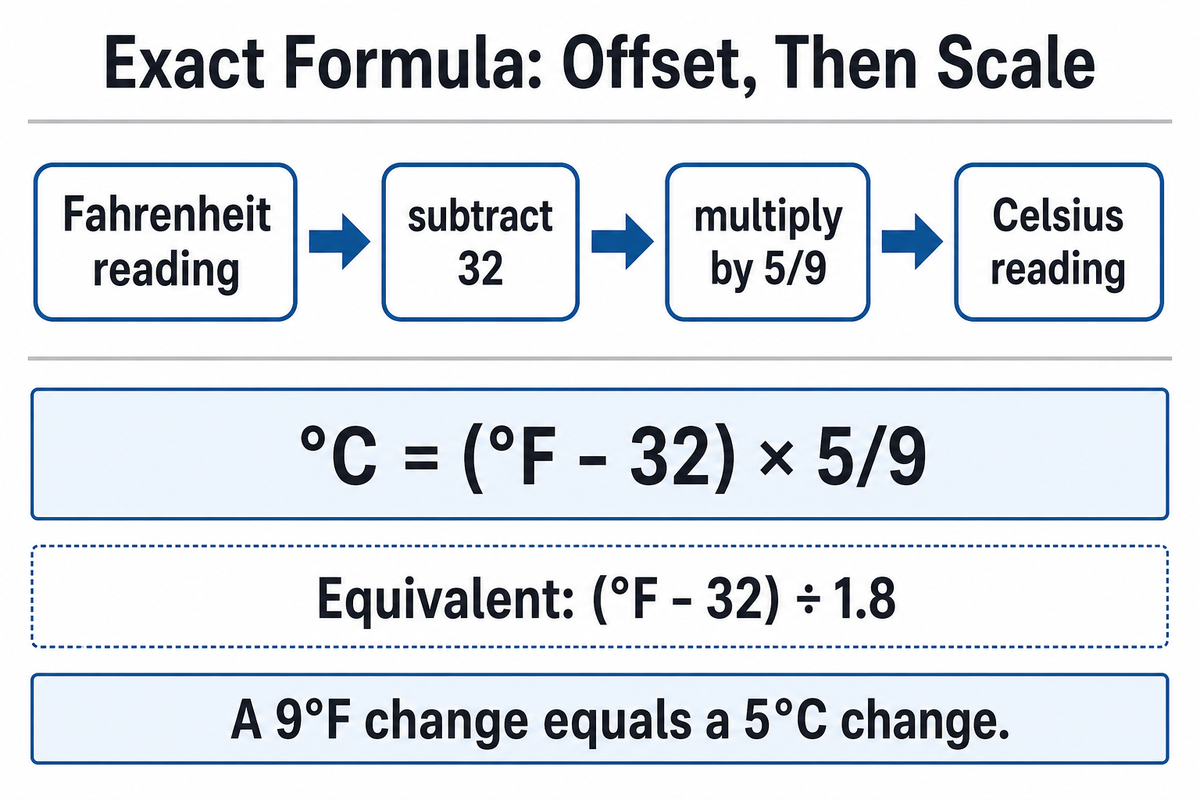
The exact Fahrenheit-to-Celsius formula is °C = (°F − 32) × 5/9. The subtraction aligns the two scales at their different zero points. The 5/9 factor then accounts for degree size: a change of 9 Fahrenheit degrees equals a change of 5 Celsius degrees.
NIST’s exact temperature-conversion table writes the same relationship as (°F − 32) / 1.8. Since 9/5 equals 1.8, multiplying by 5/9 and dividing by 1.8 produce the same answer.
This math check takes only a few seconds and catches a reversed fraction, a missing offset, or an incorrect unit label before the value moves into another document.
“An interval of one Celsius degree corresponds to an interval of 1.8 Fahrenheit degrees.”
Order matters. Subtract 32 before multiplying. If you multiply first, 77°F would incorrectly become 42.8°C instead of 25°C. Use a quick reasonableness check: ordinary indoor temperatures should land near 20–25°C, not above 40°C.
Scale structure also explains the two familiar systems. Celsius places the common water-freezing reference near 0 °C, while Fahrenheit places it near 32°F. Their degree sizes differ, so the conversion needs both an offset and a scale factor. This is why simply subtracting 32 is incomplete, and why multiplying a Fahrenheit reading by 5/9 without first aligning the zero points gives the wrong result.
Calculators convert Fahrenheit to Celsius instantly, but hand calculation remains useful as a check. If the Fahrenheit input rises by 18 degrees, the Celsius result should rise by 10 degrees. If the input is below 32°F, a negative Celsius answer is plausible. If the result violates both checks, inspect the operation order and conversion direction before trusting the display.
The 32–5/9 Offset–Scale Walkthrough: Step-by-Step Examples
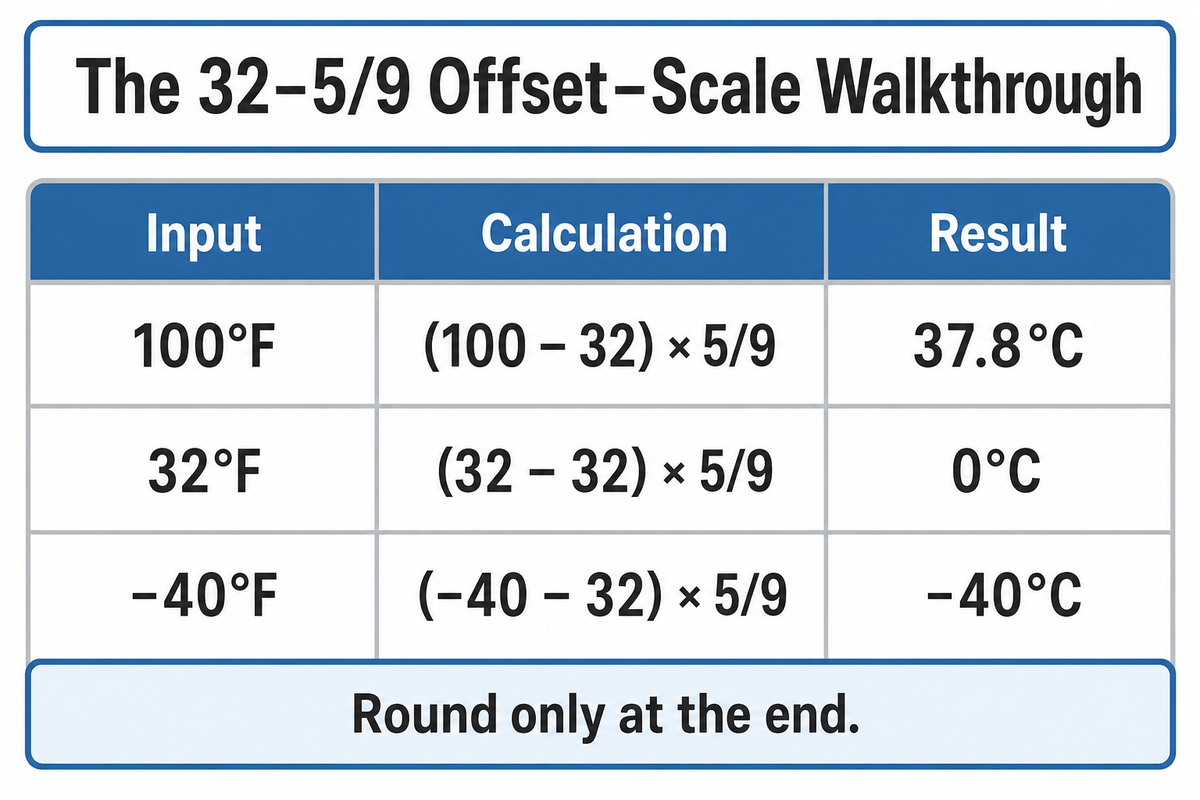
Use the 32–5/9 Offset–Scale Walkthrough to keep every Fahrenheit-to-Celsius calculation in the same three steps: align the zero points, scale the degree size, then round only at the end. Keeping the unrounded number through the second step prevents small errors from accumulating.
- Start with the Fahrenheit reading.
- Subtract 32.
- Multiply by 5/9, or divide by 1.8.
- Round for the context, not before the calculation is complete.
| Input | Calculation | Result |
|---|---|---|
| 100°F | (100 − 32) × 5/9 | 37.777…°C, or 37.8°C |
| 32°F | (32 − 32) × 5/9 | 0°C |
| −40°F | (−40 − 32) × 5/9 | −40°C |
One example catches a frequent misconception: 100°F isn’t 40°C. An exact 40°C reading is 104°F. At the other end of the table, −40 is the crossover point where both scales show the same number.
Negative inputs deserve care because the subtraction makes the intermediate value more negative. For −4°F, the aligned value is −36; multiplying by 5/9 gives −20°C. Don’t remove the minus sign or subtract 32 from the absolute value. For decimal inputs, keep at least two extra decimal places during the calculation. Recording 72.5°F preserves the exact 22.5°C result, while rounding 72.5°F to 73°F first produces 22.8°C and changes the answer before the formula even begins.
Write the final rounding rule beside the result. “37.8°C, rounded to one decimal” tells the reader what happened; “38°C” alone hides whether the input, intermediate value, or output was rounded. That distinction becomes important when the number is later reverse-converted or compared against a tolerance.
Fahrenheit to Celsius Chart for Common Values
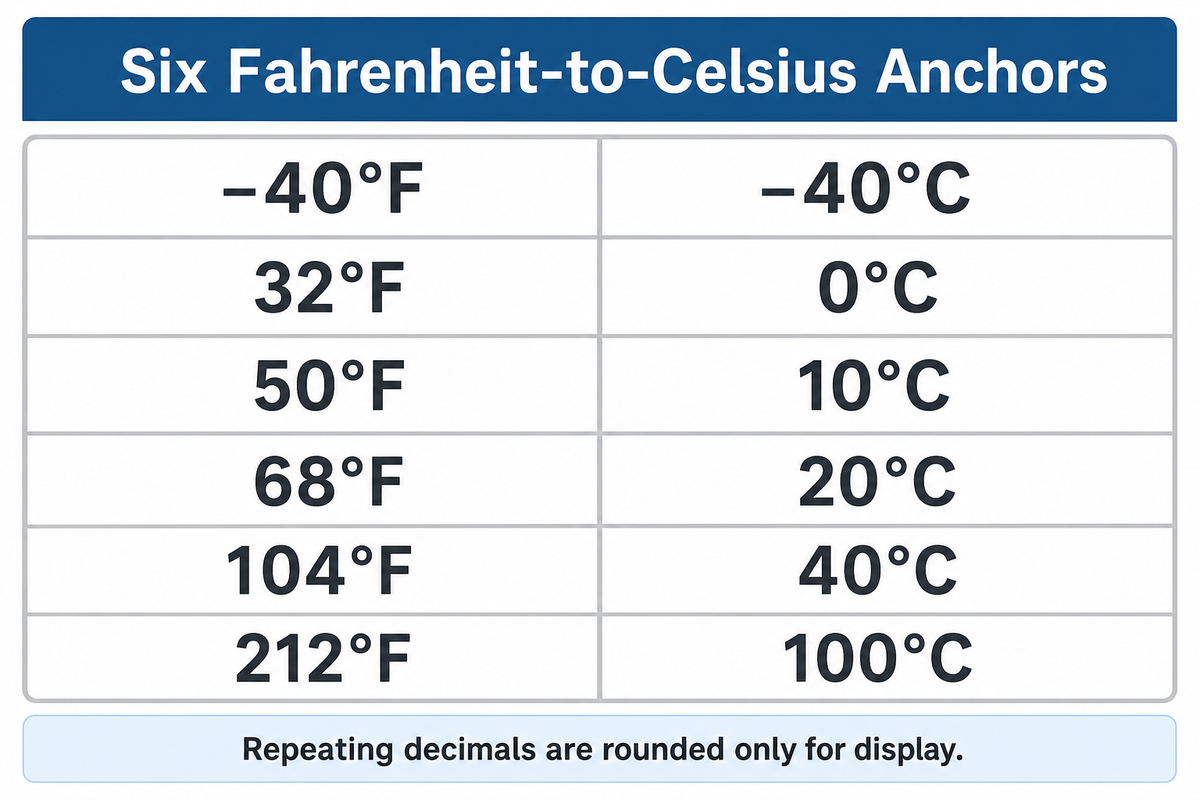
The Fahrenheit-to-Celsius chart below is calculated from the exact NIST equation. Values with repeating decimals are rounded to one decimal for display. Each pair remains traceable to the same formula. Keep the unrounded result if a drawing, test method, or governing document demands more precision.
| °F | °C | °F | °C | °F | °C |
|---|---|---|---|---|---|
| −40 | −40.0 | 50 | 10.0 | 100 | 37.8 |
| −20 | −28.9 | 59 | 15.0 | 104 | 40.0 |
| 0 | −17.8 | 68 | 20.0 | 122 | 50.0 |
| 10 | −12.2 | 77 | 25.0 | 140 | 60.0 |
| 20 | −6.7 | 86 | 30.0 | 176 | 80.0 |
| 32 | 0.0 | 95 | 35.0 | 194 | 90.0 |
| 41 | 5.0 | 98.6 | 37.0 | 212 | 100.0 |
As scale values, 32°F equals exactly 0°C and 212°F equals exactly 100°C. Physical water reference points require context. NIST describes water as freezing at 0°C and boiling at about 100°C because pressure, purity, and measurement conditions affect the observed event. A calculated identity and a physical touchstone are not the same evidence class.
Older material may use centigrade for Celsius. The numerical scale is the same for ordinary conversion, but Celsius is the current name used in the International System of Units. Phrases such as “the boiling point of water is 100 °C” or “water is 32 °F” need a conditions note; they’re practical reference statements, not definitions of the equation. In a table, label 212 °F = 100 °C as a calculated scale pair, then describe the physical water event separately.
This separation makes the chart reusable. Buyers can copy a calculated pair into a bilingual unit column without importing an unstated pressure condition, while teachers or operators can still use freezing and boiling as memorable checks. The formula-derived values remain accurate to the precision shown; the physical example carries its own limitation.
How to Convert Fahrenheit to Celsius Fast Without a Calculator
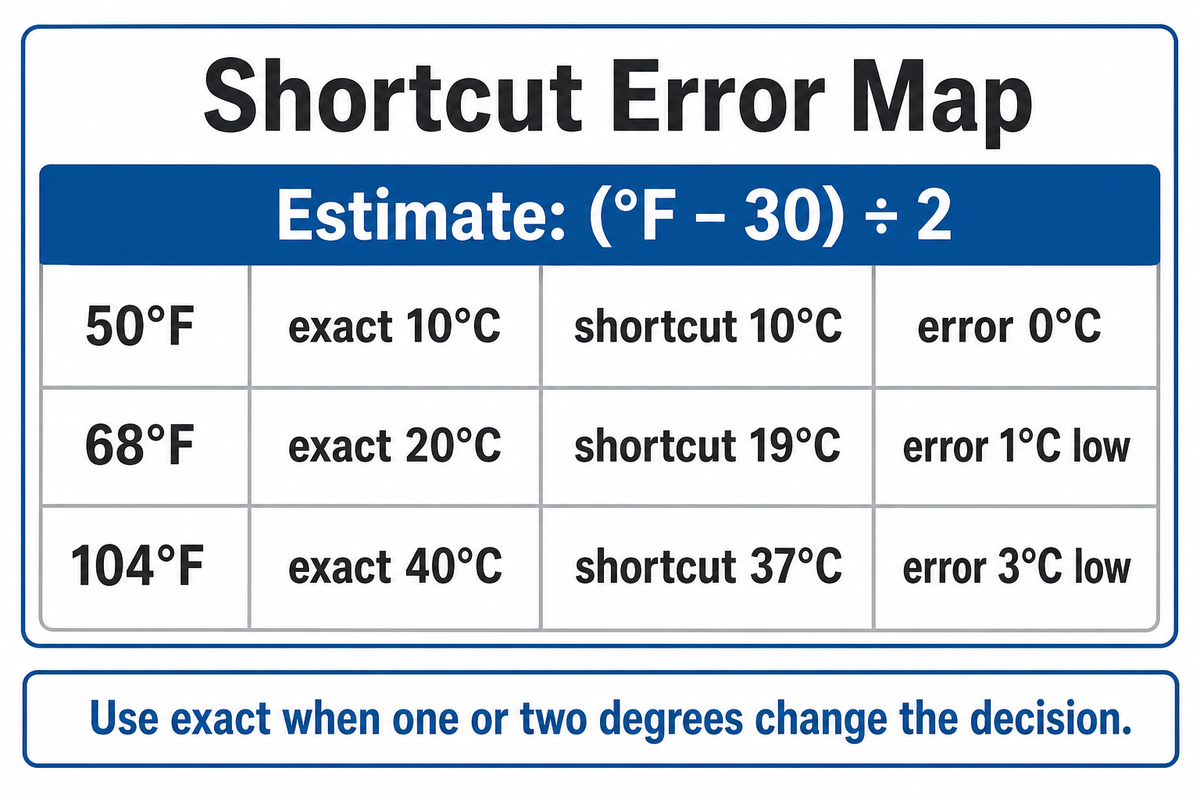
For a quick mental estimate, subtract 30 and divide by 2: °C ≈ (°F − 30) ÷ 2. Using the chart’s calculated pairs as a reference, it’s easy to see where this shortcut is useful. It isn’t an exact conversion and shouldn’t be copied into a specification, acceptance record, or machine setting.
The Shortcut Error Map shows exactly how the estimate behaves. If the shortcut result is S and the exact Celsius result is C, then:
S − C = (50 − °F) ÷ 18
At 50°F, the shortcut is exact. Below that point it estimates too high; above it the estimate runs too low. Error grows by 1°C for every 18°F you move away from 50°F.
| Fahrenheit | Exact Celsius | Shortcut | Absolute error |
|---|---|---|---|
| −40°F | −40.0°C | −35.0°C | 5.0°C |
| 32°F | 0.0°C | 1.0°C | 1.0°C |
| 50°F | 10.0°C | 10.0°C | 0.0°C |
| 68°F | 20.0°C | 19.0°C | 1.0°C |
| 86°F | 30.0°C | 28.0°C | 2.0°C |
| 104°F | 40.0°C | 37.0°C | 3.0°C |
| 212°F | 100.0°C | 91.0°C | 9.0°C |
Use the shortcut to decide if 68°F feels closer to 20°C than 30°C. Use the exact equation for oven settings, laboratory readings, production parameters, test reports, and purchase specifications. Follow one simple rule: if one or two degrees can change the decision, don’t use the shortcut.
No mental shortcut is perfect. This one is attractive because dividing by 2 is easier than multiplying by 5/9, but the convenience comes from changing both the offset and the scale factor. The two approximations cancel at 50°F and drift apart on either side. That’s why memorizing only “subtract 30, divide by 2” is less useful than memorizing its center point and error direction.
For a second mental method, subtract 32 and take slightly more than half of the remainder. At 86°F, the remainder is 54; half is 27 and the exact answer is 30°C. Adding about one-ninth of the half-result brings the estimate close to 30. This method is slower, but it preserves the correct zero point and makes the source of any remaining approximation easier to see.
The Reading–Delta Split: A Reading-or-Interval Fork
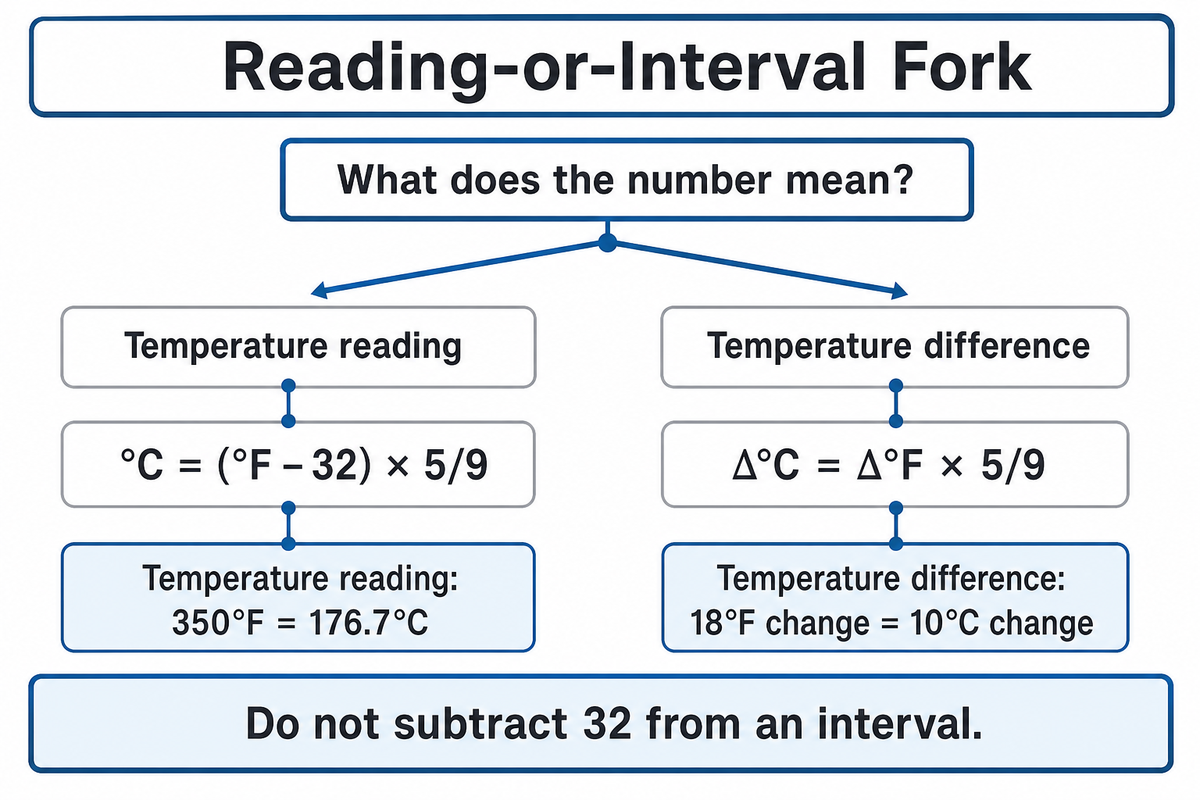
Is this number a position on the temperature scale, or is it a change between two readings? Before converting, ask that question. The mental estimate above concerns speed; this split concerns meaning. A reading uses the 32-degree offset. A difference doesn’t. This Reading-or-Interval Fork prevents one of the most plausible-looking conversion errors in technical documents.
| What the number means | Correct formula | Example |
|---|---|---|
| Temperature reading “The oven is at 350°F.” | °C = (°F − 32) × 5/9 | 350°F = 176.7°C |
| Temperature difference “Increase the setpoint by 18°F.” | Δ°C = Δ°F × 5/9 | 18°F change = 10°C change |
Applying the reading formula to an 18°F increase would produce −7.8°C, an answer that’s mathematically generated but semantically wrong. NIST Special Publication 811 Appendix B.8 removes the ambiguity by listing separate conversion rows for “degree Fahrenheit (temperature)” and “degree Fahrenheit (temperature interval).”
Tolerances follow the same distinction. A band of ±9°F is a ±5°C band, not −12.8°C. Convert the nominal reading with the offset formula, then convert the tolerance width with the interval formula. Keeping those two calculations separate is safer than converting the upper and lower limits after they’ve been rounded.
Consider a process target of 350°F ±9°F. The nominal reading is 176.7°C, and the tolerance is ±5°C, so the converted specification is 176.7°C ±5°C before any document-specific rounding. Converting the 341°F and 359°F endpoints separately also gives 171.7°C and 181.7°C, but only if every value remains unrounded. The split method shows the intent more clearly and lets a reviewer verify the nominal value and tolerance independently.
Rate statements follow the delta rule too. A temperature rise of 36°F per hour equals 20°C per hour. Because “per hour” describes an interval rate, the 32-degree offset never enters the calculation. The sensor span, deadband, or alarm separation uses the delta formula even when the underlying setpoints use the reading formula.
Weather, Oven, and Equipment-Spec Conversions
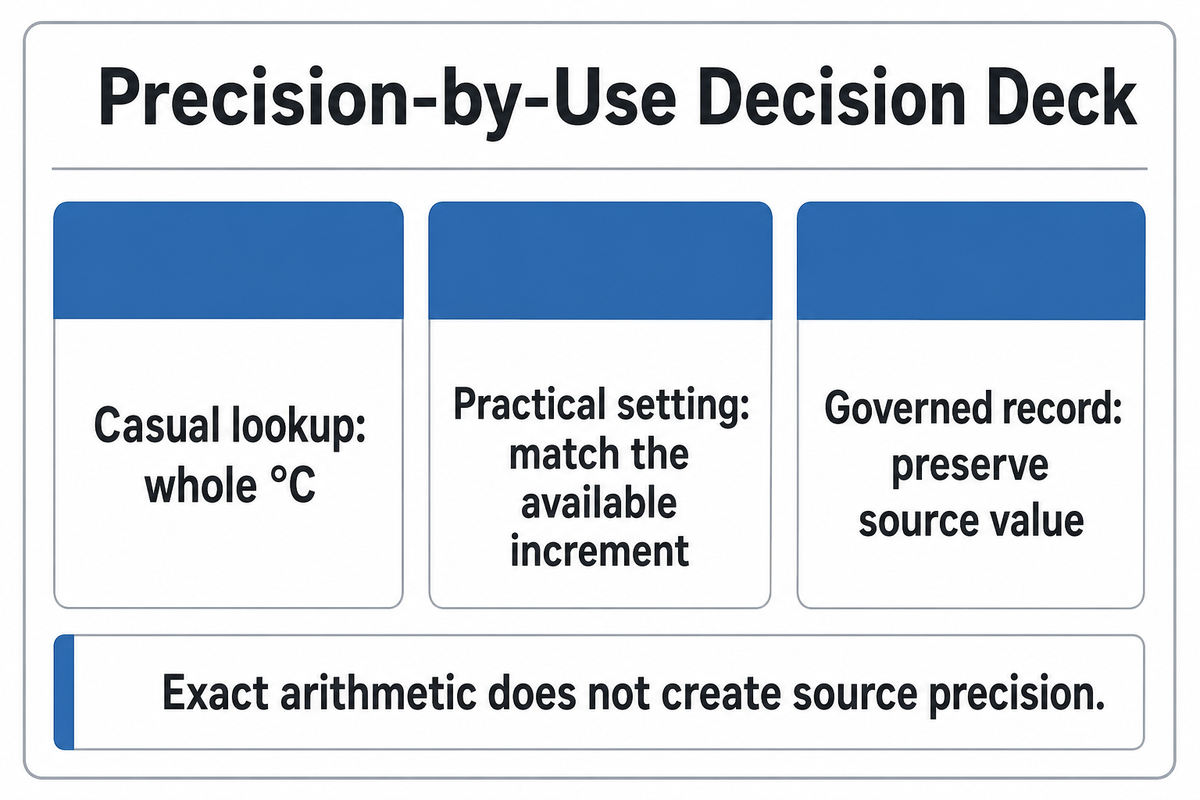
Even the NIST exact equation can’t guarantee that the input measurement is exact or that a rounded output retains the original reading. The reading-and-delta distinction from the previous section decides which conversion formula applies; the use case then decides how much rounding is appropriate. Choose precision from the decision the number supports. The Precision-by-Use Decision Deck below separates casual lookup, practical settings, and governed technical records.
| Context type | Method | Display | Do not use when |
|---|---|---|---|
| Casual weather comparison | Shortcut or exact formula | Whole °C | A one-degree difference changes the decision |
| Oven dial or recipe | Exact formula, then match available setting | Nearest selectable increment | The equipment manual gives a different approved setting |
| Travel packing | Shortcut | Whole °C | Weather extremes or warnings are involved |
| Home heating or cooling | Exact formula | Whole degree available on the thermostat | A controller uses a calibrated decimal setpoint |
| Machine setpoint | Exact formula | Same precision as the validated controller input | The governing process sheet specifies the original unit |
| Tolerance or temperature rise | Interval formula | Preserve tolerance resolution | Someone has applied the 32-degree offset |
| Cold-storage label | Exact formula | Precision on the approved label | The storage standard defines a unit-specific limit |
| Supplier quotation | Exact formula beside original value | Both units | The converted value would replace the source requirement |
| Test report or acceptance record | Convert from unrounded source data | Precision required by the test method | Only a rounded display value is available |
A National Weather Service observation FAQ documents a real round-trip loss. An automated station records 80°F, converts it to 26.7°C, and transmits a rounded 27°C value. Many websites converting that rounded value back obtain 80.6°F and display 81°F. Both equations were correct; the lost precision came from rounding the intermediate value.
This example separates three ideas that are often collapsed into “accuracy.” The conversion equation can be exact. The sensor or source reading still has finite resolution. The displayed result can lose another decimal when a reporting system rounds it. An accurate conversion therefore preserves the source measurement as far as the output format allows; it can’t create information that the source never recorded.
For equipment documents, the cleanest handoff uses a source field, a converted display field, and a stated rounding rule. A line such as “setpoint: 350°F (176.7°C calculated; controller entry 177°C)” exposes all three layers. A line that says only “177°C” hides the original requirement and makes later dispute resolution harder.
Technical handoff rule: store the original reading and its unit. Convert for display, but don’t overwrite the source value with a rounded conversion. This preserves auditability when suppliers, operators, and buyers work in different unit systems.
For equipment discussions, retain the original unit in the request and add the conversion beside it. That practice is useful when comparing temperature setpoints in temperature-controlled extrusion equipment and paper-making machinery, where controller resolution and process documents govern the final number. When a project value needs confirmation, send both the source and converted figures through UDTECH’s project contact form.
Common Formula, Rounding, and Precision Mistakes
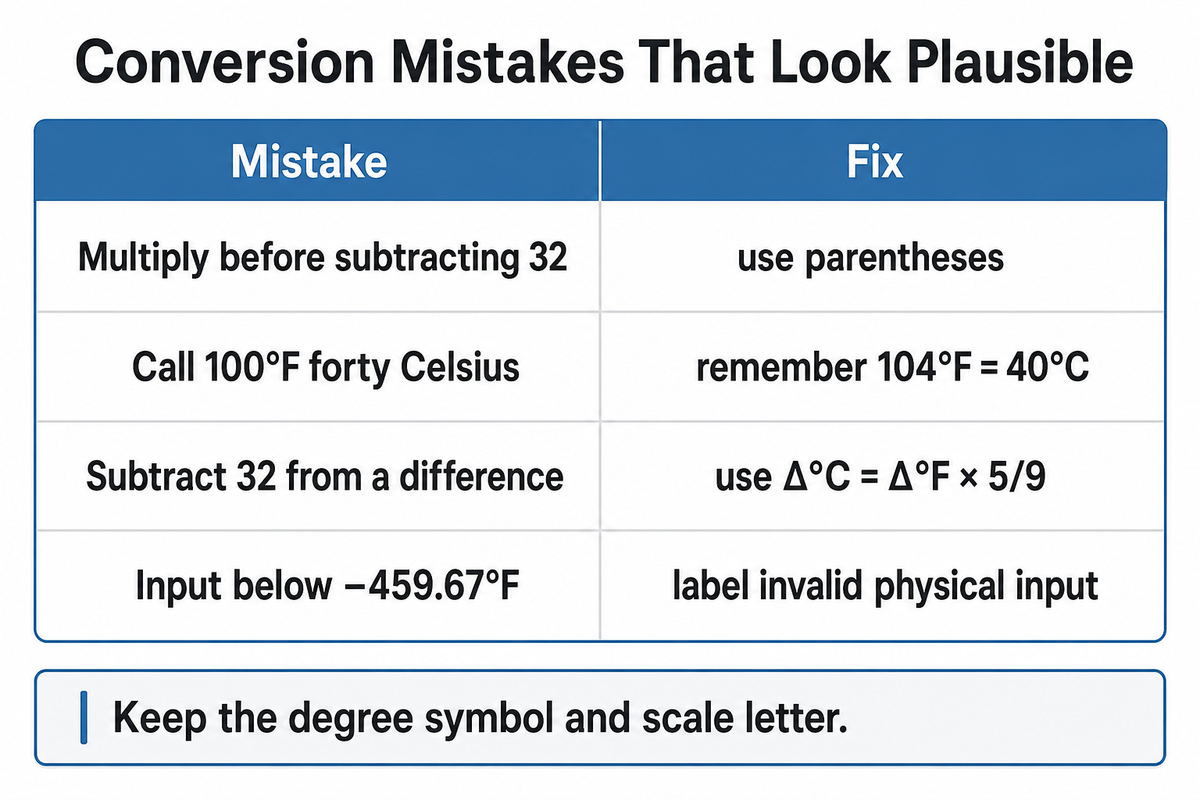
Most bad Fahrenheit-to-Celsius results aren’t random. The equipment handoffs above fail when the conversion loses its original unit or setpoint context. Other errors come from reversing the operation order, confusing readings with differences, rounding too early, or treating every official-looking page as error-free.
| Mistake | Consequence | Fix |
|---|---|---|
| Multiply before subtracting 32 | 77°F becomes an implausible 42.8°C | Use parentheses: (77 − 32) × 5/9 |
| Call 100°F “40°C” | Overstates the result by 2.2°C | Remember 104°F = 40°C |
| Subtract 32 from a difference | Turns an 18°F rise into a negative Celsius value | Use Δ°C = Δ°F × 5/9 |
| Round before the final step | Creates a round-trip mismatch | Keep source precision until display |
| Assume every numeric output is physically possible | A calculator accepts readings below absolute zero | Treat values below −459.67°F as arithmetic output, not a physical temperature |
Source ownership isn’t a substitute for reading the page. During research for this article, an official weather glossary displayed the correct conversion equation beside incorrect unit symbols for water’s freezing and boiling points. The page was rejected. For a number that affects a specification, trace the exact statement to a reliable page and check that the surrounding labels agree with the equation.
Absolute zero adds another boundary check. The NIST relationship to kelvin places 0 K at −459.67°F. A basic converter will still perform arithmetic on −500°F and return about −295.6°C, because algebra doesn’t know whether the input is physically realizable. When a result crosses a known physical boundary, label it as an invalid physical input instead of presenting the decimal as meaningful precision.
A final check is dimensional: the result must retain the degree symbol and scale letter. “25 degrees” is incomplete when a document moves between unit systems. Write 25°C or 77°F, and use Δ°C or Δ°F when the number is an interval. Those small labels carry the semantic distinction the arithmetic depends on.
Celsius to Fahrenheit Reverse Formula
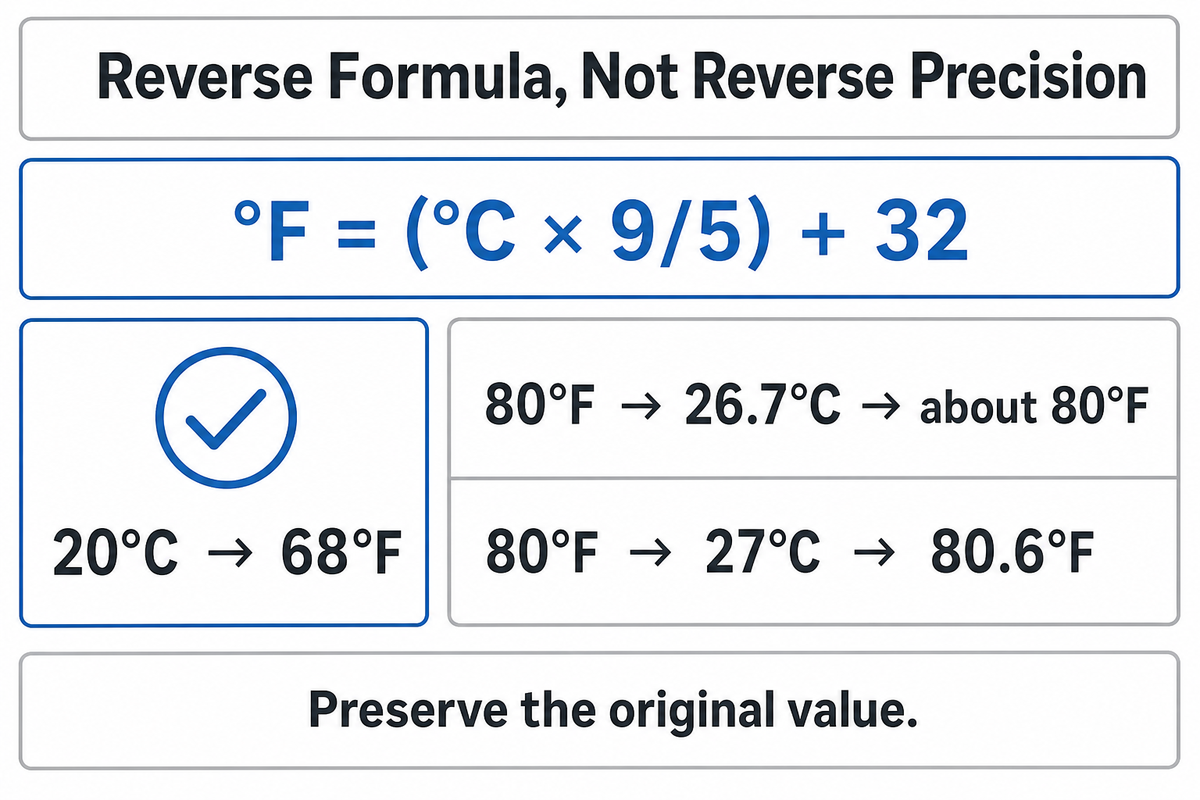
To convert Celsius to Fahrenheit, multiply Celsius by 9/5, then add 32: °F = (°C × 9/5) + 32. The same degree symbol and scale letter still matter when the conversion direction reverses. For 20°C, the calculation is (20 × 9/5) + 32 = 68°F. For 200°C, it gives 392°F.
A reverse calculation is a useful arithmetic check, but it can’t restore precision that was already rounded away. If you converted 80°F to 26.7°C and kept that decimal, the reverse returns about 80°F. If you stored only 27°C, it returns 80.6°F. Preserve the original value whenever the record must be reversible.
To convert temperatures in a two-column specification, calculate both directions from one authoritative source column rather than converting each column back and forth. Mark the source column, lock its values, and regenerate the display column if the rounding policy changes. This prevents a one-degree display difference from being mistaken for a changed process requirement.
For other unit handoffs, use UDTECH’s reverse check for metric-source dimensions or the source-unit handoff guide for inch drawings. The same rule applies: keep the source unit and round only for the intended display or specification.
Fahrenheit to Celsius FAQ
What is the formula for Fahrenheit to Celsius?
Show answer
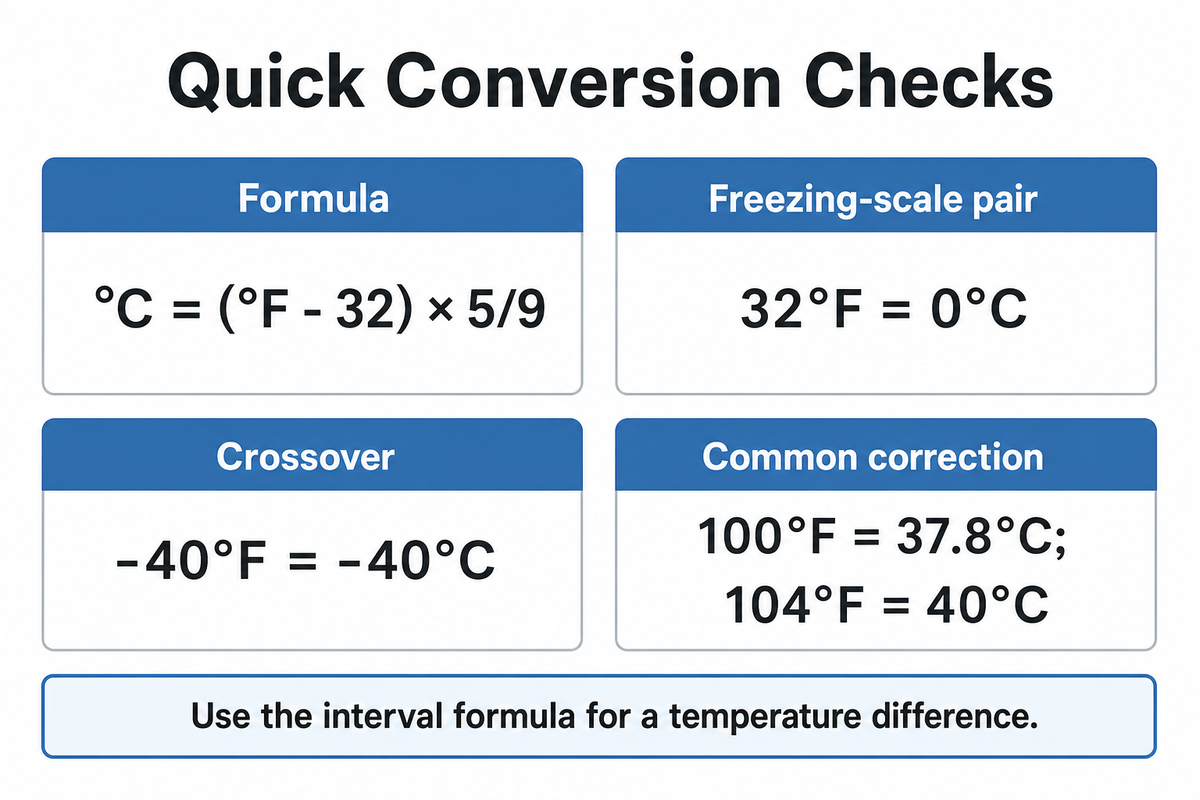
Subtract 32 from the Fahrenheit reading and multiply by 5/9: °C = (°F − 32) × 5/9. Dividing by 1.8 gives the same result because 9/5 equals 1.8. Complete the subtraction first, carry the unrounded value through the calculation, and round only for the precision your context needs. For a temperature difference, use Δ°C = Δ°F × 5/9 without the 32-degree offset. The same source-unit and display-rounding rule used above still applies.
How do you convert F to C fast?
Show answer
For a rough mental estimate, subtract 30 and divide by 2. The shortcut is exact at 50°F, about 1°C low at 68°F, and 3°C low at 104°F. Below 50°F it estimates too high; above 50°F it estimates too low. Use the exact formula for a specification, test result, oven setting, or any decision where a one- or two-degree difference matters.
Is 100°F equal to 40°C?
Show answer
No. 100°F equals 37.777…°C, usually shown as 37.8°C. The exact 40°C reference is 104°F. You can verify it directly with (104 − 32) × 5/9 = 40. The common mental shortcut gives 35°C for 100°F, so it is not suitable when the difference between 35°C and 37.8°C affects the decision.
What is 32°F in Celsius?
Show answer
32°F equals exactly 0°C as a scale conversion: (32 − 32) × 5/9 = 0. It’s also the familiar approximate freezing point of water under ordinary reference conditions.
At what temperature are Fahrenheit and Celsius equal?
Show answer
The scales are equal at −40: −40°F = −40°C. Substituting −40 into the exact equation returns the same number.
Which is warmer, 30°C or 30°F?
Show answer
30°C is much warmer. It equals 86°F. By contrast, 30°F equals about −1.1°C.
Why does the formula subtract 32?
Show answer
Fahrenheit and Celsius place zero at different points. Subtracting 32 aligns the Fahrenheit reading with the Celsius zero point before the 5/9 scale factor adjusts degree size. Temperature differences don’t use this offset because they measure a span, not a position on either scale.
References & Sources
- National Institute of Standards and Technology, SI Units: Temperature
- NIST Guide to the SI, Appendix B.8, temperature readings and intervals
- International Bureau of Weights and Measures, SI Brochure Annex 1: Thermodynamic Temperature
- National Weather Service, observation conversion and rounding FAQ
- NASA Dryden Flight Research Center, Celsius to Fahrenheit conversion chart
Method note: chart values and shortcut errors in this article were calculated from the NIST exact equation. Physical reference points are described separately from mathematical identities. Editorial and semantic integrity checks were completed before publication.