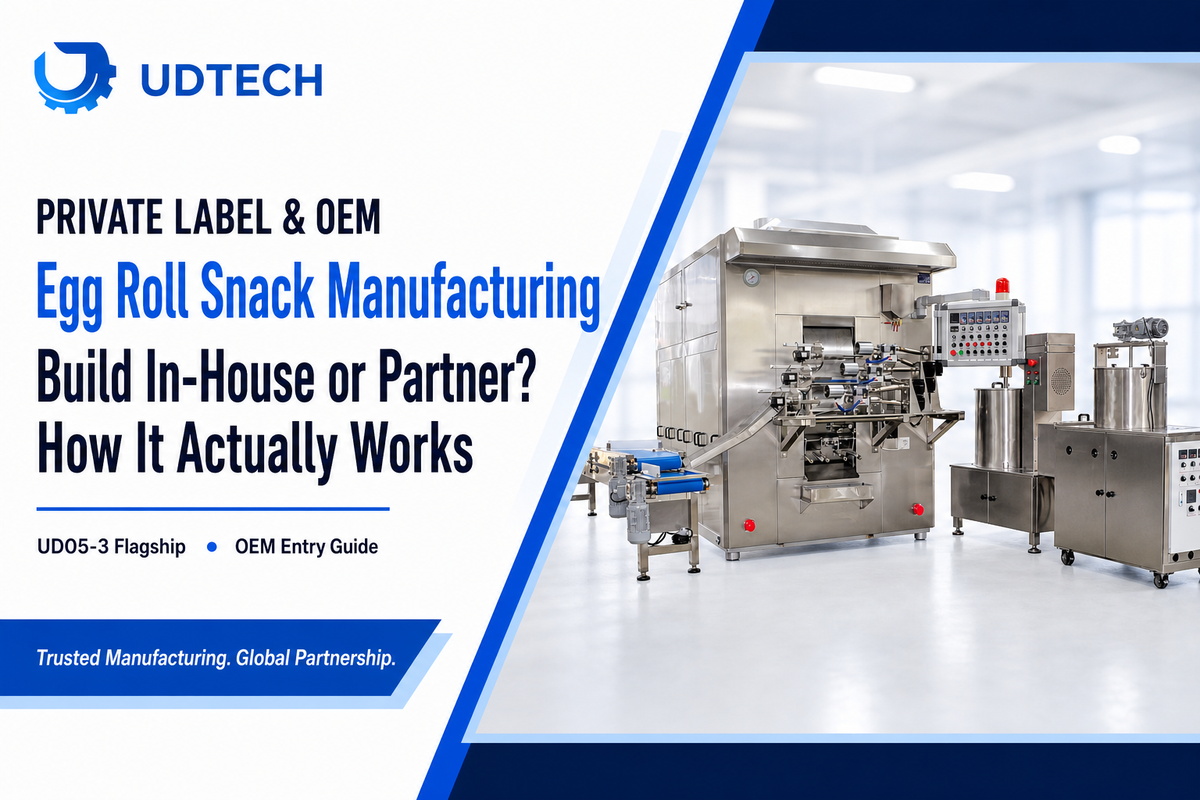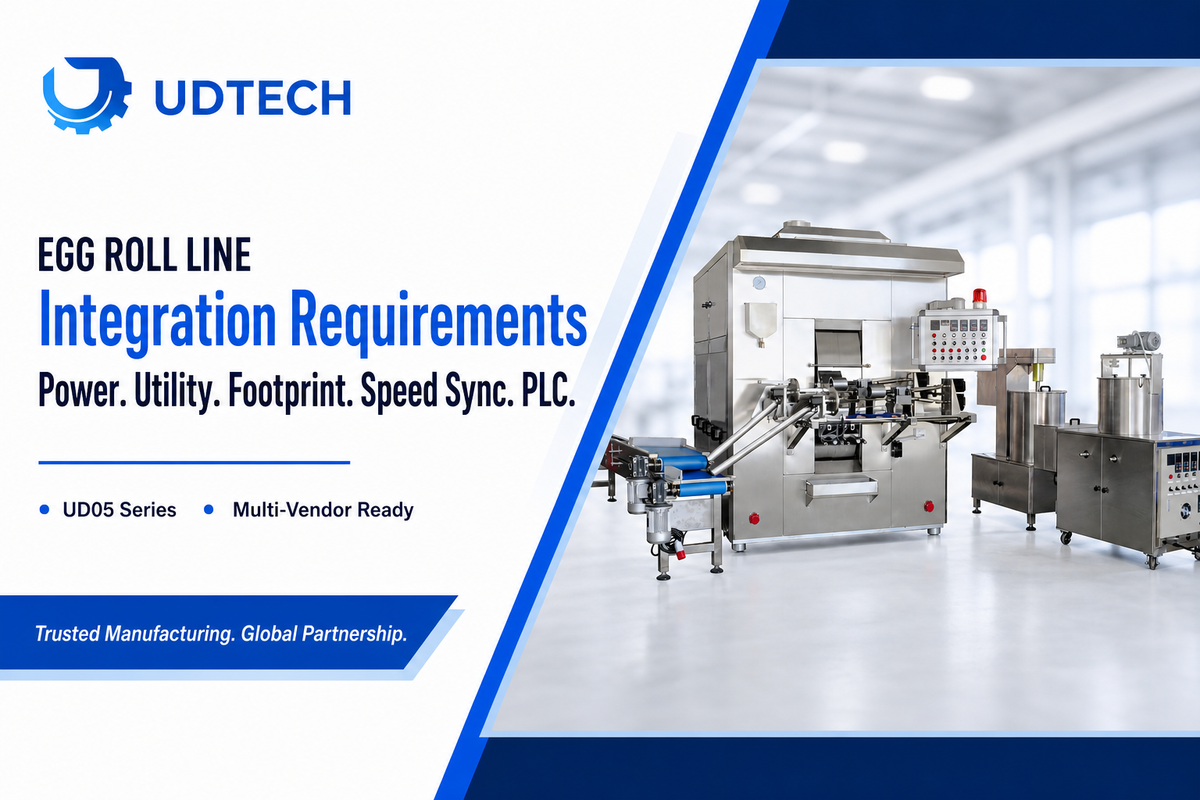
Egg roll line integration requirements are the electrical, utility, footprint, speed-sync, and PLC-protocol checks a facility must confirm before a new or additional line goes into production.
Quick Specs
| Electrical draw | 9.7 kW (UD05-2) / 12 kW (UD05-3), 380V/50Hz (220V/60Hz optional) |
| Gas consumption | LPG ~6-8 kg/h or natural gas ~8-10 m³/h, model-dependent |
| Machine footprint | 4.2 × 3.7 m (15.5 m²), single-side operator access |
| Output rate | 220-330 pieces/minute (factory-measured, UD05-class rotary-drum line) |
| Controls | Onboard PLC (temperature/combustion) — plant-level protocol confirmed separately per supplier |
An egg roll line integration requirements checklist needs to address much more than just a single machine’s spec sheet, whether you’re speccing a commercial egg roll machine for a first line or adding a second to existing food machinery. The wafer egg roll machine – the egg roll wrapping machine that does the dough sheeting, deposits filling, and rolls up the finished unit – is but one element of a line that must have electrical headroom, a verified utility source, adequate floor space, upstream and downstream equipment synchronized at line speed, and a controls solution that integrates effectively with the broader plant systems. (Note: If comparing wafer lines vs. savory spring roll machines, you can find more info on that subject elsewhere).
Adding an egg roll line means planning for enough extra room in your electrical panel over and above the machine’s plain nameplate kW, making sure you’ve confirmed both the gas and compressed-air utility supplies before ordering, and ensuring the machine’s PLC can talk with the rest of the plant’s automation – and not just run its own temperature and combustion controls. You miss even one and you most likely have an installation delay.
- You shouldn’t budget on the kW value found on the machine’s nameplate – the real food-facility tests prove total panel load increase by 54 to 84% over that number when a new line is implemented.
- Air is that utility everyone never seems to ask about up front – it’s not specified in any egg roll equipment section at all, and not on this guy’s website, or his product brochures.
- It’s easy to believe the egg roll machine is the line’s bottleneck. Usually, it’s not.
- Machine controls on an onboard PLC regulating its own combustion temperature is one layer, while an onboard PLC able to log to a plants SCADA/MES system is another. The gap is the single most underappreciated element in the system integration.
| Category | Requirement | Typical value |
|---|---|---|
| Electrical | Panel headroom above nameplate kW | +54% to +84% |
| Electrical | Line voltage | 380V/50Hz (220V/60Hz optional) |
| Utility | Gas consumption | LPG 6-8 kg/h or NG 8-10 m³/h |
| Utility | Compressed air | Assess per auxiliary station (CFM/psi) |
| Footprint | Machine footprint | 4.2 × 3.7 m (15.5 m²) |
| Footprint | Access clearance | Operator-side + conveyor runs both ends |
| Throughput | Output rate | 220-330 pieces/minute |
| Controls | Onboard PLC scope | Temperature/combustion control only |
| Controls | Plant-level protocol options | Modbus, Profinet, EtherCAT, or OPC-UA |
| Commissioning | Hazardous-energy control | Lockout/tagout per OSHA 1910.147 |
How Much Electrical Power Does an Egg Roll Line Actually Draw?
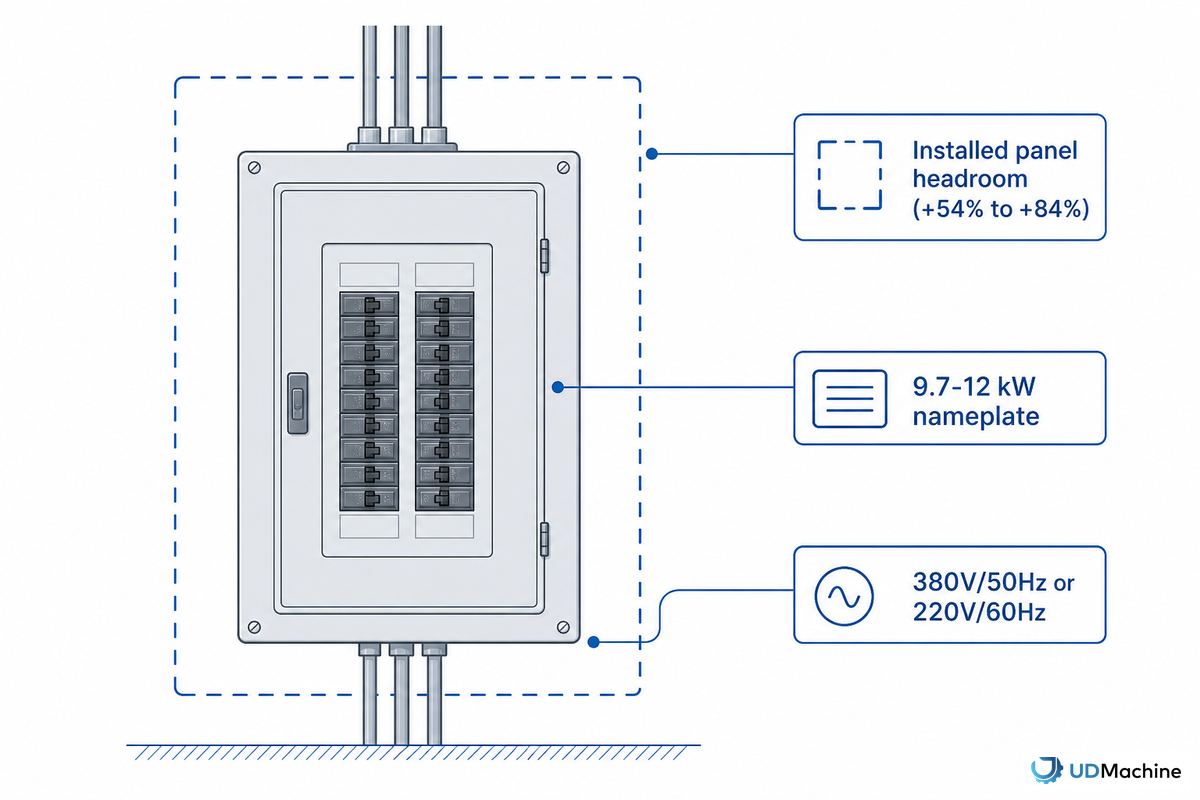
Factory-measured figures put the UD05-2 at 9.7 kW and the UD05-3 at 12 kW, both at 380V/50Hz (220V/60Hz optional) – on-site readings, not catalog guesses. That nameplate kW number is where an electrician starts a panel schedule. It is not where the schedule ends.
A study funded by a California utility on all-electric commercial food facilities found that adding new processing equipment commonly pushes a facility’s overall electrical load 54-84% above the new equipment’s own rating, and adds $1,600 to $7,400 to demand charges depending on utility rate structure.[1] That gap comes from starting motor inrush, extra conveyors, control cabinets riding the same new circuit, and lighting or ventilation added alongside the line – none of which show up on the egg roll machine’s own nameplate.
Applying that 54-84% range to a UD05-3’s 12 kW nameplate draw gives a real panel-headroom budget of roughly 18.5 kW at the low end (12 × 1.54) to 22 kW at the high end (12 × 1.84) — not 12 kW. Ask your electrical contractor to size the new circuit and breaker against that range, and confirm against OSHA’s wiring and equipment-grounding requirements for the branch circuit before final sign-off.[2]
Voltage and phase can be just as important as the pure kW rating. By default, the UD05 models come configured for 380V/50Hz electronics; we can order the control package to be built as 220V/60Hz if required – just tell us the appropriate voltage before your unit goes to the factory floor, not after it has arrived on the truck at your site. If you’re still in the “what model should I buy?” stage instead of the “what size panel do I need?” phase, the egg roll machine buyer’s guide has more detail on choosing the right capacity.
| Machine | Nameplate kW | Budget panel headroom |
|---|---|---|
| UD05-2 | 9.7 kW | ~15-17.8 kW |
| UD05-3 | 12 kW | ~18.5-22 kW |
Gas and Compressed Air, The Utility Requirement Nobody Asks About
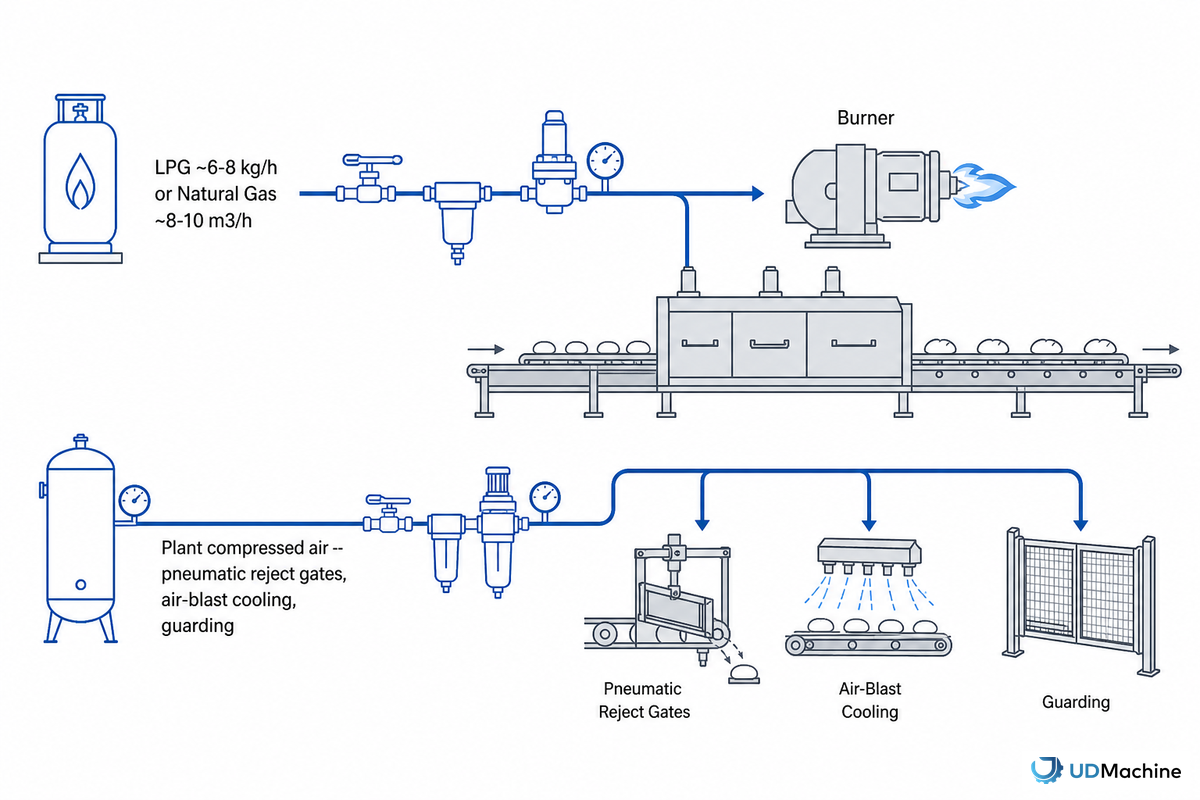
UD05 Both models are available with multi-fuel burner options and a choice between natural and LPG gas fuels – around 6-8 kg/hr (LPG) or 8-10 m³/h (natural) (dependent on model and rated output). The selection of the preferred fuel should be finalized upfront due to differences between delivery dates for equipment, installation, venting and piping. Coordination failures between these items have been reported as a significant source of installation delays in the food industry.[3]
Whether the filling is meat, vegetable, or a blend, the lesser half of the utility conundrum is compressed air; the usage is also almost absent from records in this class of equipment – including from this manufacturer’s product catalog, in which there’s a detailed page-by-page record of the food line gas consumption, but not one mention of compressed or plant air – not because compressed air is never needed. Pneumatically activated rejection gates, cylinder-actuated guards, prepackaging air-blast cooling, and many pieces of auxiliary equipment bolted to the line are usually supplied by the plant’s compressed air, and the sizing calculation is readily available for any plant or factory environment even where it’s missing from a food equipment manufacturer’s specs: it’s common to cite the rule of thumb that at a reference pressure of 100 psig, each increment of 2 psig increased air header pressure is associated with an increment in compressor input power of about 1 percent.[4]
Compressed air supply isn’t just about utility sizing, it’s about food safety: it’s easy to overlook compressed air on a food production line as a “utility sizing issue,” but in fact, it’s a food-safety requirement on its own. The FDA’s 21 CFR 117.40 current good manufacturing practice (GMP) rule for human food states that compressed air and other gases used to mechanically incorporate them into food, or to clean food contact surfaces or equipment, shall be filtered in a way so that food is not contaminated. [14] Practically, what this means is that the compressed air in a food line is not just a pressure consideration in terms of running a cylinder, but needs filtration suited for food environments, regardless of whether the source is a dedicated food grade compressor or the general plant compressed air.
Think of “what utilities does this machine need” as one gas-only question. Any station downstream that uses compressed air — a pneumatic reject sorter, an air-operated case sealer, a high-velocity air-knife dryer before a freezing application — needs that air demand factored into the overall plant air compressor capacity before the line even reaches the site.
Create a utility request checklist for the machine before it’s shipped: -Confirmed gas fuel and gas rate -Yes or no as to whether your auxiliary station will require compressed air (with estimated CFM and psi if the answer is yes) -Gas utility or AHJ estimate of permit lead-time (don’t make any assumptions going into commission week)
Footprint Isn’t Just Floor Space, It’s Integration Clearance
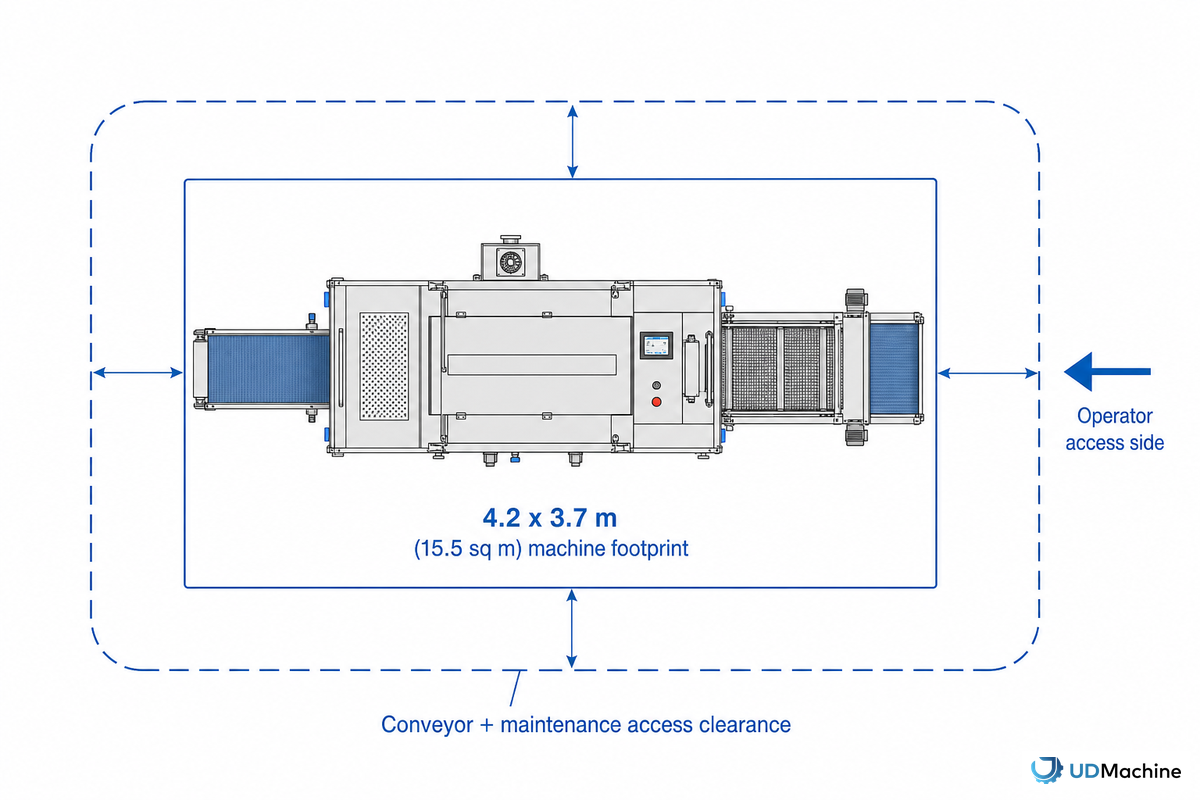
Published UDTECH machine footprint runs 4.2 × 3.7 m (15.5 m²) for each of the UD05’s two models, with operator-side clearance meant to allow single-side loading with conveyors on the other side. That last piece of information is more important than the merely square-meters: the true footprint must include the conveyor run leading to and from it, plus operator-side clearance for cleaning and maintenance access – the factory layout question is never just about the machine’s own footprint.
Published guidance on building a food production line tends to say the same thing – retrospective facility layout and equipment placement are costly to change, and saving investment dollars with headroom above published equipment dimensions is cheaper out in the dirt than it’s once you’ve poured the slab. [5]
Operator works one side; cooling/packaging conveyors join from the opposite side. Takes a longer overall run (machine + both conveyor extensions) but keeps the operator aisle clear and makes cleaning easier.
Fits a shorter overall footprint in a constrained bay, but comes at the expense of more difficult maintenance access and the inconvenience of requiring operators to cross conveyor routes – a compromise that, only when the bay is a critical dimension, can be deemed reasonable.
Matching Line Speed: The Wrong-Bottleneck Assumption
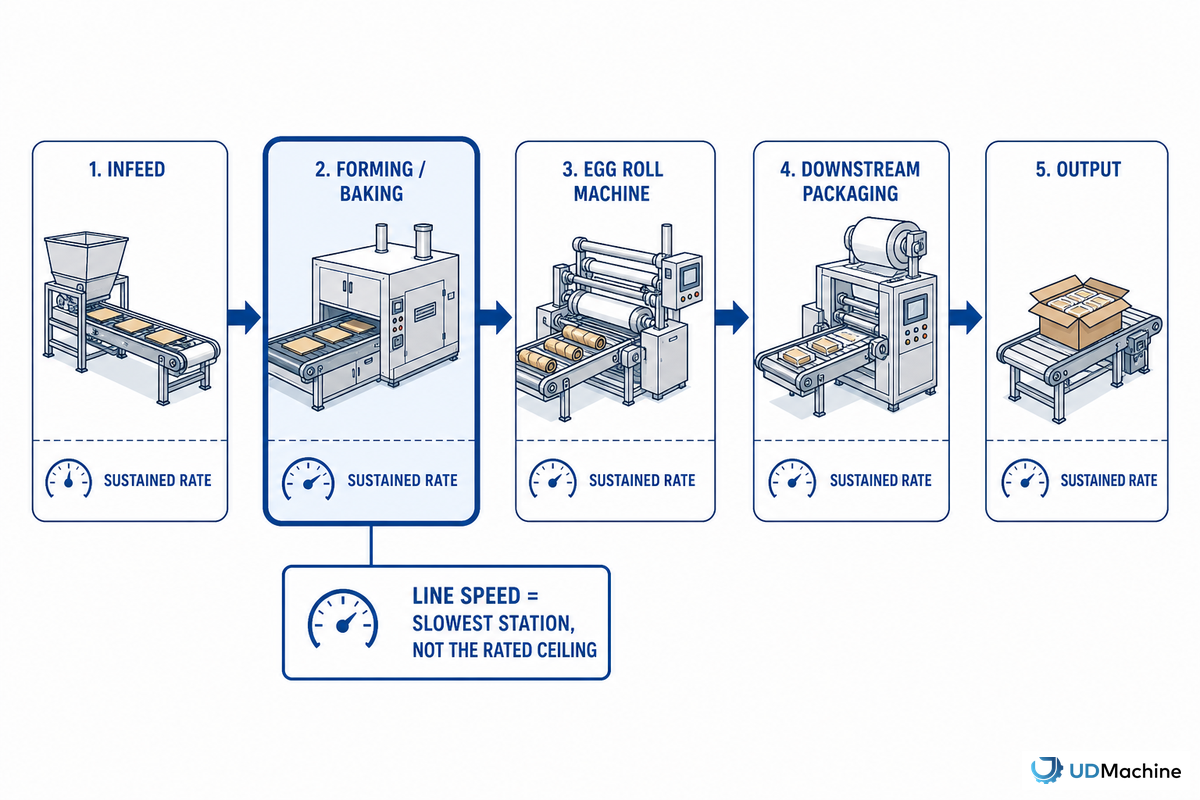
A UDTECH UD05-class rotary-drum wafer egg roll line can produce 220-330 parts per minute – roughly 13,200-19,800 pieces per hour across a full shift – a range measured in a real-world operating environment at the UDTECH factory rather than a promotional pitch. The real question of integration isn’t ‘can the egg roll machine do that’ – it almost always can – but ‘can everything that comes before it and everything that comes after it do that.’
The Wrong-Bottleneck Assumption
The assumption that the newest, most automatic machine on a line must be its bottleneck is usually wrong – it’s more often a machine further upstream or downstream that constrains the entire process.
In empirical observation, the newest, most automated piece of equipment on the line is often assumed to be the constraint, when the real constraint can often be a mundane element either further upstream or downstream, such as product variation, upstream feeding inconsistencies, guide rails in need of replacement, or even just a slight misalignment that persists over several hours of operation. [6] A similar observation from general manufacturing is that a line doesn’t always operate at its rated maximum speed; the station where work piles up is the line’s real bottleneck, not necessarily the station with the highest apparent workload. [7]
‘Every station on a line has to be rated above your target output, not just meet it. If your oven or fryer can only turn out 1,500 pieces an hour, a forming machine rated for 2,400 does not give you 2,400 – it gives you 1,500, and the rest of that rating is fiction until the rest of the line catches up.’
In practice this translates to regarding speed-matching as a line-wide audit, not a single spec comparison: map out every station from raw-material infeed through final packaging, jot down the real world sustained rate (not the rated ceiling; a thin fill deposit or slightly under-hydrated wrapper dough can easily pull the forming station well below its rated number) for each one, and size any new station -egg roll machine or otherwise – according to whatever existing station proves slowest. Readers sizing an entire line instead of an individual machine may find sizing your line to demand a useful companion piece – it covers the capacity-planning math which this section assumes as a starting point.
PLC Protocol Compatibility: Modbus, Profinet, EtherCAT, or OPC-UA?
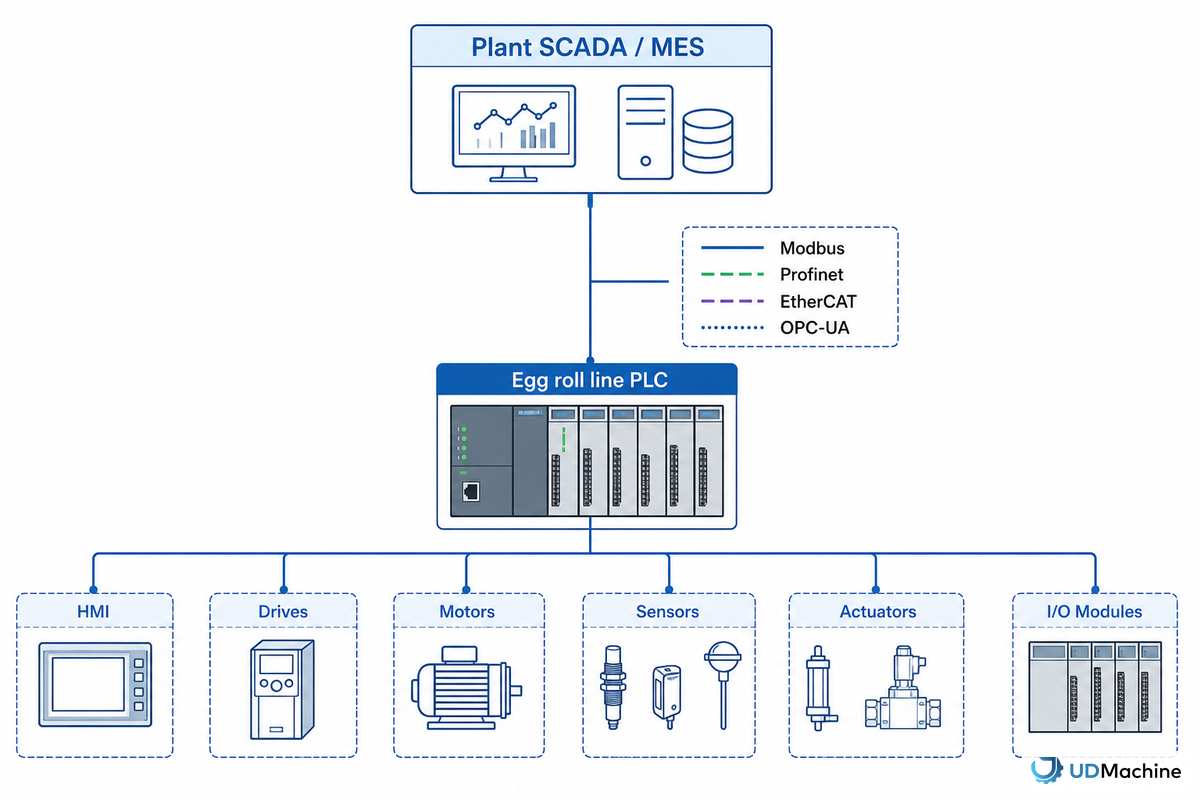
Egg roll lines typically use whichever protocol matches the plant’s dominant automation platform: Modbus for simple legacy integrations, Profinet inside a Siemens-standardized facility, EtherCAT for tight motion control on the machine itself, and OPC-UA when the line must exchange data across multiple vendor brands and a central SCADA/MES system. Confirm the specific protocol with your supplier before signing, since not every egg roll machine PLC exposes all four.
Machine-Ready vs. Line-Ready
Machine-ready is a PLC doing its own process right, on its own. Line-ready means that plc can do its own process right, and can also talk to the rest of the plant.
An egg roll machine that contains its own stable PLC that performs good temperature control and combustion control is machine ready, doing its own process right, on its own. Line ready is another matter; this machine’s PLC must also be able to expose its data and accept commands via whatever communication protocol your existing plant automation systems already use.
Existing industry coverage of energy management makes the distinction explicitly clear: the goal is to create an integrated layer of power monitoring, controls, and communication throughout your facility-not just to install good controls on individual machines[8]. Increasingly, that integration layer relies on OPC-UA, a cross-vendor open standard defined by the OPC Foundation and published as IEC 62541, which the IEC committee last revised in March of this year.[9]
| Protocol | Typical use case | Integration effort |
|---|---|---|
| Modbus (RTU/TCP) | Simple register-level data exchange with legacy PLCs | Low — widely supported, minimal configuration |
| Profinet | Real-time control within a Siemens-centric plant network | Medium — strong within one vendor ecosystem, added effort outside it |
| EtherCAT | High-speed motion/servo synchronization on the machine itself | Medium — excels inside a single machine, less common as a plant-wide bus |
| OPC-UA | Vendor-neutral data exchange between mixed-brand equipment and plant SCADA/MES | Medium-High upfront — but lowest long-term lock-in across a multi-vendor line |
Vendor preference usually dictates the specific protocol rather than some elegant process-mapping rulebook; a predominantly Siemens plant will standardise on Profinet, no matter the application, while a Beckhoff based line will often lean towards EtherCAT. There’s no “one” protocol for all cases: OPC-UA represents the emerging, open-standards integration layer between plants which can’t standardise on one PLC vendor throughout. OPC-UA isn’t a substitute for a machine’s own, tight, real-time process bus: independently published data on embedded OPC-UA implementation cautions that the overhead in terms of memory and processor performance can make it a poor fit for “hard real-time” applications, which is why it tends to run above such real-time buses as EtherCAT or Profinet as a plant-wide information layer.[17] The question to ask any potential egg roll machine vendor is what protocols the machine’s PLC natively offers and how those protocols can be bridged to plant standard-which question should be posed and answered, before you sign the purchase order.
Coordinating Multiple Equipment Suppliers on One Line
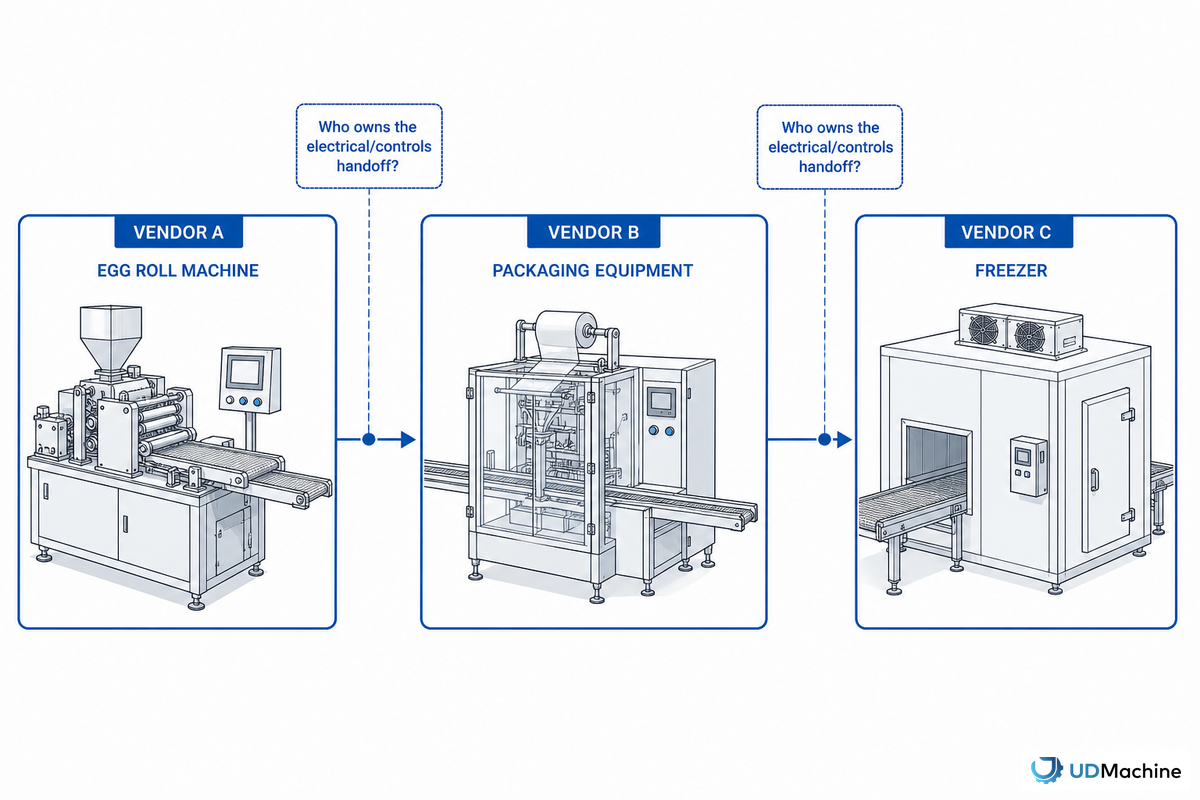
When the egg roll machine, packaging line and freezer come from three different suppliers, at least one dimension of the problem is based on a de facto standard: PackML (an Organization for Machine Automation and Control, or OMAC, initiative that was adopted by ISA as TR88.00.02) dictates standard machine states and behaviors “regardless of which machine and what control system manufacturer” they come from.[15] This covers the problem of technical vocabulary for packaging machinery – not the problem of commercial terms. It doesn’t address the question of whose specifications are governing the physical and electrical handover between machines, nor who carries the risk of integration if there are problems with that handover. Even machine builders of egg roll equipment tacitly acknowledge the gap; a major competitor advertises that they’ll answer buyers’ concerns about “managing multiple equipment suppliers” with a single-source turnkey system, rather than proposing a common framework that buyers can use to integrate machines from various vendors.[10] This works fine if a buyer want to deal with only one vendor. It doesn’t work if a plant has multiple machines from different suppliers and wants the machines to have a common state language, and needs a written contract that establishes who’s responsible if the handover go awry.
| Interface point | Who should specify it | Common failure if unowned |
|---|---|---|
| Mechanical handoff (infeed/outfeed height, speed) | Line integrator or plant engineer, not either machine vendor alone | Conveyor height/speed mismatch discovered at commissioning |
| Electrical/controls interface (PLC protocol) | Plant controls engineer or a dedicated PLC system integrator handling the PLC SCADA system integration work, confirmed in writing by both vendors before order | Protocol mismatch requiring a costly retrofit gateway |
| Utility supply (power, gas, air) | Plant facilities/engineering, sized to combined equipment load | Undersized panel or compressor discovered after delivery |
Installation, Commissioning and Operator Readiness
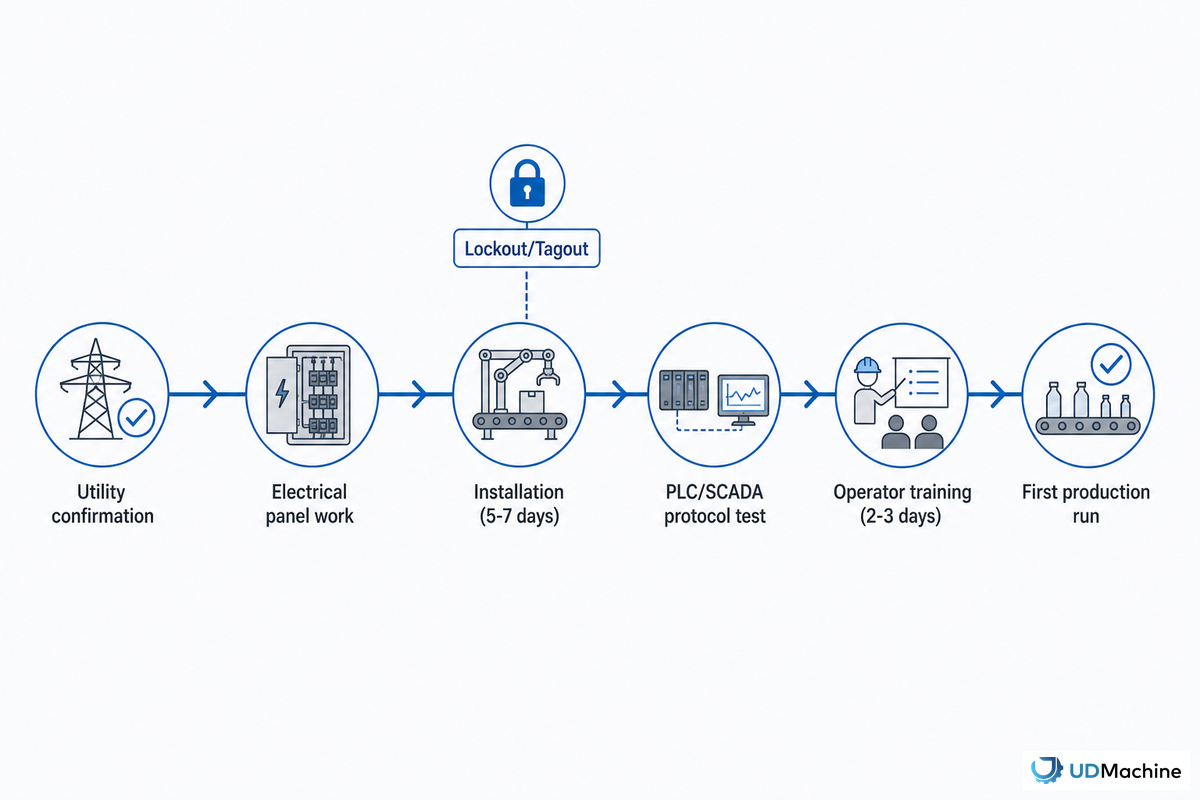
Once utilities, footprint and control integration are cleared on paper, the actual commissioning follows a routine: tie in utilities, perform a dry run without product, handshake PLCs with existing plant systems (as needed), then provide operator training prior to placing the line into service, an established sequence of events for this group of equipment.
- Hook up utilities per the specifications confirmed during panel headroom and gas/air requirements verification.
- Lock out/tag out new equipment before starting the dry run in accordance with OSHA’s requirements for hazardous energy control.[11]
- Install point-of-operation guarding on all rollers, formers and cutters before commencing operation; this differs from LOTO as it guards ongoing machine operation (e.g., ingoing nip points, moving components).[16]
- Test PLCs against plant SCADA/MES using the protocol confirmed during the vendor handoff discussion above.
- Train operators on this custom line configuration rather than generic training – if you’re still working out startup sequencing at a higher level, starting an egg roll production line covers that ground in more depth.
Lock out/Tag out procedures matter most right here, during commissioning, because a new line has more exposed electrical wiring and open moving parts at this stage than it will ever have again in full operation; the OSHA standard on control of hazardous energy is meant for this period of maintenance, adjustment, and testing.[11]
Where Multi-Vendor Line Integration Is Headed
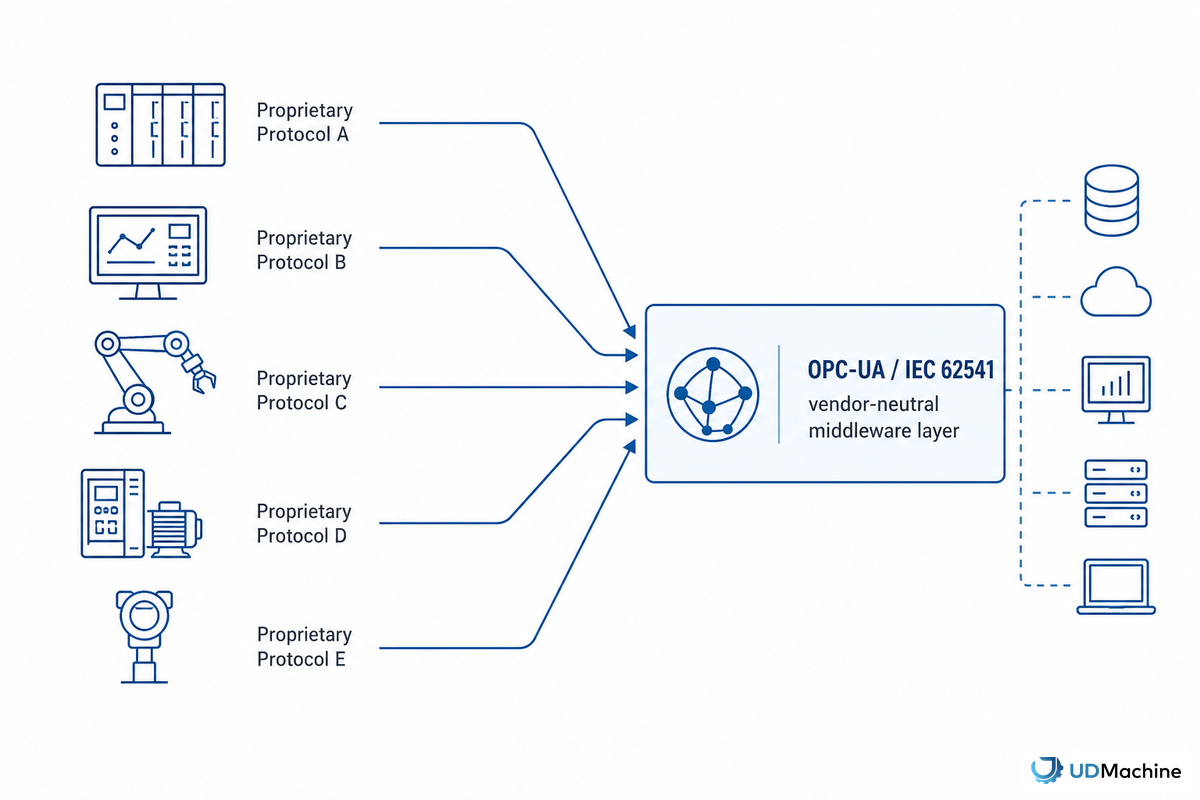
Buyers don’t care about a market-size number – they care that industrial controls are consolidating around standardized, vendor-neutral protocols to reduce the multi-vendor integration friction described above. Core PLC programming still anchors machine-level control, but the layer connecting machines from different vendors is increasingly OPC-UA-class middleware, not a single vendor’s proprietary bus.[12] The OPC Foundation’s 2026 update to IEC 62541 is a concrete, dated data point in that direction, not a projection.[9]
For a plant planning a 2026 or 2027 line addition, the practical action is to ask every equipment vendor – egg roll machine included – which protocols they support today and which they’re adding, rather than assuming today’s protocol list will be sufficient two purchase cycles from now.
Market-size context only: several market-research firms estimate double-digit CAGR growth for OPC-UA-related connectivity software through the early 2030s.[13] That figure is directional background, not the basis for the recommendation above – the case for standardized protocols rests on integration friction, not market size.
The 5-Point Line-Integration Go-No-Go
A five-question pass/fail check across electrical, utility, footprint, speed and controls before placing an order.
- Electrical: Is the panel budgeted at nameplate kW plus 54-84% headroom, not the bare machine rating?
- Utility: Is the gas type confirmed AND has compressed-air demand been assessed for every auxiliary station (even if the answer is “none needed”)?
- Footprint: Does the layout include clearance for conveyors and maintenance access, not just the bare machine dimensions?
- Speed: Has the slowest station in the entire line – not just the egg roll machine – been identified and rated against it?
- Controls: Has the PLC protocol been confirmed compatible with the plant’s existing SCADA/MES in writing, before the order is placed?
Q: What certifications does an integrated egg roll line need beyond the machine itself?
View Answer
Q: Can one PLC control both the egg roll machine and adjacent packaging equipment?
View Answer
Q: How much compressed air does an egg roll line typically require?
View Answer
Q: What’s a realistic timeline from utility confirmation to first production run?
View Answer
Q: Does upgrading from a semi-automatic to a fully automatic line change my utility requirements?
View Answer
Q: Who is responsible for the electrical/controls interface when equipment comes from multiple suppliers?
View Answer
Review UDTECH UD05 Series Specifications →
Why We Write This
Integration questions – panel sizing, compressed air, protocol compatibility – consistently surface after a machine is purchased, not before, based on the factory-measured specifications and installation documentation UDTECH maintains across its UD05 wafer egg roll line. We wrote this guide for the engineering and plant-management stage that follows a purchase decision, not the purchase decision itself. Reviewed by the Suzhou UDTECH Technology Co., Ltd. technical team.
References & Sources
- All-Electric Commercial Kitchen Electrical Requirements Study — CalNEXT (California utility ratepayer-funded research program)
- 1910.305, Wiring methods, components, and equipment for general use — U.S. Occupational Safety and Health Administration
- When Good Integrations Go Bad — Food Industry Executive
- Compressed Air Systems — Business Energy Advisor
- How to Build a Food Production Line for Your Business — Digit Software
- Before Adding Another Production Line, Find the Real Bottleneck — CN Welldone
- How to Find and Reduce Bottlenecks in Production — Eliter Packaging
- Improving Energy Management in Food and Beverage Production — IndustryWeek
- Update for IEC 62541 (OPC UA) Published — OPC Foundation
- Egg Roll Machine and Automatic Production Line — ANKO Food Machine Co., Ltd. (competitor marketing page, referenced for its own stated buyer pain point)
- 1910.147, The control of hazardous energy (lockout/tagout) — U.S. Occupational Safety and Health Administration
- Industrial Automation in 2026: Why PLC Programming Still Matters — RL Consulting
- OPC-UA Gateways for Legacy PLC Integration Market — Fact.MR (market-size context only)
- 21 CFR 117.40, Equipment and utensils — U.S. Food and Drug Administration
- PackML — Organization for Machine Automation and Control (OMAC), adopted by ISA as TR88.00.02
- 1910.212, General requirements for all machines — U.S. Occupational Safety and Health Administration
- Research on embedded OPC-UA implementation constraints — arXiv
Related Articles
- How to Start an Egg Roll Production Line — the startup planning stage this article’s commissioning section builds on
- Egg Roll Machine Capacity Planning — sizing your line to demand before you get to the speed-matching question above
- Manual vs. Automatic Egg Roll Machine — how automation level changes the utility and control picture
- Food Safety Certifications for Snack Machinery — the compliance layer alongside the engineering requirements here
- UDTECH UD05 Series — full specifications for the machines referenced throughout