- Chinese name: 香酥蛋卷 (xiāng sū dàn juǎn) / 蛋卷 (dàn juǎn)
- Also called: biscuit rolls, love letters, kuih kapit, wafer roll cookies
- Origin: Hong Kong, Guangdong and Macau, within a wider rolled-wafer tradition
- Type: light, sweet, thin rolled wafer biscuit — not the savory fried roll
- Core ingredients: egg, flour, sugar, butter or oil, often black sesame
- Texture: thin, glossy, crisp, flaky; softens within about 30 min once exposed to humid air
- When eaten: a year-round snack that peaks as a Lunar New Year gift
What Exactly Are Chinese Egg Roll Cookies?
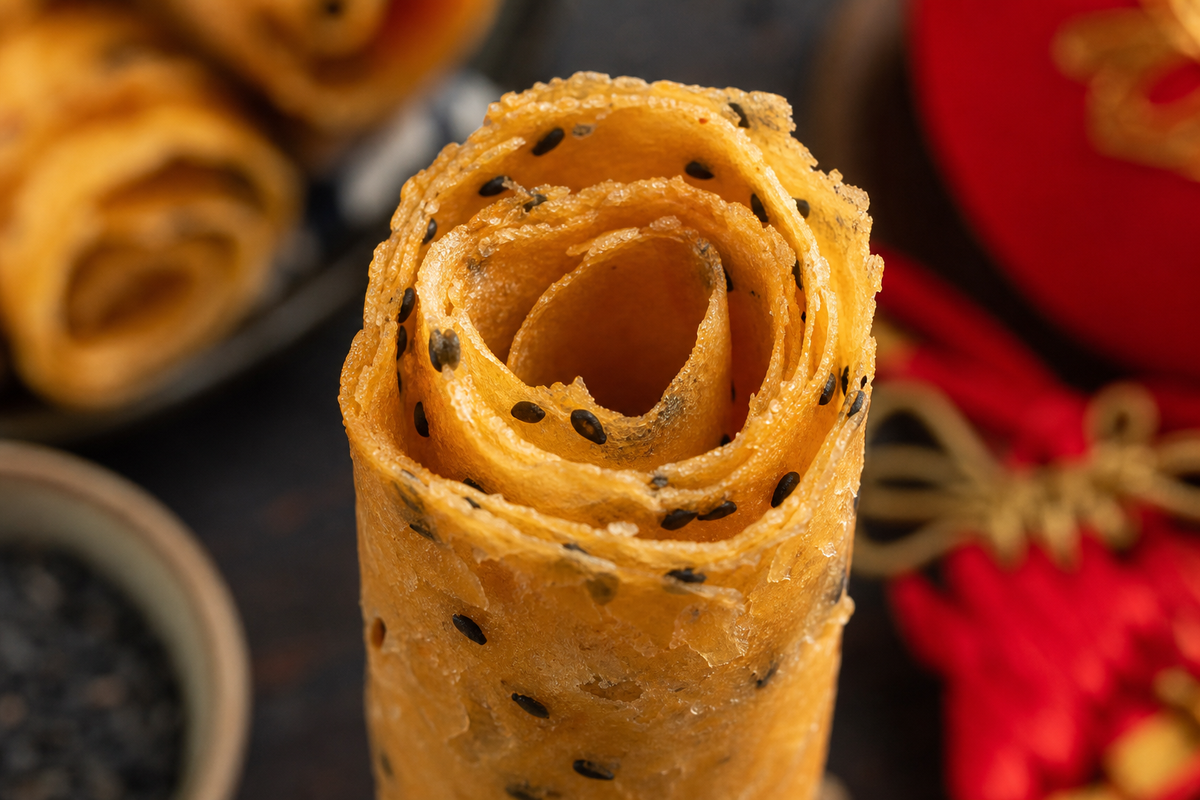
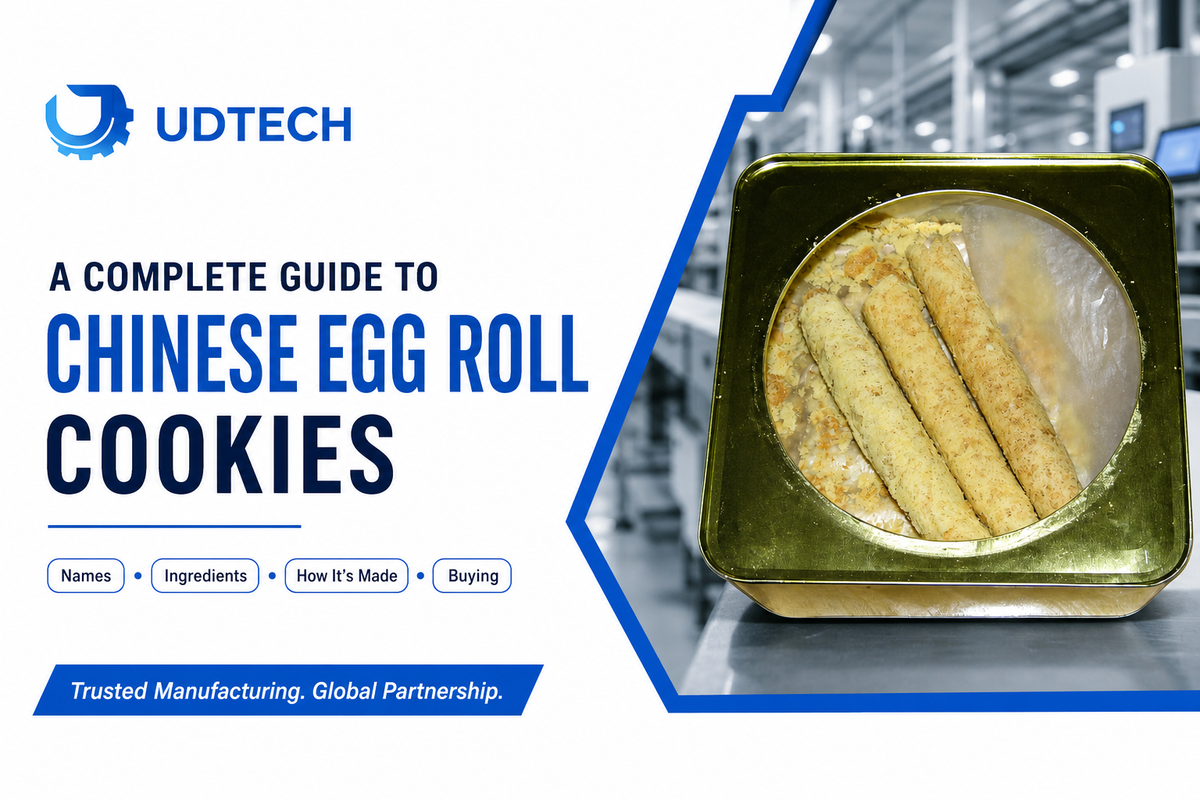
Chinese egg roll cookies are light, thin, crispy, sweet rolled wafer biscuits made from eggs, flour, sugar, and butter or oil, often with black sesame. They are baked as a lacy wafer on a hot iron or flat pan, then rolled into a hollow tube while hot so they cool hard, brittle and glossy. Despite the name they are a sweet dessert, not the deep-fried spring roll.
These crispy egg roll cookies are prized as a light Lunar New Year treat. The most common mistake shoppers make is confusing them with the savory roll. That wrong turn is a real problem for gift-buyers, and it persists because the savory “chinese egg roll” pulls roughly 4,400 searches a month of its own.
It’s no wonder that it can get a little confusing: in Cantonese these cookies are “daan gyun”, or in other words, literally “egg rolls.” The name it’s taken on in English is unfortunately a direct overlap with the deep-fried appetizer you might get at your neighborhood American Chinese restaurant. The Hong Kong version, as clarified by the South China Morning Post, is a delicate flaky biscuit cooked in a hinged iron between two hot plates and it bears nothing more in common with the savory snack than its name. If you have ever pulled a slim golden tube out of a red-and-gold tin at New Year, that is the cookie this guide is about.
In writing, the most common form is 香酥蛋卷 — “fragrant crispy egg roll” — read xiāng sū dàn juǎn in Mandarin and hēung sōu daahn gyún in Cantonese. You will also see the shorter 蛋卷 (dàn juǎn / gai daan gyun). Folded, not rolled versions can be found across Southeast Asia, and under such various monikers as Malay kuih kapit, or what affectionate English-speakers simply call “love letters”.
Egg Roll Cookies vs the Savory Chinese Egg Roll (and Other Chinese Cookies)
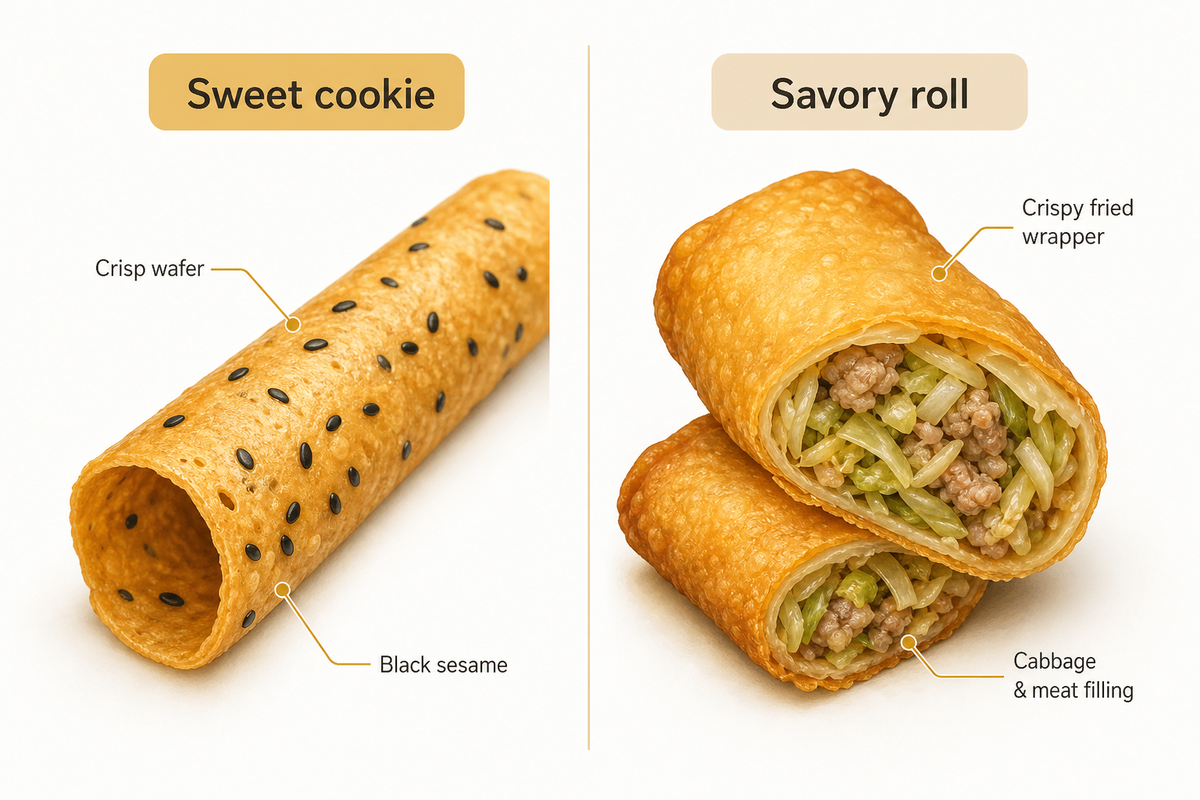
The #1 question most people come with is whether or not egg rolls and the sweet biscuit are the same thing. No, no, and there’s actually a whole world of difference between sweet and savory. Now, here’s where things get confusing.
It actually turns out, in fact, that if you want to get encyclopedic, the savory American Chinese egg roll actually contains no egg filling, it’s just an egg enriched extra thick wrapper, where as the sweet biscuit is made of an actual egg filling. So the “egg” refers to two totally different things.
- Baked thin wafer, rolled into a tube
- Egg, flour, sugar, butter, black sesame
- Crisp, glossy, lightly sweet
- Eaten as a snack or New Year gift
- Deep-fried wheat wrapper around a filling
- Cabbage, pork or shrimp; wrapper is egg-enriched
- Hot, greasy, salty
- Served as a restaurant appetizer
Lookalikes aren’t where it stops, either. You might find cookie eaters confab egg roll cookies for almond cookies (which is basically an almond shortbread, thick and crumbling) and fortune cookies (basically just a folded, empty wafer that was the invention of the Western-restaurant). It’s a long, thin, hollow, breaking-on-the-first-bite cookie that can be nothing else: an egg roll cookie.
A Family of Many Names: Biscuit Rolls, Love Letters, and Regional Cousins
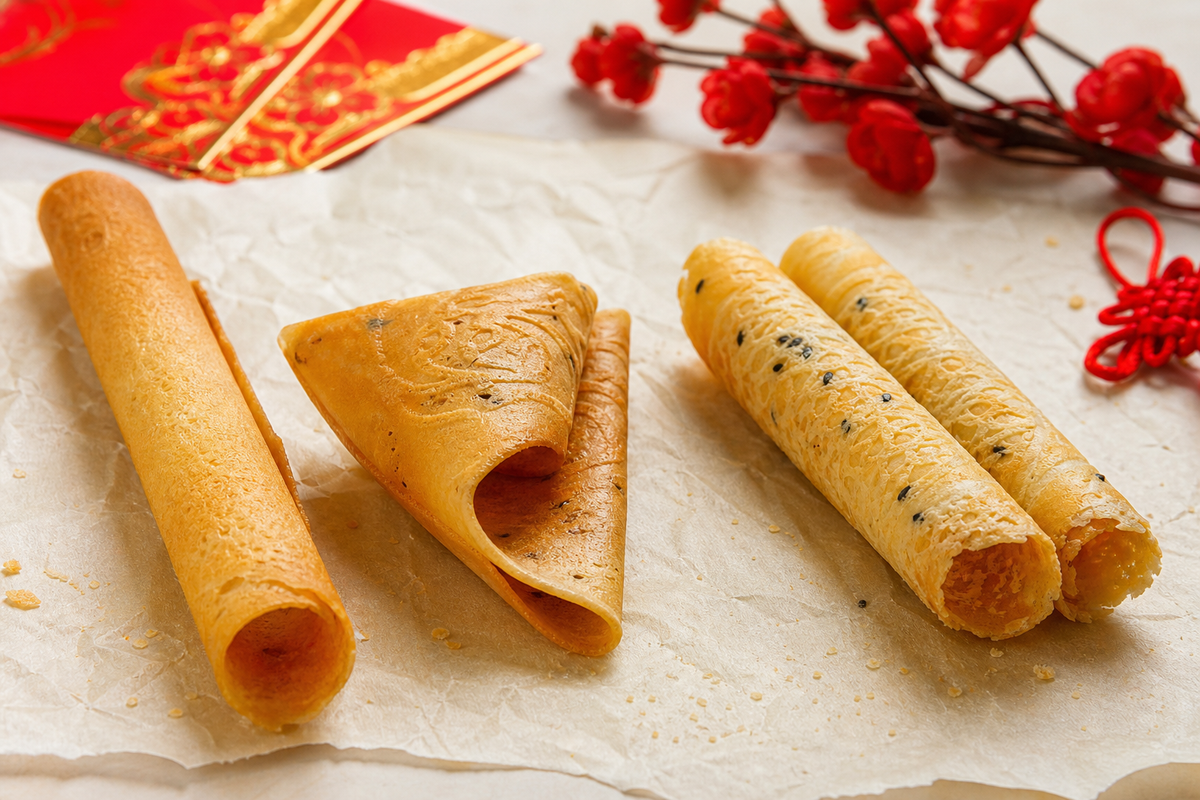
Almost no other cookie has so many names, a matter of history rather than branding. We know it best in English as egg roll biscuits or Chinese biscuit rolls (aka biscuit rolls) – no wonder none of the retail tins agree on what to call it. It’s a shared, entangled biscuit roll tradition rather than a discrete invention that passed down a linear, familial path.
A thin batter-on-a-hot-iron process popped up in countless spots wherever trade and migration carried it, and as the South China Morning Post notes, even the Hong Kong 蛋卷 is best understood as one regional node of that wider family. Mapping the cookie’s name is like mapping the cookie’s dispersion.
The Rolled-Wafer Family Tree (names edition)
| Name | Language / region | Distinctive trait |
|---|---|---|
| 香酥蛋卷 / 蛋卷 (dàn juǎn) | Cantonese / Hong Kong, Guangdong | Buttery, rolled into a slim tube |
| 鳳凰卷 (phoenix roll) | Hong Kong / Macau | Folded flat, often with a seaweed-and-pork-floss layer |
| Kuih kapit / love letters | Malay / Nyonya, Singapore, Malaysia | Coconut-milk batter, folded in a pincer mould |
| Kue semprong | Indonesian | Thin coconut wafer, rolled or folded |
| Biscuit / wafer roll cookies | Western English | Catch-all retail label on tins and menus |
Its most charming name has the least romantic origin. “Love letters,” used across Malaysia and Singapore, sounds like a courtship token, but the Malay word behind kuih kapit is simply kapit – “clamped” – describing the two-plate mould: a hinged iron roughly 11 cm across, held over a flame for about 15 s per wafer, not romance. The letters, in other words, are named for the press, and the romance is a happy accident of translation.
What They Are Made Of, and Why They Turn Out So Crispy
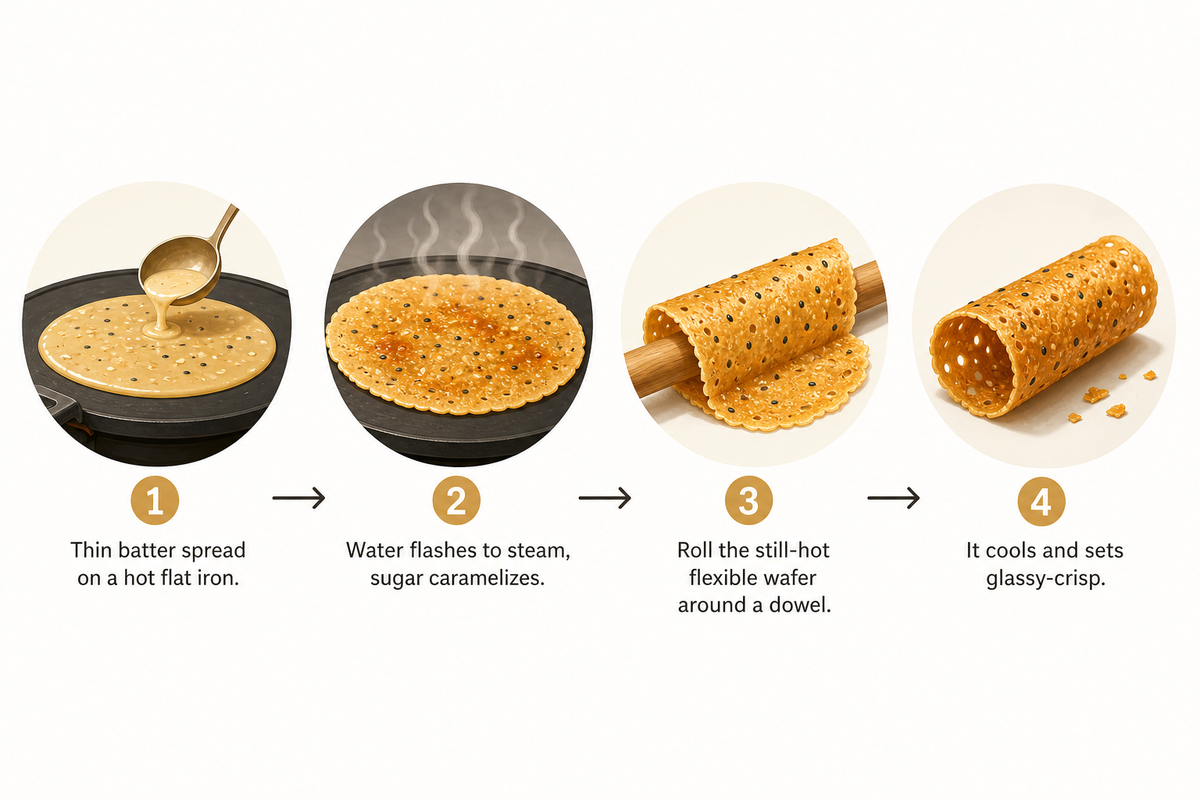
The Chinese egg roll cookies ingredients list is short: eggs for structure and lift, flour for body, sugar for sweetness and browning, and fat (butter or a neutral oil) for tenderness and shatter. Black sesame seeds are the signature aromatic — usually about 5% of the batter by weight — and the sugar browns near 170°C on the plate. The ratios otherwise sit close to equal parts by weight, with egg usually running heaviest.
Those black sesame seeds go in as a scatter of toasted seeds stirred straight into the batter, though coconut milk, cornstarch and a pinch of salt turn up depending on the region.
| Component | Buttery HK style | Coconut kuih kapit |
|---|---|---|
| Egg | 3 eggs + 1 yolk | 3 eggs |
| Sugar | ~100 g | 150 g |
| Flour | ~130 g all-purpose | 100 g rice + 50 g all-purpose |
| Fat / liquid | ~100 g butter | 150 ml coconut milk |
| Aromatic | 1 tbsp black sesame seeds | pandan / vanilla |
The Cool-and-Crisp Countdown
Here’s the mechanism most home bakers get backwards: the crunch isn’t made in the heat, it’s made in the cooling. Spreading the batter to well under 1 mm lets almost all of its water flash off on the hot plate, and the Institute of Culinary Education describes what’s happening as “your moisture is evaporating, your sugars are caramelizing.” What’s left is a molten sheet of sugar and set egg protein. Iowa State University Extension puts the timing plainly: white sugar makes cookies crispy, and that crispness set “when the cookies cool and harden” – not on the iron.
“As the cookie cools, that liquid sugar hardens up, which can give the cookie an extra-crisp, toffee-like texture.”
That’s why the countdown matters. The window between “flexible enough to roll” and “set too hard to bend” is only about 3 to 5 s long, and it runs while the wafer is still on the plate. Roll too early and the paste smears; roll too late and the sheet cracks. The whole craft of these cookies is beating that clock, wafer after wafer – which, as the next section show, is exactly why they’re so tedious to make by hand.
How Chinese Egg Roll Cookies Are Made at Home (No Special Equipment Needed)
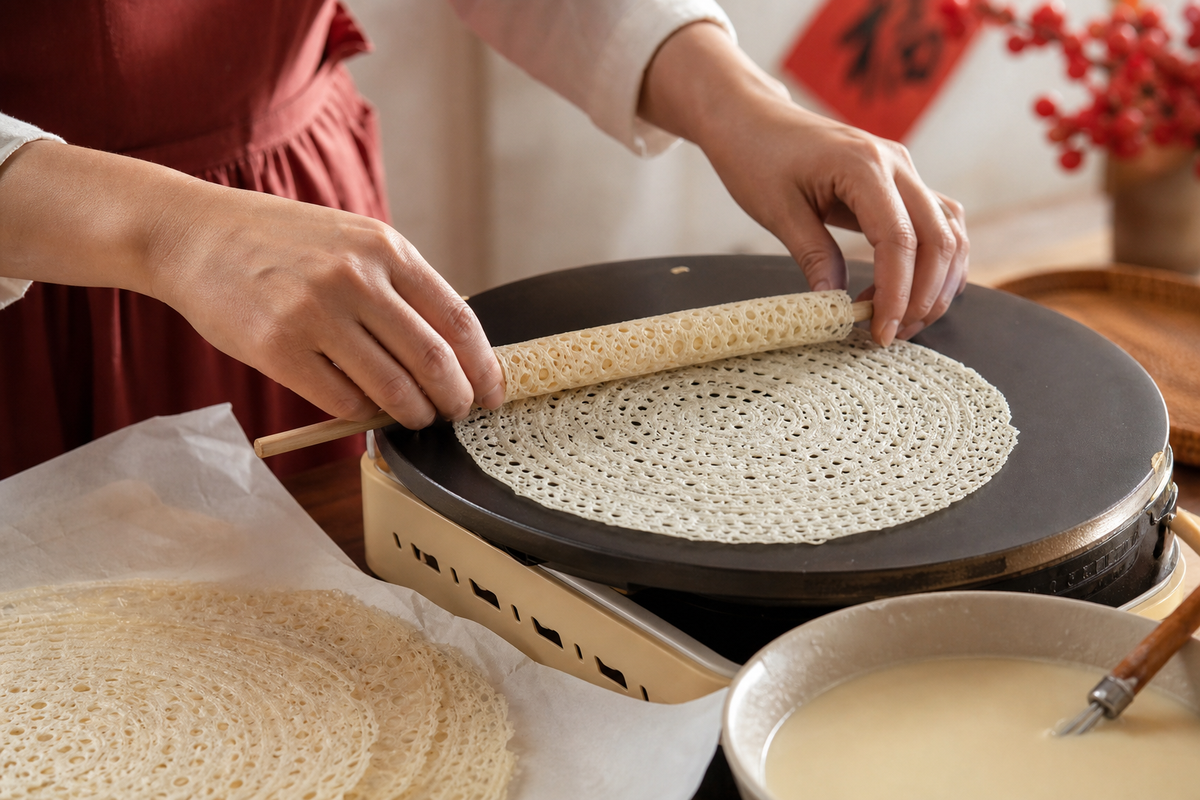
Traditionally the tool is a two-sided embossed cast-iron press, but you don’t need one. A tested home workaround, done without specialized equipment, swaps the press for a flat griddle, a sheet of parchment and a wooden dowel, and it produces the same lacy wafer. Keep the heat low: the wafers should stay pale, so you judge doneness by a fading straw color, never by browning.
That low heat is also why the cooking time per wafer runs longer than beginners expect – often 4 to 5 min each on a plain griddle, versus roughly 1 min with a dedicated two-plate press. The reason is structural: because a bare griddle cannot press both faces at once, the batter dries slowly, and the risk of scorching the edges rises the moment you push the heat to save time. It also pays to remember the food-science point from Iowa State University Extension: the crisp sets as the wafer cools and hardens, so the goal at the stove is a pale, fully dried sheet, not a browned one.
- Rest the batter — whisk, then let it stand about 15 min so the flour hydrates and the wafer cooks even.
- Spread it thin — drop about a tablespoon onto a medium griddle, lay parchment over it, and press flat with a heavy cake tin.
- Cook low, do not flip — cook one side only for a few minutes until uniformly pale; flipping dries the wafer so it cracks when rolled.
- Roll while hot — lift the soft wafer and wrap it around a dowel or thick chopstick right on the pan, before it loses flexibility.
- Cool to set — slide the roll off and let it cool completely; it crisps as it cools, then goes straight into an airtight tin.
One optional finishing trick is worth knowing: a low oven at 80 C (175 F) for 60 to 90 min drives off the last traces of moisture, deepening the crisp and rescuing any wafer that came out a shade too thick. It’s the one step that turns a decent home batch into one that snaps like the tinned kind.
Picture a first-timer at the stove on a Sunday afternoon: the first two wafers tear, the third rolls but cracks, and somewhere around the sixth wafer the timing finally clicks — spread, count out 4 to 5 min, lift, roll on the dowel, slide it off. Most Chinese egg roll cookies recipes share this same beat. That learning curve is normal. Most home cooks treat the first 3 or 4 wafers as testers, sacrificed to dialing in the heat, and the batch only turns out clean once your hands have learned the countdown.
- Keep the heat low and the color pale
- Roll each wafer while it is still hot on the pan
- Use a dowel; it beats fiddling with chopsticks
- Cool fully before sealing the tin
- Flip the wafer to speed cooking — it will crack
- Chase browned edges; that is over-baked here
- Move a hot wafer to a cool board before rolling
- Seal cookies while any warmth remains
Chinese Egg Roll Cookies vs Pizzelle, Krumkake, and Pirouline
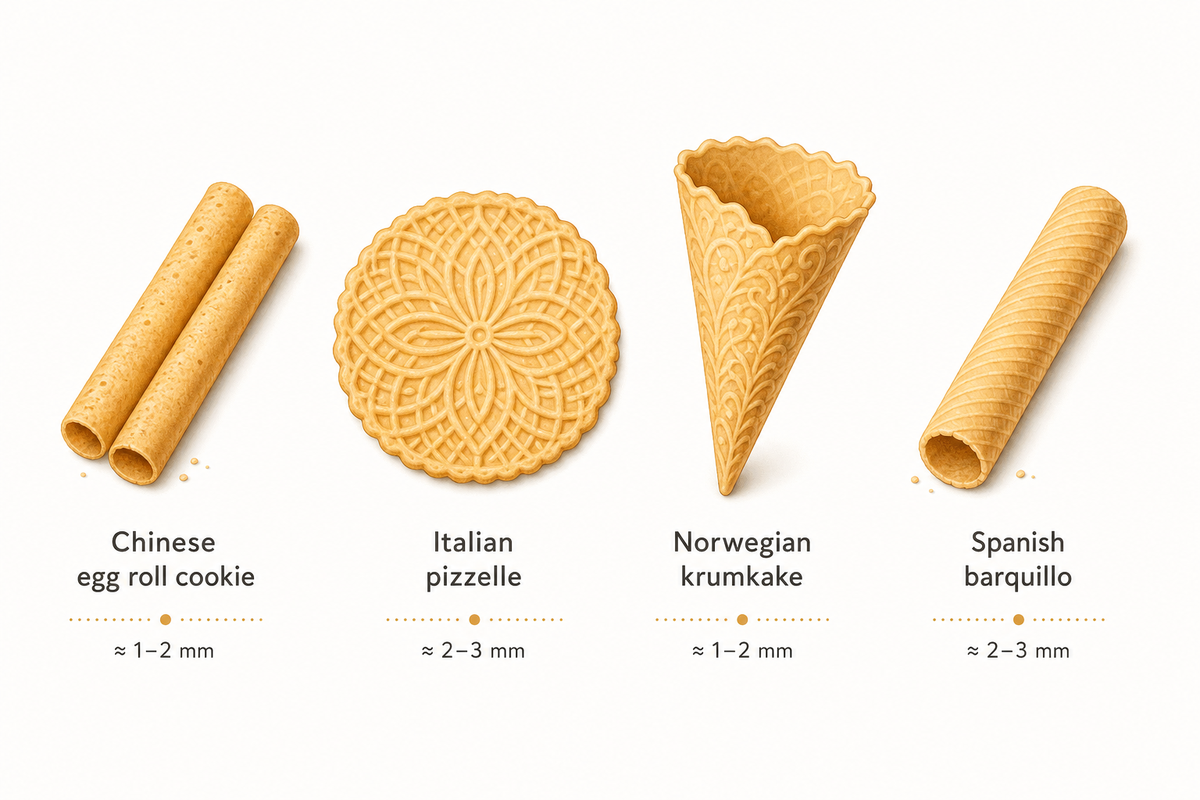
Look up again, and you’ll discover that the Chinese egg roll cookie is really just a single variation of an extensive family of rolled wafer cookies known all over the globe. Everywhere in Europe and Asia you’ll find a thin batter spread on hot plates and curled up in a similar way before the metal cooling plates on top lift off – the primary variations are simply the thickness of the batter and the instrument you use. In fact, Wikipedia calls the Western rolled cookie “a type of rolled wafer cookie made by machine,” with a link back to even older family members such as the Spanish barquillo.
The 10-Family Rolled-Wafer Matrix
| Type | Region | Tool | Shape | Signature |
|---|---|---|---|---|
| Egg roll cookie (蛋卷) | Hong Kong / Guangdong | Hinged flat iron | Slim rolled tube | Butter, black sesame |
| Phoenix roll (鳳凰卷) | Hong Kong / Macau | Hinged iron | Folded flat | Seaweed, pork floss |
| Kuih kapit / love letters | Malaysia / Singapore | Pincer mould | Folded triangle | Coconut milk |
| Kue semprong | Indonesia | Patterned iron | Rolled or folded | Coconut |
| Pizzelle | Italy | Patterned iron | Flat disc | Anise, vanilla |
| Krumkake | Norway | Krumkake iron | Rolled cone | Cardamom |
| Strull | Norway | Flat iron | Rolled | Cream, no egg |
| Barquillo | Spain / Philippines | Rolled iron | Rolled tube | Cinnamon, plain |
| Pirouline | Western / commercial | Automatic machine | Tight thin tube | Chocolate cream |
| Wafer / biscuit roll | Global retail | Automatic machine | Rolled tube | Milk, chocolate |
This isn’t simply factoids: this explains the texture. The batter for krumkake is looser than pizzelle, as any food writer has observed-which is why krumkake will form a cone and pizzelles form a flat disc, and is why the whisper-thin Chinese wafer is coiled so tight. You see this reflected in timing and gauge as well; where a thin pizzelle iron might take only 10 to 12 s for a wafer, a special krumkake iron requires anywhere from 30 to 60 s, and the 2- to 3-mm disc made on a pizzelle iron compares to the sub-mm wafer made on an egg roll or krumkake iron.
A krumkake iron can even, in an emergency, produce an adequate, if somewhat stilted, approximation of a pizzelle (and vice versa), if the batter thickness is just so-or thick enough on the pizzelle iron to result in fragments.
Take a real example a home baker runs into: you own a pizzelle iron from an Italian grandmother and want to make egg roll cookies with it. It works, but the 2 to 3 mm plate gap means you must thin the batter and roll faster, or the disc sets too stiff to curl. Picture the first attempt cracking into shards — that is the plate gap talking, not your technique, and it is exactly why the thinner Chinese and Norwegian irons exist.
From Home Kitchen to Factory: How the Tinned Rolls Are Made at Scale
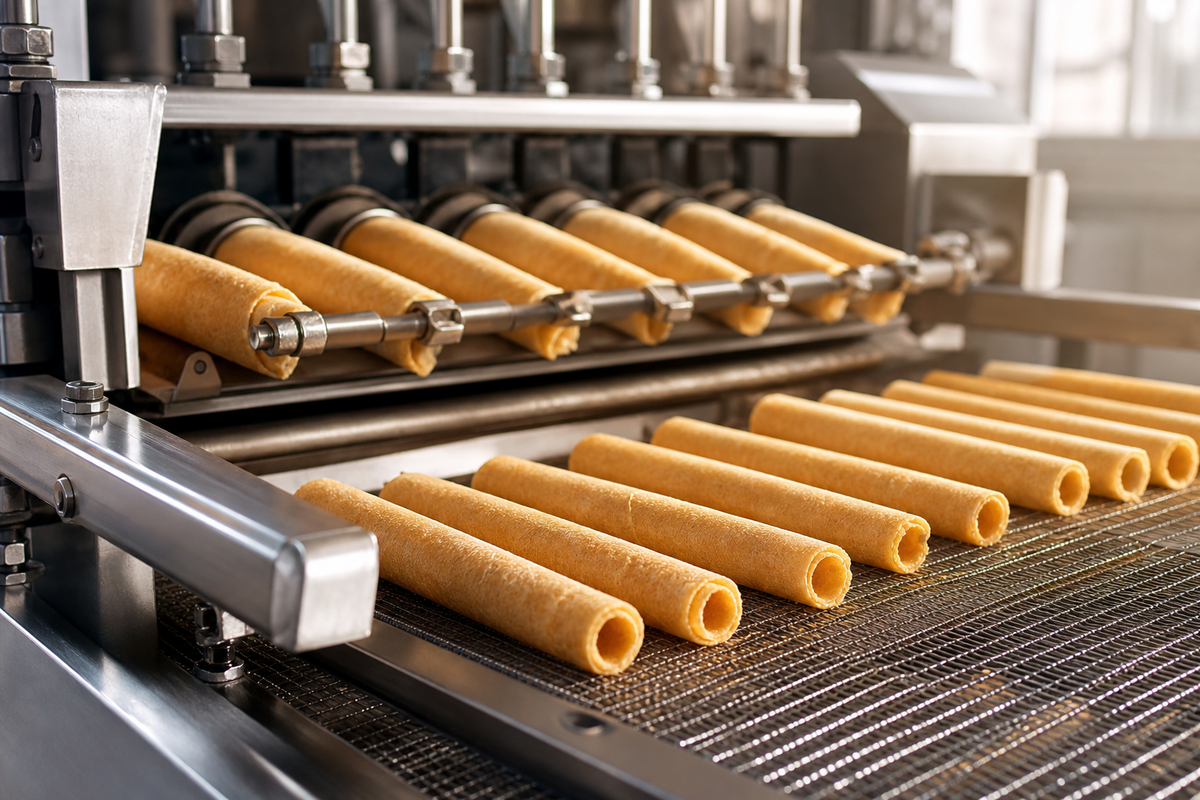
So, once you’ve experienced just how temperamental one wafer can be, it becomes logical to ask: what about those uniform tins for Christmas and birthdays?
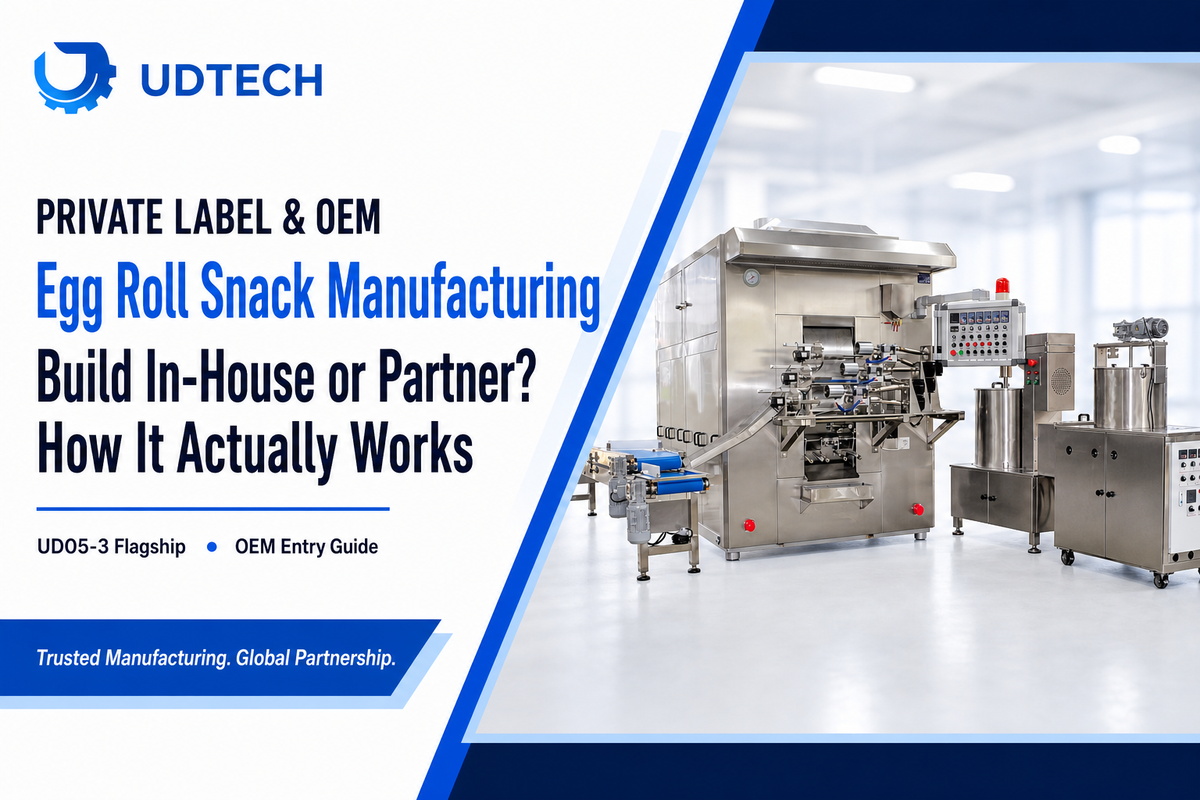
They’re filled by the thousand. Machinery, replacing the skilled touch – that’s the explanation – and it’s a part of the saga you’ll only glimpse working from within a food machinery supplier like UDTECH.
The One-a-Minute Ceiling
Hand production is capped by that same cool-and-crisp countdown: one cook, one roll, one wafer at a time. A practiced cook on a single pan averages about one wafer a minute — a back-of-the-napkin figure rather than a lab measurement — which is why kuih kapit survives as a family-workshop craft where a whole day may yield only a few tins.
Take a real example: a café-bakery operator who has promised 200 gift tins for the New Year hits that wall fast — at roughly one wafer a minute, a single pair of hands cannot fill 200 tins in a season without help. That is the moment an operator starts pricing a machine, weighing the romance of the hand-rolled wafer against a line that keeps running while the shop sleeps.
An automated egg roll maker demolishes that ceiling. Batter flows onto a plate rotating at perhaps 160-180°C, where it’s pressed and baked by the constant grouting-baking-forming process, spread to well under 1 mm, then the still-pliable sheet (around 50°C) is automatically rolled-commercial production lines clock in the low thousands per hour, and the roll size simply becomes a function of the quantity of batter placed on each plate. It’s the same physics as your hand roll, except a mould does the twisting.
Which explains why they’re all so perfect in factory cans.
But the jump from wrist to robot isn’t specific to the cookie; it’s a wider saga about how food comes into existence. Economists with the U.S. Department of Agriculture reported that food-manufacturing jobs grew at only 0.12 percent a year over 20 years, while investment in equipment jumped by about 2.39 percent a year-a “substitution of capital for labor” in other words, where workers have more machines to use.
The egg-roll assembly line is the translation of that into practical application.
Scale comes with its own set of rules the home baker likely never even consider. Because those lines are egg, wheat, milk, soy, and sesame across all kinds of different surfaces, food-contact surfaces have to be designed and kept “to protect food from allergen cross-contact” as dictated by 21 CFR 117.40. This translate into stainless steel and wash-down machine construction, and a genuine, proper cleaning and changeover between a sesame bake and a simple one – the sort of food-grade machine precision that’s lightyears beyond the hobby griddle.
When a baker decides to invest in a phoenix roll machine and leave their hand-rolling behind, they’re purchasing that repeatable compliance as much as they’re the increase in speed.
Buying and Gifting: Brands, Flavors, and Lunar New Year Tins
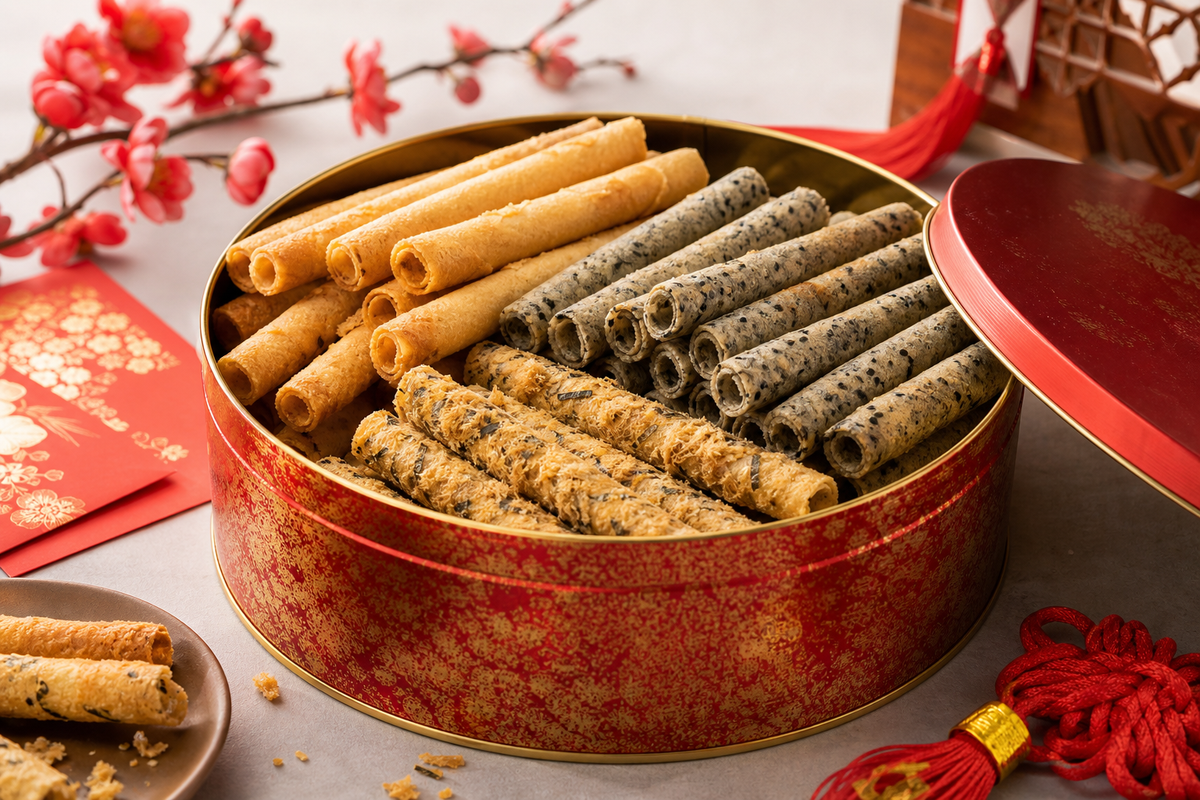
And if it’s a purchased than baked experience you desire, this one’s for you. Traditional Hong Kong egg roll cookies still come from heritage makers like Kee Wah Bakery and Ching Kee, who craft these iconic roll cookies and pack them in the padded tins of Hong Kong and Macau. But they also can be shipped anywhere via online retailers like Goldbelly.
They can always be recognized by the packaging – red and gold with bubble wrap protecting its interior contents – and an opening that’s always slightly too small to retrieve the entire roll without breaking off some. Packaged so tightly, a tin holds its crispness for 5-7 days after opening; leave the rolls out in humid air, though, and they soften within about 30 min as they pull moisture back in.
The Assorted-Tin Flavor Lineup
| Flavor | Character | Best for |
|---|---|---|
| Original butter | Plain, rich, lightly sweet | A safe crowd-pleasing gift |
| Black sesame | Nutty, toasty, traditional | Fans of classic Cantonese flavor |
| Seaweed & pork floss (phoenix roll) | Sweet-savory, layered | Those who like the savory twist |
| Coconut / osmanthus | Floral, fragrant, modern | 2026 fusion gift boxes |
Gifting logic here’s as much symbol as taste. Because egg roll cookies are so often given as a gift and popular around the holidays, a snug golden roll reads like a tiny scroll of prosperity, which earns it a place in the New Year “tray of togetherness” (全盒) alongside other lucky sweets — and Forbes notes the 2026 gifting window stretches from February 17 through March 3, so the tins move all season, not just on New Year’s Day. And because the highest compliment a Cantonese cook can pay a dessert is 不太甜 — “not too sweet” — a good egg roll cookie is prized for its restraint, making it an easy gift even for people who claim not to like sweets.
Say you are standing at the tin aisle before a New Year visit, unsure what to bring. When buying for a mixed crowd, a plain butter or black sesame tin is the safe pick; if the host leans adventurous, the seaweed-and-pork-floss phoenix roll is the conversation piece; and for a sesame-sensitive friend, read the label first, since a Taiwanese egg roll biscuit or a Ching Kee tin will spell out the allergens.
Are Chinese Egg Roll Cookies Healthy? Calories and Nutrition
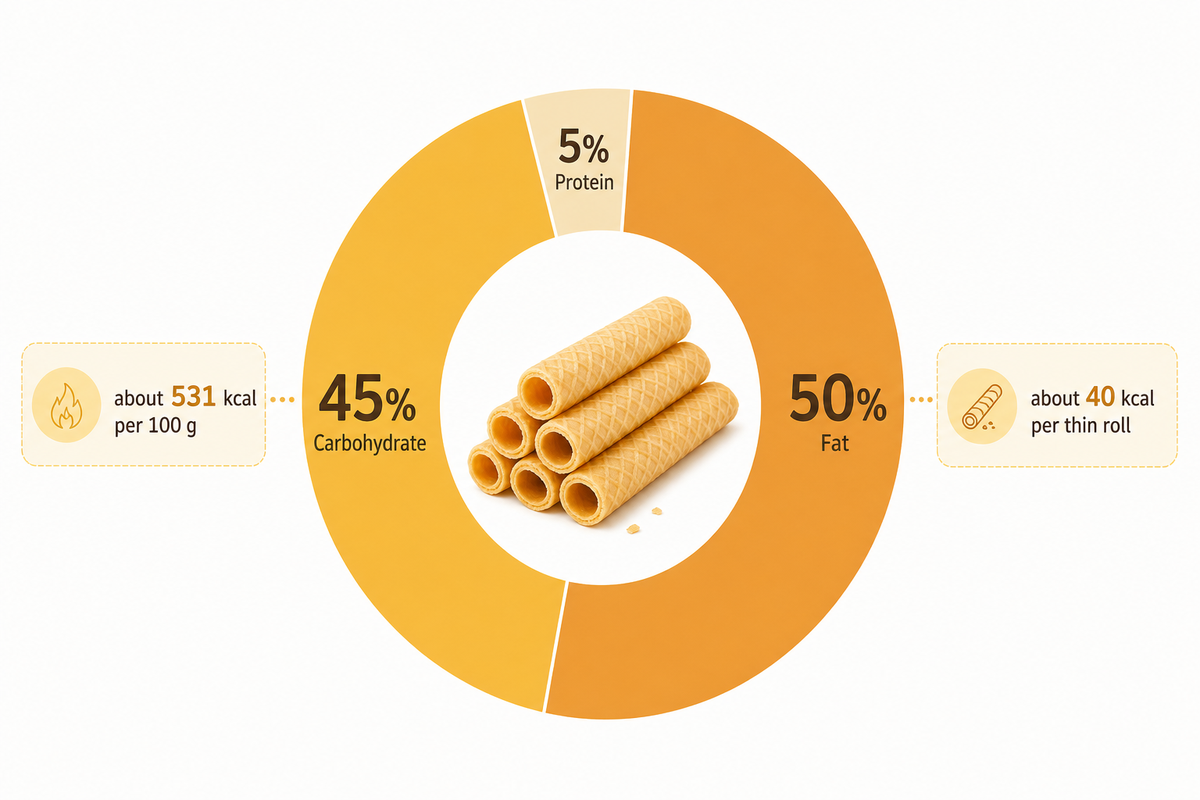
This light crisp masks the fact that these are calorie rich as nearly all are comprised of sugar, flour and fat with all of the water baked out, so the USDA sugar-wafer reference class averages 531 kcal per 100 g – a typical split between calories is about 45% carb, 50% fat and 5% protein.
Per piece, the numbers vary according to size-thin factory rolls are roughly 40 calories, while large homemade rolls can pack 120-but regardless, it’s a light, crispy treat, not a healthy one. A common mistake is to assume the airy texture means low calories; the disappointment comes when you realize a handful of these thin rolls quietly adds up to more than 200 kcal. (It’s worth reiterating that, calories-wise, it isn’t the fried savory version you may be picturing). One allergy consideration for gifting: The black sesame seed, essential to this cookie, has been added to the FASTER Act’s list of the top nine U.S. allergens, meaning any packaged cookie should list it as such, a good bit of info if you plan on presenting a friend who avoid it with a tin.
Where Chinese Egg Roll Cookies Are Headed: Naming, Seasonality, and Demand
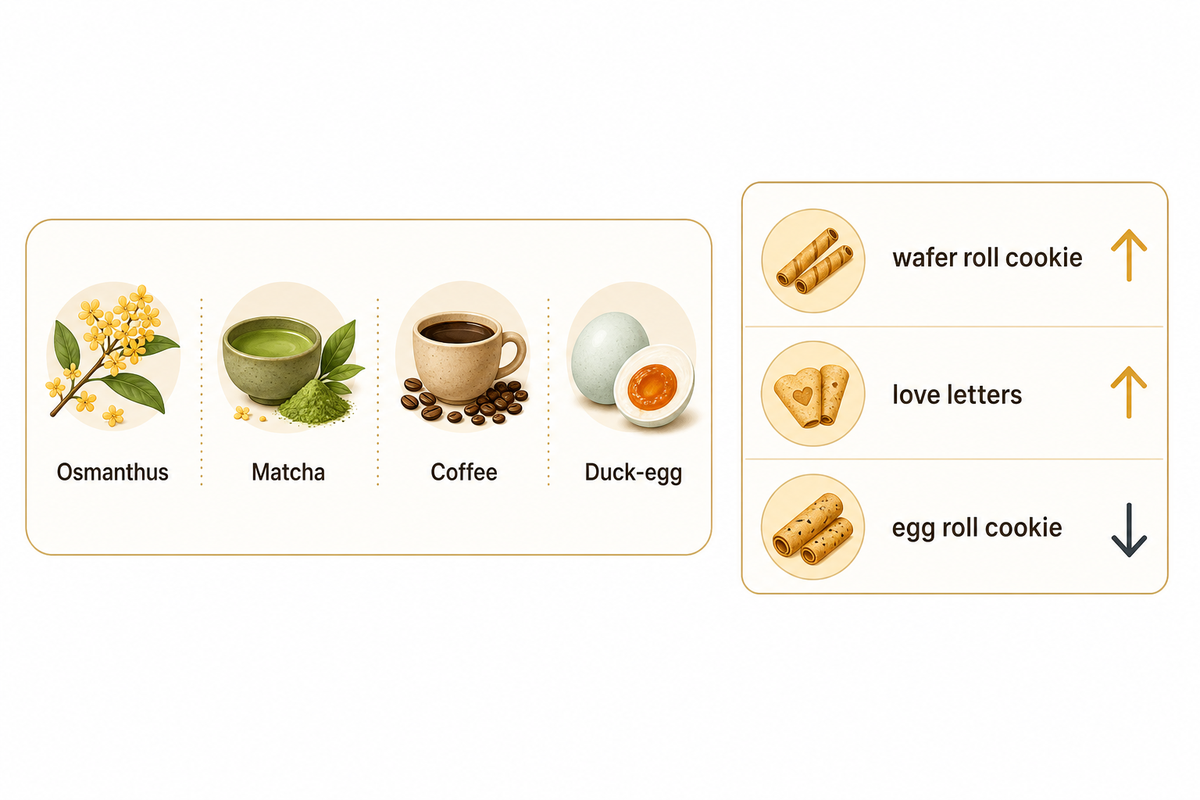
As one of the most searched Chinese recipes around Lunar New Year, egg roll cookies leave a bright trail through search data, and the terminology is actively shifting beneath buyers’ feet. Our keyword analysis shows “egg roll cookie” declining roughly 34% year over year, while “wafer roll cookie” climbs about 22% and the Southeast Asian “love letters” gains about 22% too.
The useful takeaway: if your search for “egg roll cookie” pulls up fried appetizers, that mismatch is the whole problem — try adding “wafer” or “biscuit roll” to refine the results. Picture a shopper in mid-December with 3 weeks to source New Year gifts: knowing this vocabulary shift is what gets them to the right tin instead of a takeout menu.
Demand for egg roll cookies is stable-to-growing as a gift but seasonal — it ramps sharply from November into the Lunar New Year window (February 17 to March 3 in 2026), so buy or bake ahead of the rush.
The cookie is leaning “less sweet, more balanced” in terms of flavor, with “osmanthus, matcha, and coffee” expected to be dominant notes in 2026 New Year cookie tins, and a heritage bakery here has recently introduced “duck egg” to its version. This cookie isn’t dying out, but rather being subtly remade with a subtle hint of floral sweetness.
Frequently Asked Questions
View answer
Egg roll cookies are thin, crisp rolled wafer biscuits made from a sweet batter of egg, flour, sugar and butter or oil, often with black sesame. The batter is baked into a lacy wafer on a hot iron and rolled into a hollow tube while still warm, so it sets glassy and crunchy. They are a light dessert biscuit and a popular Lunar New Year gift — not the savory fried egg roll appetizer.
View answer
The full name is 香酥蛋卷 (xiāng sū dàn juǎn), meaning “fragrant crispy egg roll,” often shortened to 蛋卷 (dàn juǎn). In Cantonese it is read gai daan gyun. Related folded versions across Southeast Asia go by other names, most famously kuih kapit, or “love letters,” so a single cookie can carry several different labels depending on the region.
View answer
No. Spring rolls and the savory American-Chinese egg roll are fried wheat wrappers around a vegetable or meat filling. Egg roll cookies are baked, sweet wafer biscuits rolled into a crisp tube. Confusingly, the savory roll usually contains no egg in its filling, while the sweet cookie is genuinely egg-based — they share only the English word “roll.”
View answer
Yes. Spread the batter thin on a griddle under parchment, cook one side until pale, and roll it around a dowel while hot. It is slower than a press but works.
View answer
Both are thin wafer cookies from an iron, but egg roll cookies use a thinner butter batter and are always rolled into a tube, while Italian pizzelle are thicker, patterned discs usually left flat and flavored with anise.
View answer
Usually the batter was spread too thick, the wafer was under-cooked, or it absorbed humidity. Cook thinner and longer on low heat, cool fully, then seal with a desiccant.
View answer
Sealed airtight with a desiccant, about 2 to 3 weeks. They soften within roughly 30 min of humid air exposure, so keep the tin closed.
Making egg roll cookies at commercial volume?
Hand-rolling tops out near one wafer a minute. If you are planning a bakery line or a gift-tin product, an automatic egg-roll machine handles batter deposit, baking and rolling in one continuous, food-grade cycle.
Explore UDTECH’s food machinery range to match output and format to your product.
Related Articles
- Egg Roll Machine Guide
- Seaweed Egg Roll Machine
- Egg Roll Machine Capacity Planning
- Phoenix Roll Machine Buying Guide
References
- Institute of Culinary Education — Understanding the Science of Cookies.
- Iowa State University Extension — Cookie Science.
- U.S. FDA — The FASTER Act: Sesame Is the Ninth Major Food Allergen.
- U.S. FDA — Water Activity (aw) in Foods.
- eCFR — 21 CFR 117.40, Equipment and utensils.
- USDA FoodData Central — nutrient reference data.
- South China Morning Post — Hong Kong egg rolls vs American egg rolls.
- Wikipedia — Pirouline and Egg roll.
Reviewed by the Suzhou UDTECH Technology Co., Ltd. technical team. UDTECH designs and builds automatic egg-roll and wafer-roll machinery; the home-baking details here are drawn from published recipes and food-science sources, while the production-scale perspective reflects our machine-side engineering experience. Nutrition and allergen figures are general references, check product labels for specifics.