Updated July 2026
The ROI of automating egg roll production is not decided by the machine’s rated speed. It is decided by how much saleable output, labor stability, waste control, and run-hour coverage the plant can turn into monthly cash savings after installation.
For most food factories, the wrong question is “How fast is the machine?” The better question is, “How many good egg rolls can the plant sell, pack, and ship after automation, and what cost disappears from each 1,000 good pieces?”
A useful payback model should make one decision easier: whether the project deserves a quote, a production trial, or a delay. If the goal is high-quality, crispy egg rolls for frozen food production, the worksheet should test shape, weight, texture, packing rate, labor plan, and sellable demand before any ROI claim is accepted.
Quick Specs For The Payback Model
| Main calculation | Payback months = total project investment / monthly net savings |
|---|---|
| Core output unit | Cost per 1,000 good egg rolls |
| UDTECH model examples | UD05-2 at 220 pcs/min and UD05-3 at 330 pcs/min, used here only as sample model inputs |
| Best-fit buyer | A food factory or frozen food producer with repeatable recipes, stable demand, and measurable labor or yield pressure |
| Board-level question | Can the project beat the plant’s 18, 24, or 36-month payback threshold without hiding installation, utilities, training, or downtime? |
- Manual rolling or transfer limits the line.
- Overtime is used to meet predictable demand.
- Rejects, rework, or filling giveaway are tracked.
- Downstream cooling, packing, and storage can absorb added output.
- One short shift will leave the line down most of the month.
- Recipes change too often for repeatable settings.
- Freight, installation, training, or utility work is ignored.
- Extra throughput cannot turn into sellable orders.
Picture a frozen-food plant that can sell more product, but manual rolling forces overtime three weeks per month. If automation only removes one helper, the project may look weak. If the same line also cuts giveaway, improves good-piece yield, and lets the plant run 22 planned days instead of 12 short days, the payback case changes from a labor discussion into a capacity decision.
The 5-Input Egg Roll Automation Payback Ladder
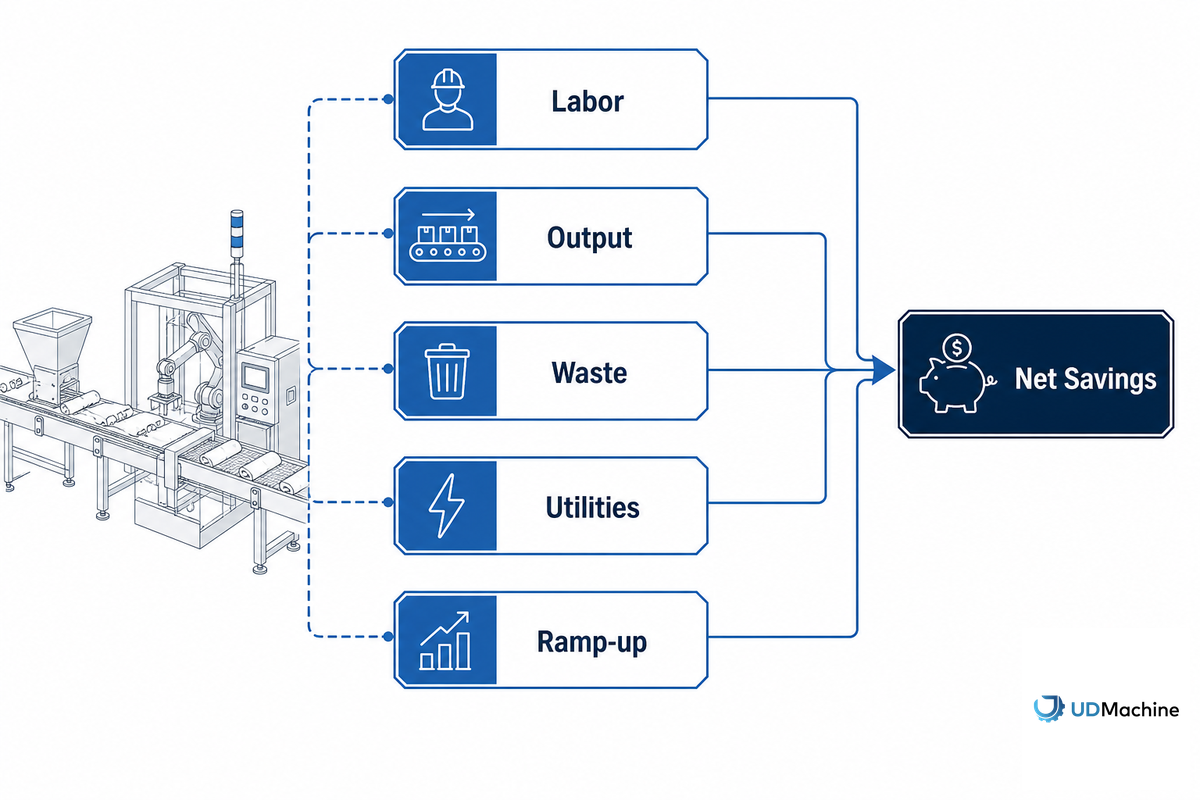
Use the 5-Input Egg Roll Automation Payback Ladder to test whether an automatic egg roll machine will pay back based on actual plant economics. Those inputs are wage and overhead, good-piece output, waste, utilities, and installation ramp-up. If any one input is guessed, the payback model becomes a sales pitch instead of a finance tool.
| ROI input | What to measure | Unit | Payback effect |
|---|---|---|---|
| Direct labor | Crew members tied to wrapping, rolling, transfer, and inspection | people/shift | Fewer paid hours per 1,000 good pieces shortens payback. |
| Loaded wage | Hourly wage, benefits, payroll burden, overtime factor | USD/hour | Higher loaded labor cost increases monthly savings. |
| Good output | Sellable egg rolls after rejects and rework | pcs/hour or pcs/shift | Higher good output lowers cost per 1,000 pieces. |
| Shift count | Paid production hours with enough demand to run | hours/month | A line used for 2 shifts/day pays back faster than a line used for short trial runs. |
| Wrapper or batter waste | Scrap from thickness variation, tearing, or unstable feed | kg or % | Reduced waste adds savings beyond labor. |
| Filling giveaway | Extra grams of filling beyond target weight | g/piece | Small gram differences become large monthly material cost differences. |
| Energy | Electricity, LPG, or natural gas used by the line | kW, kg/h, or m3/h | Energy adds cost, but it is usually tested against output per hour. |
| Maintenance | Wear parts, planned service, cleaning parts, and spare inventory | USD/month | Ignoring maintenance overstates net savings. |
| Ramp-up | Training, recipe tests, installation, and first-month yield loss | days or weeks | Longer ramp-up delays the first full-savings month. |
| Downstream capacity | Cooling, packing, freezing, storage, and order volume | pcs/hour | A downstream bottleneck can erase the value of faster forming. |
This ladder should be completed prior to getting quotes on any egg roll machines. It forces the calculations to reflect how a food factory operates rather than just how fast a machine runs.
Step 1: Build The Manual Egg Roll Production Baseline
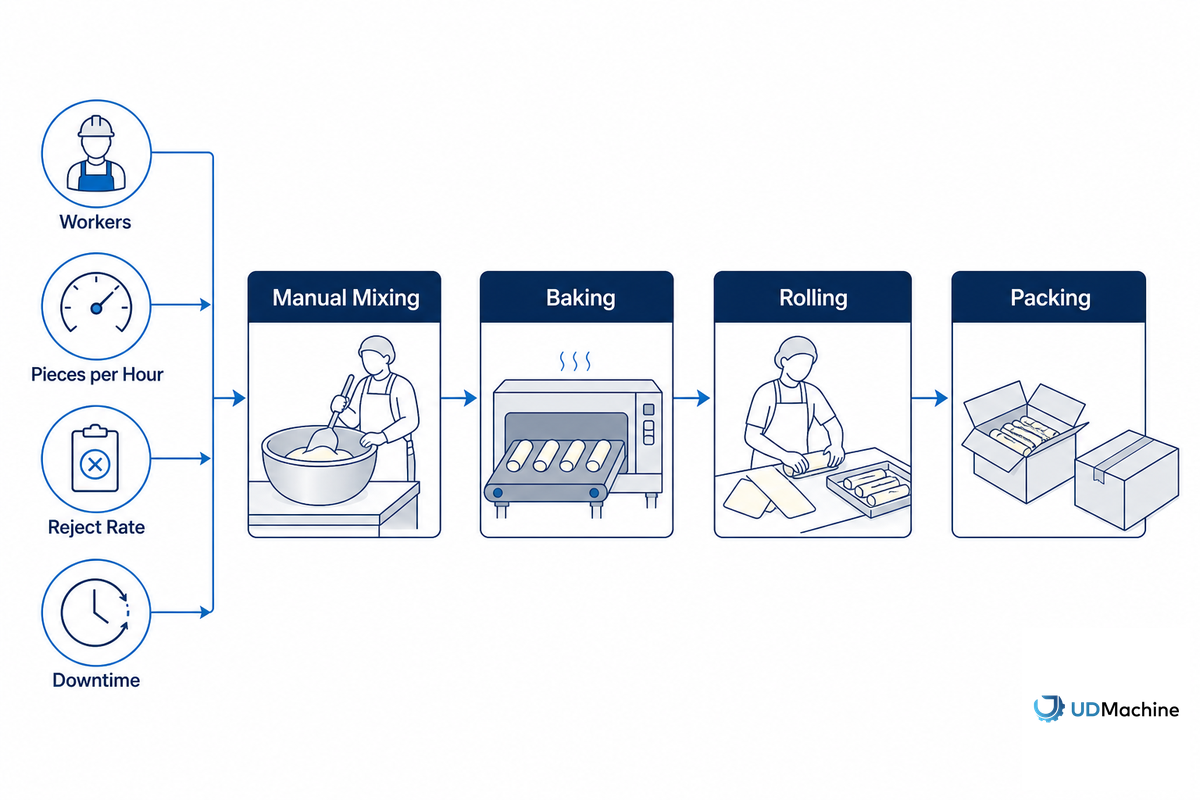
Your baseline is the cost of present operations before automation. If the buyer cannot state today’s good-piece output, worker count, paid hours, reject rate, and rework cost, the automation proposal has no financial anchor.
Start with current manual production, then remove only the costs that will actually change. Count labor tied to wrapper handling, filling, rolling, tray transfer, first inspection, and rework only if those roles are removed or redeployed after installation.
Do not count packaging, cold storage, sanitation, or quality release as savings unless the new layout changes those duties. A person who moves from rolling to packing is not a headcount saving; that move may still help payback if it unlocks more sellable output.
Food factories must keep the ROI calculation completely separate from food-safety compliance activities.
US food facilities operate under current good manufacturing practice requirements of 21 CFR Part 117. Any new line should first be evaluated for cleanliness, contact materials, allergen controls and documented procedures before your finance team signs off on the budget.
Follow four math steps to construct a realistic baseline of your current egg roll process:
- good pieces/shift = total pieces produced – rejected – unsold rework.
- loaded labor cost/shift = worker count x hours worked x loaded labor cost/hour.
- manual labor cost/1000 good pieces = loaded labor cost/shift / good pieces/shift x 1000.
- manual waste cost/1000 good pieces = material waste cost/shift / good pieces/shift x 1000.
For the wage input, a U.S. buyer can use the BLS food manufacturing hourly earnings series as a public benchmark for production and nonsupervisory labor, then replace the public benchmark with the plant’s loaded wage, benefits, overtime, and local staffing cost. Finance approval should use the buyer’s loaded number, not a national average.
Manual production often hides cost in waiting time, rework, overtime, and uneven line balance. A strong worksheet names the cost center that changes, the tasks that stay, and the month when the new crew plan starts. That is the difference between a payback case finance can audit and a headline labor claim sales can make.
What if manual labor is not the largest cost?
Then the payback model should say so. In many plants, yield, product consistency, or added order capacity may provide most of the savings, not headcount reduction. That is why this article uses “reduce or redeploy” for labor savings.
Someone moved away from manual egg roll production may still be needed for packing, inspection, sanitation, or changeover.
Step 2: Model The Automated Egg Roll Production Case
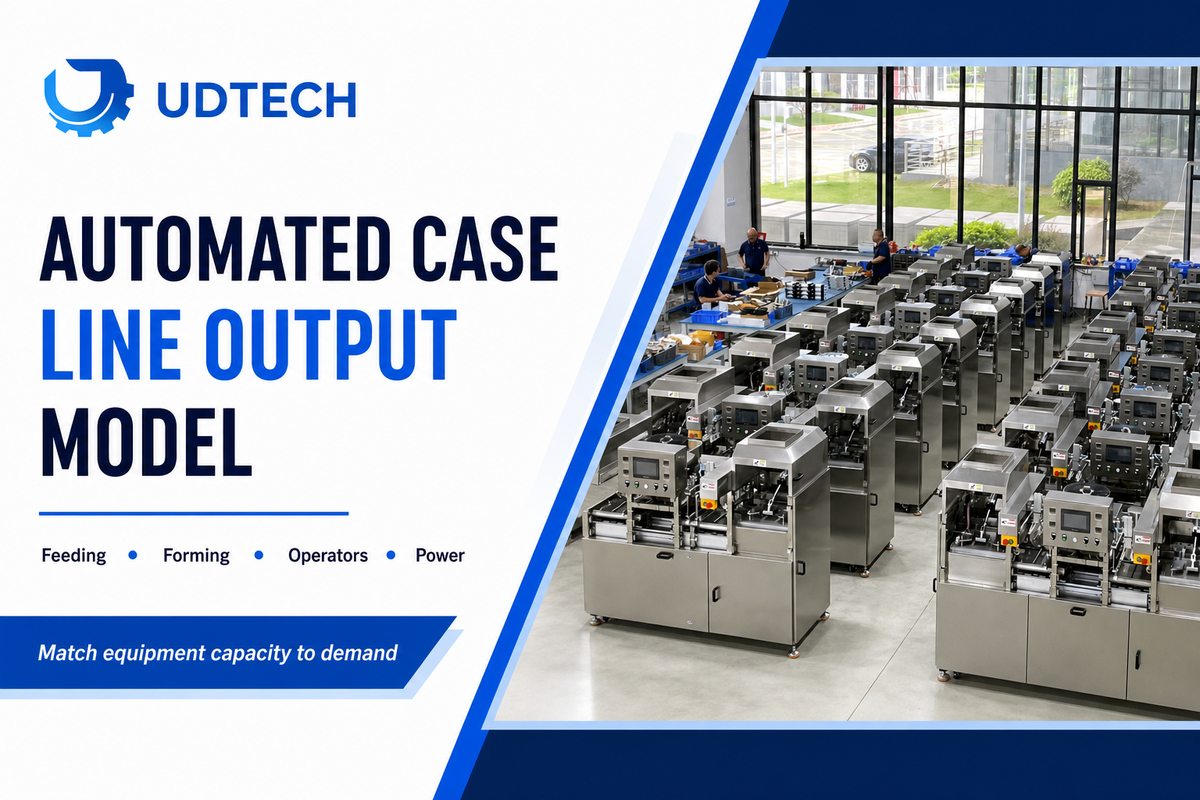
The automated case should describe the plant after installation, not the brochure version of the machine. It needs a machine quote, target recipe, shift plan, utility plan, operator plan, and ramp-up assumption. Do not mix best-case rated speed with conservative labor unless both figures are clearly labeled as rated, expected, or conservative.
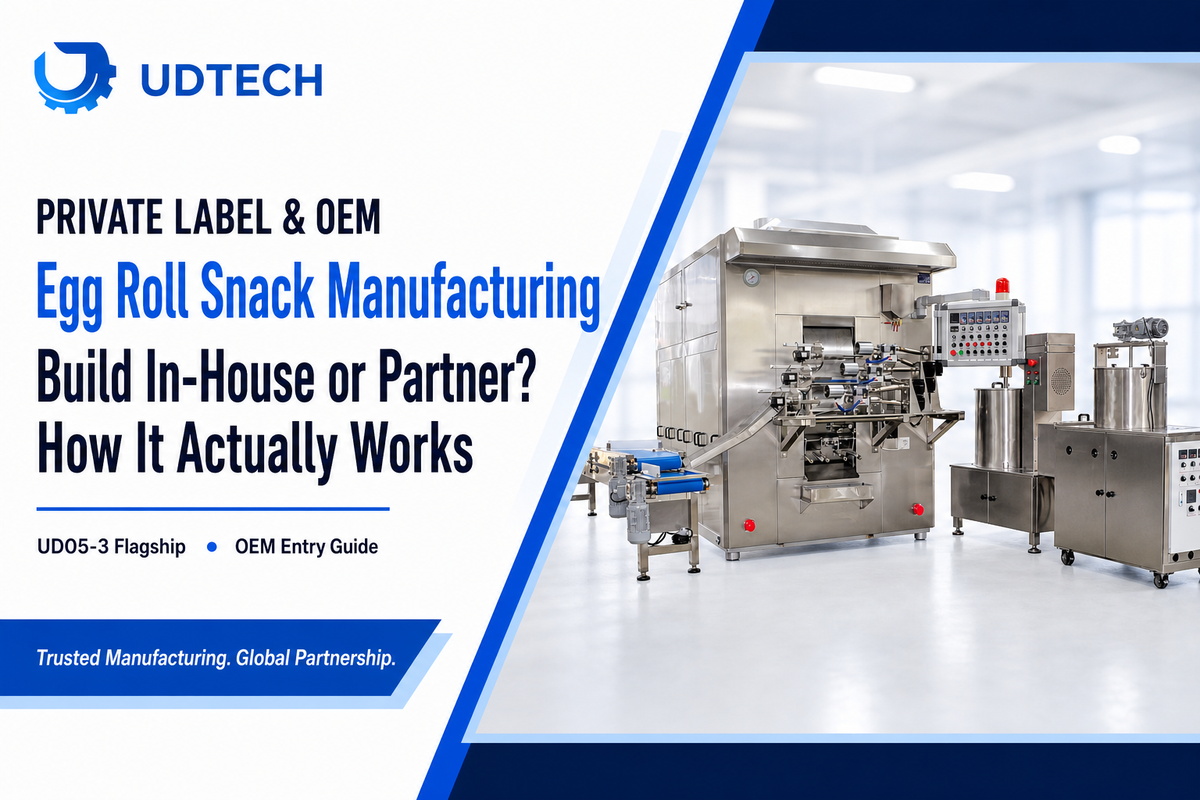
In egg roll manufacturing, an egg roll making machine should be tested as part of the full process: batter feed, wrapper control, forming machine setup, baking or frying condition, cooling, and packing. Production efficiency and output depend on the whole food processing plant, not only the automatic egg roll machine.
UDTECH’s automatic egg roll machine page lists the UD05-2 at 220 pcs/min and the UD05-3 at 330 pcs/min. It also lists example output values of 600 kg per 8-hour shift for UD05-2 and 900 kg per 8-hour shift for UD05-3, with listed power values of 9.7 kW and 12 kW. Those values are useful as model inputs, but final payback still depends on the buyer’s product size, recipe, fuel cost, uptime, labor plan, and saleable demand.
| Model input | UD05-2 example | UD05-3 example | How to use it in ROI |
|---|---|---|---|
| Rated capacity | 220 pcs/min | 330 pcs/min | Convert to good pieces per shift after yield and downtime. |
| Shift output | 600 kg/8h | 900 kg/8h | Map kg to piece count using product weight. |
| Power | 9.7 kW | 12 kW | Add electricity cost to monthly operating cost. |
| LPG use | about 6 kg/h | about 8 kg/h | Use local fuel price and monthly run hours. |
| Natural gas use | about 8 m3/h | about 10 m3/h | Build a fuel sensitivity case if gas prices vary. |
| Listed footprint | 15.5 m2 | 15.5 m2 | Check actual layout with feeding, cooling, access, and packing space. |
| Installation | 5-7 days | 5-7 days | Add planned downtime or trial production days. |
| Training | 2-3 days | 2-3 days | Model early yield lower than steady-state yield. |
| Delivery window | 9-13 weeks | 9-13 weeks | Place expected savings after commissioning, not after purchase order. |
For a deeper machine-capacity discussion, pair this ROI model with UDTECH’s egg roll machine capacity planning guide. For quote-category detail, use the commercial egg roll machine cost guide rather than repeating every cost line inside the ROI worksheet.
Step 3: Convert Savings Into Payback Months
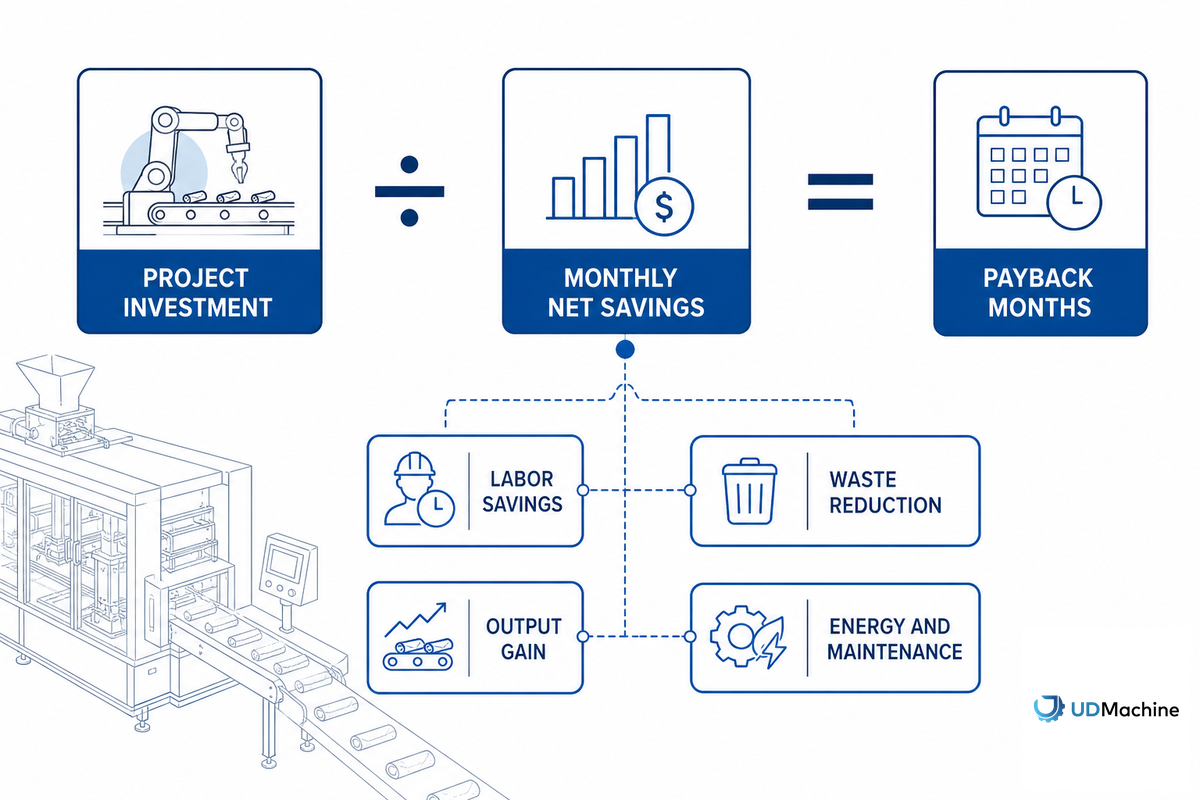
Payback months should be calculated from monthly net savings, not from gross labor savings. Run schedule is the swing factor: a plant running 22 planned production days per month will see a different result from a plant that uses the new egg roll machine only 8 days per month.
- Monthly gross savings = Labor savings + Waste savings + Throughput contribution.
- Monthly added operating cost = Utilities + Maintenance + Consumables + Planned downtime.
- Monthly net savings = Monthly gross savings – Monthly added operating cost.
- Payback months = Total project investment / Monthly net savings.
Total project investment should include the egg roll machine price, shipping, import duties, installation, start-up spare parts, facility work, operator training, product trials, and planned lost production during startup. Payback will look artificially short if the model counts labor savings but ignores the costs required to make the line work.
A short worked example
Example: if a plant spends USD 8,400 per month on manual rolling and transfer labor, loses USD 1,600 per month to rework and giveaway, and expects USD 2,100 per month in added utilities, maintenance, and service parts after automation, monthly net savings would be USD 7,900. With a USD 145,000 total project investment, payback is 145,000 / 7,900 = about 18.4 months.
Energy should be a sensitivity input, not an afterthought. Fuel-price uncertainty can be framed with the U.S. Energy Information Administration’s Annual Energy Outlook, but the quote model should use the buyer’s actual electricity, LPG, or natural gas price and the expected monthly run hours.
Manual vs Automated Cost Per 1,000 Good Pieces
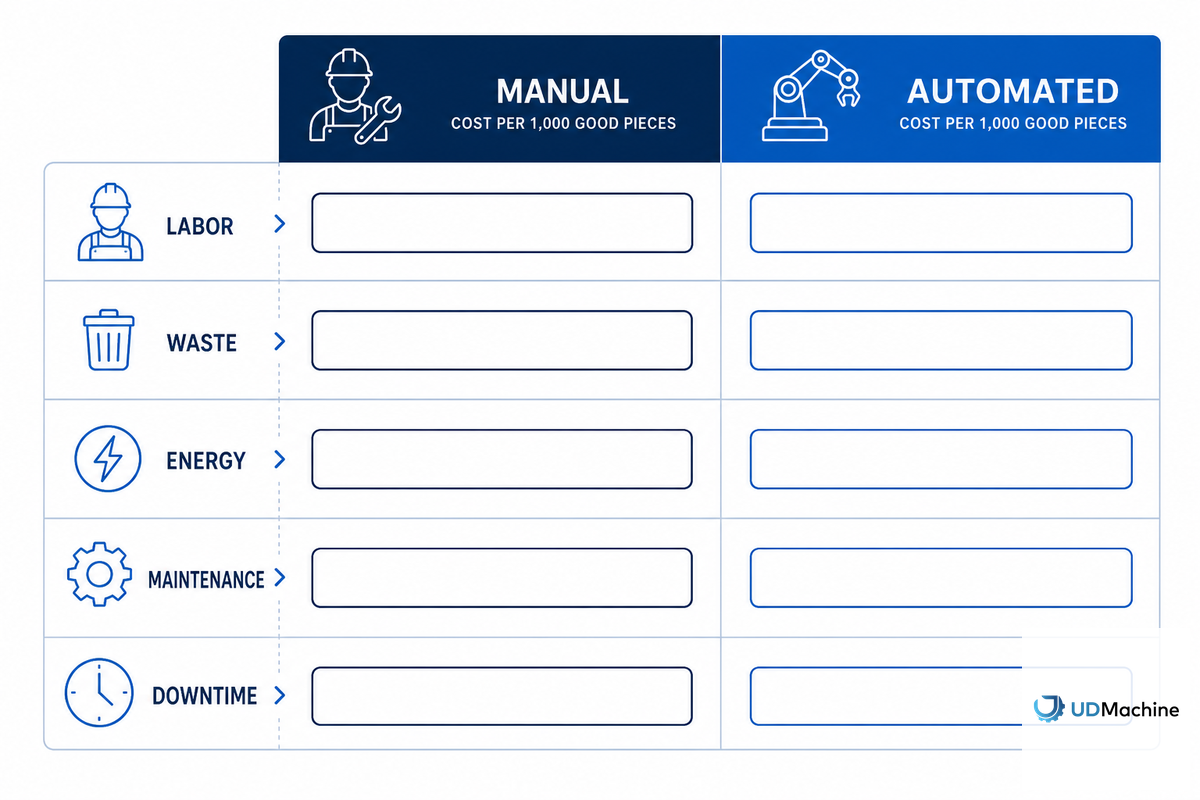
Calculating cost per 1,000 good pieces is more useful than cost per hour because it includes yield. Two lines can run at similar speed and still produce different financial results if one line creates more sellable egg rolls, fewer rejects, or less filling giveaway.
| Cost category | Manual baseline | Automated case | Data to collect |
|---|---|---|---|
| Direct labor | Workers x hours x loaded wage | Operators x hours x loaded wage | Crew plan before and after installation |
| Overtime | Paid premium hours when demand peaks | Reduced premium hours if the line catches up | Last 3-6 months of payroll detail |
| Wrapper scrap | Manual tearing or thickness variation | Controlled sheet or feed settings | Kg scrap per shift |
| Filling giveaway | Extra grams per piece from hand portioning | Targeted deposit or controlled feed | Average fill weight and tolerance |
| Rejects after rolling | Open ends, poor roll shape, visible defects | Repeatable forming and transfer | Reject count per 1,000 pieces |
| Energy | Manual or semi-automatic cooking load | Line power and fuel use | kW, kg/h LPG, or m3/h gas |
| Maintenance | Small tools and manual fixtures | Wear parts, service kits, planned service | Monthly service budget |
| Cleaning and changeover | Manual station clean-down | Line cleaning, setup, and recipe change | Minutes per changeover |
| Downtime | Staffing gaps or manual bottlenecks | Planned downtime plus line stoppages | Good pieces lost per month |
| Training and ramp-up | Existing worker learning curve | Operator training, recipe tests, first-month yield | Days to target yield |
This table prevents a common payback error: counting labor savings at full value while setting new operating costs to zero. An automatic egg roll production line can reduce unit cost, but the model still needs power, fuel, wear parts, sanitation, recipe trials, and startup time.
A Sample Payback Model For Egg Roll Automation
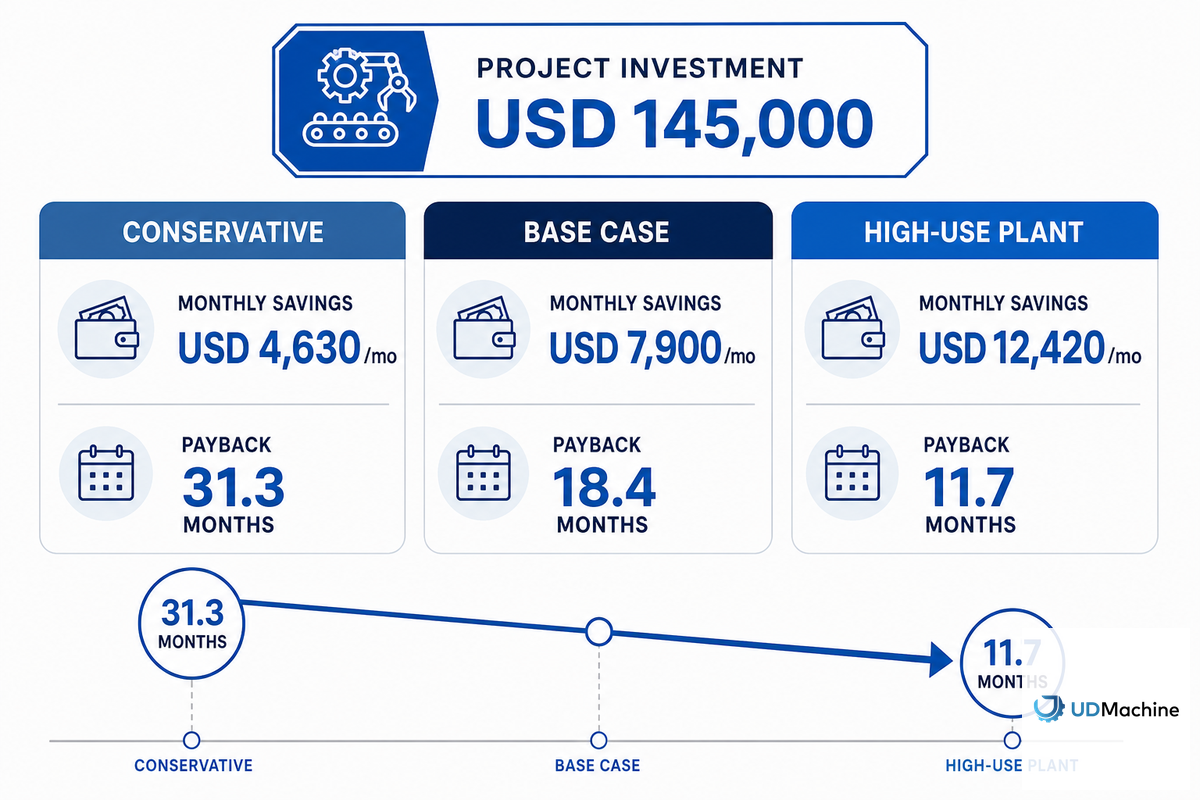
This sample is not a quote. It shows how the same USD 145,000 project can move from a weak payback case to a strong one when run days, labor redeployment, waste savings, and added operating costs change. What matters is not the exact number; it is the sensitivity of the decision.
| Scenario | Run plan | Labor reduced or redeployed | Waste savings | Added operating cost | Monthly net savings | Payback on USD 145,000 project |
|---|---|---|---|---|---|---|
| Conservative | 1 short shift, 12 days/month | 2 people | USD 900/month | USD 1,400/month | USD 4,630/month | 31.3 months |
| Base case | 1 full shift, 22 days/month | 3 people | USD 1,600/month | USD 2,100/month | USD 7,900/month | 18.4 months |
| High-use plant | 2 shifts, 24 days/month | 5 people | USD 3,200/month | USD 4,000/month | USD 12,420/month | 11.7 months |
Conservative payback lands at 31.3 months because the line is underused: one short shift and 12 run days do not create enough monthly savings. Base case reaches 18.4 months because the plant has a full shift and a clearer crew change. High-use plants can reach 11.7 months only when two shifts and 24 run days turn fixed investment into more monthly output. Replace the USD 145,000 project value, labor count, run days, waste savings, energy cost, and maintenance budget with plant-specific data. For a worksheet built around UDTECH line options, use the wafer egg roll production ROI worksheet.
When 18-24 Month Payback Is Realistic, And When It Is Not
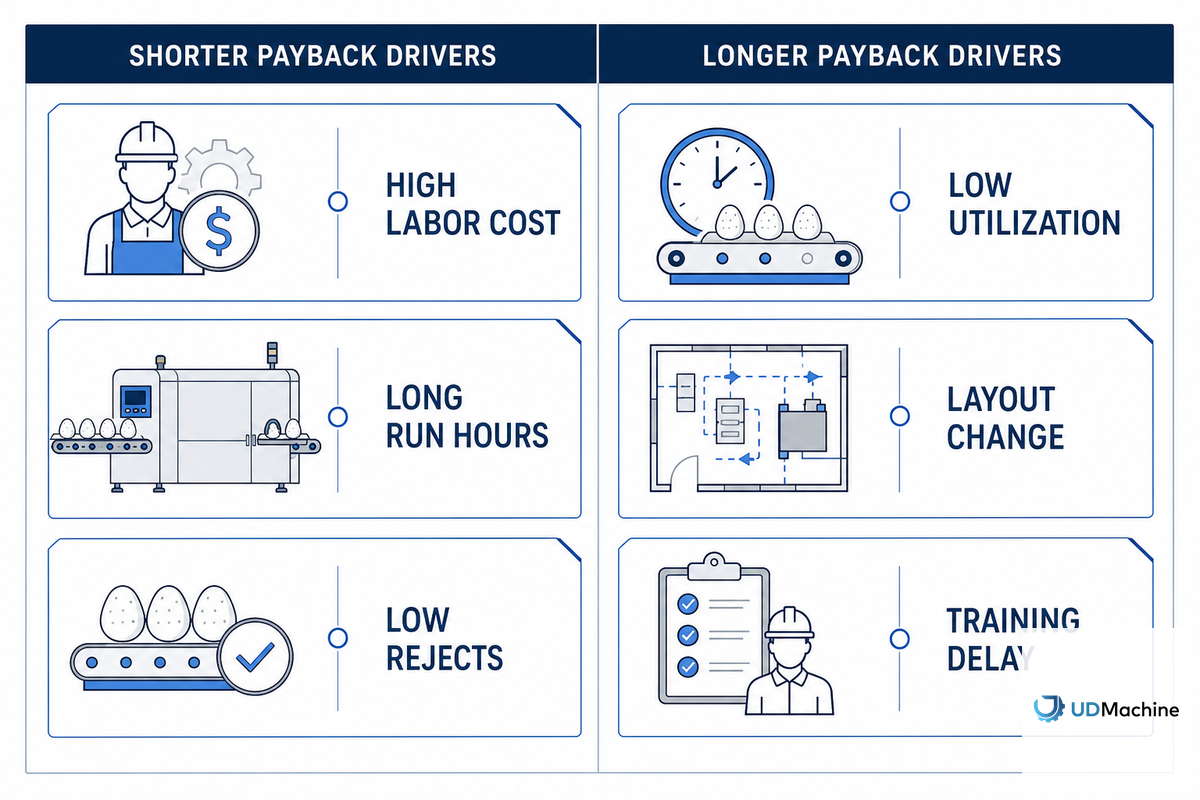
UDTECH’s product page for its automatic egg roll machine specifies a typical payback period between 18-24 months for an appropriate project. Treat that as a planning window, not a guarantee. That range is realistic only when the plant has enough labor pressure, planned run hours, recipe stability, and downstream capacity to turn automated output into sales.
A buyer should be skeptical if a proposal promises 18-24 months while assuming one short shift, uncertain demand, no training delay, no utility work, and perfect yield from day one. In that case, the machine may still be the right investment, but the project should be justified as a capacity or quality move rather than a fast cash-payback project.
| Variable type | Pushes payback shorter | Pushes payback longer | Buyer check |
|---|---|---|---|
| Demand | Signed orders or stable forecast for added output | Trial demand only | Can sales absorb added pieces/month? |
| Labor | 3-5 manual roles reduced or redeployed | 1 role changes, rest remain fixed | Which positions change after installation? |
| Run hours | 22-48 production days-equivalent/month | Less than 12 production days/month | What will the first 90 days actually run? |
| Recipe stability | Repeatable wrapper and filling settings | Frequent size or filling changes | How many changeovers per shift? |
| Yield | Rejects fall by measured pieces/shift | Rejects are not measured today | What is the current good-piece rate? |
| Utilities | Existing gas and power capacity fits the line | Panel, gas, ventilation, or layout work is needed | Has facilities reviewed kW and fuel demand? |
| Installation | 5-7 day installation fits planned downtime | Installation interrupts a peak season | When can the plant safely install? |
| Training | 2-3 days training plus assigned line owners | No dedicated operators | Who owns settings, checks, and changeover? |
| Downstream equipment | Cooling and packing match new line rate | Packing becomes the new bottleneck | Can downstream handle peak pieces/hour? |
| Food safety and documentation | SOPs, sanitation, and inspection are ready | Validation work starts after delivery | Which records must be ready before launch? |
Safety and ergonomics are not usually entered as direct cash savings unless the plant has measured injury, absence, or job-rotation cost. OSHA’s ergonomics material can still help buyers ask better questions about repetitive manual work, but those benefits should be documented separately from the core payback formula.
The Finance Checklist Before Requesting An Automation Quote
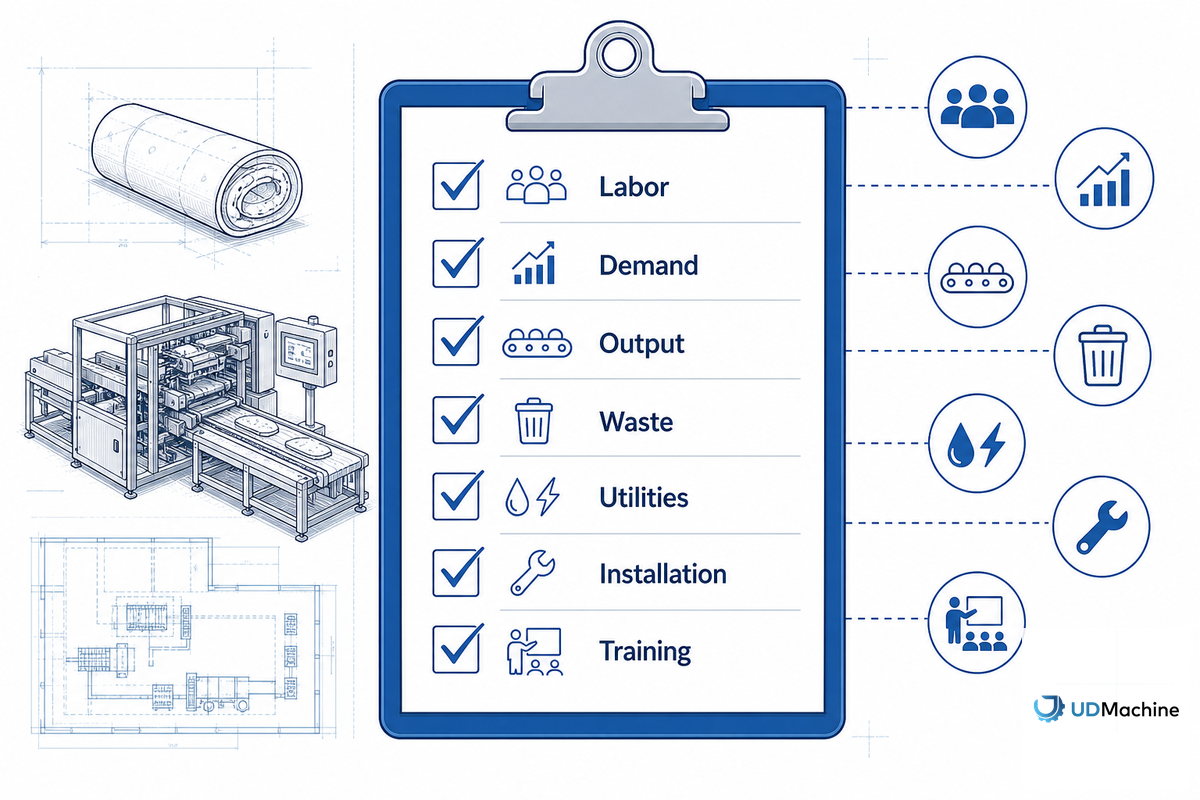
A supplier can model the line more accurately when the buyer brings real plant data instead of asking for a generic ROI promise. Before requesting a quote, prepare these items:
- [ ]Current monthly good-piece output and reject count.
- [ ]Current workers per shift tied to wrapping, rolling, transfer, and inspection.
- [ ]Loaded hourly labor cost, including overtime and benefit load.
- [ ]Target output per shift and monthly demand forecast.
- [ ]Product weight, wrapper thickness target, filling target, and allowed tolerance.
- [ ]Available floor space, including access, feeding, cooling, and packing zones.
- [ ]Electricity, LPG, or natural gas price and available utility capacity.
- [ ]Required food-safety records, sanitation plan, and quality checks.
- [ ]Finance-approved payback threshold, such as 18, 24, or 36 months.
For machinery safety review, buyers working with CE-aligned equipment can compare supplier records against the EU Machinery Directive 2006/42/EC and their own national requirements. This check does not replace a local compliance review, but it prevents the finance model from ignoring installation and records work.
Use The Model With UDTECH’s Automatic Egg Roll Production Line
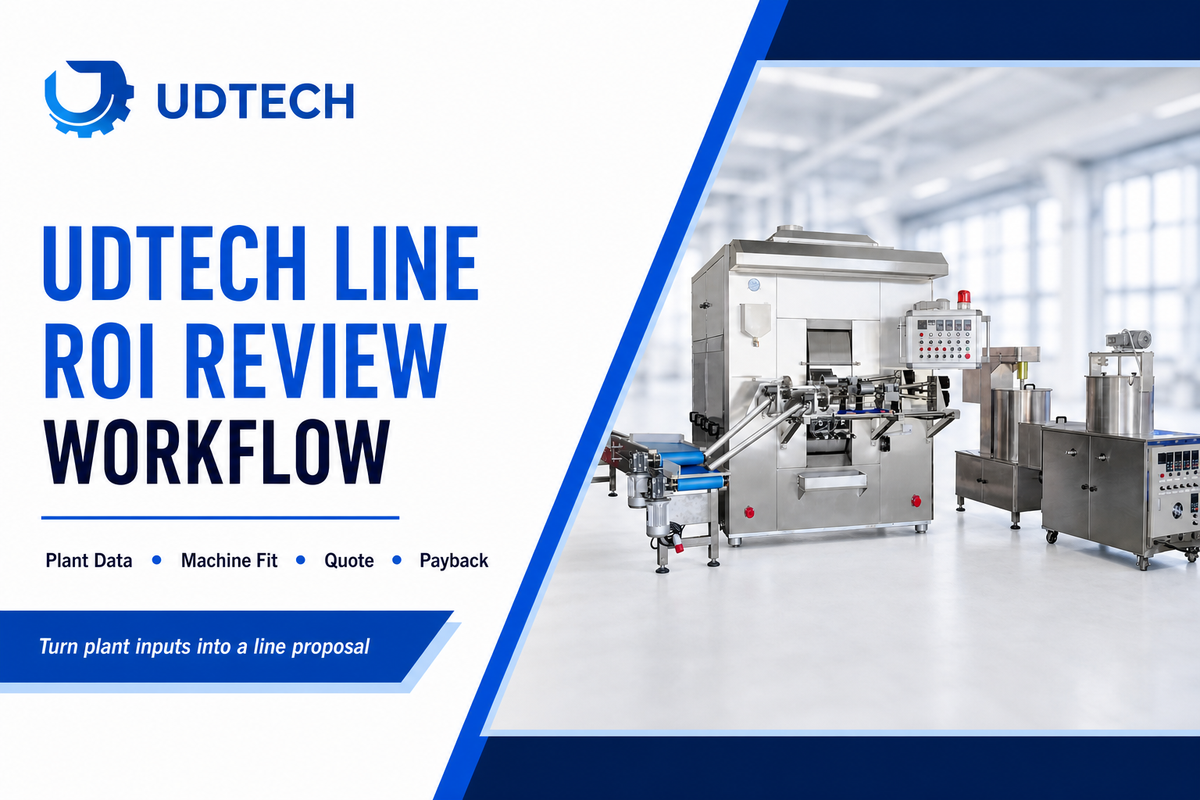
After the payback inputs are ready, compare them with the actual line proposal. UDTECH can map the model around target output, recipe, crew size, utility plan, and facility layout. Start with the automatic egg roll machine page for production-line specifications, then use the ROI worksheet to turn plant data into a payback view.
If your team is still choosing between machine categories, read the egg roll machine types and buyer guide. If the question is whether wafer roll and spring roll systems should be treated as the same project, the wafer roll vs spring roll machine comparison helps separate product format, process flow, and equipment choice.
Send your current shift output, crew count, target product weight, run days per month, reject rate, and utility prices. UDTECH can help convert those inputs into a payback model around the right egg roll production line configuration.
FAQ
Q: What is the typical ROI for automating egg roll production?
View Answer
Q: How much labor can an automatic egg roll machine reduce?
View Answer
Some workers may be redeployed to packing, quality checks, sanitation, or changeover rather than removed from the plant. Good worksheets show the before-and-after crew plan by shift, not only a headline labor reduction.
Q: Is throughput or labor saving more important for payback?
View Answer
In that case, yield and labor stability may matter more than maximum pieces per minute.
Q: How much floor space is needed for an egg roll production line?
View Answer
Real layouts need more room for access aisles, ingredient feeding, cooling, packing, sanitation, gas or electric service, and maintenance clearance.
Q: Does automation change egg roll texture or product quality?
View Answer
It does not remove the need for recipe trials. Before purchase approval, test the target product size, filling, texture expectation, and quality checks with the supplier.
Related Articles
- Commercial Egg Roll Machine Buyer Guide – use this when the buyer needs quote categories and TCO inputs.
- Egg Roll Machine Capacity Planning – use this when output sizing is the main question.
- Egg Roll Machine Types And Buyer Guide – use this before comparing equipment classes.
- Wafer Roll vs Spring Roll Machine – use this when product format is still being defined.
- Automatic Egg Roll Machine Blogs – browse related UDTECH articles for this equipment category.
About This Payback Model
This article is written for food factory owners, plant managers, and finance teams evaluating automatic egg roll production. It uses UDTECH equipment data where relevant, separates sample assumptions from verified inputs, and keeps payback tied to plant-specific labor, utility, yield, and run-hour data. Reviewed by the UDTECH technical team.
References & Sources
- Food manufacturing hourly earnings series – U.S. Bureau of Labor Statistics
- Annual Energy Outlook 2026 – U.S. Energy Information Administration
- Ergonomics Program Case Study Appendix – Occupational Safety and Health Administration
- 21 CFR Part 117 – Electronic Code of Federal Regulations
- Machinery Directive 2006/42/EC – EUR-Lex