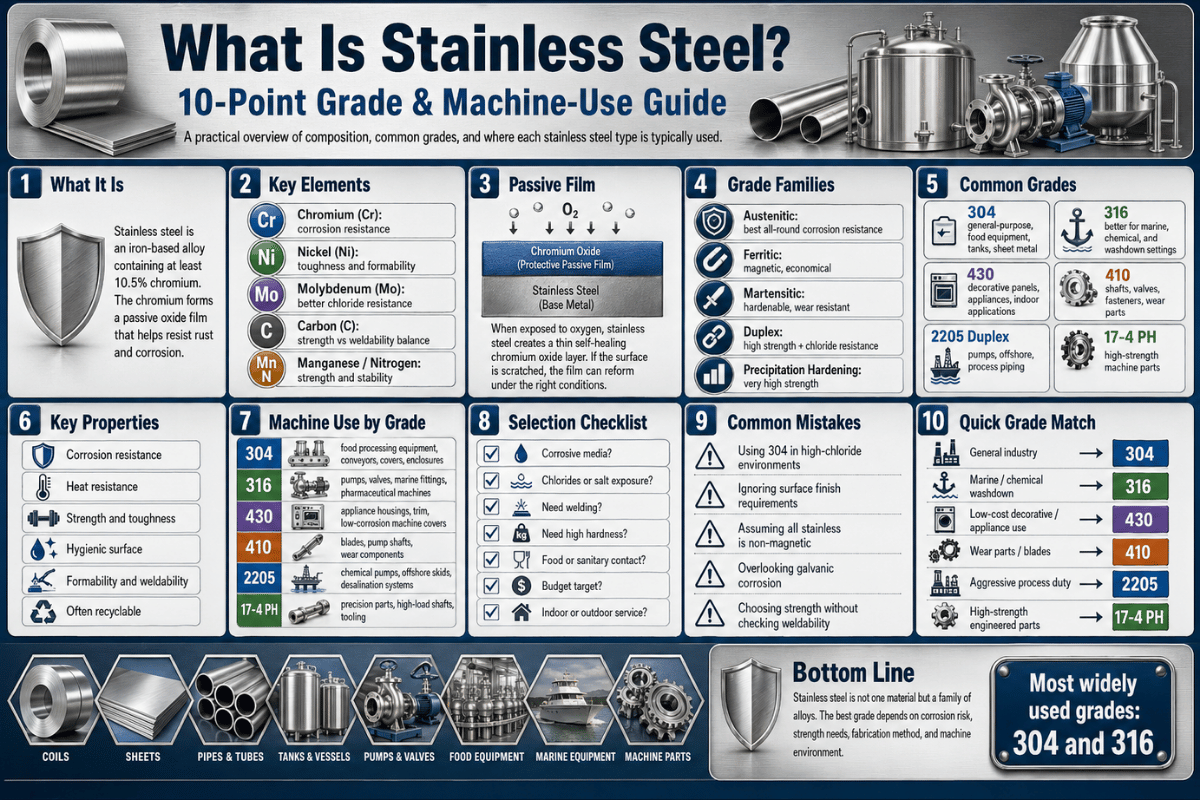
What is stainless steel? This iron-based alloy contains enough chromium to form a thin protective oxide film, which is why it resists rust better than ordinary carbon steel. Machine buyers should start with one practical detail: stainless is not one material. Grade, finish, weld condition, cleaning chemistry, and operating environment decide whether it performs well.
Quick Specs: Stainless Steel In One Page
| Defining element | Chromium, usually at least 10.5% by mass |
| Protective action | Chromium reacts with oxygen and forms a thin chromium oxide film |
| Main families | Austenitic, ferritic, martensitic, duplex, precipitation-hardening |
| Common equipment grades | 304/304L for general food and machine contact; 316/316L for harsher chloride exposure |
| Common mistake | Treating “stainless” as rust-proof instead of corrosion-resistant |
Composition Of Stainless Steel In Simple Words

In simple terms, stainless steel is a steel alloy made mainly from iron, carbon, and chromium. Chromium gives stainless steel its corrosion resistance by forming a passive surface film. Even so, the metal can still stain, pit, or rust if the grade is wrong, the surface is contaminated, or the environment is too aggressive for the alloy.
That distinction is important. This is not ordinary steel with a shiny coating. Corrosion resistance comes from the alloy itself. If a scratch exposes fresh surface, oxygen can help the protective film form again, provided the surface is clean and the chemistry is suitable.
10.5% Chromium Rule Ladder

A 10.5% chromium minimum is the most cited stainless steel threshold. BSSA and Worldstainless both use this level when defining stainless steels. Chromium is the ladder’s first rung, not the whole story. Nickel, molybdenum, carbon, nitrogen, manganese, surface finish, and passivation all change how the final grade behaves.
| Rule rung | What it tells you | What it does not tell you |
|---|---|---|
| 10.5% chromium | The alloy can be considered stainless by the common definition | Whether it fits salt, acids, food washdown, or welding |
| Nickel addition | Often improves ductility and stabilizes austenitic grades | A higher nickel number alone does not rank every grade |
| Molybdenum addition | Helps with pitting and crevice corrosion resistance | It does not fix poor drainage or trapped chloride cleaner |
| Passivated surface | Surface contamination has been addressed after fabrication | It does not change a wrong grade into the right grade |
Properties Of Stainless Steel That Machine Buyers Should Check

The properties of stainless steel come from chemistry, processing, and surface condition. The chromium content of 10.5% is the entry point, but it is not the full buying rule. Chromium reacts with oxygen at the surface and forms a layer of chromium oxide. That thin layer gives stainless steel’s resistance to corrosion when the surface remains clean and the grade matches the service environment.
Different grades of stainless steel solve different tradeoffs. Austenitic stainless steel is common for cleanability and forming. Ferritic steel can reduce nickel cost in lower-exposure parts. Martensitic stainless steel is used where hardness or wear behavior matters. Duplex stainless steel can help when strength and chloride resistance are both needed. Precipitation-hardening stainless steels can gain strength through heat treatment, which is why a grade number alone is not enough.
| Property question | What to confirm | Buyer note |
|---|---|---|
| Resistance to corrosion | Grade, finish, passivation, and cleaner exposure | Steel corrosion often starts at contamination, crevices, or the wrong cleaner |
| High temperatures | Heat exposure, oxidation risk, and strength loss | The melting point of stainless steel varies by grade, so use supplier data for thermal design |
| Fasteners and wear parts | Galling risk, hardness, and stainless steel fasteners specification | High strength may require a different stainless steel material than food-contact sheet |
| Recycling and sourcing | Stainless steel scrap route, certificate path, and traceability | Stainless steel recycling matters when the project has material-origin requirements |
During steel production, molten steel becomes molten stainless steel only after the alloying route is controlled. Making stainless steel for a machine part is different from buying a generic type of steel. Use stainless steel when the application needs cleanability, appearance, corrosion resistance, or a combination of these benefits of stainless steel.
Stainless Steel Families And Types Of Stainless Steel

Stainless steel grades are grouped into families. Family grouping tells you more than the grade number alone because it hints at magnet response, hardening method, weld behavior, and corrosion profile.
| Family | Example grades | Magnet response, 0-5 | Machine-use note |
|---|---|---|---|
| Austenitic | 304, 304L, 316, 316L | 0-2 | Common in food contact parts, tanks, covers, and general corrosion-resistant machine surfaces |
| Ferritic | 430, 409 | 4-5 | Ferritic stainless steel can fit panels or lower-nickel parts where exposure is less severe |
| Martensitic | 410, 420, 440 | 4-5 | Harder and wear-focused; corrosion resistance can be more limited than 304/316 in wet service |
| Duplex | 2205 | 3-5 | Stronger chloride and stress-corrosion option when ordinary austenitic grades are stretched |
| Precipitation-hardening | 17-4PH | 3-5 | High-strength parts where a heat-treatment path is part of the design |
304 Vs 316 Stainless Steel: The Buyer-Safe Rule

304 stainless steel is often the all-around workhorse. 316 adds molybdenum and is usually selected when chloride exposure, stronger cleaning chemistry, or marine-like conditions make pitting risk more serious. Joined assemblies often use 304L or 316L rather than the carbon-sensitive standard grades.
On a snack line, pet food line, or powder-contact machine, the safer question is not “Is it stainless?” A more useful question is: “Which grade, which finish, which weld treatment, and which cleaning chemistry will touch the product?” Contact parts matter, so UDTECH buyers can compare that question against a food machine solution review or a twin screw extruder for polymer compounding discussion.
Does Stainless Steel Rust?

Yes, stainless steel can pit or rust. Common causes include the wrong grade, chloride exposure, embedded carbon-steel particles, weld heat tint, trapped fluid in crevices, or missing passivation after fabrication. Machinist forum discussions point to a practical problem: stainless parts can show rust marks when machining or grinding leaves ordinary steel on the surface.
Rust Risk Ladder
- Carbon steel contamination from shared tools or grinding media.
- Chloride cleaner, salt, or pool-like water exposure.
- Weld heat tint left on the surface.
- Crevices, poor drainage, or food residue trapped around joints.
- Wrong grade for the environment.
- No passivation or poor cleaning after machining.
Can stainless steel rust in water?
Plain clean water is usually less aggressive than chloride-rich water, acidic washdown, or stagnant crevice conditions. Risk rises when chlorides are present, when a part stays wet without drainage, or when the surface is contaminated with iron. A laser-cut or machined stainless component may still need cleaning and passivation before it goes into service.
When existing parts need rust removal, a fiber laser cleaning machine or laser machine rust removal guide can help with surface cleaning. That cleaning step should never replace correct grade choice or sound fabrication practice.
How Stainless Steel Is Made, Finished, And Recycled

Stainless steel starts by melting iron with alloying elements such as chromium, nickel, molybdenum, manganese, and carbon. The alloy is then refined, cast, rolled, annealed, cleaned, and finished into sheet, plate, bar, tube, or other product forms. Surface cleanliness matters because stainless steel depends on a clean surface for corrosion resistance.
Recycling also matters because chromium and nickel-bearing scrap can be remelted into new stainless steel. Worldstainless’ public 2025 figures notice confirms that Stainless Steel in Figures is the current reference for global industry statistics, although the detailed data tables are not public on that page.
Machine Uses For Stainless Steel: Food, Laser, Cleaning, And Extrusion

In machinery, stainless is usually chosen for cleanability, corrosion resistance, wear behavior, or appearance. Food-contact grades need to be smooth, non-porous, inert, durable, cleanable, and safe. A peer-reviewed Food Protection Trends article states that stainless is generally the preferred material for food processing equipment.
Laser work exposes another issue: stainless behaves differently from mild steel, copper, or aluminum. Grade, thickness, assist gas, heat input, and finish all influence edge color, burrs, oxidation, and later corrosion behavior. Use UDTECH’s stainless steel laser cutting guide, fiber laser material compatibility guide, and laser marking machine for metal page as deeper process references.
In extrusion and processing machines, stainless steel may appear in hoppers, guards, contact zones, fasteners, nozzles, or cleaning-sensitive areas. Often, it is one part of a larger material stack rather than the only material in the system. Compare stainless decisions with other material and process guides such as types of metal for manufacturing and types of CNC machines.
“The first stainless question is rarely the grade number. Service condition matters: chloride, temperature, cleaning, wear, and whether the surface was contaminated during fabrication.”
How To Specify Stainless Steel For A Machine Or Part

A supplier cannot select stainless steel well from the word “stainless” alone. Provide the operating environment, product contact, cleaning chemistry, operating temperature, part geometry, and surface finish requirement. Then ask for the grade and certificate path.
10-Point Stainless Specification Matrix
Use this matrix as a quoting checklist, not as a universal standard. Values such as 0.8 µm, 3.0 mm, or 80°C are example field formats that a buyer can replace with project-specific requirements.
| Material/type checkpoint | Why it matters | Answer format |
|---|---|---|
| Which grade? | 304, 316, 430, and 410 solve different problems | Grade plus standard or certificate request |
| Which finish? | Cleanability and corrosion depend on surface condition | Finish name, roughness target if required |
| Welded or cut? | Heat tint, burrs, and contamination can reduce performance | Process plan plus cleaning/passivation step |
| Which chemicals touch it? | Chlorides and acids change grade choice | Cleaner name, concentration, temperature, contact time |
| Is traceability needed? | Food, export, or regulated projects may require proof | MTC, PMI, or project-specific documentation |
| Chromium content | The stainless definition starts at 10.5% chromium | Grade certificate showing 10.5%+ chromium where applicable |
| Low-carbon grade need | Welded assemblies may need lower carbon sensitivity | 304L/316L request; example carbon field: 0.03% max if the project standard requires it |
| Surface roughness | Cleanability depends on the actual surface, not only the alloy | Record Ra target such as 0.8 µm or 1.6 µm only when your food or hygiene standard calls for it |
| Sheet or contact-part thickness | Vibration, forming, and cleaning damage change with thickness | Example quote fields: 1.5 mm, 2.0 mm, or 3.0 mm plus tolerance |
| Drainage and crevice control | Stagnant liquid increases corrosion and sanitation risk | Document weld cleanup and any 3 mm or larger drainage clearance your design requires |
| Temperature exposure | Hot washdown, drying, or process heat can change grade choice | State routine and peak values, for example 80°C cleaning or 200°C process exposure |
| Laser-cut edge plan | Heat tint, burr, and oxidation affect later corrosion behavior | List material thickness such as 1 mm, 3 mm, or 6 mm and the post-cut cleaning step |
| Cleaning pressure or spray condition | Pressure, temperature, and cleaner concentration can change corrosion risk | Record actual plant value, for example 150 PSI washdown if that is part of the project brief |
What Is Changing In Stainless Steel Decisions In 2026?

The core definition is not changing, but buyer behavior is. In 2026 planning, material traceability, recycled-content claims, nickel and chromium cost exposure, and cleanable design are harder to ignore. Worldstainless’ public 2025 figures notice confirms that the industry follows meltshop production, foreign trade, and market potential categories, although exact tables require the paid brochure.
Equipment buyers have a simple move: define the grade, finish, cleaning method, and inspection requirement before placing the order. This protects your project better than choosing the lowest-cost material that merely says “stainless.” These resources may help if you are comparing machine categories: pair this article with fiber laser vs CO2 guide, laser cleaning machine explainer, and extrusion process guide.
FAQ
What is stainless steel made of?
Answer.
Is stainless steel 100% steel?
Answer.
Is stainless steel magnetic?
Answer.
Does stainless steel rust outside?
Answer.
What is the difference between 304 and 316 stainless steel?
Answer.
What does stainless steel 304 mean?
Answer.
What is stainless steel 316?
Answer.
How is stainless steel passivated?
Answer.
What is the melting point of stainless steel?
Answer.
Can stainless steel be laser cut or welded?
Answer.
Transparent Scope Note
This article brings a machinery buyer perspective to stainless steels. Project specific material requirements, food safety evaluations, or corrosion engineer approval still apply. Confirm exact grade required based on your product, cleaner, temperature, weld design and paperwork needs.
References & Sources
- Introduction to stainless steels – Worldstainless
- The Basics about Stainless Steel – British Stainless Steel Association
- General principles for selection of stainless steels – British Stainless Steel Association
- Characteristics of Food Contact Surface Materials: Stainless Steel – Food Protection Trends
- Stainless Steel in Figures 2025 – Team Stainless / Worldstainless