Types of Metal: Guide to Properties, Applications, and Industrial Uses
Knowing the kinds of metals available is the initial key to sound material decisions in any welding, machining, or engineering endeavor. From carbon steel poles supporting skyscrapers to bio-compatible titanium plates, metals constitute the fabric of the modern world, often unnoticed. Here’s a simple explanation of the types of metals, comparisons of quantifiable properties, and a chart relating each to their ideal use.
⚡ Quick Specs
| Total Metallic Elements | 94 |
| % of Periodic Table | ~75% |
| Most Produced Metal | Steel — 1.326 billion metric tons in 2024 |
| Most Abundant in Earth’s Crust | Aluminum — 8.2 wt% |
| Only Liquid Metals at Room Temp | Mercury (melting point −³8.8 °C) and Gallium (29.8 °C) |
What Is Metal? Definition and Atomic Structure
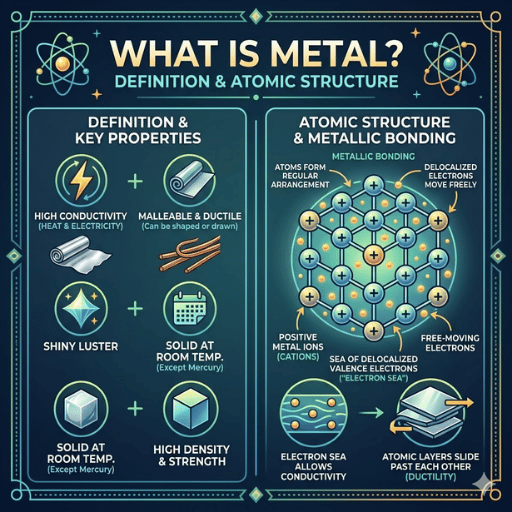
By definition, a metal is a chemical element that ionizes easily to form positive ions, (cations), and that it forms metallic bonds between the positive ions. These chemical bonds produce a “sea” of free-moving electrons which are in constant motion throughout the entire crystal structure. This explains the properties seen with all metals: high electrical and thermal conductivity, malleability, ductility and when polished a shine.
It is that sharing of electrons that gives us a copper wire that travels a current and a steel girder that bends in front of it snapping. The delocalised electrons in metals enable one layer of atoms to slide over each other when under stress without breaking bonds, like can be the case with ceramics or glass, which snap instead of bend. This delocalised electron giving us the ductile nature of metals when drawn into thin wire or hammered into sheets, the malleability.
If you have ever had a go against the metal on a press brake to bend metal you will have seen metallic bonding in practice.
In general, the periodic table is mostly paved by metals on the left center, of which the d-block transition metals such asiron, copper, nickel, titanium and chromium are the workhorses in industrial production. The alkali metals such as lithium and sodium, and alkaline earth metals such as magnesium and calcium can be found in the extreme left, but they are so reactive that none of them is appropriate for structural applications in theirnative states. In the overall picture, 94 out of about 118 known elements can be identified as metals.
And two of those 94 metallic elements are liquid, at your average room temperature: mercury and gallium.
Liquid at room temperature is fairly unusual in the periodic table, in a family of states generally characterised by the strength of the solidstate element.
For practical engineering, metals split into three broad groups:
- Les métaux ferreux – Ferronickel, Argent ferreux… Contiennent du fer. (ex: acier, fonte, fer…)
- Metalli non ferrosi – nessun il contenuto di ferro (Alluminio, rame, titanio, zinco)
- Alloys – The engineered mixtures of two or more element, at least one metallic (brass, bronze, Inconel)
Suppose each section of the list below introduces one group of metals that is studied in depth individually, then compares the properties that can be measured of each, and demonstrates what applications each group of metals truly performs well.
Key Properties of Metals That Determine Industrial Selection
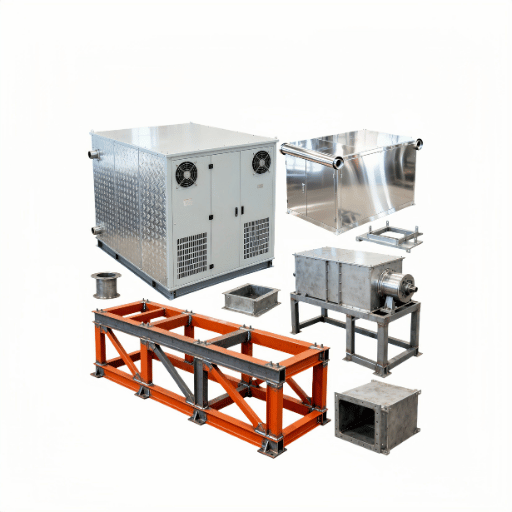
Picking a metal for a project is never about one number. A fabricator considers strength to weight ratio, looks at conductivity specifications, reviews corrosion characteristics in the actual service environment, then considers budget and machinability. Six typical engineering metals are simultaneously tabulated below on the parameters which are of greatest importance.
| Property | Steel (1018) | Aluminum (6061-T6) | Copper (C11000) | Titanium (Ti-6Al-4V) | Zinc | Nickel (200) |
|---|---|---|---|---|---|---|
| Density (g/cm³) | 7.87 | 2.70 | 8.96 | 4.4³ | 7.13 | 8.89 |
| Melting Point (°C) | 1,510 | 660 | 1,085 | 1,668 | 420 | 1,455 |
| Tensile Strength (MPa) | 440 | 310 | 220 | 950 | 37 | 462 |
| Elec. Conductivity (%IACS) | 12 | 43 | 100 | 3 | 27 | 25 |
| Machinability Rating | 65% | 50% | 70% | 22% | 80% | 30% |
Mains Source: ASM International Materials Database; Engineering Toolbox
Strength tensile strength is how much tension a metal can stand before cracking. In this category, titanium bests all with 950 MPa, which is why of the world’s leading users are the aerospace engineers of landing gear and turbine blades. At the weakest end of the scale, zinc can only stand 37 MPa, which means it gets used for coatings and die-cast housings but not structural work.
Electrical conductivity is measured as a percentage of the IACS- International Annealed Copper Standard. 100% equals pure copper. Aluminum is 43% IACS, by no means the best electrical conductor, but light enough to make good overhead high-tension pylon cabling for one third the weight per volume of copper. Titanium’s at the bottom, only 3%, which makes it useless for wiring but more than ideal as a material used in body and head implants where electrical conductivity would only be harmful.
Corrosion resistance relies on the metal’s ability to form a protective oxide layer. Aluminum’s ability to form a naturally metal-preventing silicon oxide layer (AlO) is quite remarkable- it isn’t even that easy to invent such a layer as thick and protective. Stainless steel depends on 10.5% minimum chromium into the base metal so that a layer of chromium oxide can be grown. Green mild carbon steel, contaminated by no more than a trace of the element that makes stainless steel as good in corrosion resistance as it is, quickly corrodes in humid and salt atmospheres unless painted, galvanized or otherwise protected.
Aluminum with a conductivity of only 205 W/mK versus steel at 50 W/mK. A rough ratio of 4:1 seems to impose a practical limitation- laser cutting aluminum. For the same cross sectional area of the beam dimensions, the higher power density required to focus the delivery of laser energy also means faster train speeds to avoid heat build-up and spreading laterally producing that rough gutter. If operators are torch cutting 5 or 6 parts on different types of material, the machine needs to be re-calibrated to each work piece at each job change with respect to laser power output, speed of travel and assist gas pressure.
What Types of Metal Are Magnetic?
Magnets attract a number of different metals in three different ways. Ferromagnetic materials attract magnets extremely well and are the only metallics than can become permanent magnets themselves. These are the only metals the magnetic chucks can hold workpieces during machining. Diamagnetic materials are effectively repulsive to a magnetic field such as gold and copper you would have to use laboratory equipment to even find out. Paramagnetic materials such as aluminum or titanium are said to exhibit a very weak magnetic attraction that is practically impossible to detect with the naked hand. In industry, the rule of thumb is simple the metal if it sticks to a magnet, then its has iron, nickel or cobalt content.
“All metals are a compromise. High strength, low weight, corrosion resistance, and low price are rarely encapsulated in one alloy. The mechanical engineer’s problem is to reckon up which two or three properties matter most to the customer and settle for the rest”.
— Materials engineering principle, paraphrased from ASM International guidelines
Ferrous Metals: Steel, Cast Iron, and Iron-Based Alloys
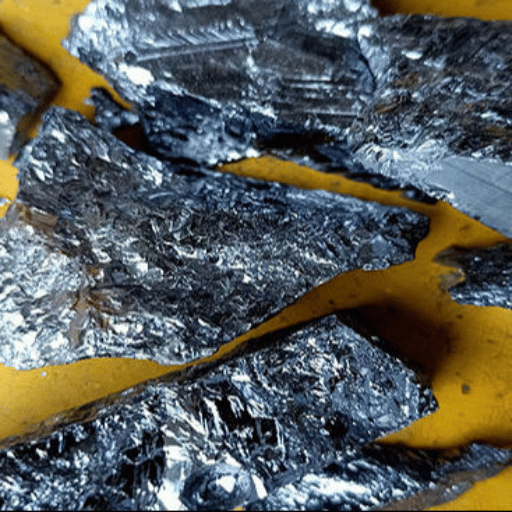
Over 90 percent of the world’s metals are ferrous- having an iron base. Over 632 million metric tons of crude steel was made in 2024, a staggering amount overwhelming all other metals combined. There is a very good reason for this. Iron is plentiful, and infrastructure exists to turn ore into metal, and the physical properties of steel can be altered on a scale of enormous to nonexistent only be additives such as carbon and alloying elements to them.
Carbon Steel
Carbon steel is classified by its carbon percentage:
- Low carbon / mild steel (<0.25% C) – Weld-able, form-able, machinable. The AISI 1018 is the standard general-purpose grade for brackets, fixtures, and structural members. Tensile strength approximately 440 MPa.
- Medium carbon (0.25-0.60% C) – Stronger, harder, used for automotive axles, gears, and railway track. AISI 1045 has a typical tensile of around 585 MPa.
- High carbon (0.60-2.0% C) – Very hard, used for cutting tools, springs, and wire. Heat treatable to extremely high hardness but suffers from having a very brittle microstructure and suffers greatly from poor weldability.
Stainless Steel
Stainless steels require at least 10.5% Cr in order to be called stainless. The chromium forms an invisible oxide layer on the surface giving exceptional resistance to corrosion. Three grades account for the vast majority of industrial uses:
- 304 (18% Cr / 8% Ni) – The most widely used stainless steel in the world. Serves the food processing industry, kitchen sinks, architectural trim, and chemical processing tanks. Non-magnetic in the annealed condition.
- 316 (16% Cr / 10% Ni / 2% Mo) – The molybdenum addition provides excellent chloride pitting resistance. Specified for marine hardware, pharmaceutical equipment, and coastal architecture. Cost about 20-30% more than 304.
- 430 (17% Cr, no nickel) – A ferritic grade which is magnetic, cheaper than 304, suitable for decorative panels, appliance trim, and automotive exhaust systems.
For projects that involve stainless steel laser cutting, 317 and 316 both exhibit a clean cut profile when laser cutting with a fiber laser at the appropriate power and gas setting – but 316 requires slightly more power due to its increased Mo content.
Alloy Steel
Alloy steels use combinations of chromium, molybdenum, vanadium, nickel etc to produce functional properties:
- 4140 grade (Cr-Mo) provides excellent toughness and fatigue resistance making it common in the oil & gas drill collars, axle shafts, and high-stress fasteners.
- 4340 grade (Ni-Cr-Mo) is an aerospace grade alloy with very high strength at depth, used in landing gear, power transmission gears, and heavy-duty tooling.
Cast Iron
- Gray cast iron (3-4% C) is extremely brittle but very good at absorbing and damping vibrations. This makes it the ideal base material for machine tools and engine blocks graphite flakes inside the microstructure convert vibration energy into heat.
- Ductile (nodular) cast iron contains graphite in spherical nodules instead of flakes, vastly improving the impact resistance and ductility. Used for pipe fittings, crankshafts, and heavy-duty gears.
- White cast iron is very hard and wear resistant. It used to make abrasion resistant liners for ball mills and slurry pumps.
White hot wrought iron – a historically important material for gates, railings, and chains – has given way to the cheaper and more machinable mild steels. Modern “wrought” iron products are usually mild steel shaped to resemble wrought iron.
| Ferrous Type | Composition | Tensile Strength (MPa) | Melting Range (°C) | Key Application |
|---|---|---|---|---|
| Mild Steel (1018) | 0.18% C | 440 | 1,505–1,530 | Structural, fixtures |
| Medium Carbon (1045) | 0.45% C | 585 | 1,500–1,520 | Gears, axles |
| SS 304 | 18Cr / 8Ni | 515 | 1,400–1,450 | Food equipment, architecture |
| SS 316 | 16Cr / 10Ni / 2Mo | 515 | 1,375–1,400 | Marine, chemical, pharmaceutical |
| Alloy Steel (4140) | Cr-Mo + 0.40% C | 655 | 1,415–1,450 | Drill collars, high-stress shafts |
| Gray Cast Iron | 3–4% C, graphite flakes | 150–400 | 1,140–1,260 | Machine bases, engine blocks |
What Types of Metal Rust?
“Rusting” is a particular chemical reaction: it occurs when iron interacts with oxygen and humidity to create a layer of rusting (which is ferrous oxide, FeO) that causes the weakness and flakiness in old steel. All ferrous metals are vulnerable because ferrous means there is at least some quantity of iron in their structure. Mild carbon steel will get rusty the fastest in response to salt spray or high moisture. Alloy steels such as 4140 are also prone unless lubricated, painted or otherwise protected.
In the case of stainless steel, that barrier to rusting is chromium oxide, and the alloy is said to be “resistant” rather than “rust-proof”. In particular, grade 304 can suffer from pitting corrosion in chloride environments (sea water, de-icing salts, brine solutions) above roughly fifty degree centigrade. That’s why specification for marine and chemical plant says that you need to use 316, where the 2% molybdenum content prevents that attack.
Most other metals that are not ferrous are non-magnetic and do not rust because they don’t contain iron. They suffer their own variations of corrosion; aluminum will produce a white powdery aluminum oxide and copper produces the attractive green verdigris effect on old roofs and statues. These oxide levels are actually resistant to subsequent attack – the opposite of that flaky ferrous oxide, which becomes more annoying the more you try to keep it in check.
They can. A food processing plant used grade 304 stainless for a saltwater brine system. Within 2 years, pitting corrosion became apparent at the welds were the magnesium and carbon gave way to the weak point in the chromium oxide layer. Switching to 316L made the problem go away- 2% molybdenum provides the salt resistance that isn’t there in 304. Always choose the stainless for the local conditions.
Non-Ferrous Metals: Aluminum, Copper, Titanium, and Beyond
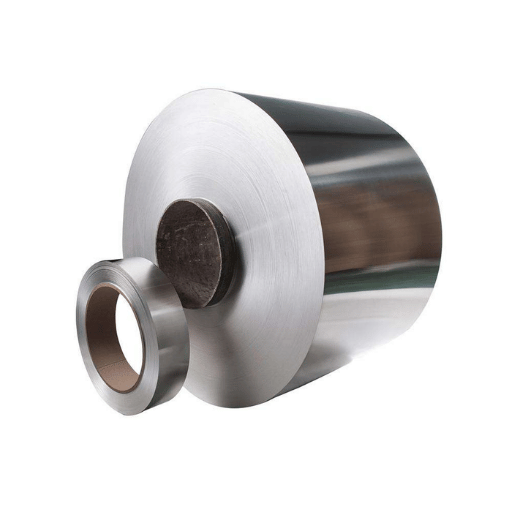
Non ferrous metals do not contain iron, which means they do not oxidize in the same way, since that process relies on the presence of iron. They are frequently non-magnetic and more corrosion resistant than ferrous materials, more conductive, lighter – but also more expensive and some times requiring different manufacturing methods.
Aluminum
Aluminum has the greater native crust in 8.2% of the Earth’s crust, at the second highest concentration after oxygen. Despite this, it was more costly than gold until Hall-Heroult technology was discovered in 1886. It represents the second most popular metal after steel: value in low density (2.70 g/cm), corrosion resistance and ease of machining.
Tensile strength of 6061 aluminum is 310 MPa, with a yield stress of 278 MPa, and a density of 2.70 g/cm. At a recommended 200-400 SFM with carbide tooling, this alloy has a machinability of 50%. It is used in 60,000 machines run yearly in the United States.
High in strength yet low in weight, the 7075 aluminum alloy has a tensile strength of 570 MPa, which borders on medium carbon steel territory. Sadly it is very weld resistant and more expensive than 6061 is.
Because aluminum reflects nearly 90% of the wavelength of a CO2 laser, laser welding aluminum alloys requires careful control of heat reflection and conduction.
Copper and Copper Alloys
Copper (C11000) defines 100% IACS as a measure of its conductivity. It is used as a fixed reference for electrical wiring, bus bars, and heat exchangers. The weeping problem; is its softness – with a tensile of just 220 MPa, it cannot sustain structural loads.
- The first commercially used alloy of copper, brass; which when alloyed with the other metallic element (zinc), is significantly harder than copper, inherently corrosion resistant and easy to machine – used for fittings, wind instruments, decorative hardware, and ammunition casings.
- An alloy consisting of copper and tin, bronze; provides greater strength and corrosion resistance in a saltwater environment than brass; traditional uses including ship’s propellers, bearings and marine hardware.
Laser processing of copper – it’s its specularity that makes it such a challenge to process with a laser. Because of the high-reflectance, fiber laser sources with a wavelength near 1,070 nm are much more suited than CO 2 sources. Read more about cutting copper with a laser.
Titanium
Ti-6AL-4V; the banner titanium alloy: 950 MPa tensile at 4.43 g/cm the most representative example of medium-strength steels, at 44% lighter weight. The world depends on titanium for this advantage in the aeronautic, medical and ultra-performance-motorsport worlds.
One cost constraint that is not addressed by marketing: at 25 to 100 times higher cost per kilogram (depending on form and grade) than stainless-steel, combined with a manufacturability rating of just 22%, component fabrication with titanium is financially expensive. When weight savings or the ability to make the body or product habitually would make the component advantageous, titanium is justified; given the rest of the time, stainless or aluminum are a better, cheaper choice.
Other Non-Ferrous Metals
- Zinc is in a handful of application areas; the most prevalent is galvanizing, the application of a zinc coating to steel or iron in order to provide corrosion protection. The second most popular application area is die-casting for door handles and automotive trim.
- Nickel appears in super-alloys (Inconel, Hastelloy) that govern the gas turbines and jet engines above 700 C degrees in temperature; and can also be used as a coating in electro-plating and batteries.
- Tin contributes to solder alloys for electronics, with tin-plating prevalent in food-cans, and bronze construction.
- Lead is involved in around 80% of the worldwide battery production, with radiation shielding and ballast applications as well; but the demand for which are suffering due to regulatory restrictions on toxicity.
- Precious metals (gold, silver, platinum) found their place in jewelry, circuits (gold wire bonding), catalyst converters (palladium and platinum), and investment;
| Metal | Density (g/cm³) | Melting Point (°C) | Conductivity (%IACS) | Cost Tier |
|---|---|---|---|---|
| Aluminum (6061) | 2.70 | 660 | 43 | $$ |
| Aluminum (7075) | 2.81 | 635 | 33 | $$$ |
| Copper (C11000) | 8.96 | 1,085 | 100 | $$$ |
| Brass (C26000) | 8.53 | 955 | 28 | $$ |
| Bronze (C93200) | 8.93 | 1,000 | 12 | $$$ |
| Titanium (Ti-6Al-4V) | 4.43 | 1,668 | 3 | $$$$$ |
| Zinc | 7.13 | 420 | 27 | $ |
| Nickel (200) | 8.89 | 1,455 | 25 | $$$$ |
Metal Alloys: How Combining Elements Enhances Performance
An alloy is an admixture of metallic element with one or more other elements; metallic or otherwise. The intended result is the creation of a property set that would not be attainable from the two or more constituents used alone. Steel is an alloy: iron and carbon. Bronze is an alloy: copper and tin. The modern world’s whole commercial civilization is based upon the production and processing of alloys rather than virgin metallic elements due to the general inability of virgin metals to meet the demands for strength, hardness, corrosion-resistance or modulus of real-world service environments.
Alloying works through ‘disruption at the atomic level’. Pockets of foreign atoms distort the regular arrangement of the crystal lattices, impeding the diffusion of dislocations the imperfections which allow metals to deform. Otherwise, mobile dislocations are set free and flexible metals become rigid, harder materials.
| Alloy Family | Base Metal | Key Alloying Elements | Flagship Grade | Standout Property |
|---|---|---|---|---|
| Carbon Steel | Iron | Carbon (0.05–2.0%) | AISI 1045 | Cost-effective strength |
| Stainless Steel | Iron | Cr, Ni, Mo | SS 316L | Corrosion resistance |
| Aluminum Alloys (2xxx–7xxx) | Aluminum | Cu, Mg, Si, Zn | Al 7075-T6 | High strength-to-weight |
| Copper Alloys | Copper | Zn (brass), Sn (bronze) | C36000 (free-cutting brass) | Machinability |
| Nickel Superalloys | Nickel | Cr, Fe, Nb, Mo | Inconel 718 | Withstands 700 °C+ |
What is the prevailing failure mode for the part in question? Select the alloy category designed to combat it. If corrosion is a concern, begin with stainless steels or titanium alloys. Fatigue due to cyclic loading cases is addressed by 4340 steel or Inconel. Weight issues are resolved by aluminum 7075 or titanium 6Al-4V, which are strongest at reduced weight. This single question—”What kills this part?”—automatically prunes over 80% of candidates before you have even looked in the material database.
Scenario: A fabrication shop transitioning from mild steel to 316L stainless to process food must change its welding wire (316L filler), switch the shielding gas to argon plus 2% carbon monoxide, and slow the cutting by about 30%. The mineral alloy selection determines every subsequent manufacturing process—tooling, fixturing, welding settings, and grinding or polishing steps. Material choice is never an independent process.
In addition to ferrous versus nonferrous classification; grouping metals into base (easily oxidized, zinc, iron, tin, aluminum), noble (resistance to oxidation, gold, platinum, palladium), or periodic table group is useful. Obtain of these groups—transition (d-block), alkaline earths, lanthanides—is available as separate categories.
How to Choose the Right Metal for Your Project
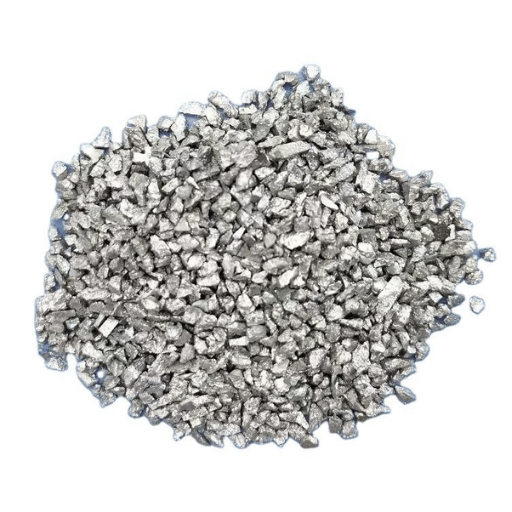
Metal selection errors are the most common cause of fabri-cation mistakes, and typically irremediable—once welded, you cannot un-weld the joint. A matrix below compares ten familiar metals across six parameters on a 1 (poor) to 5 (excellent) scale.
| Metal | Tensile Strength | Weight (inverse) | Corrosion Resist. | Machinability | Cost-Effective | Weldability |
|---|---|---|---|---|---|---|
| Mild Steel (1018) | 3 | 2 | 1 | 4 | 5 | 5 |
| SS 304 | 3 | 2 | 4 | 2 | 3 | 3 |
| SS 316 | 3 | 2 | 5 | 2 | 2 | 3 |
| Al 6061-T6 | 2 | 5 | 4 | 4 | 4 | 3 |
| Al 7075 | 4 | 5 | 3 | 3 | 3 | 1 |
| Copper | 1 | 2 | 4 | 4 | 2 | 3 |
| Brass | 2 | 3 | 4 | 5 | 3 | 2 |
| Ti-6Al-4V | 5 | 4 | 5 | 1 | 1 | 2 |
| Zinc | 1 | 3 | 3 | 5 | 4 | 1 |
| Nickel 200 | 3 | 2 | 4 | 2 | 1 | 3 |
Rating: 1=poor,5=excellent.Comparison across variables for guidance only.
Application-Specific Picks
- When discussing CNC machining, aluminum 6061 points to the best nonferrous, and mild steel 1018 seems to be the choice for the best ferrous. In terms of machinability, these score 4+ on ease of working.
- Laser cutting is optimal for mild steel—it’s easiest to cut and it is the most laser-friendly metal. Free of oxides and resists burning, other less desirable metals include stainless (which however does require higher-powered laser), aluminum (best with a fiber laser owing to reflection), and titanium (laser ‘field stone’ reserved for expensive, high-value parts). Visit the list of materials a fiber laser can cut for more choices.
- For corrosive environments used 316L stainless or titanium, pitting out at 5 each for best corrosion and oxidation protection. Ti only just so if weight reduction is worth 25 to 100 times the material expense.
- In the case of structural and architectural applications, residential or commercial, carbon steel (1018 or A36) provides 3 and 5 ratings of strength and cost respectively.
- Electronics and computer applications make use of copper for 100% IACS electrical conductivity and aluminum (with higher density) for light-weight enclosures and heat sinks.
What Type of Metal Can Be Used in Laser Cutting?
Almost all metals can be cut with a laser given the right equipment but different machines will need to be used. If very reflective metals like aluminum, brass, or copper are to be cut fiber lasers with 1070nm can be used. These won t have any trouble with back-reflect ions as the CO2 lasers have a 10600nmwave length – back faces the resonatorand/or damage it.
Mild steel is the most laser cutable metal in the world, it produces a good quality cut at a greater speed than any other and at a lower cost. Stain less steels take 20-30%more laser power than an equivalent thickness mild steel to cut, with titanium inert gas sealing ( usually argon) is necessary.
For a side-by-side comparison of fiber versus CO2 laser technologies, look at the fiber laser vs CO2 comparison section. You may also be interested in finding out which materials can be marked with a fiber laser and how they pair with various metal types, or viewing our laser marking machine range for the equipment capable of processing steel, aluminum, copper and titanium components.
Get a small test run machined/cut with your actual equipment on the actual material before you buy any large amount of metal. Material datasheets always give you nominal values – real world is very dependent on machine rigidity, tooling condition and batch of material. Better to spend 15 minutes cutting a sample than having to scrap a production run, in the long run.
Recyclability note: All but a few metallic elements can be recycled back ad-infinitum with very little change to their base properties. Recycling of Aluminum uses only 5% of the energy needed to produce it from Bauxite ore and is one of the most energy efficient processes invented. Steel is the most recycled material by weight on the planet.
Frequently Asked Questions
What are the 10 types of metals?
View Answer
A commonly used classification scheme identifies 10 metallic types for common use in manufacturing and construction; (1) carbon steel, (2) stainless steel, (3) alloy steel, (4) cast iron, (5) aluminum, (6) copper, (7) titanium, (8) zinc, (9) nickel, and (10) brass. These are, of course, not systematically defined. (The periodic table has 94 metallic elements, and historic and business-driven naming schemes have developed thousands of different alloy grades within the metallic families listed above; the Society of Automotive Engineers, for instance, lists over 400 steel grades under the SAE “10” classification code alone, and aluminum alloys are grouped from the 1xxx to the 8xxx series.) However, this “ten types” categorization can help narrow the range of candidate materials for engineering and fabrication tasks.
How many types of metal are there?
View Answer
There are 94 metals on the periodic table. They are approximately 75% of all elements in existence. Even more if you count alloys- engineered blends of said elements.
SAE/AISI alone shows several hundred steel “qualities”, and aluminum blends number into the 1000’s with their 4 digit designations of 1xxx through 8xxx.
How are alloys different from pure metals?
View Answer
Pure metal defined as the element (ie. pure copper, pure iron) Alloyed metal a combination of two or more elements is used with at least one element being a metal where the alloy has a combination of said elements in the metallic form. Alloying alters the crystal lattice, generally increasing strength and hardness, but improving corrosion resistance or temperature tolerances. The disadvantage: alloys are generally more difficult to recycle into constituents and have increased production costs compared to the elemental form.
Which type of metal does not rust?
View Answer
No non-ferrous metal rusts as rusting pertains to iron. Aluminum, copper, titanium, zinc, brass, bronze, gold and silver have never rusted. In the case of stainless steel, rust resistance works by protecting the surface with a chromium oxide film but is not totally rust proof. Chlorides in lower grades such as 304 can cause pitting. Only stainless steels and some higher-chromium content alloys are amongst ferrous metals able to resist rust. For a purely non-iron oxide forming application, non-ferrous metals are preferable.
What types of metals can be recycled?
View Answer
Nearly all metals can be recycled indefinitely with minimal degradation; steel tops the world in material recycling by tonnage, while aluminum recycling delivers energy savings of around 95% over primary production.
What type of metal can be used in 3D printing?
View Answer
Most structural metal additive manufacturing generally uses stainless steel (e.g. 316L, 17-4 PH), titanium (e.g. Ti-6Al-4V), aluminum (e.g. AlSi10Mg), Inconel 718, cobalt-chrome and tool steels. These are produced in either wire form for directed energy deposition (DED), or as fine powder for powder bed fusion (SLM/ DMLS). Titanium and Inconel are particularly widely used in 3D printing because the metal’s notoriously difficult machinability greatly increases costs relative to subtractive manufacturing; producing compliant near-net shape parts thereby vastly reducing wastage.
Are metals generally malleable and ductile?
View Answer
Most – metallic bonding allows atom layers to slide together, allowing the majority of metals to be ductile and malleable. Cast iron and hardened high-carbon steels are notable exceptions, however.
Ready to Work With These Metals?
From mild steel to titanium, the right machine makes the difference.
About This Material Analysis
All metal types referenced in this types of metal guide source published data from the US Geological Survey, World Steel Association and ASM International materials data bases. Machine property comparisons cited herein are based on general industry standards and grade specifications rather than proprietary testing. This material laser marking and cutting equipment manufacturer has extensive over 15 years manufacturing CNC laser systems in the United States using steel, aluminum, copper and titanium workpieces and has incorporated the resulting cutting and processing insights throughout this web publication.
References & Sources
- USGS Mineral Commodity Summaries 2025 — U.S. Geological Survey
- World Steel in Figures 2025 — World Steel Association
- USGS Aluminum Statistics and Information — U.S. Geological Survey
- ASM International Materials Database — ASM International
- Engineering Materials Properties — Engineering Toolbox
- Titanium vs Steel & Aluminum — ANSI Blog