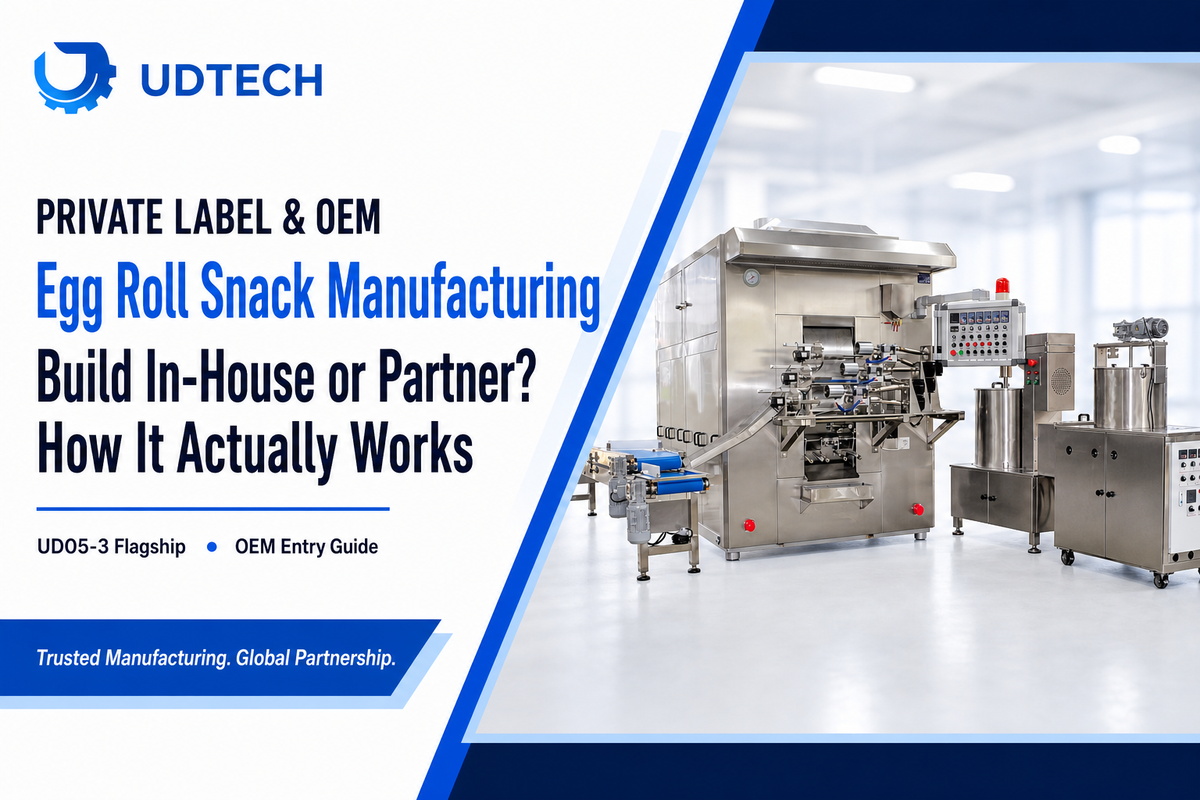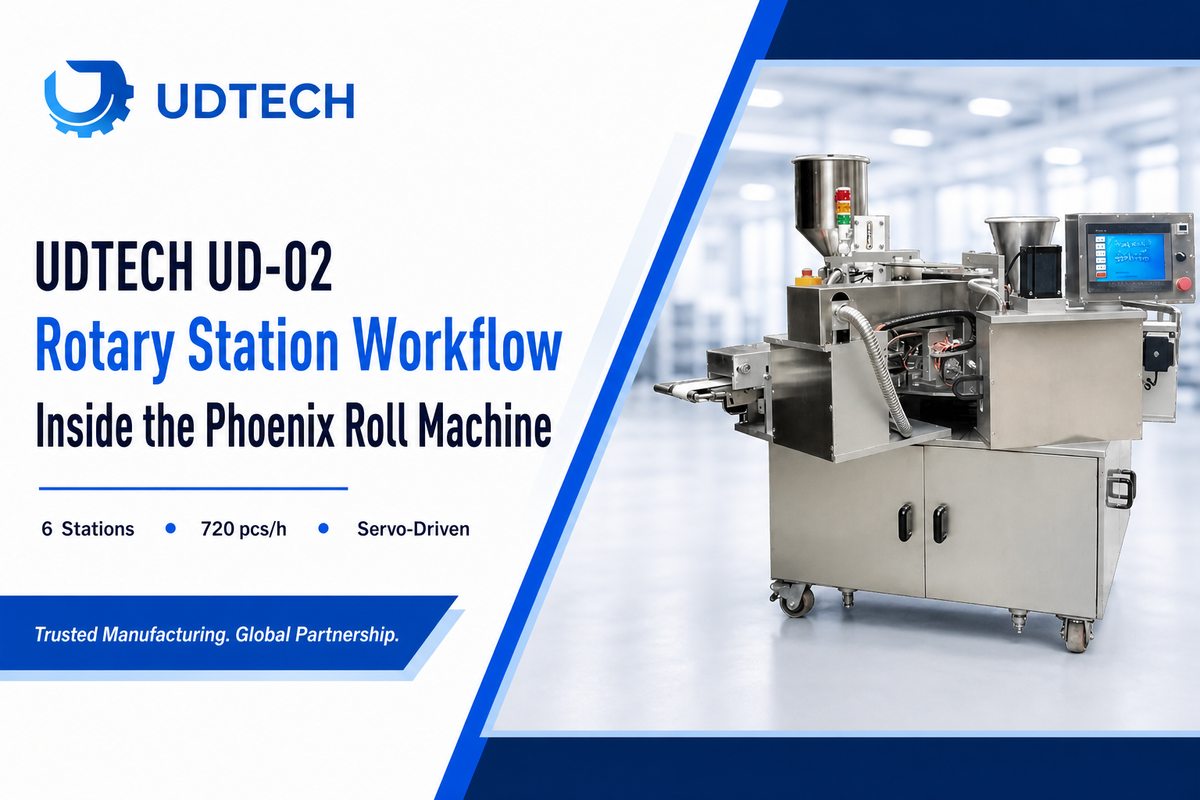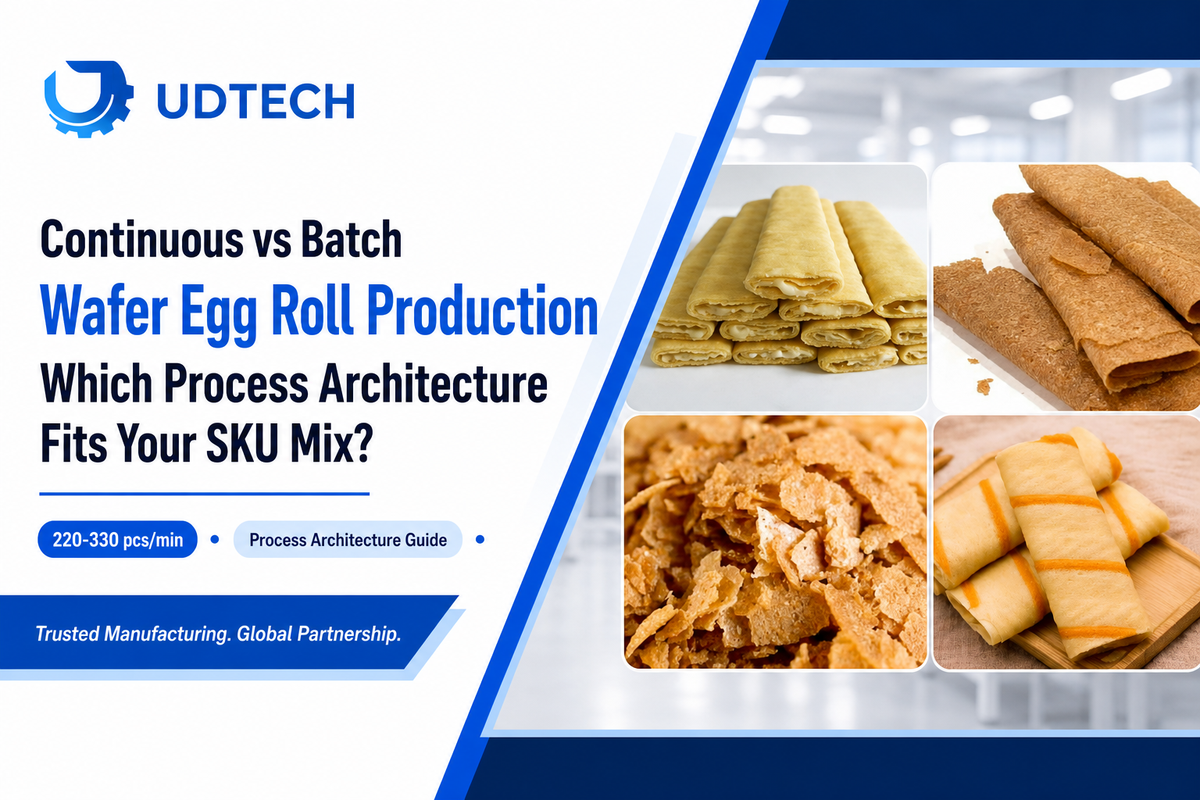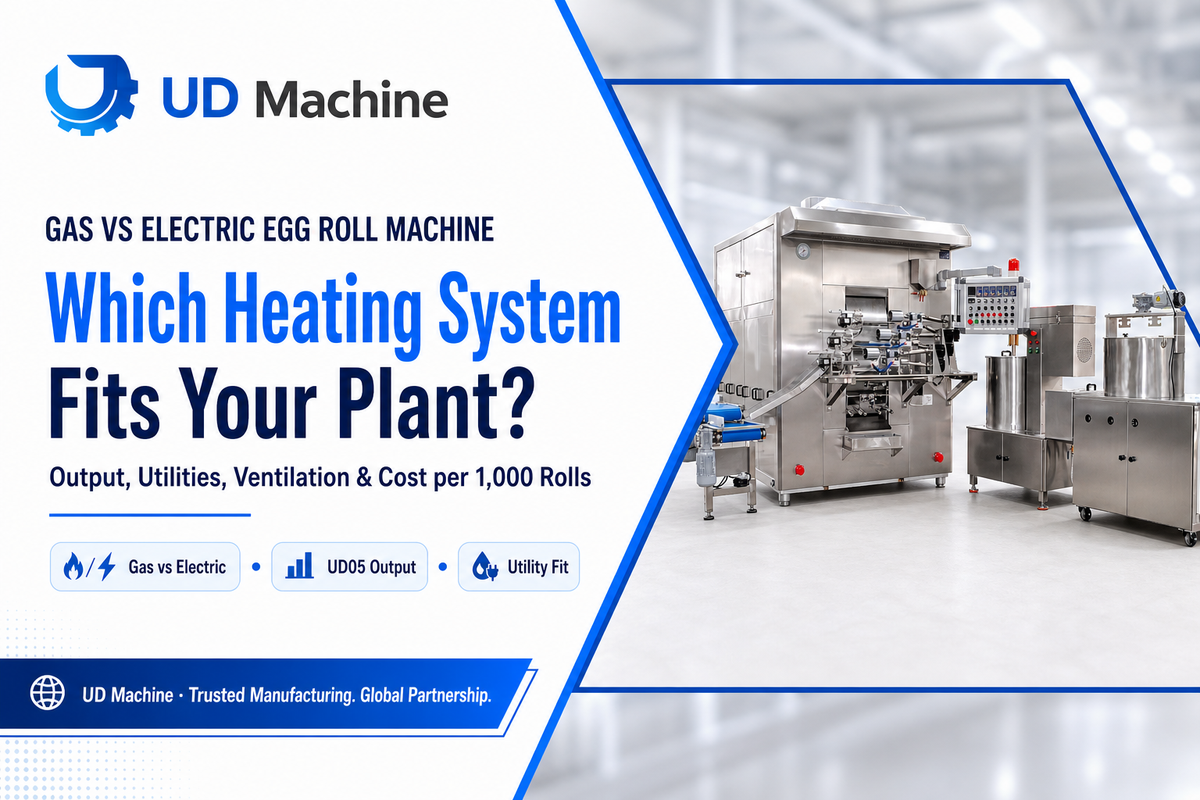
A gas vs electric egg roll machine is a plant-level comparison of heat source, output, utility capacity, ventilation, safety, and records.
Updated July 2026
- UD05-2: 220 pcs/min, or 220 pieces per minute, 600 kg per 8-hour shift, 9.7 kW controls, about 6 kg/h LPG or 8 m3/h natural gas, 15.5 m2 footprint (4.2 x 3.7 m).
- UD05-3: 330 pcs/min, or 330 pieces per minute, 900 kg per 8-hour shift, 12 kW controls, about 8 kg/h LPG or 10 m3/h natural gas, 15.5 m2 footprint (4.2 x 3.7 m).
- Public page heat source: natural gas or LPG. Don’t assume a pure electric UD05 line unless the supplier confirms it in writing.
Gas vs Electric Egg Roll Machine? The Wrong Place to Start is Gas vs. Electric.
Your decision on whether to purchase a gas or electric egg roll machine shouldn’t begin with a general fuel price assumption. Instead, consider factors like output needs, utility availability, exhaust requirements, safety guards, and project records. At UDTECH, the standard UD05 is a gas/LPG industrial machine, so the question of electric heating must be framed as a separate feasibility evaluation, unless you’re given a detailed specification sheet for an electric equivalent.
A gas vs electric egg roll machine choice is really an output-and-utility choice: gas/LPG is proven for UDTECH’s high-output UD05 line, while electric only makes sense after installed power, heat recovery, and operating cost are verified.
- The same keyword can describe tabletop gas egg rolls, wafer egg roll lines, spring-roll wrapper equipment, or home appliances.
- Use cost per 1,000 sellable rolls, not hourly fuel alone, when comparing gas, LPG, and electric options.
- Ventilation, LPG handling, electrical service, machine guarding, and cleaning access can block a purchase even when the machine price looks right.
- Food-contact and machinery records apply regardless of heat source.
Short Answer: Gas Fits Proven UD05 Output, Electric Needs a Feasibility Check
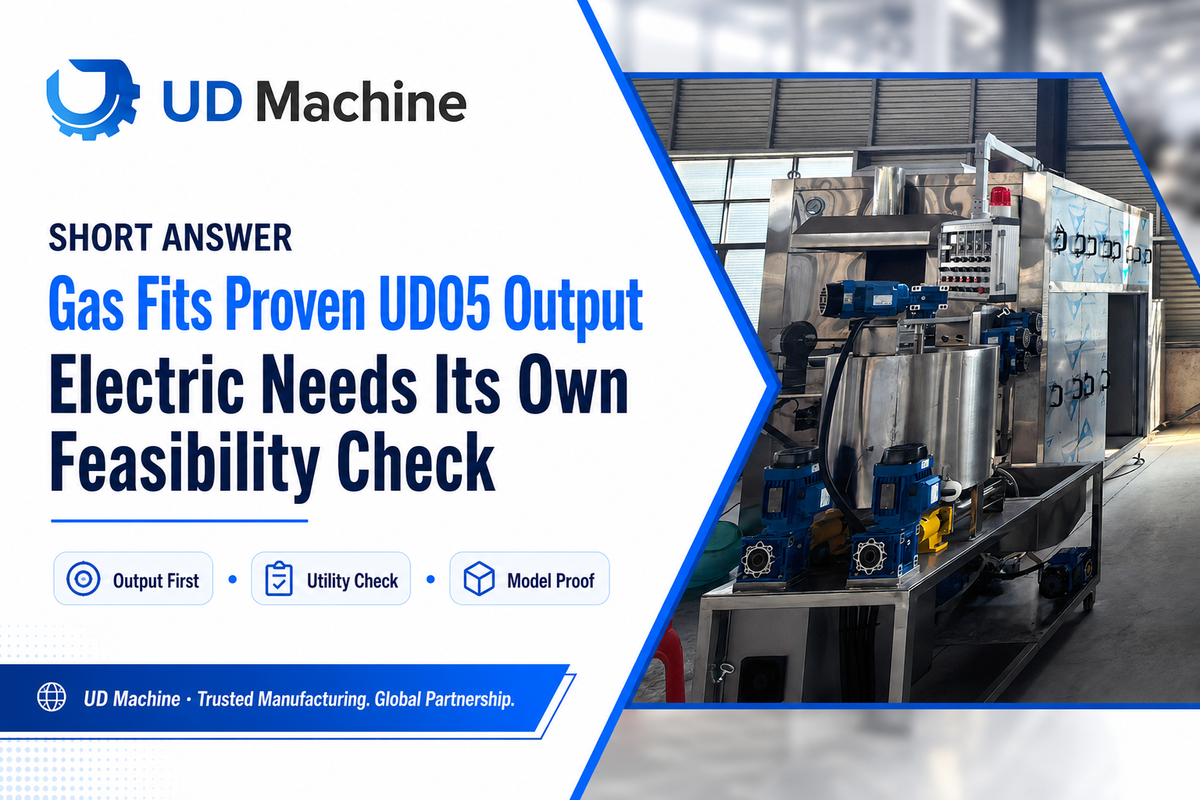
For UDTECH’s popular wafer egg roll machines, gas/LPG represents the industry-proven industrial choice, and the electric option is effectively an unknown that requires its own model analysis. Any buyer comparing an egg roll making machine should base the assessment on actual production capacity, energy input and heat recovery specific to that type of machine – not on smaller benchtop devices or commercial oven specifications.
- Use when the supplier’s rated output is built around gas or LPG heating.
- Check exhaust route, make-up air, gas pressure, and LPG storage before deposit.
- Model fuel cost with local rates and sellable output, not nameplate speed alone.
- Ask for burner, safety, and commissioning records.
- Use only when an electric model sheet confirms output, power draw, and recovery time.
- Check installed electrical capacity, voltage, breaker sizing, and tariff structure.
- Confirm whether electric heat can meet peak-month production capacity.
- Ask whether electric heating changes footprint, baking temperature control, or service parts.
When choosing a UDTECH product, you should begin by assessing the industrial wafer egg roll machine as the gas/LPG reference, and then determine if there are compelling reasons to inquire about a separate electric viability study. This approach ensures a fair comparison; the UD05 is an established industrial gas/LPG solution, and any electric system must have its own supporting data.
“The fuel question should not be separated from the output target. A plant that needs 600 to 900 kg per shift has to verify heat recovery, utilities, exhaust, guarding, and cleaning access before comparing prices.”
Product Family Check: Wafer Egg Roll Line, Spring-Roll Wrapper, Or Countertop Maker?
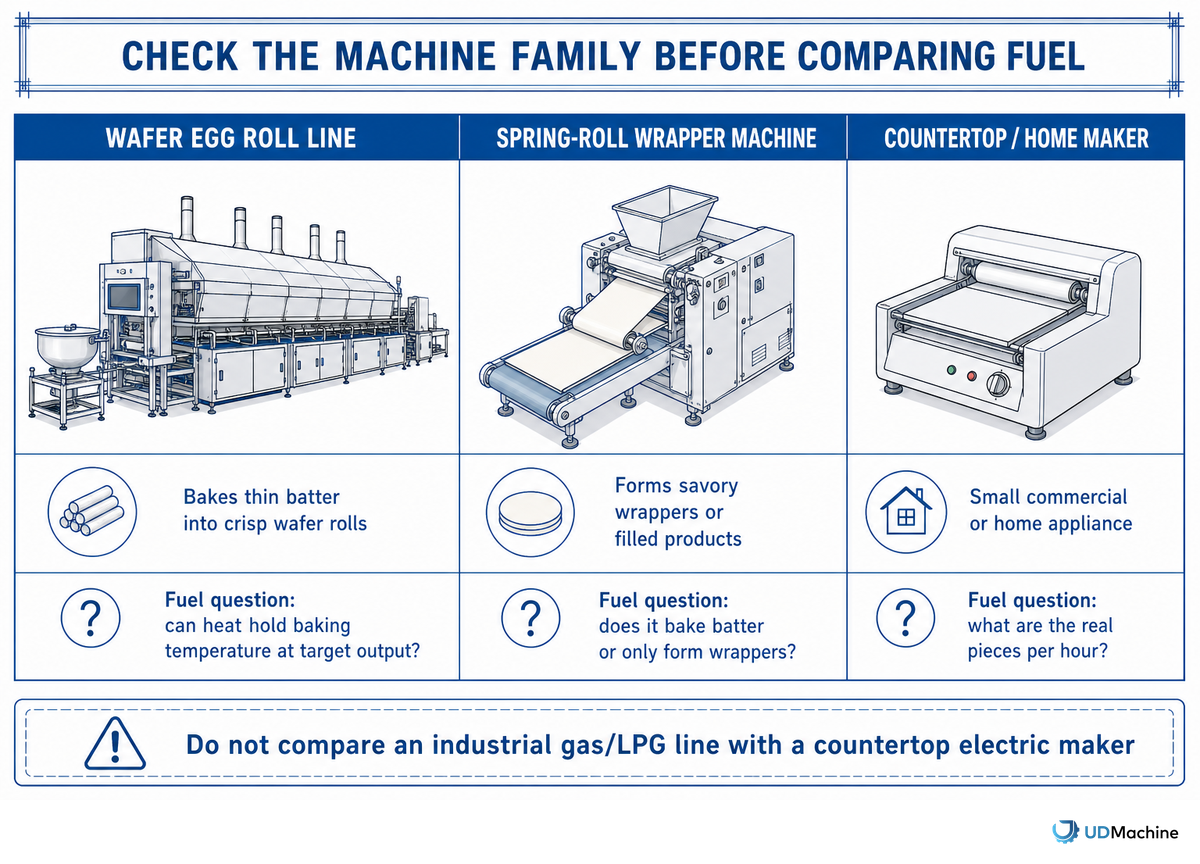
Many egg roll machine comparisons fail by mixing unlike product families. Wafer egg roll machines bake thin batter into crispy wafers. Spring-roll wrapper machines create savory shells. Street-style gas egg roll units make rolled snacks in round molds, while home egg roll machines are in a class of their own.
Search results and marketplaces often use the same search terms for disparate machines. This article, however, connects fuel choice to the machine category. If you’re producing sweet wafer egg rolls, focus on wafer-line specifications for output and heat recovery. If your target product is a savory filled egg roll, look at spring-roll or filled-product machine comparisons instead. To differentiate further, consult UDTECH’s guide to manual versus automatic egg roll machines.
| Search label | Likely equipment family | Fuel question to ask | Do not compare with |
|---|---|---|---|
| Wafer egg roll machine | Industrial wafer roll line | Can the heat source maintain batter baking temperature at target output? | Home roller or savory wrapper machine |
| Gas egg roll machine | Often tabletop or stall machine in marketplaces | Is this LPG tabletop equipment or an industrial line? | UD05 shift-output data without conversion |
| Spring roll machine | Wrapper or filled-product equipment | Does it cook/bake batter or form wrappers? | Crispy wafer egg roll line |
| Electric egg roll maker | Small commercial or home appliance unless proven otherwise | What is the actual power consumption and pieces per hour? | Industrial gas/LPG line without a model sheet |
Fuel-to-Throughput Crossover Matrix
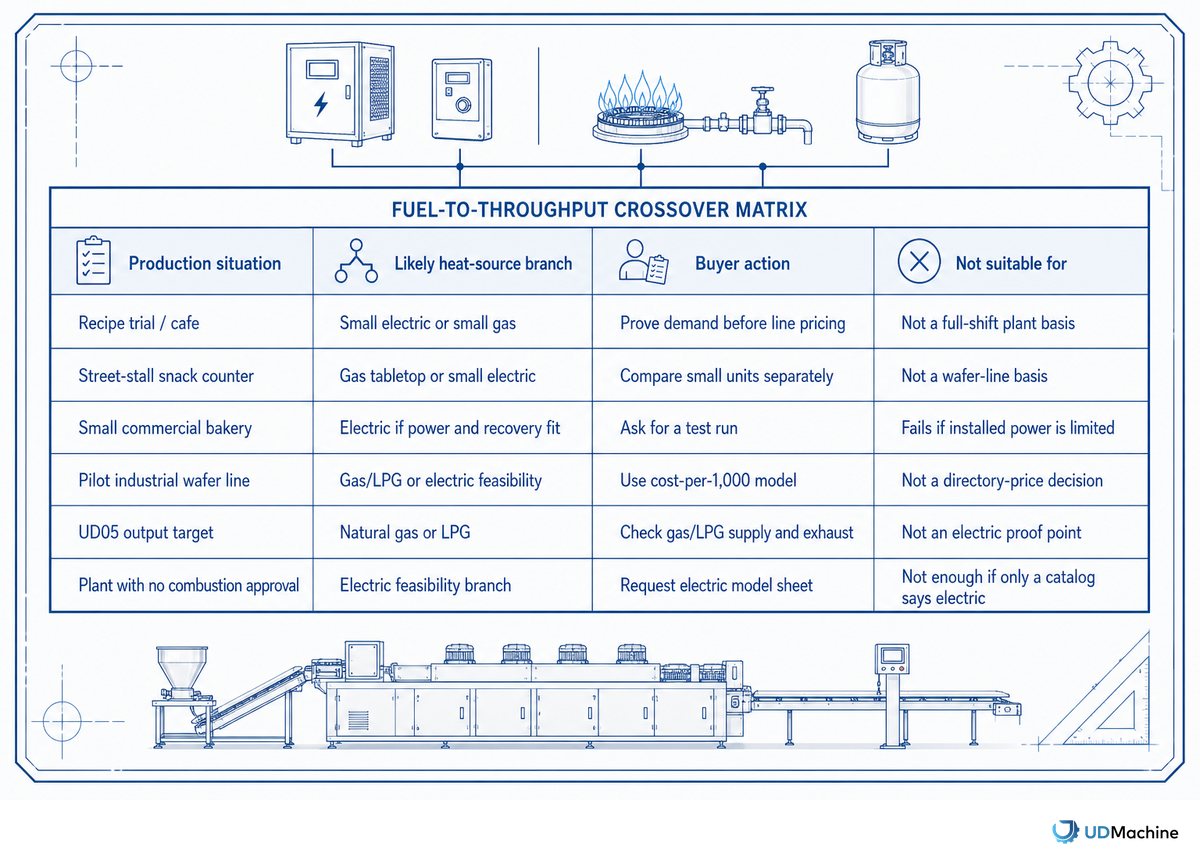
Use the Fuel-to-Throughput Crossover Matrix to move the energy source debate beyond simple cost per unit and into a practical plant decision. It separates basic shopping from a utility and production planning exercise. The matrix doesn’t declare gas or electric universally superior; it highlights when a shift between energy sources should be seriously considered.
| Equipment type / production situation | Likely heat-source branch | Proof to request | Buyer action | Limitations / Not suitable for |
|---|---|---|---|---|
| Recipe trial or cafe output | Small electric or small gas unit | Actual pieces per hour and product size | Avoid industrial line pricing until demand is proven | Not a 600 kg/shift plant basis |
| Street-stall or snack counter | Gas tabletop or small electric | Cycle time, cavity count, fuel type | Compare small units separately from wafer lines | Not comparable to automatic egg roll machine throughput |
| Small commercial bakery | Electric if power and recovery fit | kW draw, heat recovery, voltage, breaker load | Ask for a test run at target batter thickness | May fail if installed power is limited |
| Pilot industrial wafer line | Gas/LPG or electric feasibility | Output, reject rate, utilities, exhaust route | Use a cost-per-1,000 model before deposit | Do not use directory price alone |
| UD05-2 output target | Natural gas or LPG | 220 pcs/min, 600 kg/8h, 9.7 kW controls, fuel use | Check gas/LPG supply and exhaust before RFQ | Not an electric proof point |
| UD05-3 output target | Natural gas or LPG | 330 pcs/min, 900 kg/8h, 12 kW controls, fuel use | Validate fuel logistics for peak-month demand | Not suitable if gas route is impossible |
| Plant with no combustion approval | Electric feasibility branch | Installed power, heat recovery, temperature stability | Ask supplier for electric model sheet and sample proof | Not enough if only a catalog says electric |
| Unstable fuel or electricity pricing | Run both cost branches | Local tariff, fuel contract, utilization, scrap rate | Use finance model before locking specification | Cannot be answered by one global rule |
| Export or audit-sensitive project | Any heat source plus records gate | Food-contact, guarding, CE, FAT, installation records | Make documents part of RFQ scope | Fuel choice alone does not satisfy audit needs |
Bottlenecks often aren’t with the heating element itself. Costs around gas piping, LPG tank installation, electrical panel upgrades, exhaust ventilation, cleaning access, guarding, training, and acceptance testing are commonly overlooked. These additional costs can negate the perceived benefit of one heat source over another, especially during startup.
Cost Per 1,000 Sellable Rolls Selector
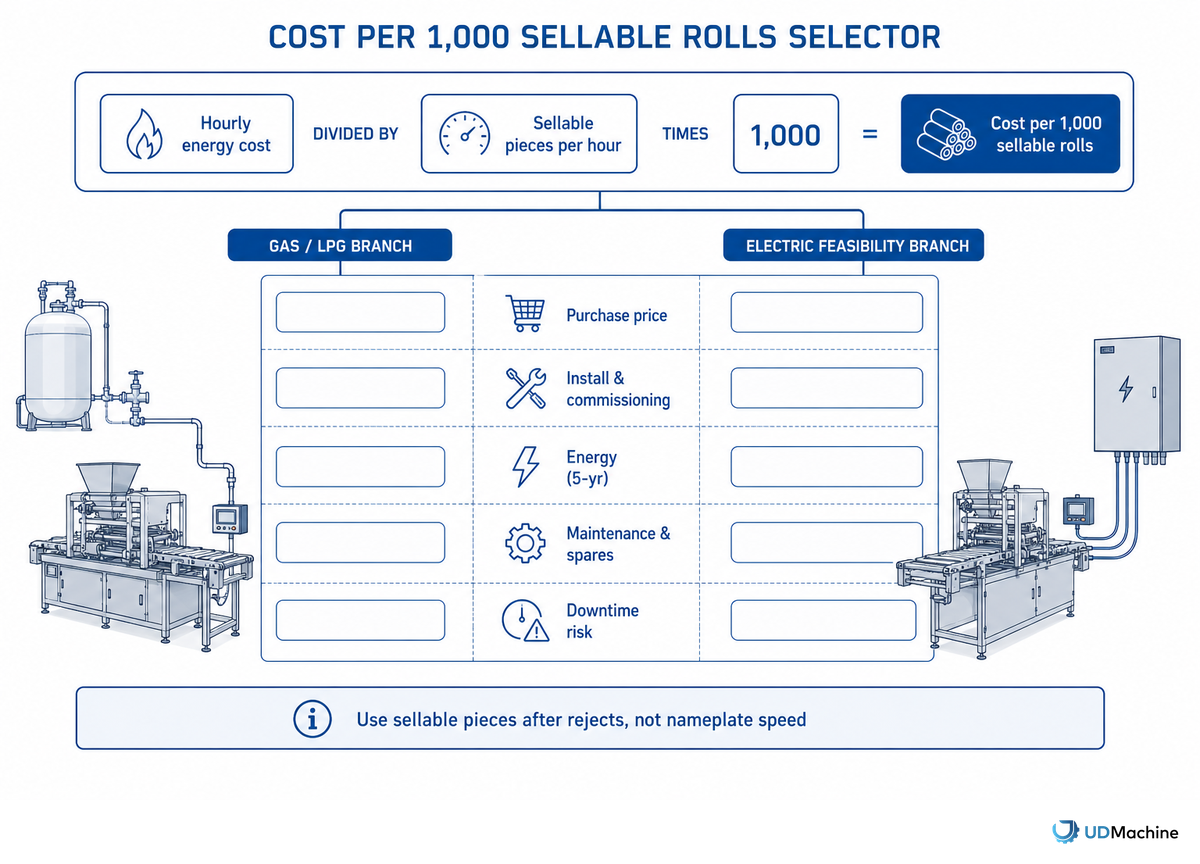
Cost per 1,000 Sellable Rolls Selector prevents finance from comparing mismatched metrics. It provides a uniform comparison across gas, LPG, and electric models, using “sellable pieces” (accounting for reject rates) as the consistent denominator. This figure can then be compared with other critical costs like labor, packaging, maintenance, and logistics.
5-year total cost of ownership:
| Cost item | Gas/LPG branch | Electric feasibility branch |
|---|---|---|
| Purchase price | Supplier quote for rated output | Supplier quote plus electric model confirmation |
| Installation & commissioning | Gas route, exhaust, fuel safety, 5-7 day install basis | Panel capacity, wiring, heat recovery validation |
| Energy (5-yr) | Local gas/LPG rate x hourly fuel use x utilization | Local electricity tariff x confirmed heat and control load |
| Maintenance & spares (5-yr) | Burner, gas train, exhaust, wear parts | Heating elements, controls, power components |
| Downtime risk (5-yr) | Fuel interruption, exhaust fault, ignition issue | Peak electrical load, element failure, recovery lag |
Payback example: if UD05-2 makes 13,200 pieces/hour by nameplate and you test an estimated 85% sellable rate, sellable output is 11,220 pieces/hour. At 6 kg/h LPG and a placeholder $1.20/kg LPG rate, the fuel line is 6 x 1.20 / 11,220 x 1,000 = about $0.64 per 1,000 sellable rolls. Replace the rate and sellable rate with your plant data.
Use this formula for every branch:
To calculate your energy cost per 1,000 sellable rolls: (Hourly energy cost) / (Sellable pieces per hour) x 1,000
Also include labor, reject loss, packaging, sanitation time, maintenance and downtime risk. If finance asks for a cost per 1,000 pieces view, keep the same denominator and state whether rejects are included. Electric heating may remove combustion-related labor, but it may introduce electrical capacity and tariff issues. Gas/LPG may support proven UD05 output, but it will add ventilation, interlock, LPG supply chain, and fuel-safety work. This selector helps put both options into common operating-cost language.
Facility Readiness: Ventilation, Electrical Load, Footprint, Guarding, And Operator Access
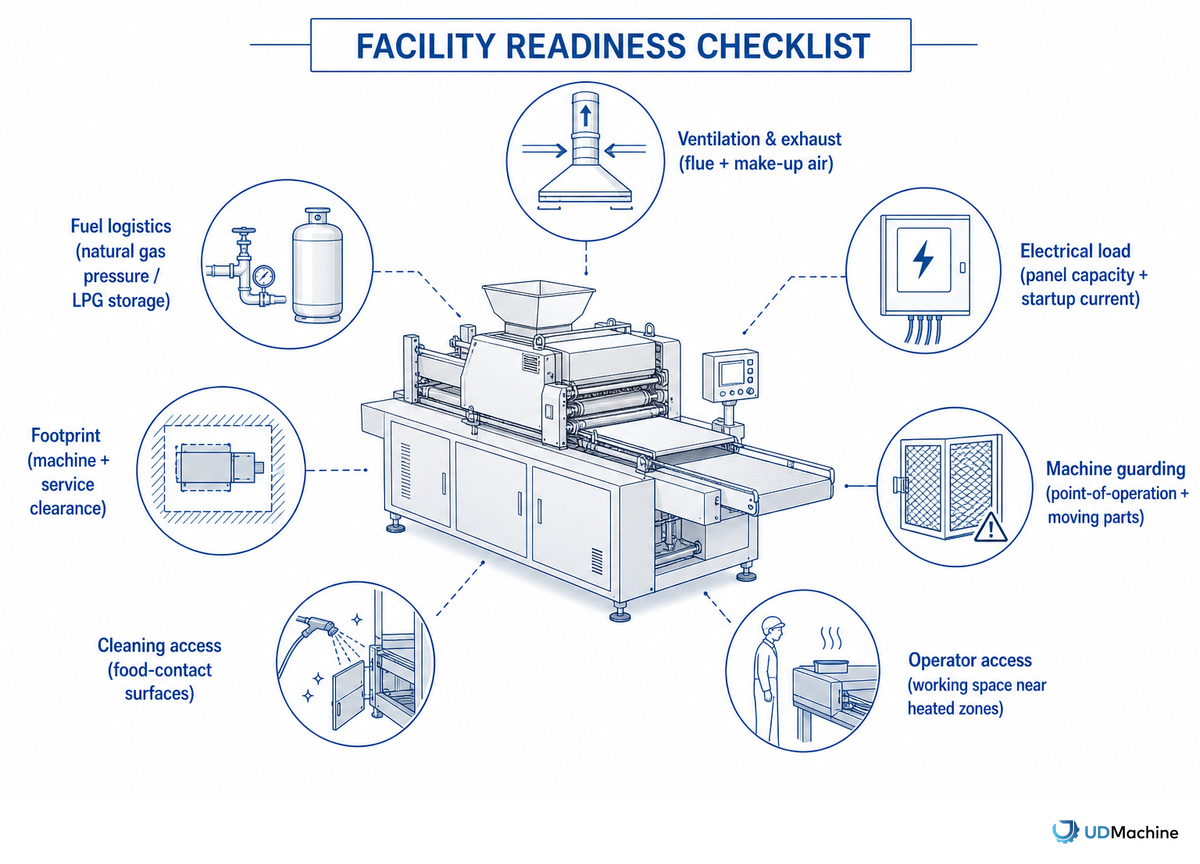
Plant readiness determines whether a commercial egg roll machine can be installed without a separate capital project. Gas/LPG requires combustion and exhaust design, electric requires available power and heat-load calculations; both require factory layout fit, access to clean surfaces, guarding, operator working space and machine access.
| Readiness item | Gas/LPG question | Electric question | Document to request |
|---|---|---|---|
| Ventilation and exhaust | Where will flue/exhaust and make-up air go? | Does electric heat change room heat load? | Ventilation layout and installation note |
| Fuel logistics | Natural gas pressure or LPG storage plan? | Not applicable unless backup fuel is used | Gas/LPG connection requirements |
| Electrical load | Controls still need stable power | Can the panel handle heating load and startup current? | Electrical diagram and load schedule |
| Footprint | UD05 footprint is 4.2 x 3.7 m before service clearance | Electric variant may change cabinet or panel space | Layout drawing with access zones |
| Machine guarding | Guard rolling/forming points and moving parts | Same guarding issue regardless of heat source | Guarding list and risk assessment |
| Cleaning access | Can operators clean food-contact areas safely after heat-down? | Can elements and shields be cleaned without contamination risk? | Cleaning SOP and contact-surface material list |
| Operator access | Enough clearance near burners, exhaust, and rolling sections? | Enough clearance near panels and heated zones? | Operator-side layout and maintenance plan |
Machine guarding deserves its own row because it’s often lost when considering only fuel sources. While the OSHA standard 1910.212 isn’t an egg-roll-specific design guide, it’s a useful reminder that the hazards at point-of-operation and within the forming-rolls are the same regardless of heat source. Inquiries to the supplier should include details about guard design, interlocks, emergency stops and cleanability of protected areas.
Engineering Note: Heating Choice Does Not Replace Food-Safety Records
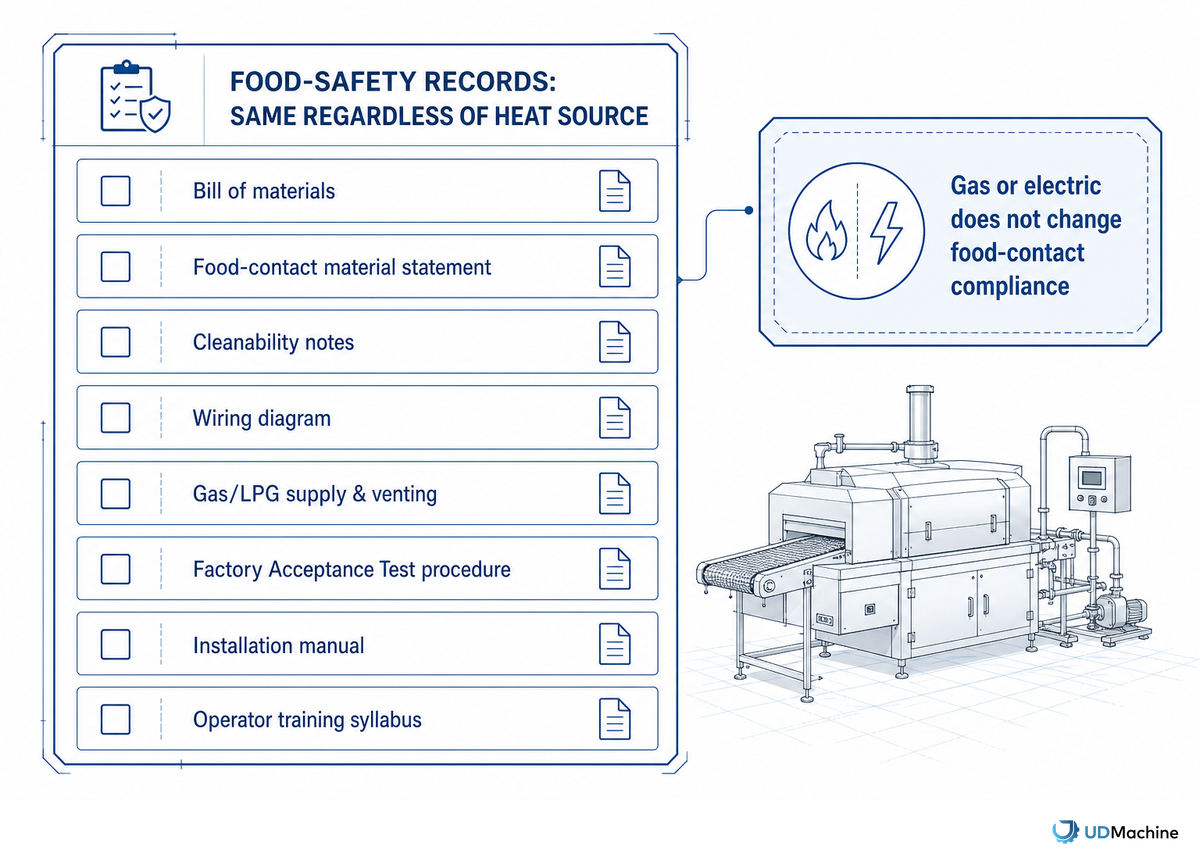
Food-safety standards stand apart from gas versus electric considerations. Both electric and gas industrial egg roll machines will need cleanable food-contact surfaces, appropriate materials, cleanable design, sanitizing protocols and maintenance records. Fuel source doesn’t affect product food-contact compliance.
Because FDA 21 CFR 117.40 and ISO 14159 frame cleanability as an equipment suitability issue, the risk belongs in the factory file before FAT, not after the machine ships.
- Equipment should be designed and maintained to protect against contamination.
- Food-contact surfaces should be corrosion-resistant when in contact with food.
- Food-contact surfaces should be made of nontoxic materials and able to withstand cleaning and sanitizing.
- The rule doesn’t say gas or electric is better. It says equipment and utensils must be suitable for safe food production.
Request a document packet before placing an order on any industrial egg roll machine: Bill of materials, food-contact statement, cleanability notes, wiring diagram, gas/LPG supply and venting, Factory Acceptance Test procedure, installation manual, operator training syllabus, and any relevant country-specific approvals or declarations. This packet is part of the product offering, not an add-on.
When Electric Makes Sense
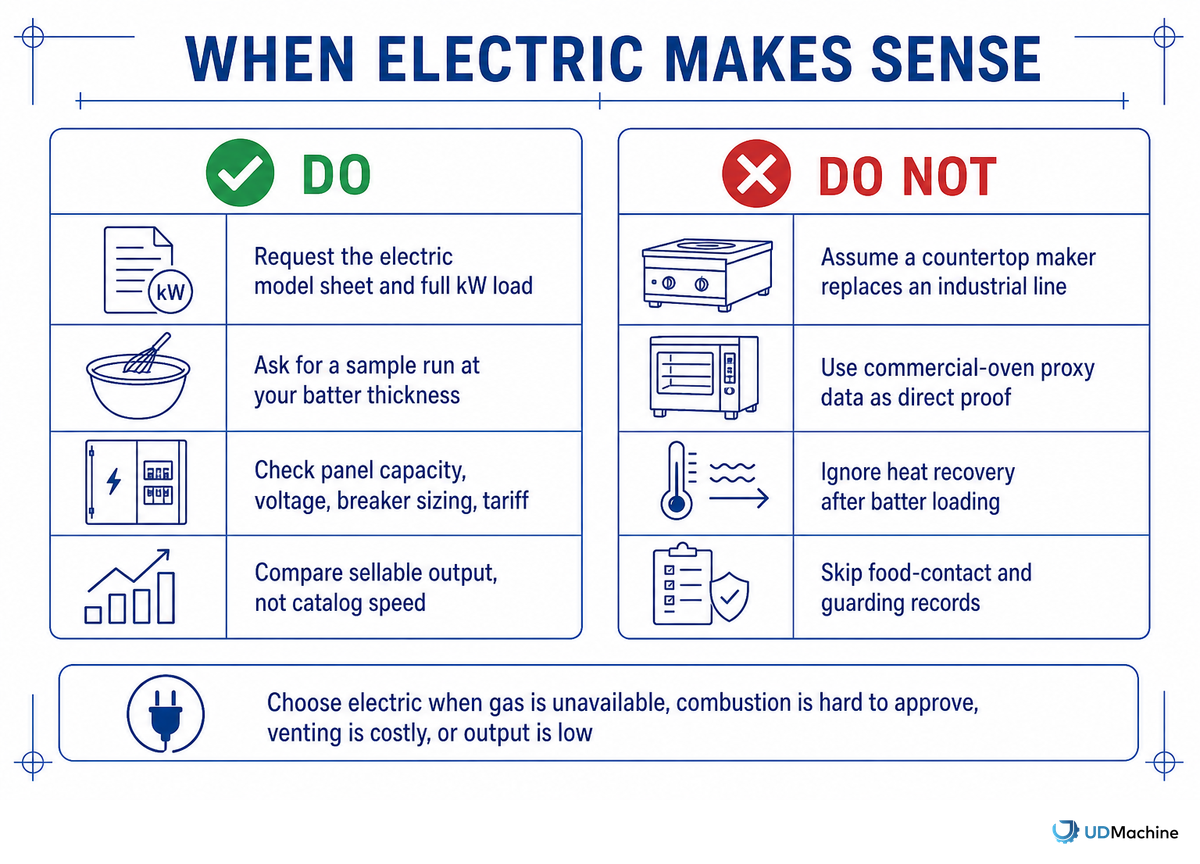
Consider electric heat when the supplier can confirm the machine can meet your throughput goals with your plant’s existing electrical service, local utility rate schedule and the thickness of your products. A label that says “egg roll machine is electric” or a power-consumption value doesn’t qualify. Require a data sheet, test run and an answer on heat-recovery rate.
ENERGY STAR commercial oven data may serve as an indirect indicator, but it isn’t proof of equipment performance on your product. It shows different efficiency ratings and idle loads for gas versus electric equipment. Ask about your specific egg roll machine’s energy consumption, idle loads, heat-recovery performance and operating assumptions to properly evaluate energy cost and simplicity.
In practice, an industrial buyer with a 25 kW panel constraint needs an application-specific test, not a generic electric label, before accepting the electric branch.
- Request the electric model sheet and full kW load.
- Ask for a sample run at your batter recipe and target thickness.
- Check panel capacity, voltage, breaker sizing, and energy tariff.
- Compare sellable output, not catalog speed alone.
- Assume a countertop electric maker can replace an industrial line.
- Use commercial oven proxy data as direct egg roll machine proof.
- Ignore heat recovery after batter loading.
- Skip food-contact and guarding records because the machine is electric.
Electric makes most sense when gas isn’t available, fuel combustion approvals are hard to clear, exhaust vent-routing is expensive, or your target output volume is below a level where adding electrical load will present a plant infrastructure challenge. This path is least sensible when the supplier can’t provide validated output and heating results.
When Gas Or LPG Makes Sense
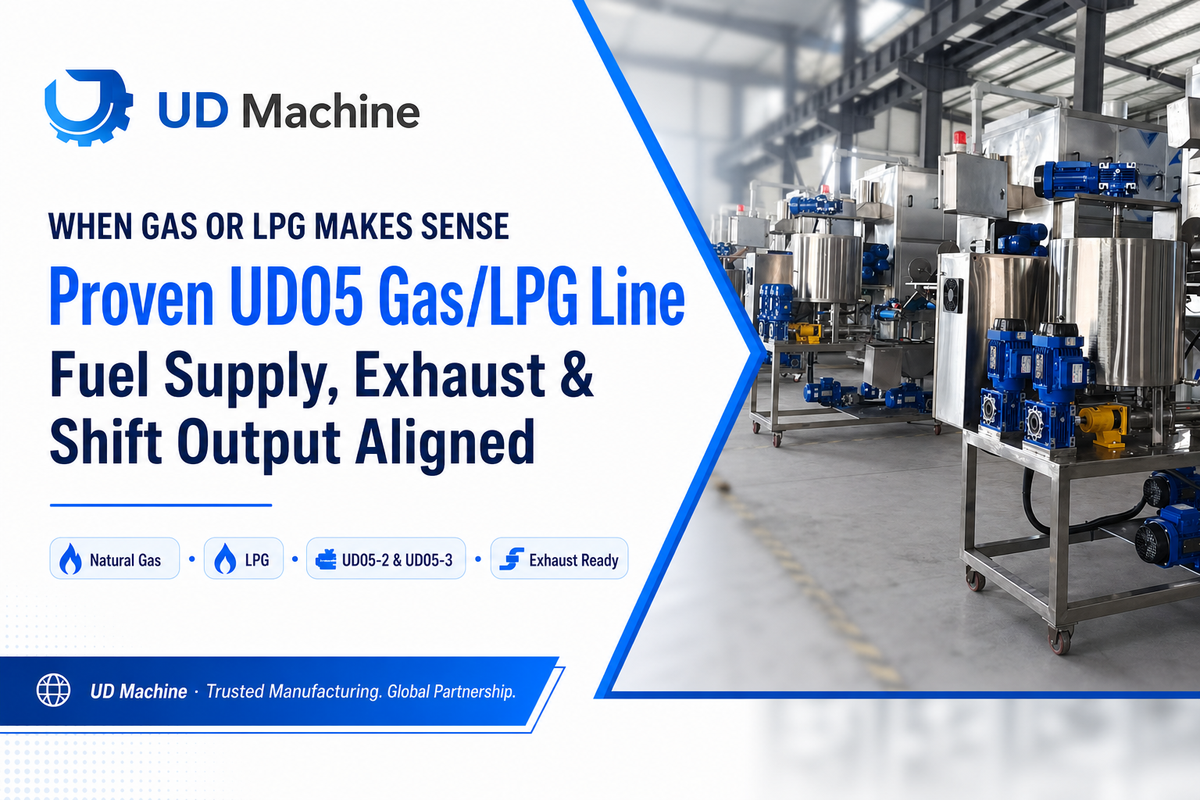
Gas or LPG makes most sense when public information about available equipment, your plant’s utilities, and your production plan align. For UDTECH’s commercially-available UD05 product line, gas/LPG is the established solution. You’ll still need to address fuel supply and venting, machine guarding and sanitation, but your bid should address installation readiness at this point.
| Model | Heat source | Capacity | Shift output | Power | Fuel use | RFQ note |
|---|---|---|---|---|---|---|
| UD05-2 | Natural gas / LPG | 220 pcs/min | 600 kg per 8-hour shift | 9.7 kW controls | about 6 kg/h LPG or 8 m3/h natural gas | Send gas/LPG source and floor plan |
| UD05-3 | Natural gas / LPG | 330 pcs/min | 900 kg per 8-hour shift | 12 kW controls | about 8 kg/h LPG or 10 m3/h natural gas | Confirm exhaust and utility readiness |
Gas/LPG is no escape from planning. It is a strong branch when the plant has secure fuel supply, acceptable exhaust routing, clear staff responsibility, and enough demand to use the output. It becomes a weak branch when there’s no gas pathway, questionable LPG security, strict indoor-combustion rules, or no staff available to maintain the heating system.
The practical risk is delay: a quoted 5-7 day installation can slip if gas pressure, exhaust routing, LPG storage, or operator access is still unresolved when the machine arrives.
RFQ Checklist: Data To Send Before Asking For Price
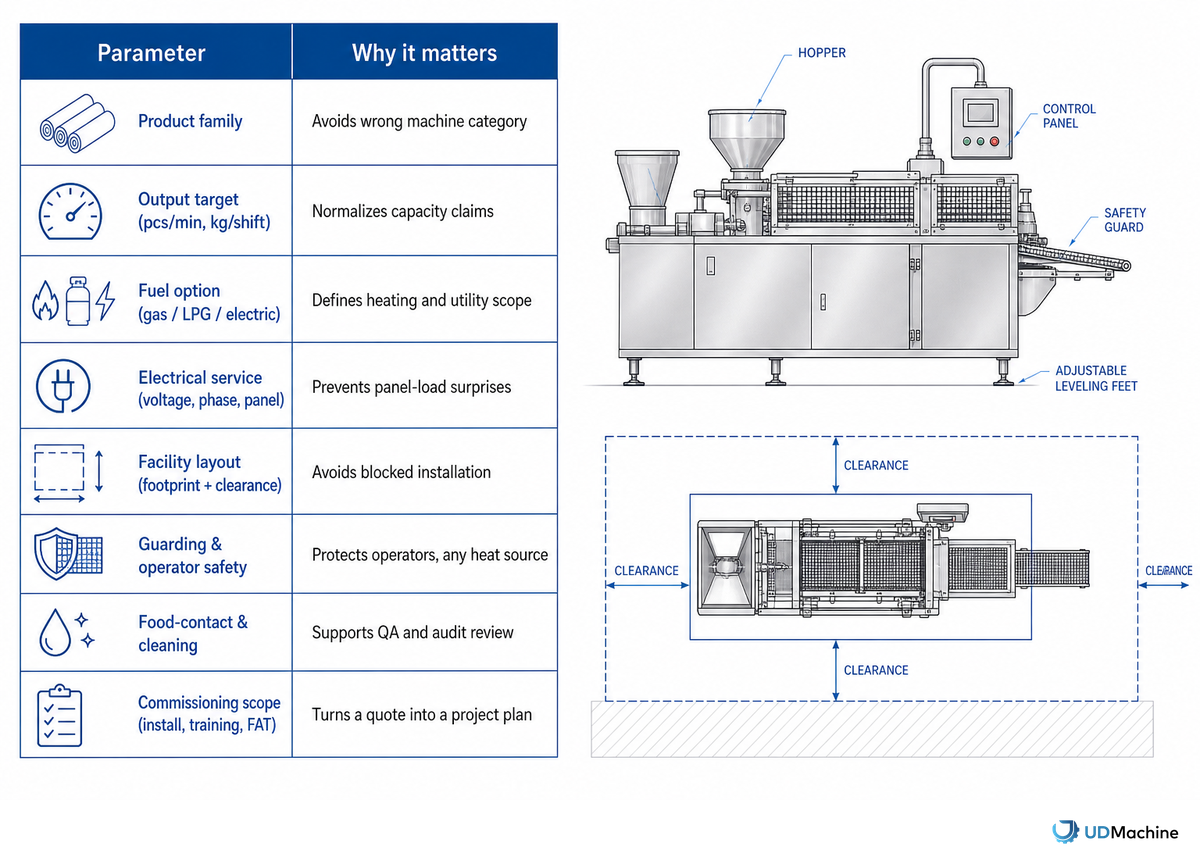
A supplier can quote quickly when real plant data is attached to the inquiry. Copy the table below to your RFQ and provide layout, utility notes, product target and destination market. A good quote request moves the discussion from a loose machine price toward install-ready scope.
RFQ checklist – copy these into your quote request:
| Parameter | Recommended range | Why it matters | How to verify |
|---|---|---|---|
| Product family | Wafer egg roll / spring-roll wrapper / other | Avoids wrong machine category | Send product photos and recipe target |
| Output target | pcs/min, pieces/hour, kg/shift | Normalizes capacity claims | State peak-month demand and sellable-rate assumption |
| Fuel option | Natural gas, LPG, or electric feasibility | Defines heating system and utility scope | Attach local utility rates and supply constraints |
| Electrical service | Voltage, phase, panel capacity | Prevents panel-load surprises | Attach electrical diagram or electrician note |
| Facility layout | Footprint plus service clearance | Avoids blocked installation path | Send floor plan with doors, drains, and exhaust path |
| Guarding and operator safety | Point-of-operation and moving-part review | Protects operators regardless of heat source | Request guarding list and risk assessment |
| Food-contact and cleaning | Material list, cleanability, sanitation access | Supports QA and audit review | Request contact-surface statement and cleaning SOP |
| Commissioning scope | Delivery, install, training, FAT/SAT | Turns quote into a project plan | Confirm 9-13 week delivery, 5-7 day installation, training days |
Forward that info before asking for an egg roll machine price. Otherwise, the supplier might deliver a machine that satisfies catalog copy, not the reality of your factory layout, employees, quality assurance group or financial structure.
2026 Buying Pressure: Utility Risk And Machinery Documentation
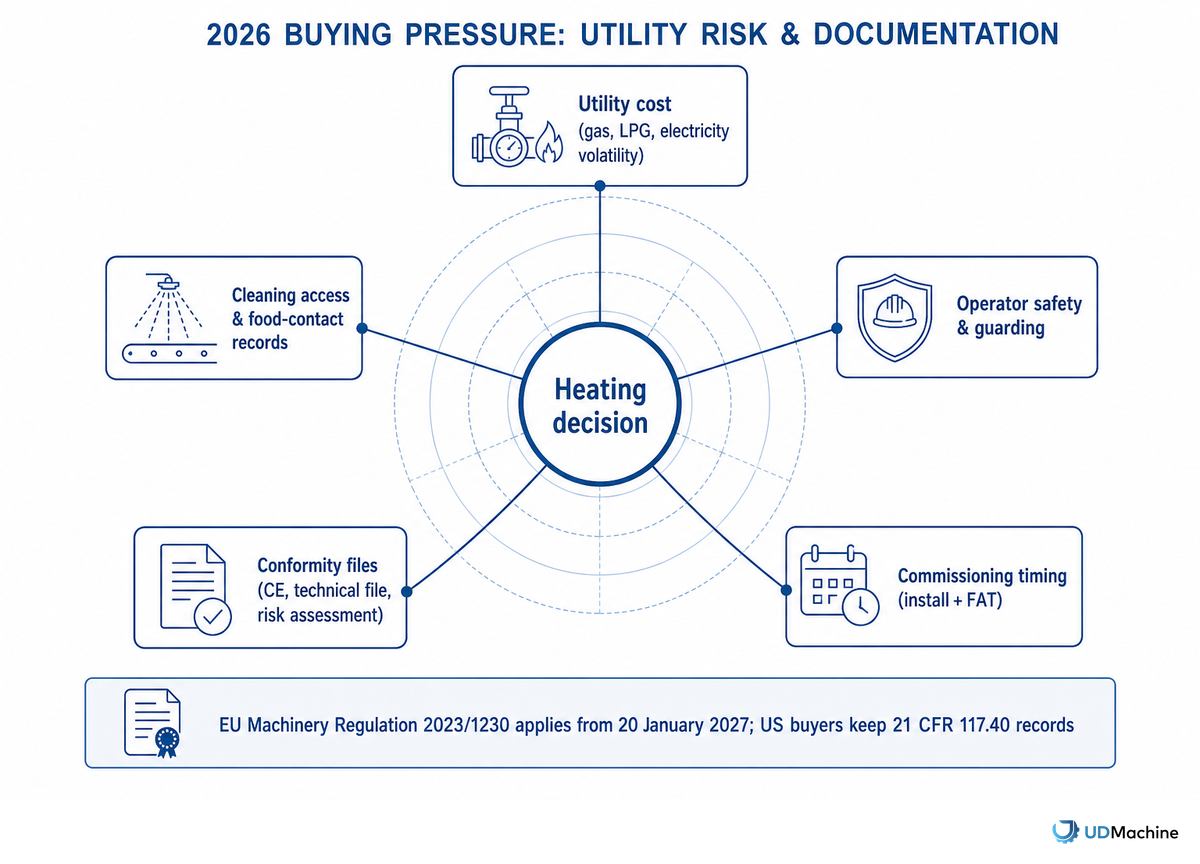
Buying pressure in 2026 is not a generic “market growth” story. Buyers must account for utility costs, staff safety, cleaning access, and paperwork throughout the buying cycle. A plant postponing questions about gas supply, venting, guarding, and conformity files until delivery risks spending more time than it saves in negotiating costs.
If you’re dealing with European clients, EUR-Lex summarizes EU Machinery Regulation 2023/1230 as effective 20 January 2027, with some parts applied earlier. Treat this as an alert for project record needs. Ask suppliers about their approaches to declarations, technical files, risk assessment, and the standards relevant for your market destination. If targeting the U.S. market, keep your project file stocked with 21 CFR 117.40, guarding, and sanitation records.
Because CE files, FDA equipment records, and guarding evidence answer different audit questions, the record gap can become a shipment risk even when the machine price is approved.
Choose the heating system after the plant proves output, utility capacity, ventilation, guarding, food safety records, and cost per 1,000 sellable rolls.
FAQ
Are gas egg roll machines better than electric egg roll machines?
Answer
Gas egg roll machines are better only when the machine’s rated output, local fuel supply, ventilation route, and operator-safety plan fit the plant. Electric egg roll machines can be better when combustion is difficult or prohibited, but only if the supplier proves output, power consumption, heating recovery, and product quality on the actual model.
Which egg roll machine is cheaper to run, gas or electric?
Answer
The cheaper egg roll machine is the one with the lower cost per 1,000 sellable rolls in your plant. That calculation needs local gas, LPG, and electricity rates; sellable output after rejects; utilization; labor; cleaning time; maintenance; service parts; and downtime risk. A global gas-versus-electric rule isn’t enough for a capital purchase.
Does a gas egg roll machine need ventilation?
Answer
A gas egg roll machine normally needs the plant to review exhaust, combustion air, make-up air, fuel connection, and operator safety before installation. The exact design depends on local code, equipment layout, production load, and building conditions, so the supplier quote should include gas and ventilation requirements, plus any interlock or inspection items.
Can an electric egg roll machine match industrial output?
Answer
An electric egg roll machine can match industrial output only if a specific electric model sheet and sample run prove the target pieces per hour, baking temperature stability, and recovery time. Don’t transfer electric oven or tabletop-maker data to an automatic wafer egg roll line unless the supplier validates the actual machine. For an industrial buyer, the useful proof is a full-load test with your batter thickness, expected reject rate, installed voltage, breaker plan, and temperature-recovery log after repeated loading. If that evidence is missing, treat electric as a feasibility request, not as an equivalent replacement for a published gas/LPG line.
What is the difference between a wafer egg roll machine and a spring roll machine?
Answer
A wafer egg roll machine bakes batter into thin crisp rolls, while a spring roll machine usually produces wrappers or handles savory filled products. Because both can appear under “egg roll machine” searches, buyers should confirm product type, recipe, thickness, cooking method, and finished shape before comparing fuel or price.
What data should I send before asking for an egg roll machine price?
Answer
Send product photos, recipe type, target pieces per hour or kg per shift, fuel options, local utility rates, voltage and phase, floor plan, exhaust path, cleaning expectations, guarding requirements, destination market, and commissioning timeline. This helps the supplier quote a production system instead of a loose machine price. Add your planned shift length, sellable-output assumption, doorway limits, drain position, gas or LPG storage constraint, and whether the project needs CE-related files, food-contact statements, factory acceptance testing, or on-site training.
Need a fuel-ready wafer egg roll line quote?
Send UDTECH your output target, product type, local fuel/electricity rates, floor plan, and destination-market file needs. The engineering team can confirm whether the published UD05 gas/LPG line fits your plant and what utility checks should happen before deposit and installation.
Transparency note
This article uses UDTECH public product data for UD05-2 and UD05-3. Commercial directory and oven sources are used only as market context or proxy evidence, not as direct proof of UDTECH electric industrial output. Final machine selection should be confirmed with a supplier model sheet, sample run, and local code review.
Related Articles
References & Sources
- ISO 14159:2002 – International Organization for Standardization
- 21 CFR 117.40 Equipment and utensils – eCFR
- OSHA 1910.212 General requirements for all machines – Occupational Safety and Health Administration
- OSHA 1910.110 Storage and handling of liquefied petroleum gases – Occupational Safety and Health Administration
- Commercial ovens – ENERGY STAR
- Ventilation in catering kitchens – Health and Safety Executive
- Machinery safety requirements – EUR-Lex
- Machinery – European Commission
- How Automation Benefits Food Processors of Any Size – Food Engineering