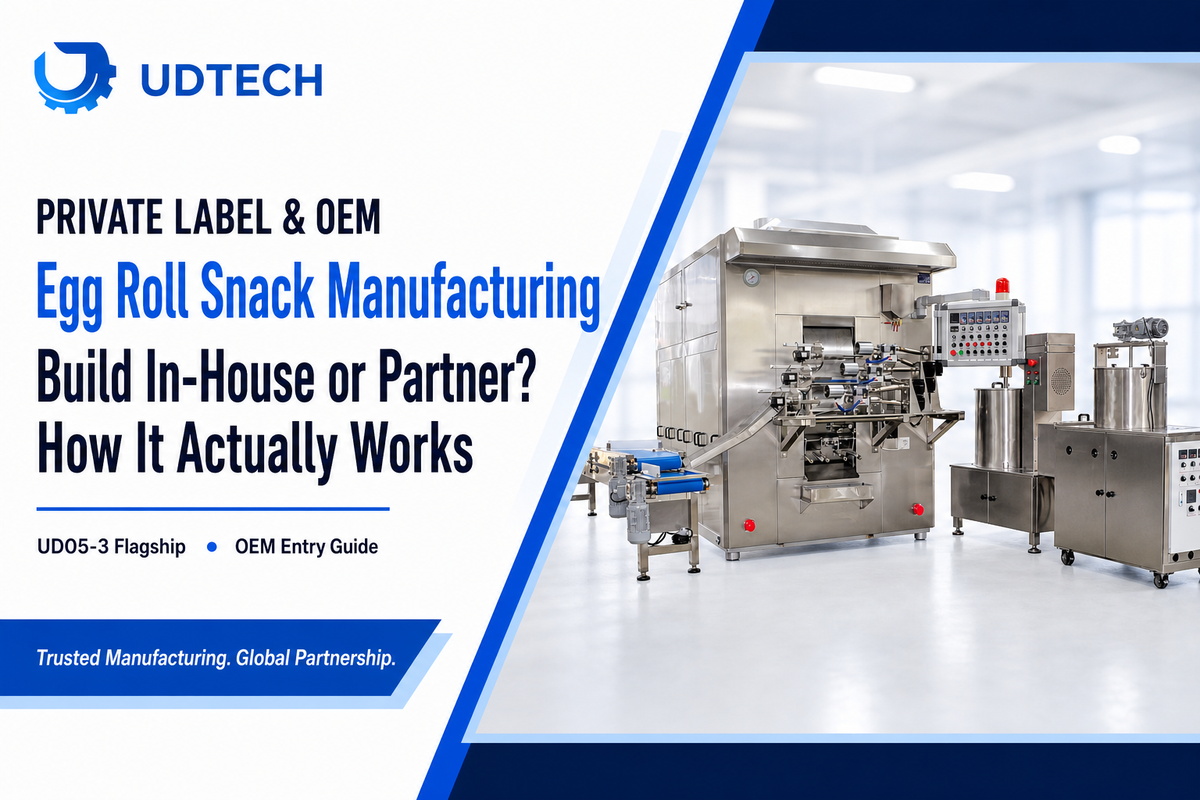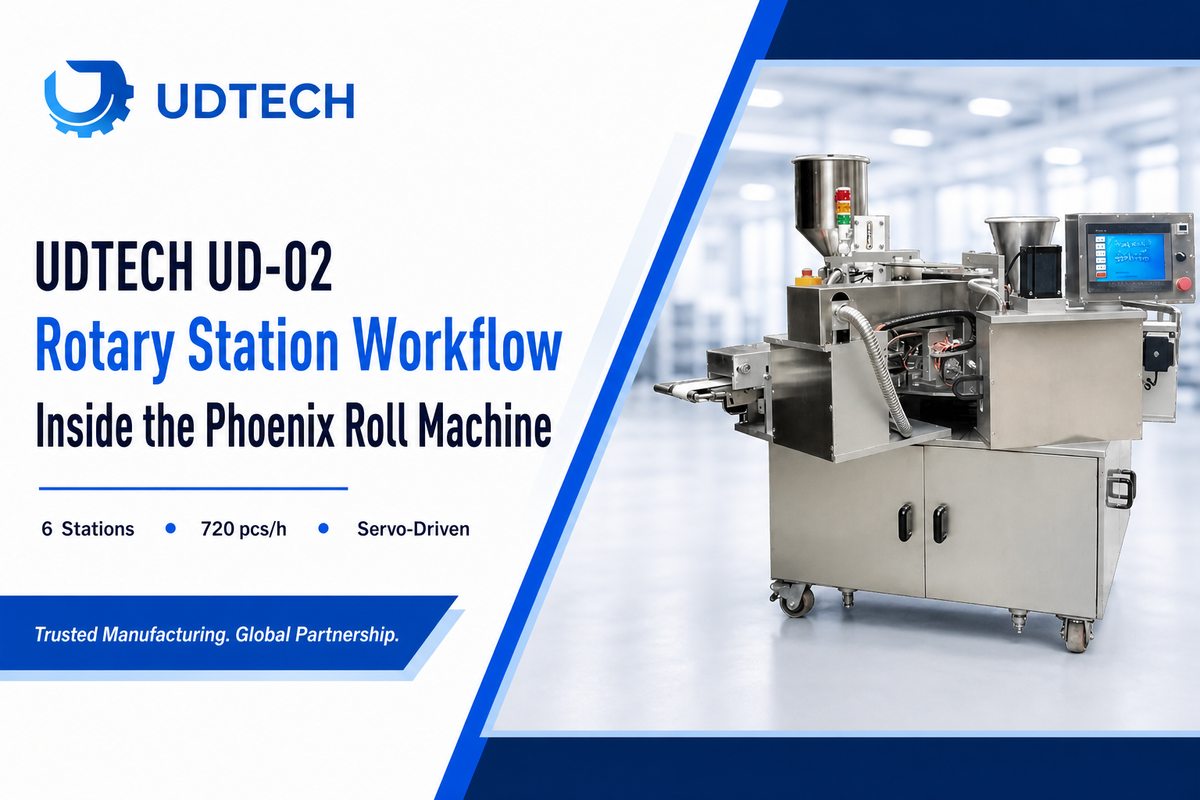
Quick Specs
| Process type | Bake-then-roll (no frying step) |
| Core mechanism | Rotating heated molds + hot-mandrel rolling |
| Heat source options | Gas (LPG) or electric/induction |
| Example throughput | Up to 330 pcs/min (UDTECH UD05-3) |
How does an automatic egg roll machine work? An automatic egg roll machine is industrial food-processing equipment that bakes batter into a crisp wafer disc and rolls it hot, in the wafer-roll sense covered here. It works by dosing thin batter onto a rotating heated mold, baking it into a crisp disc, then rolling that disc around a mandrel while it’s still hot and pliable. In U.S. usage, “egg roll” more often defaults to the savory, deep-fried spring-roll snack, so the mechanism below applies specifically to the baked wafer-roll machine class, not that one.
In short: an automatic wafer egg roll machine doses batter onto rotating heated molds, bakes it into a thin disc in seconds, and rolls the hot disc around a mandrel before it cools and stiffens. A mid-range industrial line runs this cycle continuously at well over 100 pieces per minute, with gas or electric heat as the main design choice.
What “Automatic Egg Roll Machine” Actually Means Here
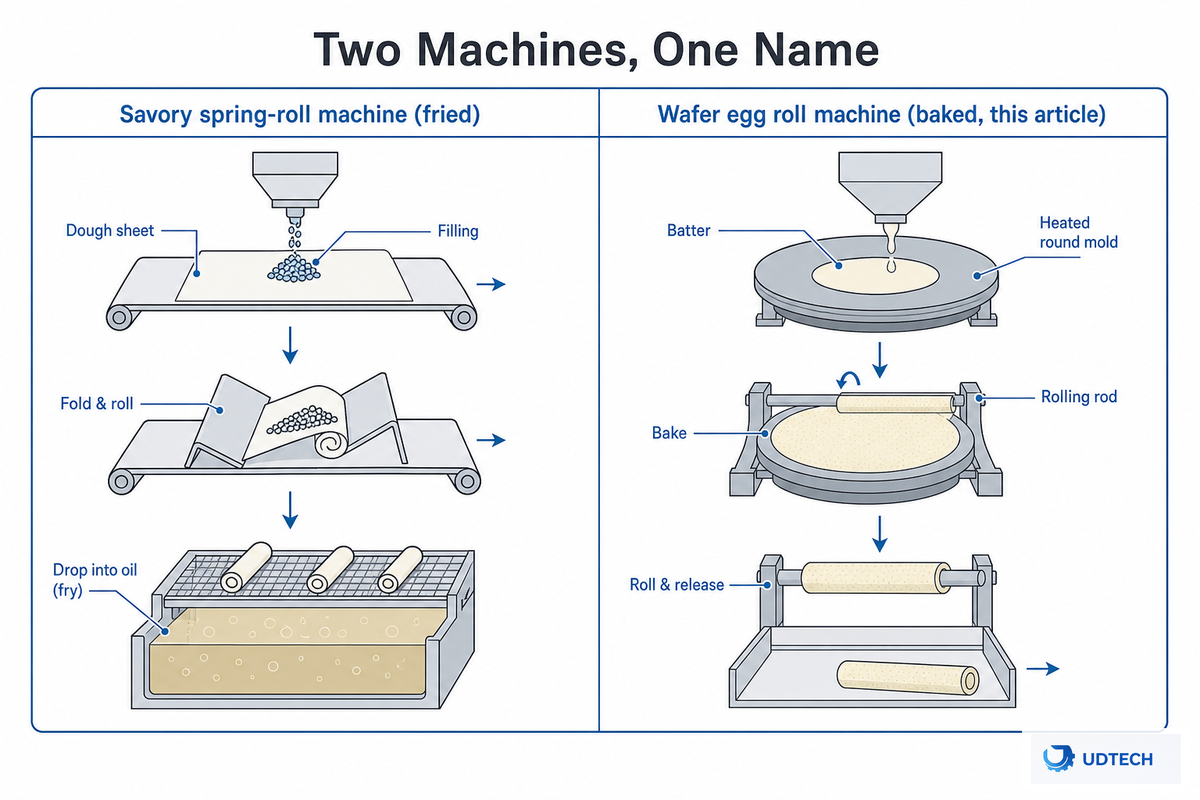
Search for “egg roll machine” and most U.S. results default to savory spring-roll equipment: a dough sheet is cut, filled, folded, and deep-fried. This article covers the other machine family instead – the one that bakes batter into a crisp wafer and rolls it hot, with no frying step at all. For a broader view of snack and bakery equipment, see the food processing machinery from UDTECH catalogue, covering wafer rolls, waffles, pancakes, sachima and mini buns.
That mix-up is not just semantic: buyers who send an RFQ to a savory spring-roll manufacturer while picturing a baked wafer line end up comparing quotes for the wrong equipment entirely, wasting a sourcing cycle before anyone spots the mismatch. These two share a name but almost nothing else mechanically; a closer breakdown of the naming split is available in our wafer vs. spring roll machine comparison.
That split is old enough to show up in the USPTO patent record itself: a 1972 U.S. patent for an “automatic egg roll machine” describes the dough-and-filling type, while a separate family of Chinese utility patents from the 2010s-2020s covers the rotating-mold, wafer-roller design this article is about – two distinct engineering lineages, not a modern SEO coincidence. If you’re still narrowing down which format fits your product, our buying guide covering wafer, savory, and home egg roll machine formats walks through the selection question directly; this article stays focused on how the wafer machine works mechanically.
| Machine type | Mechanism | Heat / frying step | Typical throughput | Best-fit use case |
|---|---|---|---|---|
| Wafer egg roll machine (this article) | Bake on rotating mold, then hot-roll around a mandrel | Baked, no frying step | 220–330 pcs/min | Industrial wafer/cookie production |
| Savory spring-roll machine | Sheet, fill, and fold dough around filling | Fried after rolling | ~2,400 pcs/hour (≈40 pcs/min) | Frozen food manufacturers, restaurants |
| Home electric egg roll maker | Beaten egg poured into a heated vertical cylinder | Cooked, no frying step | Single-serve, one at a time | Home kitchens |
| Manual hand-rolled wafer | Hand-poured batter on a griddle, hand-rolled | Baked | Low, operator-limited | Small artisanal bakeries |
| Gas-fired wafer mold line | Rotating gas-heated molds | Baked | Comparable to electric, lower upfront cost | Sites with existing LPG infrastructure |
| Electric/induction wafer mold line | Rotating induction-heated molds | Baked | ~50% less energy per bake cycle than gas | Sites prioritizing energy efficiency, no gas line |
| Filled wafer roll line | Bake, roll, then post-roll filling injection | Baked | Comparable to unfilled, plus injection step | Filled cookie/dessert product lines |
| Small-batch pneumatic wafer unit | Fewer mold cavities, pneumatic rolling assist | Baked | Below full industrial-line volume | Small bakeries, pilot runs |
| Multi-flavor wafer line (six-clamp type) | Multiple mold-clamp stations run in parallel | Baked | Several flavors produced per cycle | Diversified snack producers |
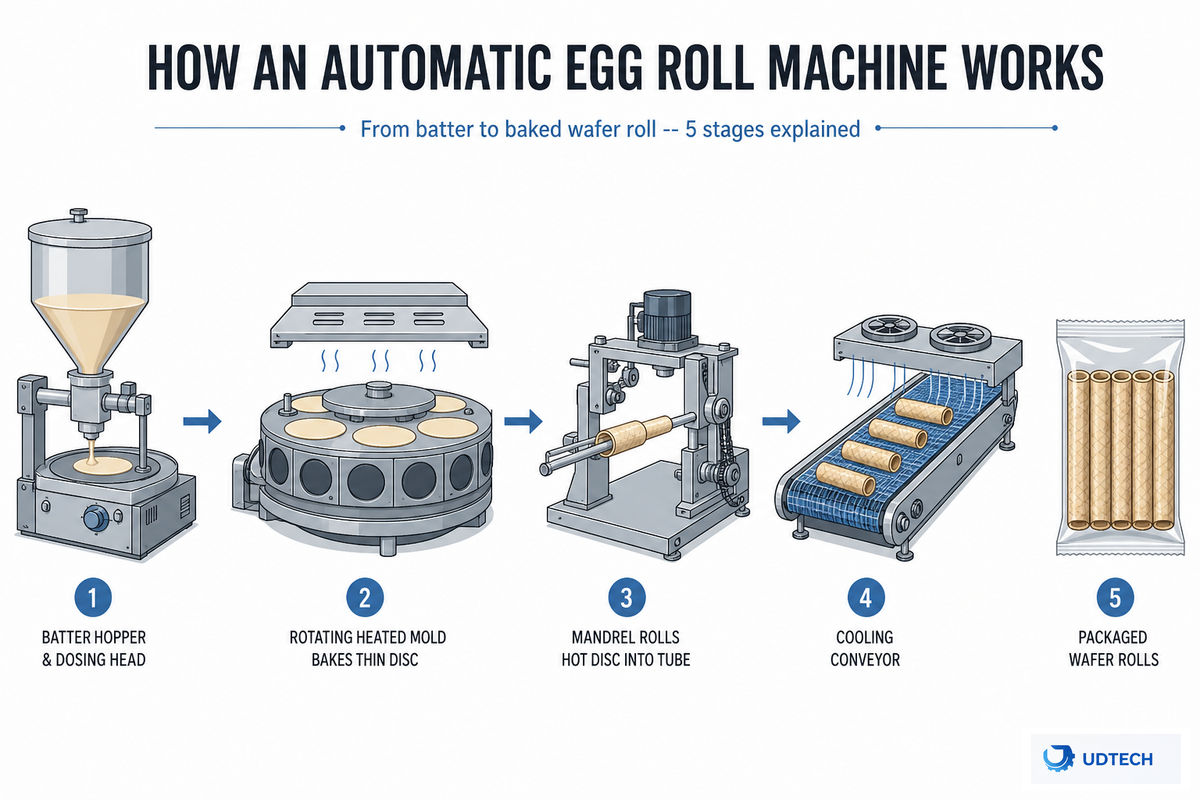
The 5-Stage Wafer-Making Process at a Glance
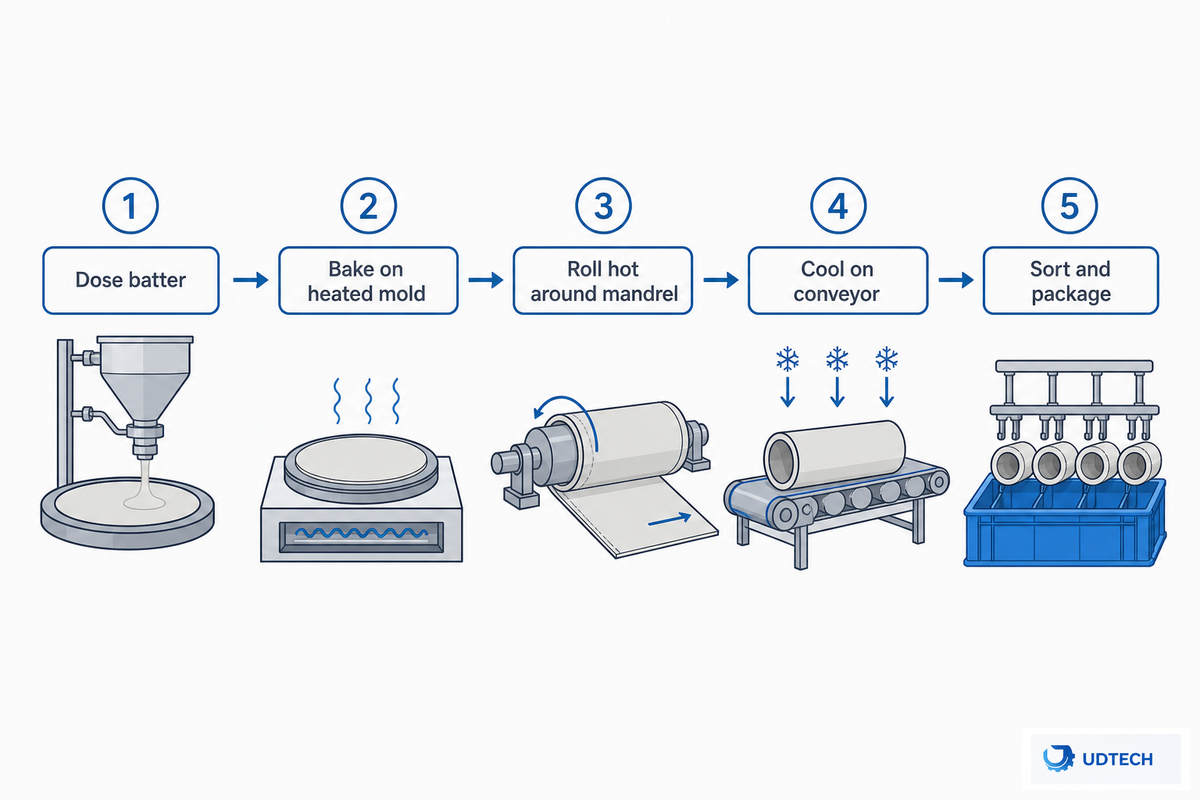
Call it the 5-Stage Wafer Build Sequence: dosing, baking, rolling, cooling, and packaging, run as one continuous cycle rather than five separate machines – and it’s what separates a wafer egg roll rolling machine from every other food-forming machine on the market. Treating any one of these five as an afterthought is where lines run into trouble: a plant that only budgets for the mold and the mandrel, and skips planning for cooling and packaging integration, ends up bottlenecked at the exact stages competing spec sheets never mention. Each stage exists because the one before it creates a constraint the next has to solve – uneven dosing forces slower baking, an inconsistent bake forces gentler rolling, and so on down the line; USPTO and Chinese patent filings on wafer-roll equipment document mechanical fixes for exactly these handoffs.
| Stage | What happens | Key parameter |
|---|---|---|
| 1. Dosing | Batter is metered onto each mold cavity | Dose volume and viscosity control |
| 2. Baking | Rotating molds bake batter into a thin disc | Mold temperature, gas or electric heat |
| 3. Rolling | A mandrel rolls the hot, pliable disc into a tube | Roller-to-bake timing |
| 4. Cooling / filling | Rolls set on a cooling conveyor; some lines add filling | Cooling time before handling |
| 5. Packaging | Rolls are sorted, inspected, and boxed | Inspection checkpoints |
Stage 1, Batter Mixing and Precision Dosing
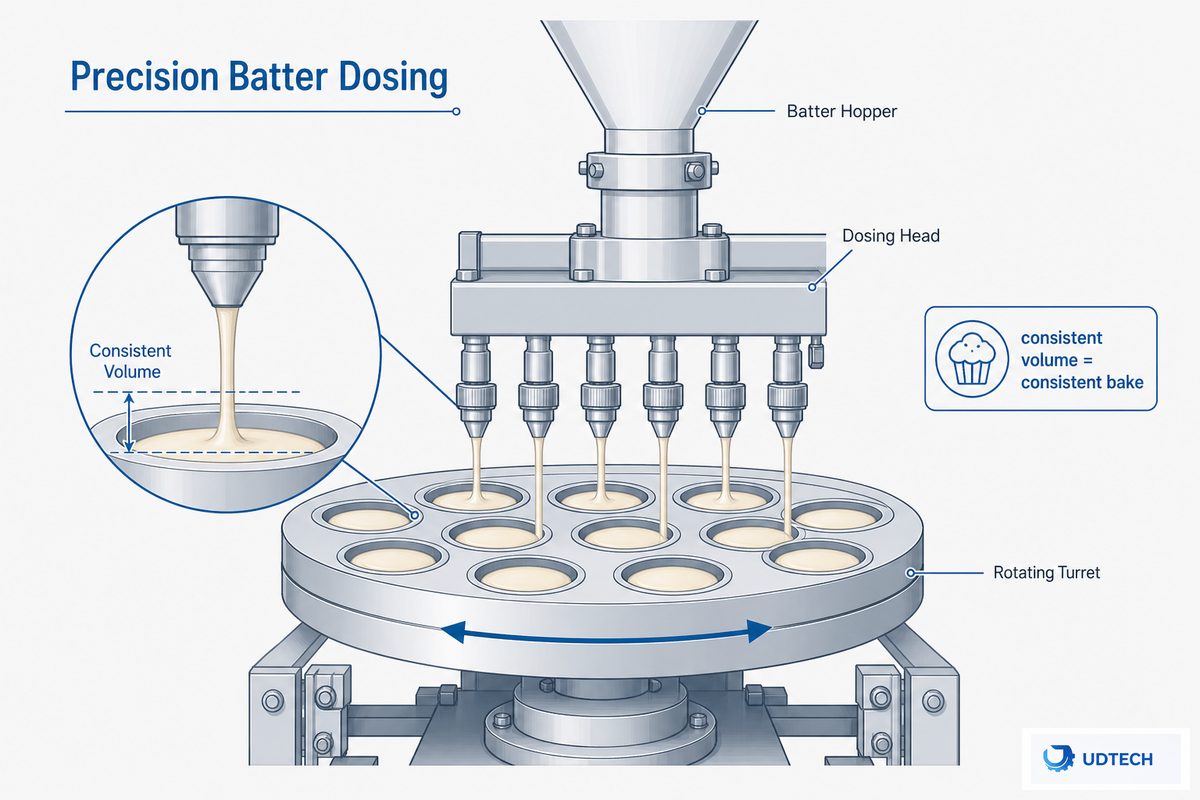
Consistent wafer rolls start with consistent dosing: each mold cavity needs the same volume of batter, at the same viscosity, or the resulting discs bake unevenly and roll unevenly downstream. The root cause is almost always upstream of the mold itself: a dosing head that drifts by even a small margin changes bake time and disc thickness, and that inconsistency shows up several stages later as cracked or misshapen rolls that get scrapped at inspection.
Automated dosing heads meter batter by volume rather than by hand-pour estimate, which is the main reason automatic lines produce a more uniform wafer than manual griddle-and-roll setups. U.S. patent filings on egg-roll and biscuit-forming equipment describe automatic encrusting-and-forming mechanisms built specifically to replicate – and hold constant – the dosing action a skilled operator would otherwise do by feel.
Batter viscosity that drifts even slightly changes bake time and disc thickness – most lines specify a target viscosity range and check it each shift rather than relying on visual judgment alone.
Stage 2, Baking the Wafer on Rotating Heated Molds
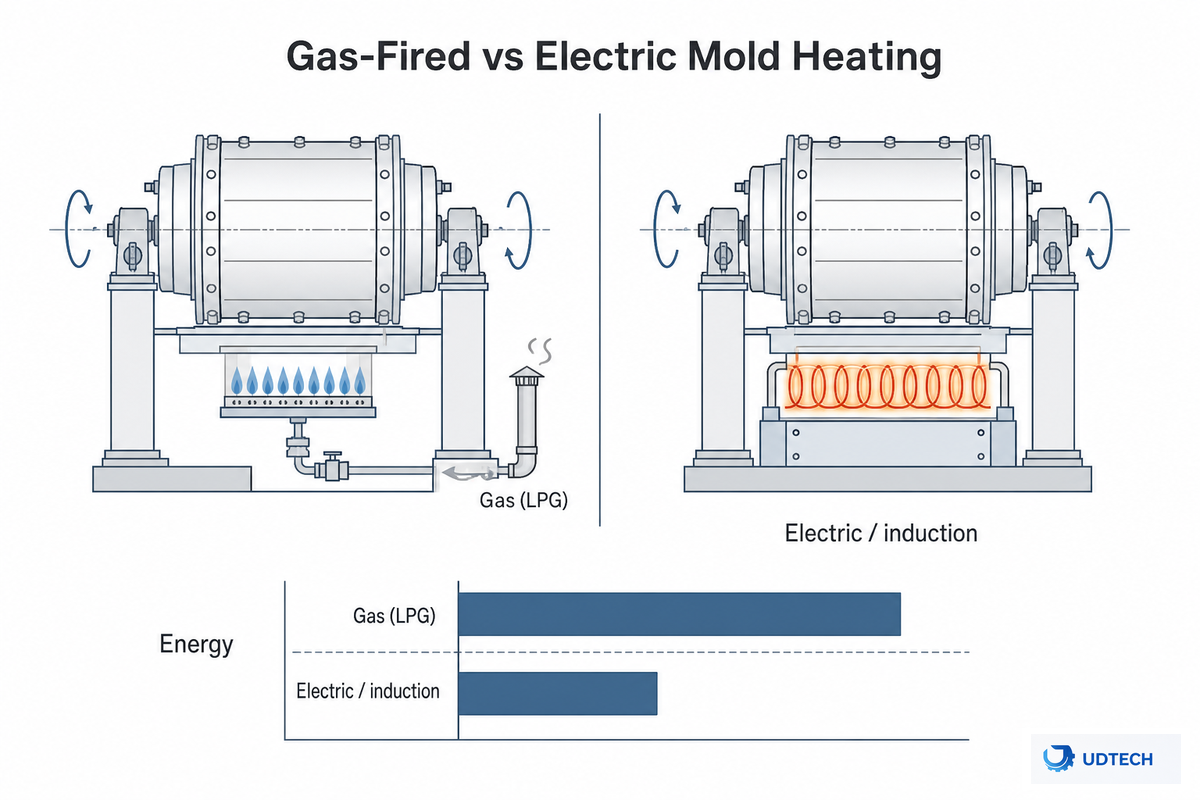
The Gas-Fired vs Electric Mold Selector below covers the single biggest equipment decision in this stage: rotating molds bake the dosed batter into a thin disc, fully cooking it in the process – unlike a savory spring roll, which is folded raw and fried afterward, a wafer egg roll has no separate frying step because baking is the cooking step. Gas-fired (LPG) molds are the long-standing default; a 2025 trade-press report on Bühler’s OptiBake oven – the first inductively heated wafer oven on the market – puts electric induction heating at roughly half the energy use of a conventional gas-fired wafer oven, with no combustion byproducts to vent. The utility rates behind that comparison move too: U.S. commercial electricity averaged about $0.14 per kWh in early 2026, per EIA data, while industrial natural gas commonly runs in the $5 to $9 per 1,000 cubic feet range depending on state and season – Henry Hub spot pricing alone swung between roughly $2.65 and $9.86 per MMBtu in 2025 – so it’s worth pulling current local utility rates rather than assuming either fuel is automatically cheaper.
- Lower equipment cost, industry-standard baseline
- Needs an LPG supply line and dedicated exhaust/makeup-air ventilation
- Heat-up time and running cost tied to gas price swings
- No combustion byproducts, no flue venting required
- ~50% less energy per bake cycle than gas, per Bühler’s 2025 OptiBake data
- Needs dedicated electrical capacity at the installation site
“[Induction heating] eliminates the need for open flame combustion, so there’s no CO2, CO, or NOx to vent, and the lower chamber temperature reduces thermal stress on cables and bearings over time.”
— Bühler wafer business unit lead, on the OptiBake induction wafer oven
NSF/ANSI 4-2025 – the closest NSF-recognized certification category for heated, rotating food-contact equipment like roller grills and waffle irons – sets the hygienic-design bar most relevant to a rotating baking mold: corrosion-resistant surfaces, self-draining CIP zones, and sealed seams that resist debris buildup. On UDTECH’s own UD05 line, the baked wafer skin runs roughly 0.8 mm to 1.4 mm thick, held within a tight plate-temperature band of ±2°C to 3°C – the kind of tolerance that keeps bake time and rolling behavior consistent from one disc to the next.
Stage 3, Hot-Rolling the Wafer Around the Mandrel
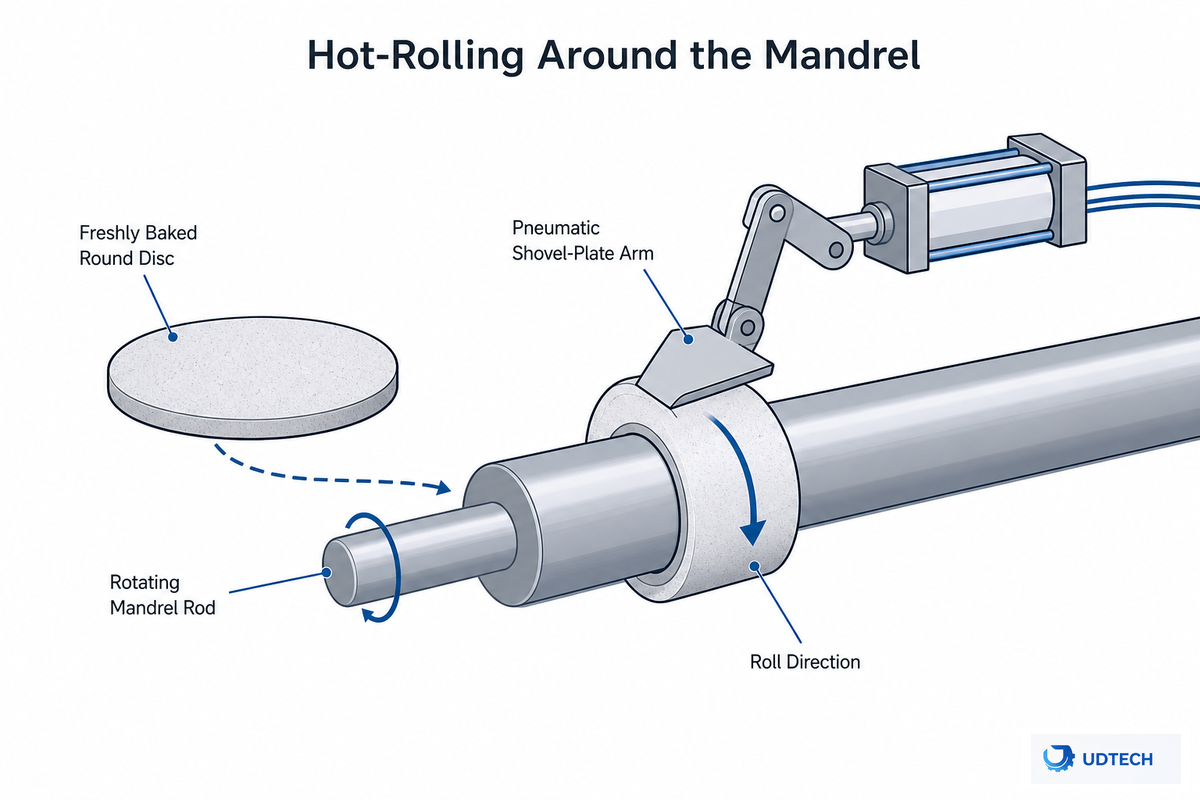
A freshly baked wafer disc has to be rolled while it’s still hot enough to bend without cracking, which is why the roller mechanism is timed to the bake cycle rather than run on a fixed clock. No manufacturer publishes a single “roll within X seconds” number – batter formulation and ambient humidity shift the pliable window too much for one figure to hold – but the patent record shows real engineering built around the problem instead of a published spec. In practice, a line running slightly humid or cool room air will need that timing re-checked, since a wafer that stiffens even a beat early tears instead of rolling clean.
One patent covers rolling the warm sheet at a roller speed deliberately slower than the sheet’s advance rate, precisely so the roller doesn’t outrun and tear the still-soft disc. Designs that rely on rotation alone to “catch” the wafer can fail to grip it cleanly – documented in patent filings as a “nature rolling” failure mode – which is why later designs add a pneumatic shovel-plate that physically presses the wafer’s leading edge onto the mandrel before rotation starts.
- Consistent grip regardless of minor batter variation
- Lower reject rate than designs relying on gravity or rotation alone
- Adds a moving part (pneumatic shovel-plate) to maintain
- Still sensitive to batter viscosity drift upstream
Stage 4-5, Cooling, Filling Options, Sorting, and Packaging

After rolling, the wafer needs to cool and set before it can be handled without cracking or crushing. Most lines run the rolled tubes across a cooling conveyor before sorting. Some wafer-roll lines add a post-roll cream or paste filling injection stage for filled cookie variants, which is separate from the savory-style “fill before rolling” approach. Unfilled crispy rolls skip this step altogether. Because the rolled wafer is a ready-to-eat product exposed to the open air between cooling and packaging, FDA’s food-safety rule for human food explicitly requires an evaluation of environmental pathogen risk anytime a ready-to-eat food is exposed to the environment prior to packaging-a real compliance check at precisely this point, not merely a hygiene nicety. Downstream integration with a packaging line is also where a buyer’s floor plan requires the most advanced thinking; our feuilletine production line breakdown discusses a similar baked-snack downstream configuration in more detail. UDTECH engineers its own conveyor and sorting handoff into each installation, so cooling and packaging integration is planned in-house rather than left for the buyer to reconcile after the mold and mandrel arrive.
How Much Automation Changes Output (and What It Costs)
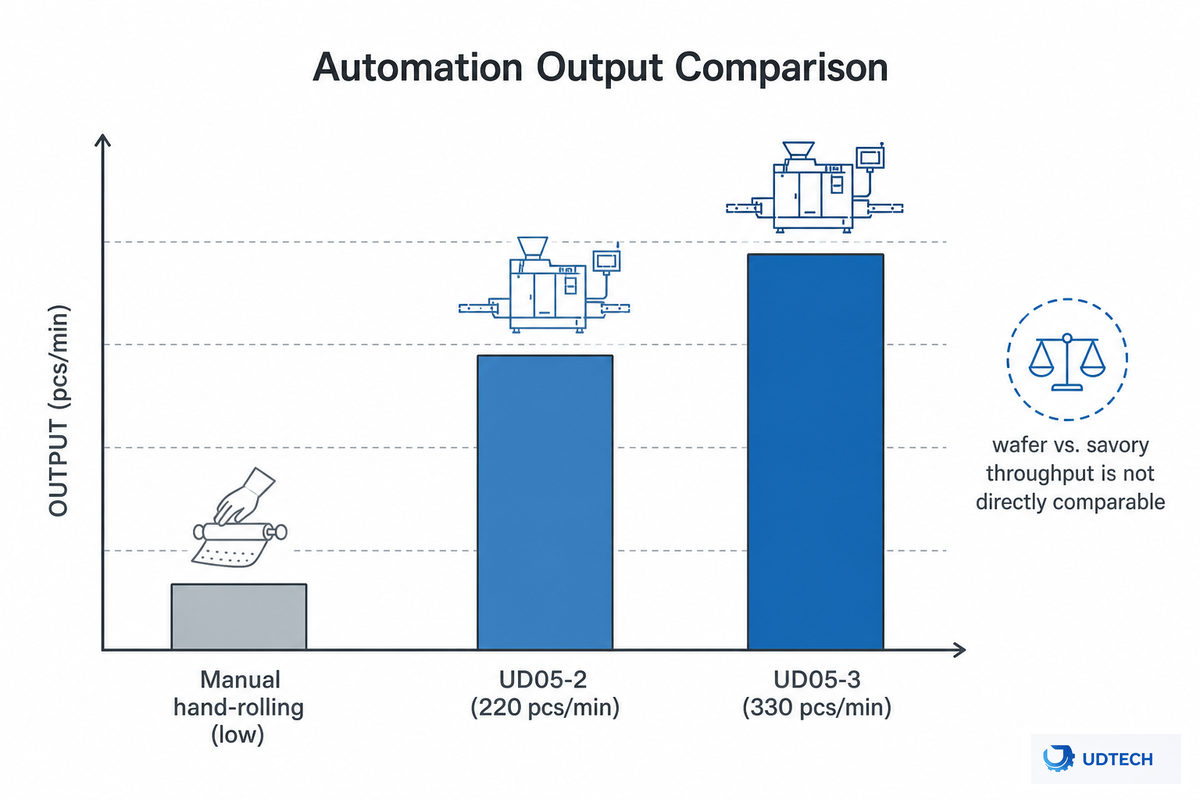
Automatic wafer lines achieve output far exceeding manual-rolling capacity. The UDTECH automatic wafer egg roll machine (UD05 series) operates at 220 to 330 units per minute depending on the specific UD05-2 (9.7 kW) or UD05-3 (12 kW) configuration, running for an 8-hour shift.
By way of scale, a savory spring-roll wrapper line (a different machine category that folds and fries the wrapper) will generally be rated for about 2,400 per hour, or 40 per minute, so the two aren’t comparable on a per-piece basis but rather designed for different end-products and batch sizes. UDTECH’s own documented example of electric-heated UD05-3 baking comes in at approximately $0.09 electricity cost per 1,000 pieces, compared to an estimated $2.36 per 1,000 pieces for a roughly 59 kW industrial spring-roll wrapper line. This disparity will vary with local electricity costs, oven idle loss, product mix and other factors, and UDTECH’s number should be read as the manufacturer’s own data, not as a universal standard. For the full labor and payback economics of upgrading from manual to automated production, see our manual vs. automatic cost breakdown and the capacity-planning guide.
Quality Control Checkpoints During Production

Proper wafer-line operation requires constant vigilance and process control; a line cannot simply be started and left unattended. As noted in food automation industry discourse, variations in the process won’t always manifest as immediately apparent defects but do impact consistency. Peer-reviewed studies on wafer baking-plates indicate color differences and cracking to be the predominant failures-both resulting from non-uniform thermal distribution across the plates. On average across all types of food processing equipment, media cite 5.0% as median unplanned downtime for equipment on any given food processing line, a figure against which the actual wafer-line downtime performance can be gauged.
- ✔Check mold temperature uniformity on all cavities each shift, not only during start-up
- ✔Monitor breakage/reject rate versus a moving baseline – a sudden rise typically indicates viscosity or timing shift
- ✔Check color & crispness from several locations – not just the end of the line
- ✔Place inspection at more than one point in the line – many bakery and snack lines run metal detection both pre-bag and post-seal, since relying on a single detection point tends to drive up false reject rates
“2D/3D vision inspection systems are increasingly used to monitor the forming and baking stages in real time, supplementing metal detectors and x-ray for foreign-object and defect detection.”
Integration & Utility Requirements Before You Install
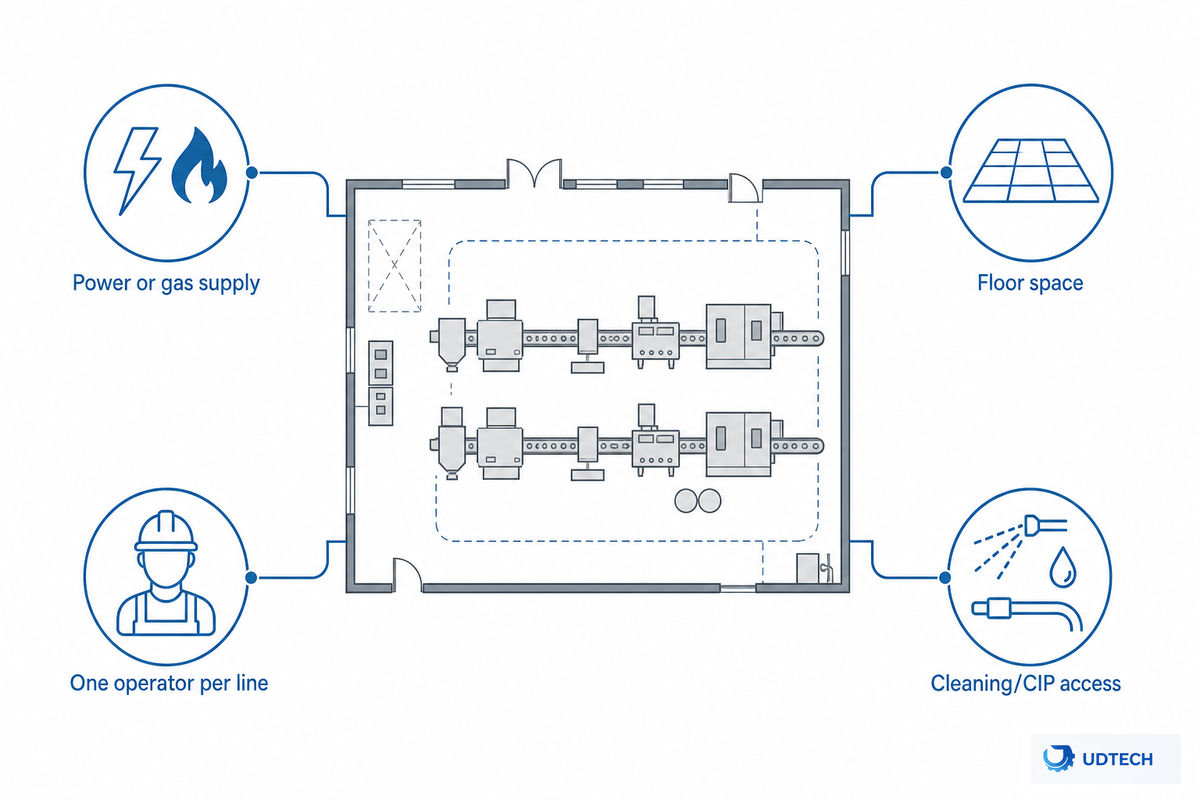
Before a wafer egg roll line arrives, a plant needs to confirm power or gas supply, floor space, staffing (typically one operator per line), and cleaning access – a gap most competing vendor pages routinely leave unfilled, largely because that data lives in facility engineering rather than marketing copy – plus point-of-operation guarding around the rotating molds, mandrel, and conveyor transfer points, separate from FDA/NSF sanitary design requirements.
If you’re planning an EU-bound installation, note that the EU Machinery Regulation 2023/1230 becomes mandatory for machinery placed on the EU market from 20 January 2027, adding new conformity-documentation duties worth building into a purchase timeline now.
RFQ checklist — copy these into your quote request:
| Parameter | Recommended range | Why it matters | How to verify |
|---|---|---|---|
| Electrical supply | 9.7–12 kW per line (electric molds) | Undersized supply trips breakers under load | Ask for a load spec sheet, not a nameplate estimate |
| Gas supply (if LPG) | Dedicated LPG line + exhaust/makeup-air ventilation | Combustion byproducts need code-compliant venting | Confirm with a facilities engineer, not the equipment vendor alone |
| Operator headcount | Typically 1 per line | Drives labor-cost comparisons vs. manual production | Request a staffing reference from an existing installation |
| Cleaning/CIP access | Self-draining, tool-less access points | Required for RTE food-contact hygiene compliance | Ask which NSF/3-A category the mold assembly is certified under |
An automatic wafer egg roll machine bakes batter into a disc and rolls it hot around a mandrel in one continuous cycle — the heat-source choice (gas vs. electric) and utility readiness matter as much to total cost as the throughput spec on the datasheet.
FAQ
Q: What is the main difference between a manual and an automatic egg roll machine?
A manual setup depends entirely on an operator’s hand-rolling speed and consistency, while an automatic machine doses, bakes, and rolls on a fixed, repeatable mechanical cycle regardless of shift or operator fatigue.
Q: How many wafer rolls can an automatic machine make per hour?
UDTECH’s UD05 series runs 220 to 330 pieces per minute depending on model, which works out to roughly 13,200 to 19,800 pieces per hour on a sustained production run.
Q: Is a gas-fired egg roll machine enough for a small bakery?
Yes, for most small-batch operations — gas-fired molds remain the long-standing industry baseline and generally cost less upfront to install than electric or induction alternatives.
Q: Can one machine make both wafer egg rolls and savory spring rolls?
Not on the same production line — the two machine types rely on fundamentally different mechanisms (baking and rolling versus folding and frying) and their tooling isn’t interchangeable.
Q: What causes a wafer roll to crack during rolling?
Cracking usually happens when the baked disc has cooled and stiffened too much before rolling begins, or when the roller mechanism catches its leading edge unevenly during the handoff.
Why We Write This
Since UDTECH manufactures the UD05 wafer egg roll line detailed here, we have a direct stake in getting the mechanical details right rather than skipping the parts – heat-source trade-offs, rolling-window timing, utility requirements – that competing product pages tend to leave out. Throughput and energy figures stated as first-hand are our own published specifications; every other data point is sourced and referenced above. Reviewed by the Suzhou UDTECH Technology Co., Ltd. technical team.
References & Sources
- Bühler Introduces OptiBake Oven for Wafer Production — Snack Food & Wholesale Bakery
- Food Safety Strategies for Snack and Bakery Companies — Snack Food & Wholesale Bakery
- NSF/ANSI 4-2025: Commercial Cooking Equipment — ANSI
- 21 CFR 117.130, Hazard Analysis — U.S. Food and Drug Administration (eCFR)
- 21 CFR 117.40, Equipment and Utensils — U.S. Food and Drug Administration (eCFR)
- EU Machinery Regulation 2023/1230 — EU-OSHA
- Investigation of the Effects of Wafer-Baking Plates on Thermal Performance — MDPI Applied Sciences (peer-reviewed)
- US Patent 4,110,482, Egg Roll Forming Apparatus — USPTO / Google Patents
- CN202635533U, Egg Roll Rolling Mechanism — CNIPA / Google Patents
- US Patent 3,633,517, Automatic Egg Roll Machine — USPTO / Google Patents
Related Articles
- Manual vs. Automatic Egg Roll Machine: Output & Payback — the full labor-cost and ROI breakdown
- Wafer vs. Spring Roll Machine: Which “Egg Roll Machine” Do You Mean?
- Egg Roll Machine Buying Guide: Wafer, Savory, and Home Formats
- Sizing an Egg Roll Line for Peak Demand
- Feuilletine Production Line: Inside a Comparable Baked-Snack Setup
- What Are Chinese Egg Roll Cookies?