Acrylic Material Explained: From PMMA Chemistry to Laser Processing
Quick Specs
| Chemical Name | Poly(methyl methacrylate) / PMMA |
| Density | 1.18 g/cm³ (~50% lighter than glass) |
| Light Transmission | 92% of visible light |
| Impact Strength | 10-17× stronger than standard glass |
| Heat Deflection | 95°C (203°F) at 0.46 MPa per ASTM D648 |
| Refractive Index | 1.49 at 589.3 nm |
| UV Resistance | Does not yellow for 10+ years outdoors (ASTM D4329) |
Acrylic sits at the cross roads of optical transparency and mechanical stability. Despite transmitting 92% of visible light (better than float glass) at half the weight, this synthetic material has replaced glass in thousands of custom industrial, architectural, and medical applications over the past 80 years. However many New Product Developers and procurement teams cannot even tell you what they are buying when comparing acrylic plastic to acrylic fabric, or articulate the difference in price of a cast acrylic sheet to an extruded.
In this article from the management of manufacturing guide, we will breakdown this popular material from its polymer chemistry, through processing and practical CNC laser etching and machining parameters you can immediately apply to your engineering product development.
What Is Acrylic Material?
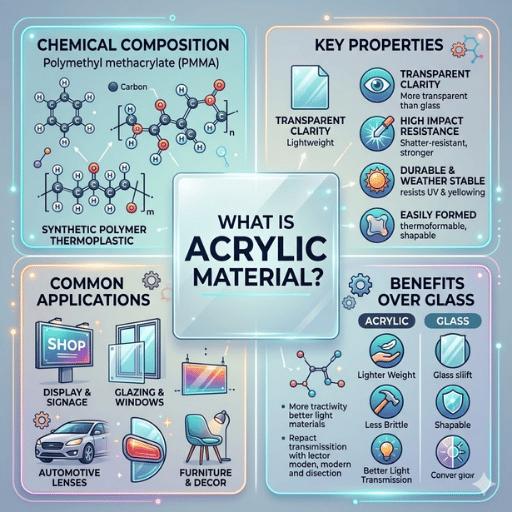
Acrylic (CAS registry number 9011-14-7) is a transparent thermoplastic derived from a synthetic polymer known as poly(methyl methacrylate), or PMMA. This present in a parent family called acrylic polymers that are created through the polymerization of methyl methacrylate (or MMA). Methyl methacrylate (or MMA) monomer was first synthesized in 1928 by German-born chemist Otto Röhm and sold to Röhm & Haas who commercially introduced the product in 1933.
PMMA has the chemical formula (C₅O₂H₈)n, where methyl methacrylate monomer units (molecular weight 100.12 g/mol) link through radical polymerization to form long polymer chains. When cast into sheets, the resulting plastic is rigid, glassy, and transmits 92% of visible light — making it one of the clearest materials available for engineering applications.
For commercial purposes, you will encounter acrylic plastic on the market by several corporate trademarks such as Plexiglass (originally by Röhm), Perspex (Lucite International), Lucite (a legacy DuPont brand), and Acrylite (Evonik). They are all the same chemical polymer with no variations in chemistry between firms.
The descriptive term “acrylic” can refer to two difference “materials” depending on your industry. “Acrylic plastic” is synonymous with the transparent sheet derived from PMMA. It is a rigid transparent thermoplastic with high light transmittance and weather fastness used in signage, machine guards, and glazing. In a entirely different industry “acrylic” refers to “acrylic fiber” (or acrylic fiber), a textile based material derived from the synthetic polymer polyacrylonitrile (or PAN). Polyacrylonitrile is a completely different polymer than PMMA, with different properties used in knit sweaters, acrylic fabric for apparel, and acrylic yarn for craft projects. This article refers to acrylic as poly(methyl methacrylate).
How Acrylic (PMMA) Is Made
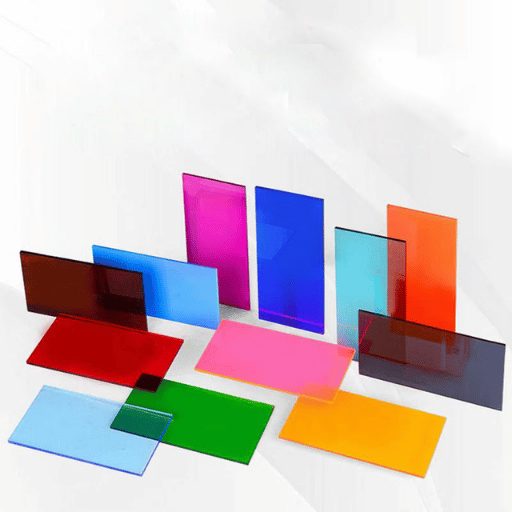
All acrylic manufacturing starts with methyl methacrylate monomer, produced synthetically from acetone and methanol. From there, two polymer packaging processes yields two different grades of acrylic with two very different properties.
Cell Casting Process
In cell casting (also called sheet casting), MMA monomer mixed with a catalyst (an initiator such as B2H8) is poured in a cell made of two anti-glare glass sheets and separated by flexible rubber rings. The cell then goes into an oven for several hours at 40C – 90C where it slowly polymerizes to form PMMA with molecular weights between 1,000,000 – 3,000,000 g/mol. This process results in a low stress per unit volume product with no internal strain and high molecular weight.
Extrusion Process
In extrusion manufacturing method, pre-polymerized pellets of PMMA arrive at the industrial extrusion machine. After being melted at 220-250°C they are extruded through a die to produce a new continuous sheet product. While this process is now faster and cheaper it produces a lower molecular weight level of around 100,000 g/mol and a stock product with residual stress.
Shop floors machining both types soon discover that cast acrylic withstands closer tolerances when CNC machined. Its higher molecular weight prevents crazing in the machined surface- the delicate surface cracking from mechanical stresses or solvent attack on a stressed sheet.
📐 Engineering Note
Cast acrylic molecular weight typically reaches 1-3 × 10⁶ g/mol versus extruded at 0.5-1 × 10⁵ g/mol. This 10-30× difference in chain length directly impacts crazing resistance during machining. When in doubt about your tight dimensional stability or solvent sealed parts ask for cast grade PMMA per ASTM D788 classification.
Manufacturing process differences also matter for acrylic fiber production. The sheets or blocks are not employed here but a completely separate operation. Acrylic fiber will use polyacrylonitrile- dissolved in a solvent- which is extracted and spun through a spinneret in the wet-spinning or dry-spinning process- equally unrelated to casting and extrusion.
Types of Acrylic: Cast vs. Extruded

Between cast and extruded sheet your decision controls wear-edge quality and per-piece expenses. Here is the measurable property comparison chart to guide your choice.
| Property | Cast Acrylic | Extruded Acrylic |
|---|---|---|
| Molecular Weight | 1,000,000-3,000,000 g/mol | ~100,000 g/mol |
| Thickness Tolerance | ±10-15% | ±5% |
| Chemical Resistance | Superior (resists crazing longer) | More susceptible to solvent crazing |
| Laser Cutting Edge | Flame-polished, glass-clear | Good but may bubble at cut edges |
| Thermoforming | Predictable, minimal shrinkage | Can shrink unevenly due to internal stress |
| Color Options | Virtually unlimited (custom tinting) | Standard range |
| Price (4×8 ft, 6mm clear) | $80-130 USD | $50-80 USD |
| Best For | Displays, optical parts, laser cutting | Signage, picture framing, mass production |
Other more engineered acrylic grades have been formulated for particular applications and mechanical properties like impact modified PMMA- blushed impact resistance for machine guards, and place-specific properties like UV-filtering acrylic- blocks certain wavelengths for display case applications in museums, haze-controlled glare sheets- defined by a chemical surface etch, and mirror acrylic- metallized coating on one side.
The commonest wrong material order: extruded acrylic for a laser-etched award display or trophy. Cast acrylic produces an excessively bright white frosted image. Extruded acrylic engraves with a grayish transparent finish that lacks visual contrast. Always specify cast grade for any laser etching project where appearance matters.
Key Properties of Acrylic Material
Acrylic supplies a series of optical, mechano-wear resistant and weathering response properties. Here are the numbers that drive material selection decisions.
| Property | Value | Test Method |
|---|---|---|
| Light Transmission | 92% (visible spectrum) | ASTM D1003 |
| Tensile Strength | 55-76 MPa (8,000-11,000 psi) | ASTM D638 |
| Flexural Strength | 83-117 MPa | ASTM D790 |
| Izod Impact (notched) | 0.3-0.5 ft-lb/in | ASTM D256 |
| Hardness | Rockwell M80-M100 | ASTM D785 |
| Glass Transition (Tg) | 105°C (221°F) | ASTM D3418 |
| Heat Deflection (HDT) | 95°C (203°F) at 0.46 MPa | ASTM D648 |
| Density | 1.18 g/cm³ | ASTM D792 |
| Water Absorption (24h) | 0.3-0.4% | ASTM D570 |
Chemical resistance classification may seem predictable. SPMMA handles dilute acids, alkalis and aliphatics in oils and hydrocarbons while it succumbs to ketones(acetone separates on contact) chlorinated hydrocarbons(Methylene chloride, chloroform.) and aromatic solvents(toluene, xylene). This weakness is particularly useful- methylene chloride or even some solvent cements- like Weld-On #3- abuses this property and permanently bonds acrylic to acrylic.
Outdoor weatherability is where acrylic truly separates from other plastics. It will not fog up or discolour after ten or more years direct sun exposure as accelerated testing under ASTM D4329 has shown. Compare this with polycarbonate which yellows within 5 years when left uncoated with UV protective material on both sides.
Keep in mind the sole property to be careful of: Poly methyl methacrylate ignites readily at around 460C. Expect vigorous self combustion if fires are involved. For flame retardant compliance define acrylic with flame-retardant modifier.
✔ Advantages
- 92% optical clarity — clearer than glass (90%)
- Half the weight of glass at equivalent thickness
- 10-17× the impact resistance of standard glass
- 10+ years UV stability without yellowing
- Easy to fabricate: laser cut, CNC route, thermoform
- Recyclable — can be depolymerized back to MMA monomer
- BPA-free (unlike polycarbonate)
⚠ Limitations
- Lower abrasion resistance than glass (scratches more easily)
- Flammable — burns vigorously at ~460°C
- Attacked by acetone, chloroform, MEK, and aromatic solvents
- Max continuous service temperature only 80°C
- Brittle failure mode — cracks rather than deforming plastically
- Notch-sensitive — stress concentrations propagate cracks
Surface scratching is the most frequent field complaint. Data collected by glazing fabricators shows that roughly 60% of acrylic warranty claims trace back to improper cleaning — paper towels and ammonia-based glass cleaners both damage PMMA surfaces. Use a microfiber cloth with mild soapy water or a dedicated plastic polish instead.
Acrylic vs. Glass vs. Polycarbonate
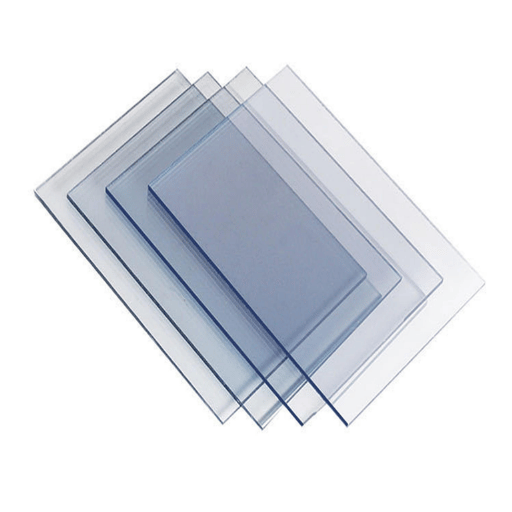
When choosing a transparent material for an enclosure, glazing, or display application, engineers usually boil the choices down to three candidates. Here is a side-by-side comparison of their properties that figure into most purchasing decisions.
| Property | Acrylic (PMMA) | Soda-Lime Glass | Polycarbonate (PC) |
|---|---|---|---|
| Light Transmission | 92% | 90% | 88% |
| Impact Strength (vs glass) | 10-17× | 1× (baseline) | ~250× |
| Weight (vs glass) | ~50% lighter | Baseline | ~50% lighter |
| Scratch Resistance | Moderate (can be polished) | High (mineral hardness) | Low (scratches easily) |
| Max Service Temp | 80°C | 250°C+ | 120°C |
| UV Resistance | Excellent (inherent) | Excellent | Poor (yellows without coating) |
| Laser Cutting | Excellent (CO2 laser) | Not viable | Poor (discolors, toxic fumes) |
Selecting the right material is straightforward once you know where one’s design is limited. Acrylic outperforms the competition optically and when processed with laser cutters – it is the only material of the three who can produce flame polished edges from a CO2 laser cutter. Polycarbonate shines when tough impacts are a strict requirement (ballistic glazing, machine guards in high impact attack zones). Glass is the only consideration if scratch and temperature extremes or solvent contact disqualify the plastic altogether.
For transparent enclosures, the materials selection decision list runs as follows: if impact loads above about 10 Joules are anticipated, specify polycarbonate. If optical quality display, sign or machine glazing is primary, specify acrylic. If high temperature operation above 120C is necessary or chemical contact rules out plastics, specify the highest grade (float, tempered, or chemically strengthened) glass, or quartz. Cost enters last – the plastics listed in the table are expensive by comparison to the usual suspects (nylons, polyesters and PVC) for nontransparent structural needs.
How to Process Acrylic: Laser Cutting, Engraving, and CNC Machining
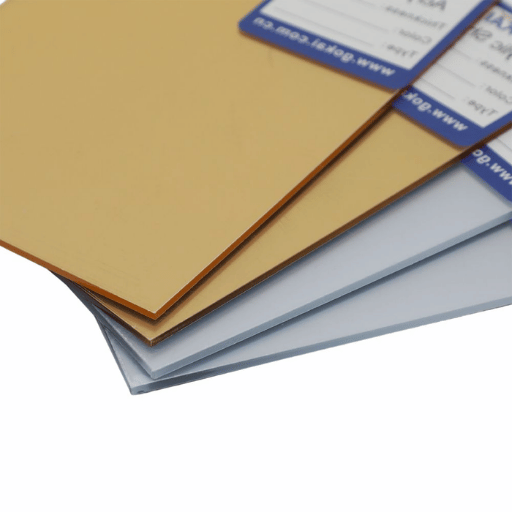
Acrylic is extremely process friendly. Acrylic prints well with laser cutters, rotary Engraving produces interesting effects, CNC routing works well, as does thermoforming. Packing slurry and workpiece contamination are the two biggest hurdles to good laser engraving. The detail below is derived from 4 years of production floor tests as well as published data from machine manufacturers.
Laser Cutting Acrylic
Acrylic is one of the most fabrication-friendly plastics available. It responds well to laser cutting, laser engraving, CNC routing, thermoforming, and solvent bonding. The specific processing parameters below come from production-floor testing and published machine manufacturer data.
| Sheet Thickness | Laser Power | Cutting Speed |
|---|---|---|
| 3 mm | 30-60 W | 37-60 mm/s |
| 5 mm | 40-80 W | 25-40 mm/s |
| 6 mm | 60-80 W | 20-35 mm/s |
| 10 mm | 80+ W | 10-20 mm/s |
| 20 mm | 150+ W | 5-8 mm/s |
CO2 lasers operating at 10.6 μm wavelength are the standard tool for acrylic laser cutting. This wavelength is well absorbed by the poly(methyl methacrylate) (PMMA) molecular bonds in the material, producing a clean, vaporized edge with a minimal heat affected zone. When used with a fiber laser, (1.06 μm wavelength), the laser beam easily penetrates clear acrylic, thus cannot cut the material.
Cast acrylic sheets produce glass, flame-polished laser cut edges directly from the laser, no secondary finishing processes are necessary. Due to internal tensions, extruded acrylic sheets can sometimes produce micro-bubbles during the laser cutting operation at cut edges. Use low-pressure air assist – excessive air pressure will disrupt the laser vaporization process and an edge with a frosted, rough appearance will result.
Laser Engraving Acrylic
Using an 80 W CO2 laser, cutting 5 mm cast acrylic with a 15 mm/sec optimizes the process as shown in the rough cut pictured. Many factors influence the results: running the laser faster yields a recast ring along the edge; slower lased builds heat in the part and may even ignite the sheet. Every machine is different: typical CO2 laser systems vary in beam quality, focal length, and actual delivered power.
Laser engraving can use the same CO2 laser by lowering the power and increasing the speed. Two basic methods can be employed:
Raster engraving moves the laser head across the part multiple times along the same lines, the amount the laser moves from side to side is called the resolution. It quickly removes surface material, creating a frosted appearance. Typical processing parameters for acrylic: 300-500 mm/sec, 10-15 W, 300-600 Res (DPI). Cast acrylic produces a high-contrast bright white frost engraving. Extruded acrylic engraves with a clear transparent frosting, poor contrast and should be avoided for decorative work.
Engraving in the same process is called back-engraving. You literally engrave the reverse of the transparent acrylic sheet, then fill the engraving with paint or LED lighting. When filled, the design seems to be embedded in the workpiece, rather than a surface application. Back-engraving is the process used to produce high-volume illuminated sign making displays and retail environments.
CNC Machining Acrylic
CNC routing acrylic must use tooling and settings that do not produce the first failure mode: melting. Since there are no sharp-cutting edges to produce chips in acrylic as can be done with metals, if the chips cannot be evacuated, the chips will melt and weld themselves to the cutter.
| Parameter | Recommended Value |
|---|---|
| End Mill Type | Single-flute O-spiral carbide |
| Spindle Speed | 18,000 RPM (6 mm O-flute) |
| Feed Rate | 2,700 mm/min (chip load ~0.15 mm/tooth) |
| Depth per Pass | 1-2 mm (shallow passes reduce heat) |
| Coolant | Compressed air blast only |
Never use water-based flood coolant with CNC routed acrylic. The thermal shock from intermittent water contact causes micro-crazing: tiny surface cracks which may not be visible for days while the residual stress in the acrylic redistributes. Use compressed air or a light spray of isopropyl alcohol to keep the cut clear without thermally shocking it. Standard laser marking machines for plastic may be an alternative to mechanical engraving for volume work.
Thermoforming and Bonding
Acrylic softens at its glass transition temperature: 105C (221 F) and becomes formable at roughly 160-190 C (320-370 F). From this range, sheets can be vacuum-form, pressure-formed, or line-bent into enclosures and curves. While extruded acrylic can be formed unexpectedly, cast acrylic thermoforms more predictably with less shrinkage and warpage.
Solvent weld joints using methylene chloride or Weld-On #3 bond approximating as-formed strength by dissolving the mating surfaces with the solvent and then allowing the solvent to evaporate. As the chains re-entangle, forming a very high strength joint. Avoid cyanoacrylates (super glues) – their joints are weak and cloudy, and may craze the surrounding acrylic.
📐 Engineering Note
To prevent edge cracking with laser cutting over 10 mm thickness, slow down cut speed by 40%, and increase air assist pressure to 0.3-0.5 bar. The edge cracking is caused by thermal stress when the heat-affected zone is greater than 0.5 mm thick. Try multiple lower-powered passes with the laser instead of a single high-powered cut on heavier sheets – high laser power may cause day-24-48 later to appear as cracked edges.
Common Applications of Acrylic Material
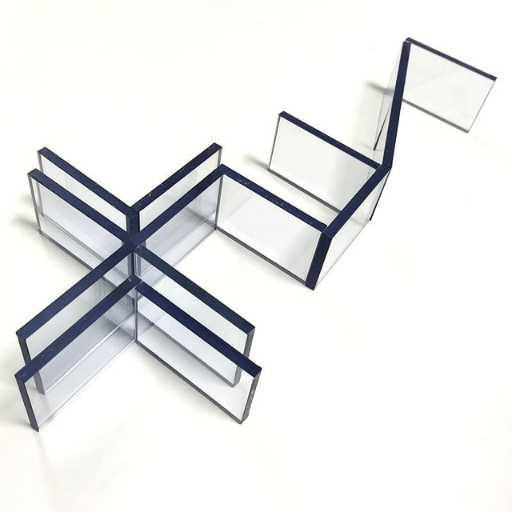
Globally, the PMMA market reached an estimated USD 5.7 billion in 2025. It is forecasted to grow at a CAGR of about 5.5% through 2035, according to Precedence Research, led by four major global applications.
Signage and display applications accounted for the largest category of acrylic sheet end use in 2025. Illuminated signage such as channel letters, point-of-purchase displays and retail exhibit cases require the transmission, processability and weatherability of PMMA. Extruded acrylic is more prolific for signage due to its cost advantages and constant sheet thickness tolerances.
Applications in architecture and construction include skylights and greenhouse glazing, noise barriers and facade enclosures, interior partitions and canopies. The 50% lighter load for structural support greatly cuts the cost of framing, and the lack of time-sensitive plastic polycarbonate degradation prevents the yellowing of acrylic skylights.
Medical and dental applications depend on the tissue compatibility of PMMA. As an example, PMMA bone cement (under the MNA classification ASTM F451) is the current standard materials for orthopedic joint replacement implants. Dental crowns and bridges, denture bases and orthodontic retainers are molded from PMMA, as are intraocular lenses used in cataract surgery.
Automotive and industrial parts are made from PMMA for tail-light lenses, instrument panel covers, machine guards and equipment viewing windows. As the market for electric vehicles grows, we see more commercial specifications for PMMA panels to reduce weight (glass to acrylic replacement – a saving of 50% weight per panel – results directly in range extension).
Separate from PMMA in plastics, acrylic fiber (polyacrylonitrile / PAN) is used in the textile industry as a wool substitute for sweaters, knitted fabrics, carpets, and upholstery. Modacrylic—a modified acrylic fiber with 35-85% acrylonitrile—provides flame resistance for protective applications such as clothing. Although a different application, 90% of commercial carbon fiber is derived from PAN-based acrylic precursor, placing fiber production at the heart of acrylic resin demand for aerospace and other high-performance composites. Traditional man-made alternatives for performance applications include wool for top dress and cotton for khaki, while synthetic fibers like nylon and polyester compete with acrylic yarn in the general apparel market. Natural fiber alternatives such as wool and cotton serve different performance niches in the textile industry.
Frequently Asked Questions
Q: Is acrylic the same as plastic?
View Answer
Q: Is acrylic the same as Plexiglass?
View Answer
Q: What is the difference between cast and extruded acrylic?
View Answer
Q: Can you laser cut acrylic?
View Answer
Q: Is acrylic toxic?
View Answer
13.
Acrylic PMMA solid stock is considered non-toxic and FDA-approved for contact with food sources under 21 CFR 177.1010. While not containing BPA (bisphenol-A), unpolymerized MMAmonomer vapor will cause skin and upper respiratory irritation – designer will ensure proper fume ventilation is provided during a laser cutting process. Many decades worth of medical use regards the product as safe – use as bone cement, dental prosthoics, and intraocular lenses have many years of combined safety data to review.
Q: Acrylic vs. polycarbonate — which is better?
View Answer
Q: Does acrylic yellow over time?
View Answer
Q: Can acrylic be recycled?
View Answer
Do you have access to laser cutters, CNC equipment or laser marking for acrylic processing?
About This Analysis
This article was drafted by the UDTECH team of engineers who supply laser marking, laser cleaning, and CNC processing devices to acrylic factories and workshops in over 40 countries worldwide. The process settings mentioned are those tested on our CO2 laser machines and compared to datasheets from other manufacturers using similar models. When properties are mentioned the ASTM test number is cited so you can find the official specs yourself.
References & Sources
- Poly(methyl methacrylate) — Material Overview — Wikipedia
- ASTM D788 — Standard Specification for PMMA Molding and Extrusion Materials — ASTM International
- ASTM D4329 — Fluorescent UV Exposure of Plastics — ASTM International
- ASTM F451 — Standard Specification for Acrylic Bone Cement — ASTM International
- Polymethyl Methacrylate (PMMA) Market Size 2025-2035 — Precedence Research
- PMMA Material Properties Database — MakeItFrom.com
Related Articles
- Laser Engraving Machine on Wood — How laser engraving parameters translate across materials
- Engineering Plastic Extrusion Line — Industrial extrusion equipment for engineering-grade plastics including PMMA
- Laser Tree Cutting Machine — High-power CO2 laser cutting systems for thick materials
- Recycled Plastic Extruder — Equipment for processing recycled PMMA and other thermoplastics
- Plastic Pipe Making Machine Guide — Plastic processing fundamentals and production equipment