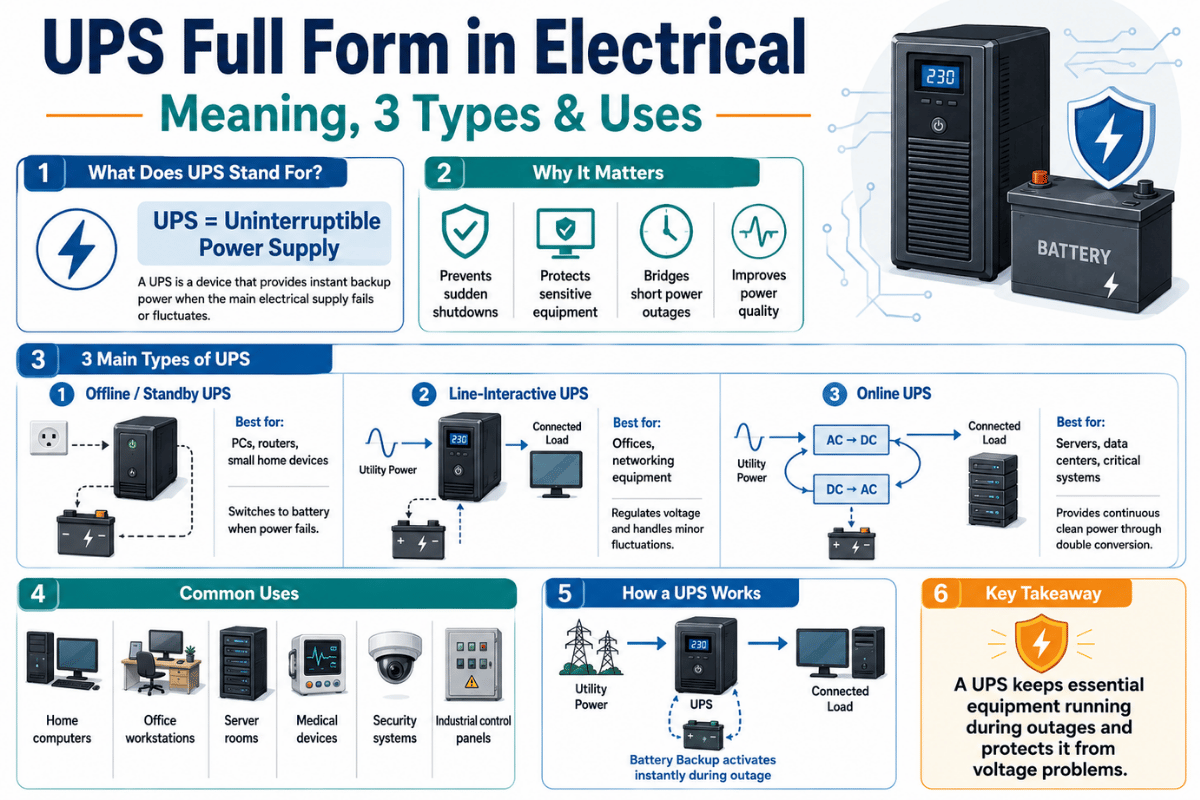
Quick answer: In electrical systems, UPS stands for Uninterruptible Power Supply. It’s an apparatus that provide instant emergency power to a load when the input or mains power fails, and conditions that power against sags, surges, and noise while running.
Key Takeaways
- A UPS is not a long-run power source, most carry the load for only 5–15 minutes, just long enough to bridge to a generator or shut down safely.
- Bigger isn’t better: UPS efficiency falls off below 50% load and drops sharply under 30%, so oversizing wastes energy.
- International standard IEC 62040-3 defines three classes, VFD (offline), VI (line-interactive) and VFI (online double-conversion).
- A true online (VFI) UPS has zero transfer time; offline units switch in roughly 4–25 milliseconds.
Quick Specs: UPS at a Glance
| Full form (electrical) | Uninterruptible Power Supply |
| Core function | Instant backup power + power conditioning |
| Output / storage | AC output; battery stores DC |
| Typical runtime | 5–15 minutes at rated load |
| Three IEC types | Offline (VFD) · Line-interactive (VI) · Online double-conversion (VFI) |
| Transfer time | 0 ms (online) → ~4–25 ms (offline) |
UPS Full Form in Electrical: What UPS Stands For
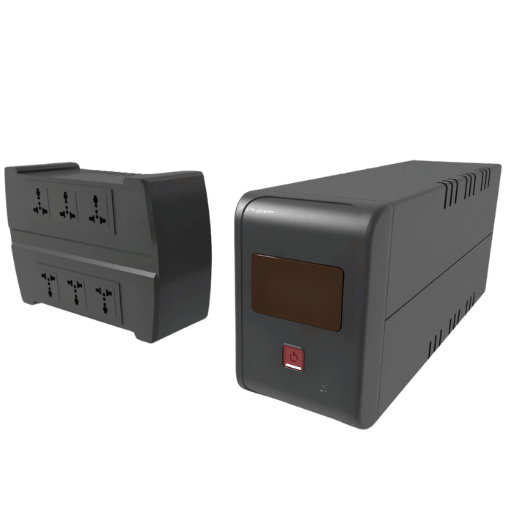
UPS stands for Uninterruptible Power Supply. The three words describe exactly what the device does: it keeps the supply of electrical power uninterrupted. When utility (“mains”) power fails, sags, or spikes, a UPS bridges the gap from its internal battery in milliseconds, so connected equipment never sees the disturbance. During a power outage it supplies continuous power to the load until the mains returns or a generator start. Wikipedia’s engineering definition frames it as “an electrical apparatus that provides emergency power to a load when the input power source fails.”
Crucially, a UPS is a bridge, not a generator. Its battery typically power the load for only 5 to 15 minutes — enough time to start an on-site generator or shut equipment down cleanly to avoid data loss. Data-center engineers make the same point: the purpose of a UPS “isn’t to keep servers running indefinitely but to provide power long enough for a graceful shutdown.”
Is the Full Form of UPS the Same in Computer and Courier Contexts?
In any electrical, IT, or computer context the answer is the same: UPS means Uninterruptible Power Supply. The confusion comes from outside engineering — “UPS” is also the brand of the courier United Parcel Service, an unrelated use of the same three letters. So when a spec sheet, electrician, or computer-hardware guide says “UPS,” it refers to the battery backup device, not the delivery company. The computer “UPS full form” is identical to the electrical one.
How a UPS Works: The Millisecond Handoff
A UPS works by watching the incoming mains and staying ready to feed the load from its battery. We call this defining behavior The Millisecond Handoff: when input power drifts out of tolerance, the UPS shifts the load to its battery-fed inverter fast enough that electronics keep running without rebooting. In an offline UPS that handoff takes roughly 4 to 8 milliseconds, and up to 25 ms in older standby units.
Inside, the energy follows a fixed path: incoming AC feeds a rectifier that produces DC, the DC float-charges the battery and feeds an inverter, and the inverter rebuilds clean AC for the load. In normal operation the battery is being charged, not drained, this is how an online UPS operates continuously, whereas an offline unit only switches to battery power at the instant of transfer. It’s the most common misunderstanding about UPS systems, even in textbooks.
“The term ‘online’ should be avoided because it is ambiguous, a product is not double-conversion simply because it is marketed as ‘online.'”
Is a UPS AC or DC?
A UPS is both, by design. The battery stores and discharges DC (direct current), but the load need AC (alternating current), so the inverter converts battery DC back to a clean AC sine wave. In an online double-conversion UPS this happens continuously, mains AC becomes DC, then DC becomes AC again, which is why its output is fully isolated from input voltage and frequency variation.
The 4 Components of a UPS
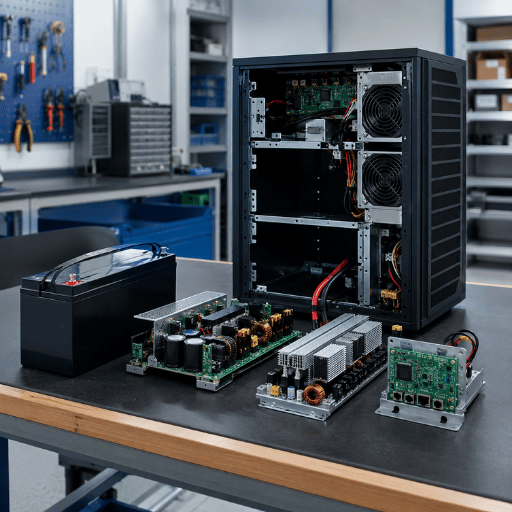
Strip away the casing and almost every static UPS is built from four functional blocks. Understanding them explains both how the device protect equipment and where it eventually fails (the battery).
- Rectifier / charger — converts incoming AC to DC to power the inverter and keep the battery topped up.
- Battery — stores DC energy; the only consumable part, typically valve-regulated lead-acid (VRLA) or lithium-ion.
- Inverter — converts DC back to a regulated AC sine wave for the load.
- Static bypass switch — routes the load straight to mains (or to battery/inverter) and enables maintenance without dropping power.
A data-center engineering analysis describes the same anatomy plainly: a static UPS “has no primary moving parts and consists of a rectifier, an inverter and a set of batteries,” with double-conversion designs converting utility AC to DC (charging the batteries) and back to clean AC. The rotary UPS, which generates its output from a spinning flywheel instead of batteries, is a fourth, niche design most guides skip. The same rectifier-inverter-battery architecture is formalized in modular UPS designs such as US Patent 6,201,319.
Types of UPS: The UPS Topology Spectrum
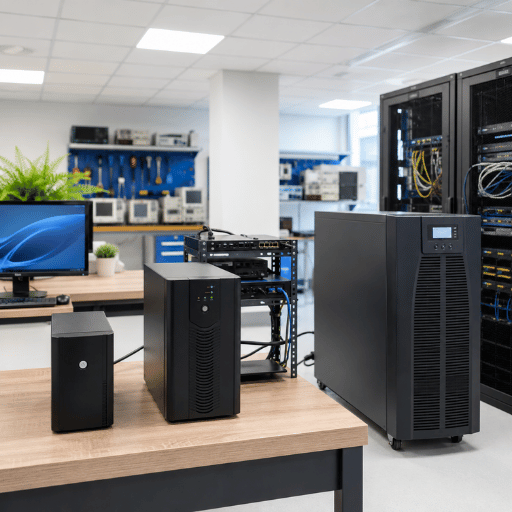
Marketing names like “offline” and “online” hide a precise international standard. IEC 62040-3 classifies every UPS by how independent its output is from the input supply, giving three classes, VFD, VI and VFI, that map exactly to the familiar topology names. We call the result the UPS Topology Spectrum.
| Attribute | Offline / Standby (VFD) | Line-Interactive (VI) | Online Double-Conversion (VFI) |
|---|---|---|---|
| IEC 62040-3 class | VFD (Voltage & Frequency Dependent) | VI (Voltage Independent) | VFI (Voltage & Frequency Independent) |
| Transfer time | ~4–8 ms (up to 25 ms) | ~2–8 ms | 0 ms (no transfer) |
| Normal-mode efficiency | 95–97% | 92–94% | 90–94% (eco 97–99%) |
| Power problems solved (of 10) | 3 | 5 | 10 |
| Voltage regulation | None (battery only) | ±20% via autotransformer | Continuous, tight |
| Typical capacity | Up to ~1,500 VA | Up to ~5,000 VA | Up to ~1,000 kVA |
| Relative cost | Lowest | ~40% below online | Highest |
| Best fit | Home PC, single workstation | Small office, servers, unstable grids | Data centers, medical, lab, critical loads |
Sources: IEC 62040-3 classification; ENERGY STAR (U.S. EPA) UPS criteria; ENERGY STAR UPS Framework efficiency bands; industry transfer-time measurements.
A line-interactive UPS sits in the middle: it adds an autotransformer to trim voltage without cycling the UPS batteries, which is why it suits unstable grids. The standard even codes a top-tier unit as “VFI SS 111.” But more isn’t automatically better. A double-conversion UPS is the only class that addresses all ten power-line disturbances, yet it’s also the most expensive and, as the next sizing section shows, not always the most efficient at partial load.
UPS vs Generator vs Surge Protector vs Inverter
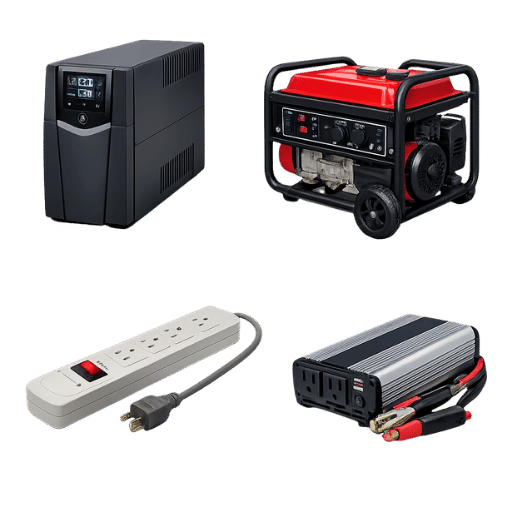
A UPS is often confused with three other pieces of power gear. The honest distinction is about how long and how fast each one acts, so think of them as layers rather than substitutes.
✔ What a UPS uniquely does
- Zero-to-millisecond switchover (no reboot)
- Conditions power (sags, surges, noise)
- Bridges seconds to minutes
⚠ What it is not
- Generator — runs for hours, but starts after the outage
- Surge protector — clamps spikes only, no backup power
- Inverter — converts DC to AC but lacks instant auto-transfer
A UPS isn’t a generator substitute. In real deployments the two work together: data-center operators report a UPS holds the load for only about 20 seconds before a diesel generator takes over, the UPS exists to cover the transfer gap, while the generator handles a sustained outage. The U.S. EPA’s ENERGY STAR guidance likewise frames UPS battery runtime as a bridge that lasts long enough for emergency generators to start. A surge protector, by contrast, only diverts voltage spikes and provides no runtime at all; a plain inverter changes DC to AC but won’t switch over automatically when the grid drop.
What a UPS Protects Against: The Power Disturbance Stack
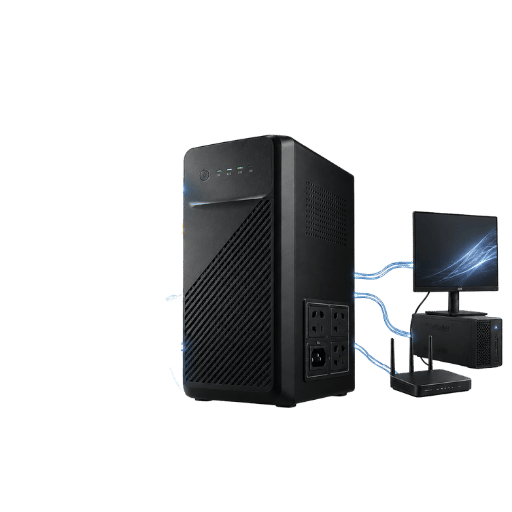
Most people buy a UPS for blackouts, but a blackout is only one of nine recognized power-quality problems a UPS can address, what we call the Power Disturbance Stack. The U.S. EPA’s ENERGY STAR program notes that UPS systems “clean up dirty power by correcting for power sags, surges and frequency distortions,” not just outages, power surges and spikes are clamped before they reach the load.
| Power problem | What happens | Best handled by |
|---|---|---|
| Blackout (outage) | Total loss of power | All three classes |
| Sag / brownout | Voltage dips below normal | VI, VFI |
| Surge / overvoltage | Voltage rises above normal | VI, VFI |
| Voltage spike / transient | Brief high-energy peak | VI, VFI |
| Undervoltage | Sustained low voltage | VI, VFI |
| Frequency variation | Hz drifts off nominal | VFI only |
| Switching transient | Fast spike from load switching | VFI only |
| Line noise (EMI/RFI) | Electrical interference on the line | VFI only |
| Harmonic distortion | Waveform distorted by nonlinear loads | VFI only |
Sources: Wikipedia (nine power problems); IEC 62040-3 (VFI solves 10, VI 5, VFD 3); IEEE Std 1100 “Emerald Book.”
This is why the IEEE 1100 “Emerald Book” exists, a recommended practice for powering and grounding sensitive electronic equipment and resolving exactly these power-quality concerns. The takeaway: if your problem is dirty power, not just outages, the topology you pick decides how many of these nine you actually solve.
How to Size and Choose a UPS: The VA-to-Watt Reality Check
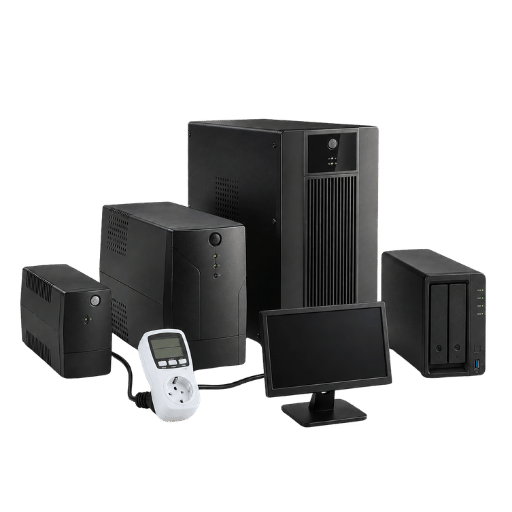
The single most common UPS buying mistake is reading the VA rating as if it were watts. They aren’t the same, and getting this wrong means you either overpay or under-protect. Run what we call the VA-to-Watt Reality Check before you buy.
📐 Engineering Note
Watts = VA × power factor. Volt-amperes (VA) is apparent power; watts is real power. Modern IT power supplies run a power factor around 0.9, but older PCs can be 0.6–0.75. Example: a 525 W load at 0.7 PF needs 750 VA; sizing that to run at ~75% of capacity points to a 1,000 VA unit.
Then resist the urge to oversize. This is the counter-intuitive part: a bigger UPS isn’t safer. ENERGY STAR data shows UPS efficiency “drops off when the load is less than 50% of UPS capacity, and drops substantially when below 30%,” because fixed (no-load) losses can exceed 40% of total losses. Schneider’s measured curves make it vivid: the same double-conversion unit that hits ~93% at full load can fall to ~89% at 30% load and ~82% once split across a redundant pair. The practical sweet spot is loading a UPS to roughly 50–80% of its rating, with about 20% headroom for growth.
How Long Does a UPS Battery Last?
Two different lifespans matter. Runtime, how long the UPS carries the load during an outage, is usually 5 to 15 minutes. Service life, how long before the battery must be replaced, is typically 3 to 5 years for VRLA and 8 to 10 years or more for lithium-ion. Seasoned operators keep VRLA on a fixed 3-year cycle and don’t trust the UPS self-test, since heat ages cells. IEEE 1188 sets replacement once capacity drops below 80%.
Where UPS Systems Are Used: PCs, Data Centers and Factory Floors
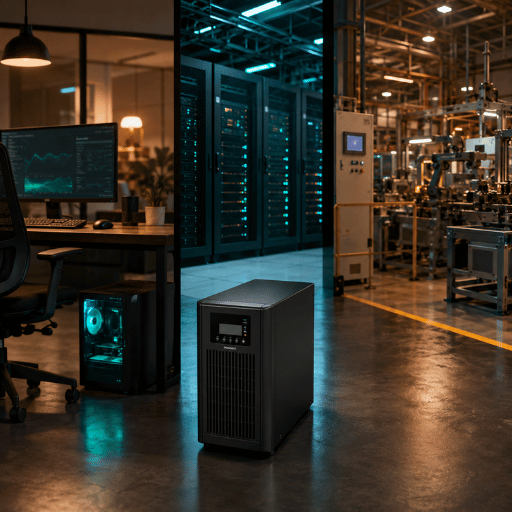
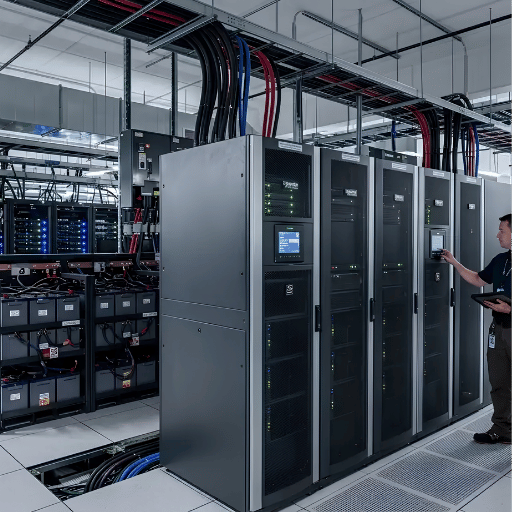
The same three-letter device scales from a desk to a megawatt hall, and the right class follows the load. A home PC needs only a small offline unit, a server room a line-interactive one, and a hyperscale data center a bank of online double-conversion modules. Match the topology to how critical and how large the load is.
- ✔Home PC / workstation — a 600–1,500 VA offline or line-interactive unit saves your work and rides out brief dips.
- ✔Network gear, servers, server rooms — line-interactive or small online units protect routers, NAS and on-prem servers.
- ✔Data centers — online double-conversion (VFI) up to ~1,000 kVA; the U.S. Department of Energy notes power distribution losses (including the UPS) average 10–12% of total data-center energy, so efficiency choices carry a real bill.
- ✔Industrial / factory floors — the loads that most need protection are the control electronics, not the motors.
That last point is where a machinery manufacturer’s perspective helps. On a plant floor running equipment like CNC and laser machines or plastic extrusion lines, it’s the CNC controllers, PLCs and servo drives, not the spindle or drive motors, that are sensitive to a millisecond power blip. A dropped controller can scrap a part mid-cut or lose a recipe; a UPS on the control circuit prevents that, while the heavy motor loads ride on the raw mains.
The Future of UPS: Lithium-Ion, Modular and the Data-Center Boom
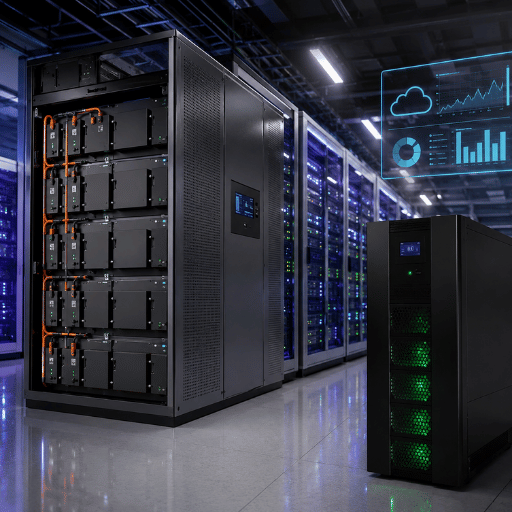
Three shifts are reshaping the UPS market through 2026 and beyond. First, scale: market researchers at GM Insights put the global UPS market at about USD 13 billion in 2025, growing at a 7.1% CAGR to 2035, with data-center demand the fastest-growing slice.
Second, chemistry. Lithium-ion is displacing VRLA lead-acid: peer-reviewed research (MIT, in Energy & Environmental Science) documents that lithium-ion costs have fallen roughly 97% since 1991, and analysts forecast lithium-ion rising toward 35% of the data-center battery market. Li-ion lasts about three times longer than VRLA and takes a fraction of the footprint, so its total cost of ownership now beats lead-acid despite a higher sticker price, reversing a decade-old rule of thumb. Third, architecture: modular, hot-swappable UPS designs are growing faster than the market overall, letting operators add capacity in increments as load grows.
What this means if you’re specifying a UPS in 2026: weigh lithium-ion against VRLA on lifecycle cost (not just purchase price), and consider modular units if your load will scale, especially for AI workloads, whose spiky power demand is now a primary driver of UPS energy-storage selection.
Frequently Asked Questions
What is the full form of UPS in electrical?
View Answer
What are the 4 components of a UPS?
View Answer
Is a UPS AC or DC?
View Answer
How long does a UPS battery last?
View Answer
What is the difference between a UPS and an inverter?
View Answer
Is “UPS” in computer the same as in electrical?
View Answer
Why We Wrote This
We build industrial machinery, plastic extruders, CNC laser systems, food and paper lines, whose control electronics depend on clean, uninterrupted power. This explainer compiles the UPS definition, IEC 62040-3 classification and sizing maths from public standards and U.S. government efficiency data so engineers can match a UPS to the right load. Reviewed by the Suzhou UDTECH Technology Co., Ltd. technical team.
References & Sources
- ENERGY STAR Key Product Criteria: Uninterruptible Power Supplies — U.S. Environmental Protection Agency
- Reduce Energy Losses from UPS Systems — ENERGY STAR / U.S. Department of Energy
- Purchasing Energy-Efficient Uninterruptible Power Supplies — U.S. DOE Federal Energy Management Program
- IEC 62040 (UPS safety & performance classification) — International Electrotechnical Commission
- IEEE Std 1100-2005 “Emerald Book” (Powering & Grounding Electronic Equipment) — IEEE
- IEEE 1188 (VRLA Battery Maintenance, Testing & Replacement) — IEEE
- Uninterruptible power supply — Wikipedia
- Re-examining rates of lithium-ion battery technology improvement and cost decline — Energy & Environmental Science (MIT, peer-reviewed)
- US Patent 6,201,319 B1: Modular Uninterruptible Power Supply — Google Patents
- Pick your UPS flavor — DataCenterDynamics