How to Choose a Cosmetic Cream Tube Manufacturer: Materials, Tubes and Sourcing
Updated June 2026
Selecting a cosmetic cream tube manufacturer is really three decisions stacked into one: which tube material protects your formula, which closure and decoration fit your brand, and which supplier can actually deliver both at your volume. This guide walks through the cosmetic tube as an engineered object – the wall, the shoulder, the cap – then turns those specs into a sourcing checklist you can hand to any tube manufacturer. We build the plastic extrusion lines that form tube stock, so the manufacturing notes here come from the production side, while the brand-facing sourcing facts are drawn from current standards and cosmetic industry data. Across the cosmetic and personal care sector, the tube is one of the most-used formats in beauty packaging, and the cosmetic tube industry now supplies cosmetic tubes for lotions, creams, serums, and gels in every format cosmetic brands need.
A cosmetic cream tube is a flexible squeeze tube – a heat-welded body, a molded shoulder and orifice, and a cap – used to dispense creams, lotions, serums, and gels, typically in 3-250 mL fills. Tube manufacturers build them in five main wall types (mono-PE, ABL, PBL, collapsible aluminum and PCR-content plastic), and the right choice is set by your formula’s oxygen sensitivity and your recyclability target, not by price alone.
Key Takeaways
- More barrier isn’t always better – over-specifying an aluminum-laminate tube can fail 2030 EU recyclability rules that a recyclable mono-PE tube passes.
- Recyclability is judged on the whole pack – a recyclable PE body can be disqualified by a non-PE cap, a metallized label, or a carbon-black dark color.
- Standard squeeze tubes draw air back after every squeeze (the suck-back effect); oxygen-sensitive actives often need an airless tube or a foil/EVOH barrier.
- For cosmetics, the relevant compliance is ISO 22716 (cosmetics GMP) and EU Regulation 1223/2009 – FDA “food-contact” 21 CFR rules are a material-safety reference, not a cosmetic mandate.
- High-SPF sunscreen is regulated as an OTC drug in the U.S., so its tube carries stricter stability and labeling expectations than an ordinary cream.
Quick Specs: Cosmetic Cream Tubes
| Diameters | Ø13–Ø60 mm (round, oval, flat-oval) |
| Fill volume | 3–250 mL |
| Wall types | Mono-PE, ABL, PBL (EVOH), collapsible aluminum, PCR plastic |
| Closures | Screw cap, flip-top, disc-top, airless pump, roller/brush applicator |
| Decoration | Offset + screen printing, hot stamping, labeling; matte/gloss/soft-touch |
| Compliance | ISO 22716 GMP; EU 1223/2009; EU PPWR 2025/40 recyclability |
What Is a Cosmetic Cream Tube? Parts and Anatomy
Because the tube is the cosmetic’s primary, product-contact packaging, its materials fall under cosmetic safety rules — in the US under FDA cosmetic authority, and in the EU under Regulation 1223/2009, which makes material choice a safety decision as much as a branding one for any cream tube you put on the market.
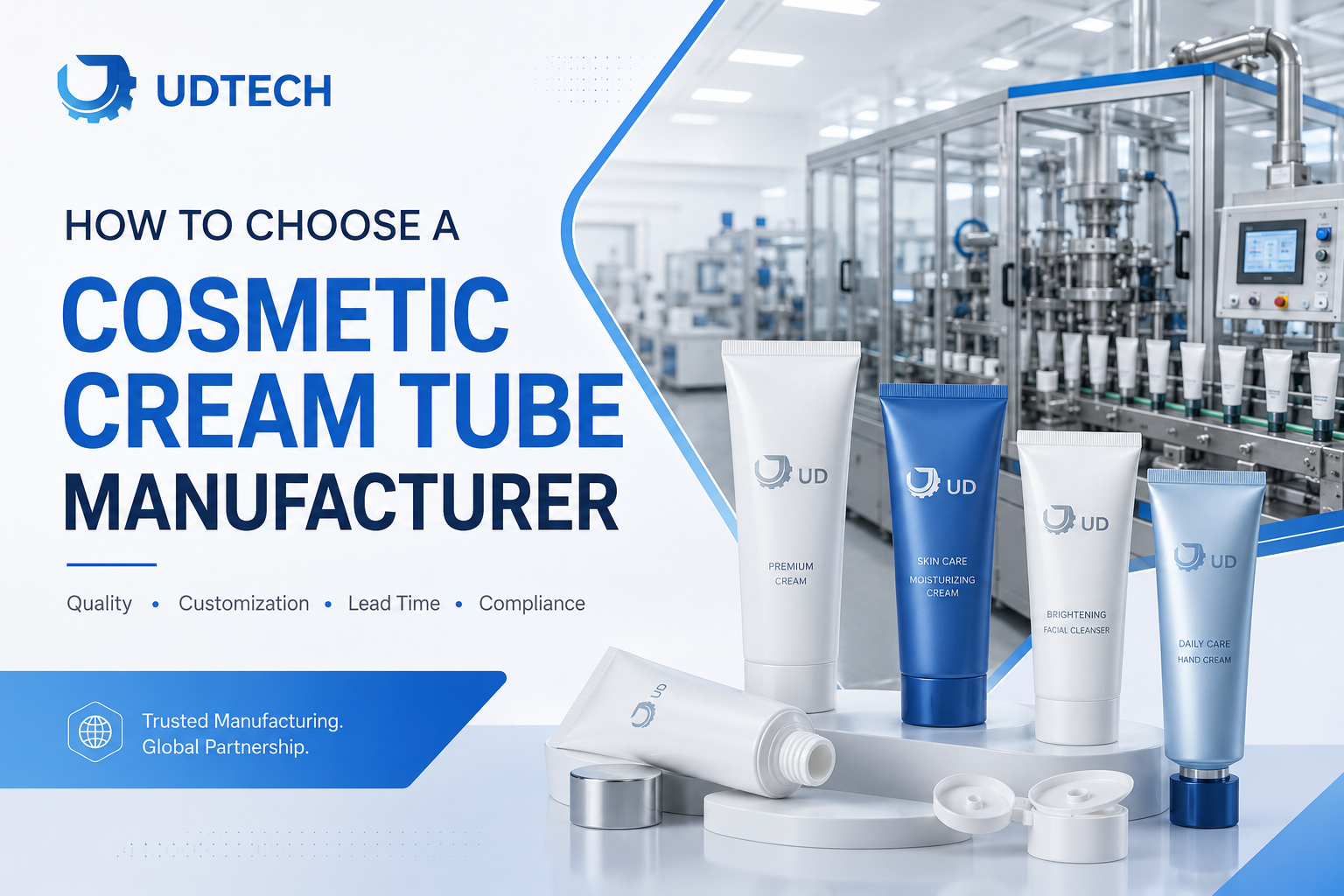
A cosmetic tube has four parts worth naming when you write a spec sheet: the body (the squeezable sleeve that holds the product), the shoulder (the molded cone that funnels product to the opening), the orifice (the dispensing hole, sized to the product’s viscosity), and the cap (screw, flip-top, or pump). On a laminate or extruded tube the body carries a side seam; on an aluminum tube the body is a smooth collapsible cylinder. Most are round cosmetic tubes, but oval and flat-oval bodies are common for shelf differentiation across skincare and personal care lines, and the same cosmetic packaging tube format scales from a 3mL sample to a 250 mL body wash.
What’s the difference between a cream tube and a squeeze tube?
There’s no real difference, a cream tube is a squeeze tube specified for thicker, creamy formulas. “Squeeze tube” names the dispensing mechanism: you squeeze the body and product exits the orifice, while “cream tube” names the contents. A cosmetic squeeze tube for creams simply uses a slightly larger orifice and a stiffer wall than a thin-lotion or lip gloss tube, because thick creams need more pressure to dispense cleanly.
The humble squeeze tube continues to thrive on shelves, an unlikely hero in the world of product dispensing, for a very pragmatic reason: light as a feather, shatterproof as stone, and designed for on-demand delivery. And all the while, it continues to provide unparalleled protection to its contents as they dwindle. These are just some of the reasons why tubes are and will likely continue to be the go-to primary packaging for a huge range of cosmetics and personal care products, spanning from eye treatments to full body lotions.
Cosmetic Cream Tube Materials: PE, ABL, PBL, Aluminum and PCR
How do cosmetic cream tubes protect against the elements? The answer can be found in their wall construction. A total of five main tube wall designs are employed, each differentiated primarily by their barrier performance against oxygen and light penetration. Choosing the right tube ultimately hinges on balancing strong barrier properties with improved recyclability-a compromise poised for radical transformation by 2026 with the rise of recyclable mono-material designs.
The 5-Layer Tube Wall Teardown
Let’s break down the constructions: Aluminium Barrier Laminate (ABL) wall Construction. An Aluminium Barrier Laminate (ABL) wall isn’t made of one single material, but rather a complex five-layer sandwich that includes a PE outer layer for printing, followed by a tie layer, the all-important thin aluminium foil barrier, another tie layer, and a final inner PE layer to be in direct contact with the product. ABL boasts impressive, nearly non-existent oxygen transmission, precisely because of the aluminium foil it contains; however, this also make it a significant recycling challenge as the embedded metal disqualifies it from plastic recycling streams. To address this, a Plastic Barrier Laminate (PBL) construction swaps the aluminium foil for a thin EVOH (ethylene vinyl alcohol) film, creating an all-plastic tube wall that can re-enter standard PE recycling programs-with a few caveats that will be explored.
| Material | Barrier | Recyclable? | Best for |
|---|---|---|---|
| Mono-PE (single-resin) | Low–moderate | Yes — recycles in PE stream | Water-based creams, lotions, body care |
| PBL (EVOH barrier) | High | Within RecyClass limits (see below) | Serums, actives needing oxygen defense + recyclability |
| ABL (aluminum foil) | Near-zero OTR (top) | No — mixed foil + plastic | Maximum protection where recyclability is not the priority |
| Collapsible aluminum | Very high | Yes — aluminum stream | Hand cream, ointments, premium minimal looks |
| PCR plastic (PE base) | Same as base PE | Yes — and uses recycled resin | Brands meeting recycled-content targets |
The diagram reflects current industry norms, with recyclability guided by the EU’s PPWR design-for-recycling standards.
What materials are commonly used for cosmetic cream tubes?
The most common cosmetic cream tube material is polyethylene (PE), used either as a single-resin mono-PE tube or as the carrier layer in a laminate. Aluminum and EVOH are added only when a formula needs a stronger oxygen or light barrier. A newer option is a SiOx glass-like coating that gives a recycled or mono-material plastic tube real barrier without any foil at all.
Recyclability isn’t measured wall deep but whole-pack deep. this is where some brand owners get their wires crossed: a PE tube is recyclable, but the finished product has other materials on it – a cap, a liner, etc., – that knock the tube out of the recycling system altogether, on top of an existing design-defective tube such as non-PE-material flip-top caps, metalized PE (Alu-foil laminations/Alu laminated plastics), carbon-black colors (which aren’t detected by NIR based recycling systems) and even NIR detectable barrier materials, where PE is recyclable provided this doesn’t exceed the values, plus the fact that, as previously statedEVOH (non PE, like PE) is deemed to be compatible with recycling as long as values are at acceptable limits, and together with PE-g-MAH to bind them; above acceptable levels, non-compatibly Materials are EVA, aluminum. As so you’ll discover that not all “PBL tubes” will come out green for the simple reason “not with my greenwashing”.
📐 Engineering Note
When requesting from a tube supplier that their tube be “recyclable”, ask for their RecyClass or APR letter for all components – tube body resin, cap resin, label/sleeve material and any ink or color. A mono material PE body with a PE flip top in light, NIR detectable color is your safest best for build for most creams.
“A recyclable PE tube body counts for little if the cap, label or decoration cannot pass through the same recycling stream, design for recycling is judged on the whole pack, not the wall alone.”
How Cosmetic Cream Tubes Are Manufactured
A cosmetic tube go through five processes of production and the quality-deciding process we know best on the machinery side is extrusion. It begins with making the body and adds up on it. Know about how cosmetic tubes are manufactured whether single- layer pe cosmetic tubes, ABL tube (an aluminum – plastic tube) or even others you can read a plastic tube quotation and judge if they’re actual manufacturer or only middlemen.
- Form the body. In one step, we make mono PE bodies by forming one long extrusion of PE tubing, cutting it, making multi-layer barrier bodies by co-extrusion creating EVOH and tie layers simultaneously, and laminate body tubes by converting PE and tie layers (PE/EVOH/PE for PBL, PE/foil/PE for ABL). It happens here on our extrusion and co-extrusion lines; the layer structure is set as wall thickness as the tubing reach a brand.
- Cut to length: Extruded sleeve cut to body length for target fill.
- Form mold and weld the head. The shoulder, orifice of this head is injection-formed and welded with the head to which forms another typical leak source when it’s misaligned.
- Decorate. The printing technique used is offset and screen printing or hot stamping or labels with finishes from matte to high gloss.
- Final caps. Final caps applied to the tube, that then passes through the leak detection and dispense & imprint test process prior to boxing up.
Since body is being extruded the most of the tube’s barrier performance, its wall feel, the and recyclability are determined by both resin and the machine line setup of the first step. seldom is the brand customer seeing step, but this is where our customers ask audit questions such as what resins, how many co-extruded layers and their wall tolerance. Our company work in the area of plastic extrusion equipment and multi-layer extrusion machines, not on finished cream tubes that are supplied by the cosmetic tube manufacturers downstream.
Knowing how cosmetic tubes are made, single-layer or multi-layer tubes, also helps a brand compare any plastic tube packaging quote and recycle empty cosmetic tubes correctly afterwards.
Matching Tube Material to Your Cream Formula
Material choice is also a compliance choice: a high-SPF sunscreen, for example, is regulated as an over-the-counter drug by the US FDA, not as a cosmetic, which raises the bar on its tube.
The quickest way to overspend on a cosmetic pump tube is to purchase way too much barrier for a formula in which very little is needed. The fastest way to over-spend on a launch is to buy way too little. First, select a tube just right for your formula sensitivity, then take action to address recyclability and pricing.
The Suckback Penalty
All standard squeeze tubes have an insidious hidden extra-cost: suckback. When you stop squeezing a squeeze tube, the wall rebounds and sucks a dose of air (and oxygen) back into the tube through the orifice. This is no threat to water-based hydrating CRMs, or emulsion-based hair conditioners. But if your active ingredients are located in a formula that’s susceptible to oxidation (so most water- and oil-soluble actives, like retinol, vitamin C, many peptides), then each dose of oxygen through the rough transition of the orifice during use may be enough to degrade a typical 20-gram tube for the entire in-use life of the formula (five years or so). This is the reason formulations with oxygen-sensitive actives are dispensed in airless tubes with a one-way valve – which also diminish the amount of cream left in the bottom of the tube).
| Formula type | Sensitivity | Recommended tube |
|---|---|---|
| Water-based cream / body lotion | Low | Mono-PE (recyclable, lowest cost) |
| Retinol / vitamin C / peptide serum | High (oxidation) | PBL (EVOH) or airless mono-PE tube |
| High-SPF sunscreen (US: OTC drug) | High (stability + regulatory) | ABL or aluminum; OTC drug GMP applies |
| Essential-oil / fragrance-heavy | Medium (permeation) | PBL or ABL; verify ESCR compatibility |
| Anhydrous balm / ointment | Low–medium | Collapsible aluminum or mono-PE |
Can I use a PE tube for a retinol or vitamin C serum?
You can, but a plain mono-PE tube is usually the wrong call for these actives. PE alone offers limited oxygen barrier, and combined with suckback it lets in enough oxygen to shorten the shelf life of retinol or vitamin C. The recyclable fix is a PBL (EVOH) tube or a mono-PE airless tube; the maximum-protection fix is ABL. Always run a formula compatibility test first.
What tube material is compatible with high-SPF sunscreen formulas?
High-SPF sunscreen needs a strong barrier, typically ABL or aluminum, because UV filters degrade with light and oxygen and the formula must hold its rated SPF through shelf life. There is a regulatory layer too: in the US, sunscreen is regulated as an over-the-counter drug, so confirm your manufacturer can meet drug-side stability and labeling rules, not just cosmetic ones.
Closures, Dispensing and Decoration
A tube with a screw cap suits a thick hand cream, so choose the tube for cosmetics, the right tube for cosmetic creams, by how the product will be used.
The tube and the print do as much for sales as the tube body. Closure decision changes the way the product flows from the pump, while decoration affects the manner in which it’s grabbed. Both should be specified separately from the tube wall, and both influence recyclability. Closure design also influences the user experience: a tube-typical pump cosmetic tube precisely measures each dose, but a screw-capped tube is better suited for tough hand creams. Choose the tube that corresponds to the use pattern of your formulation.
| Closure | Dispensing | Best for |
|---|---|---|
| Screw cap | Classic, secure seal | Hand cream, sunscreen, travel sizes |
| Flip-top | One-hand, leak-resistant | Facial cleanser, body lotion, masks |
| Disc-top | Controlled small dose | Gels, thinner creams |
| Airless pump tube | Metered, no air ingress | Serums, BB cream, sensitive actives |
| Roller / brush applicator | Targeted application | Eye cream, treatments |
How do airless pump tubes benefit cosmetic products?
Airless pump tubes protect the formula and cut waste. By dispensing through a one-way valve, they stop air being drawn back into the tube, which preserves oxygen-sensitive actives and limits contamination, and they evacuate nearly all of the product. The historic downside was recyclability, but newer mono-material PE airless tubes are built so the whole unit, pump included, recycles in a PE stream.
On decoration the usual treatments are offset/screen printing for tight graphics; hot stamping for metallic finishes; and pressure sensitive or shrink labels.The premium is established through finish (matte; high gloss or soft-touch).A Caveat to one element carries over from tube wall type: the heavy metallic inks; fully metalized sleeves and some dark colored inks can compromise recycling ratings so match your decoration to your target end-of-life status rather than thinking of this as an add-on late in the process.Many tube makers can now add batch/date coding via an ink-less plastic laser process.
| Product | Tube type | Typical closure | Typical size |
|---|---|---|---|
| Eye cream | PE / PBL | Roller / massage applicator | 10–20 mL |
| Serum (actives) | PBL / airless PE | Airless pump | 15–50 mL |
| Hand cream | Mono-PE / aluminum | Screw cap | 10–75 mL |
| Facial cream | PE / PBL | Flip-top / pump | 30–60 mL |
| BB cream | PE / aluminum | Pump / nozzle | 15–30 mL |
| Foundation | PBL / airless | Pump head | 20–30 mL |
| Sunscreen (OTC) | ABL / aluminum | Narrow screw cap | 30–60 mL |
| Body lotion | Mono-PE / PCR | Flip-top | 100–250 mL |
| Facial cleanser | Mono-PE | Flip / screw cap | 100–150 mL |
| Gel / mask | PE / PBL | Flip / screw cap | 30–150 mL |
Cream Tube Sizes, Diameters and Fill Volumes
Fill volume and fill consistency are verified under the cosmetics good-manufacturing-practice standard ISO 22716, so confirm a manufacturer’s fill tolerance alongside the tube size.
While diameter and length work together to determine tube size; diameter is where you start since it determines both capacity and shelf presence.The below formula is consistent across industry tube charts so you know diameter as soon as you’ve a target capacity and without even ordering a sample.
| Diameter | Typical fill | Typical product |
|---|---|---|
| Ø13 mm | 3–5 mL | Eye cream, samples |
| Ø16 mm | 5–7.5 mL (0.25 oz) | Eye cream, lip treatment |
| Ø19 mm | 10–15 mL (0.5 oz) | Eye cream, trial serum |
| Ø22 mm | 15–20 mL | Serum, eye cream |
| Ø25 mm | 20–30 mL (1 oz) | Serum, hand cream |
| Ø30 mm | 30–90 mL | Facial cream, BB cream |
| Ø35 mm | 40–120 mL (2 oz+) | Cleanser, sunscreen, lotion |
| Ø40 mm | 100–150 mL | Body lotion, cleanser |
| Ø45 mm | 120–200 mL | Body lotion, shampoo |
| Ø50 mm | 150–250 mL | Body lotion, masks |
There are two critical details to address with any tube maker after diameter;fill ratio (usually ~80-90% to allow space for the cap folds and air);and tube wall thickness which influences squeeze and dead-fold(the amount the tube stays open after it’s flattened).Note that diameters carry manufacturing tolerances and so if you need a tight-tolerance diameter, ask to get that information in writing.
How to Choose a Cosmetic Cream Tube Manufacturer
When sourcing cosmetic tubes, treat a professional cosmetic packaging manufacturer as a partner, not a vendor: a genuine cosmetic tube packaging supplier offers custom cosmetic packaging and tubes wholesale, supports premium cosmetic tubes and custom packaging, and helps brands seeking to differentiate their products plan their next product launch around the right tube.
Once material, closure, and size are locked, qualifying an OEM is as simple as screening them on the following five points. Any OEM/ODM provider of any of the tubes outlined below – custom luxury tube designs, plain wholesale plastic tubes and everything in between – should also demonstrate sufficient capacity as a cosmetic tube manufacturing partner and not just be a reseller of others’ ware.To successfully purchase plastic tubes, you’ve to match OEM capability with your cosmetic packaging brief.
The 5-Gate Cream Tube Supplier Audit
- Capability. Can they provide the full spectrum: PEs (mono, PBL, ABL),aluminum tubes,PCR resins and airless dispensers all from a single plant?A manufacturer locked to a particular wall type will steer you towards what they offer, and not what your cosmetic cream tube is formulated to need.You’ll recognize an experienced Cosmetic Cream Tube Manufacturer such as BoYu Packaging because it posts detailed specifications for its PE tube and laminate tube lines.
- Compliance. Require the cosmetic GMP certificate (known in cosmetics circles as iso 22716), and obtain documentation for cosmetic-grade resin if the tube cap or tip may touch the consumer’s lips; and ensure that there’s drugside stability documentation.
- Quality Assurance. Verify leak, drop and dispensing protocols and proof of print/adhesion tests; also request proof of ESCR (product/packaging interaction/compatibility) testing.
- In-House Decoration and Tooling. Producing in-house offset/screen printing, hot stamping,and labelling capabilities stream lines process and tightens quality control; lead time will be shortened compared to outsourcing those steps.
- MOQ/Lead time and Sampling.ConfirmMinimum Order Quantity, sampling timetable andbulk production lead time upfront, and verify a plastic tube recycling letter for the intended closure and decorating package.
What is the MOQ for custom cosmetic cream tubes?
Minimum order quantities for custom cosmetic tubes typically run from a few hundred units for stock aluminum tubes to around 10,000 for fully custom plastic tubes with bespoke tooling. Per-unit cost declines sharply with volume: industry estimates run from roughly 50 cents for a plain tube to over $5 for a fully custom one, driven by material, decoration and tooling. Always request pricing at two or three order sizes to see the curve.
How can B2B buyers verify supplier quality control?
Verify quality control with documents, not promises. Ask for the supplier’s ISO 22716 certificate, a recent third-party audit or test report, and sample units you can stress-test with your own formula, watching for cracking, leaking or color migration over a few weeks. A credible manufacturer also provides a compatibility test protocol and a recyclability assessment for your exact tube build.
Industry Outlook: Recyclability Rules Are Reshaping Cream Tube Sourcing
The shift is also a technology story: barrier coatings such as the SiOx process in patent EP2712821A1 let recyclable mono-material tubes reach barrier levels once reserved for aluminum foil.
A recyclable mono-PE tube is a sustainable packaging solution that doubles as a sustainable tube story for beauty products: eco-friendly packaging and eco-friendly cosmetic formats help beauty and personal care brands appeal to environmentally conscious consumers, and across the beauty and personal care market, eco-friendly beauty and personal care products increasingly lead with it.
In 2026 the main force on the plastic cream tubes and plastic packaging development is regulations, changing the game about who’s acceptable to work with. According to EU Packaging and Packaging Waste Regulation (Regulation (EU) 2025/40), all Packaging must be designed to enable recycling. From 2030, a tube must conform to “design for recycling” standards to enter the EU market. This regulation set out how EU Member States must implement packaging waste reduction, recycling rate improvements and re-usability goals.
A packaging that isn’t “designed for recycling”, from an eu retailerperspective become non-compliance with EUPackaging and packaging waste regulation (PPWR); what seemed like the lowest price, un-recyclable plastic can be the highest future retooling and sourcing cost for many brands. To meet EU directives the plastics tube supply landscape is rapidly turning towards Mono-material PE tubes, PCR content tubes, ABL to PBL shifts where a mono material is accepted within RECYCLABS parameters and many SiOx barrier options – The RE recyclability requirements and 2025/40 EU Regulation requirements of all cosmetic product containers are a key drivers to change the existing plastic cosmetic tubestockand are therefore an unavoidable consideration.Mono-PE airless tubesthatcanbe recycled as a full unit-pump included- have gone from novel item to the normal standard.For a product that was manufactured within 2026 for use and distribution within the EU a design for recycling statementfrom the tube supplier shouldbe requested and form part of all new orders.
A sustainable cream tube with an eco friendly design for you cosmetic product; A recyclable mono-PE tube can function as not just as a solution, not only in a sustainable context for your brand’s packaging, but also serves as a product marketing high light. Recyclable tubes made with PCR material or Mono materials serve to lift, differentiate your brand, attract ethically sourced cosmetics buyers and the Eco conscious consumers of the beauty market and cosmetics sector in 2026.Many Beauty & PersonalCareProducts already use Mono-PE tubing and take pride in communicating it.
Experts project growth for the cosmetic tube packaging market – they place it in the multi-billion dollar range and expect it to grow at a mid- to high-single digit percentage rate over the coming decade – but if you make this decision solely based on market size, you should actually consider the 2030 recyclability mandate.
Frequently Asked Questions
Q: Are cosmetic cream tubes recyclable?
View Answer
Q: What’s the difference between ABL and PBL tubes?
View Answer
Q: How much do custom cosmetic cream tubes cost?
View Answer
Q: Why does my cream tube get hard to squeeze over time?
View Answer
Q: Can cream tubes be made with PCR plastic?
View Answer
Q: What is the typical lead time for custom cream tubes?
View Answer
Q: What tube diameter should I choose for my cream?
View Answer
Whether you are sourcing finished cream tubes or the plastic extrusion and co-extrusion machinery that forms them, the right starting point is always a clear specification: material, barrier level, closure, fill size and recyclability target. Bring those five decisions to the conversation and the rest of the tube build follows naturally from there.
Our Perspective on Cosmetic Tube Sourcing
UDTECH manufactures the plastic extrusion and multi-layer co-extrusion lines which are used for producing the PE body and barrier webs cosmetic tubes are made of, thus, we’re very familiar with this part of manufacturing. As we’re not a cream tube manufacturer, the sourcing, MOQ and compliance information stated in this post is extracted based on present information available at EU and FDA regulatory bodies and market data – be aware of fact-check the tube specifications for the formula in specific projects for cosmetic formulators. By Technical Department of Suzhou UDTECH Technology Co., Ltd..
References & Sources
- Packaging and Packaging Waste Regulation (PPWR)European Commission
- Regulation (EU) 2025/40 on packaging and packaging wasteEUR-Lex
- Regulation (EC) No 1223/2009 on cosmetic productsEuropean Commission (Health)
- FDA Authority Over CosmeticsU.S. Food & Drug Administration
- 21 CFR Part 174, Indirect Food Additives: GeneraleCFR (material-safety reference)
- Sunscreen: How to Help Protect Your SkinU.S. FDA (sunscreen as OTC drug)
- RecyClass Design for RecyclingRecyClass
- Patent EP2712821A1, SiOx coating of containersGoogle Patents
- ISO 22716:2007 Cosmetics, Good Manufacturing PracticesISO