![What Is Recycling? Definition, Process, Types & Benefits [2026 Guide]](https://ud-machine.com/wp-content/uploads/2026/04/0-2.webp)
What is recycling?
Simply put, recycling is the process of collecting waste materials, breaking them down into a raw feedstock, then remanufacturing that feedstock into new products — instead of burying or incinerating them. While the common image is dumping empty bottles into a recycling bin, “real” recycling happens across an intensive chain of industrial facilities where sorting, cleaning, and plastic extrusion turn waste streams into usable recycled material. This overview covers the definition, the five-stage process, the main types, the quantifiable benefits, the role recycling plays in saving natural resources, and the pellet-quality truth that determines whether recycled plastic becomes a product or ends up as trash.
Recycling at a Glance
| U.S. MSW recycling rate (2018) | 32.1% — 94 million tons recycled or composted |
| Global plastic mechanical recycling | ~9% (OECD Global Plastics Outlook) |
| U.S. recycling industry jobs | 681,000 jobs — $37.8B wages, $5.5B tax (EPA REI 2020) |
| Recycled plastics market growth | $86.11B (2025) → $190.25B (2035) |
| Biggest friction point | Contamination — food residue can spoil an entire load |
What Is Recycling? Definition and Core Principles

According to the U.S. Environmental Protection Agency, recycling is “the method of collecting and processing materials that would otherwise be considered waste and turning them into new products.” In reality, recycling is only one component of the waste hierarchy, which ranks disposal strategies from most to least preferred:
| Level | Strategy | Example |
|---|---|---|
| 1 (best) | Source Reduction & Reuse | Refillable containers, lightweight packaging |
| 2 | Recycling & Composting | PET bottles, aluminum cans, cardboard, food waste |
| 3 | Energy Recovery | Waste-to-energy incineration with flue-gas treatment |
| 4 | Treatment & Disposal | Sanitary landfill with leachate control |
| 5 (worst) | Open Dumping | Unmanaged landfill (still dominant in many regions) |
Recycling vs. Reuse vs. Upcycling: What’s the Difference?
Re-use maintains an item unchanged, a glass bottle refilled, a functioning chair donated. No material change. Recycling reduces an item back to raw material, the bottle to cullet which can then be remelted into a new bottle or fiberglass.
Upcycling transforms waste into something with a greater perceived value, reconditioned pallet into furniture. All three activity types prevent waste, recycling is the only option to bring material back to its commodity state for industrial use on a mass scale.
How Does the Recycling Process Work? From Collection to New Products
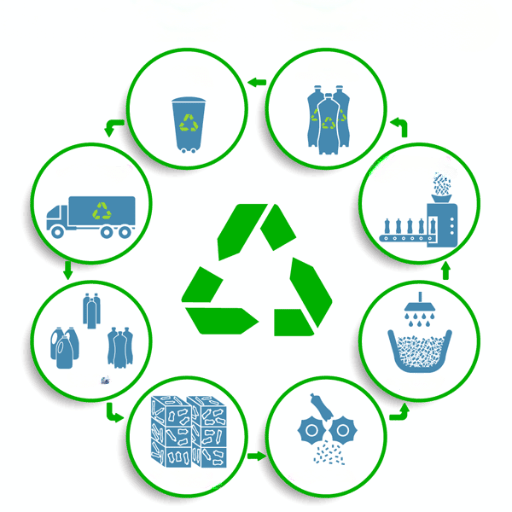
The lifecycle of recycling involves 5 stages; each one adds a cost and can either maintain or eliminate the prior value.
- Collection – presents recyclables. They can be collected via curbside bins, drop-off centers, or the use of commercial haulers. Single-stream collection is the most popular method in North America,although costs less for a resident, it results in a more contaminated input stream than source-separated collections.
- Sorting. At a material recovery facility (MRF), paper, glass, metals and plastic resin types are segregated using a combination of mechanical conveyors, optical scanners, magnets, eddy currents and Human sorters. The contamination rejected here is still a cost – it has to go down the line before it is removed.
- Handling. The sorted streams are baled, shredded, washed and (plastics) dried and ground down to flake or regrind. This is where the physical contaminants are removed and chemistry is introduced.
- Manufacturing. Feedstock was transported to a blank production line. Paper was converted into pulp then produced into new paper.Glass was converted into cullet then new bottles. Plastic flake was fed into an extruder in order to produce useful parts.
- Market – recycled content must be competitive (price, quality and consistency) with virgin material. Weak markets are the deadliest threat to any effort to make recycling programs financially viable – if consumers of recovered materials are not created, then collection is just a disposal service.
Does Recycling Actually Get Recycled?
Sort of. In the U.S. in 2018 32.1% of all municipal solid waste was recycled or composted, with paper and cardboard reaching 68.2%, but plastics just 8.7%. The bin and bale are different: contamination, wish-cycling, collapsing export markets following China’s ban on imports in 2018 mean some collected recyclables do go to the landfi.
You can be pretty damn sure that: your cardboard is being recycled that your aluminum can has been recycled that your ‘#7 Other’ plastic tray was almost never recycled
How Sorting Determines What Gets Recycled
Current MRFs operate at about 245 tpd on 65,400 ft 2 of processing area, with an average still needing the service of 27 human sorters, despite heavy automation. Near-infrared optical scanners recognize resin; ballistic separators separate rigid from flexible; magnetic/eddy-current systems drive aluminum into its own stream. One greasy pizza box or a bagged load of clean recyclables (plastic bags clog conveyors) will derate throughput more than a human error.
Clean and dry before recycling. One minute rinse – not a dishwasher cycle – removes 90% of the contamination potential. Keep caps on bottles – supermarket MRFs peel labels and separate caps, so leaving caps on keeps bottle from being blown off the sorting line by an air jet.
Types of Recycling: Mechanical, Chemical, and Energy Recovery
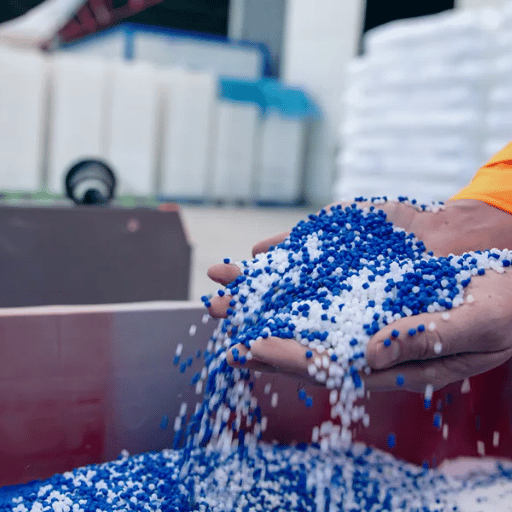
There is no single solution to recycling. There are three families of processes, intended to treat different classes of material, each having its own economics and the quality of product it produces. What a particular process is suitable for will depend on what we actually throw away, not simply what we think we’ve thrown away..
| Method | Input | Output | Scale Status |
|---|---|---|---|
| Mechanical | Single-polymer flakes (PET, HDPE, PP, PE film) | Pellets / flakes for re-extrusion | Commercially mature |
| Chemical | Mixed/contaminated carbon-based waste | Monomers, naphtha, syngas | Mostly pilot / demonstration scale (RSC Publishing) |
| Energy Recovery | Non-recyclable combustibles | Electricity, district heat | Commercial, controversial near population centers |
Which Recycling Method Fits Your Material?
- Single-polymer, low-contamination flakes. Mechanical via extrusion. The workhorse of plastic extrusion machinery, this is the cheapest route when the input is pure.
- Mixed polymers, multilayer film, or badly contaminated feedstock Chemical (pyrolysis, depolymerization) -broadly speaking still in embryonic development, largely pilot at this stage.
- Neither of the above, but combustible. Energy recovery with strict flue-gas scrubbing.
- All of the above have leachate control in the landfill and are the least-worse choice.
What Materials Can Be Recycled? A Complete Recyclability Guide
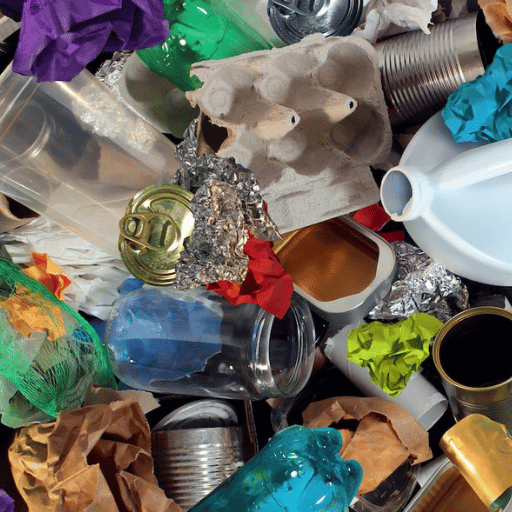
Chasing-arrows symbol only indicates that the material is a particular resin or that the packing could be, in theory, be recycled in a system (to answer the ‘yes’ you are now asking!) that takes it. Whether they do, or not, is a different matter.
| Resin Code | Material | Common Items | Recyclability |
|---|---|---|---|
| #1 | PET plastic material | Beverage bottles, food trays | Widely recycled (29.1% rate) |
| #2 | HDPE | Milk jugs, detergent bottles | Widely recycled (29.3% rate) |
| #3 | PVC | Pipes, blister packs | Rarely curbside, specialty |
| #4 | Polyethylene (LDPE) | Films, bags, squeeze bottles | Store drop-off only |
| #5 | PP | Yogurt cups, caps, straws | Growing acceptance |
| #6 | PS | Foam cups, clamshells | Rarely recycled |
| #7 | Other (PC, PLA, multilayer) | Bioplastics, baby bottles | Almost never curbside |
Other streams of materials – paper and cardboard, glass, aluminum and steel cans, scrap metals, and organics each follow different rules of processing. Aluminum cans are the greatest success story, capable of endless recycling at present estimated with a 95% saving in energy over the need to produce the original virgin smelting.
What Is the Hardest Thing to Recycle?
Multi-layer flexible packs – such as crisps (potato chip) packets combining polyesters, aluminum and polyethylene – other multi-layer composite e.g. single-use coffee capsules, are the second most difficult. They cannot be economically separated and thus mechanical recycling is not an option and chemical recycling is prohibitively expensive over large volumes. Discarded electronics are also highly problematic: reclaimable metals are embedded within fusion-welded plastics housings which must be disassembled, a process which cannot be commercial without subsidy.
What Can and Cannot Be Recycled?
- Yes, curbside in the majority of U.S. programs, PET #1 & HDPE #2 plastics, aluminum & steel tins, clean paper, cardboard, glass bottles & jars.
- Sometimes—check locally: Polypropylene #5 tubs, paperboard cartons, aerosol cans, mixed paper with contact food residue.
- No, contaminate the stream: plastic bags and film (use store drop-off), greasy pizza boxes, Styrofoam, shredded paper, small bits under 3 inches, anything liquid.
Environmental and Economic Benefits of Recycling
The benefits of recycling are measurable, and the figures are less intangible than the conversations about them might lead you to believe. Recycling an aluminum can preserves 95% of the energy necessary to process new aluminum from bauxite ore. Recycling a PET bottle saves approximately 1.5 pounds of CO2 equivalent compared to using new resin. These are not projections—they are baseline numbers that are used in every life cycle assessment.
“A circular economy is one where products and materials are kept in circulation through processes like maintenance, reuse, refurbishment, remanufacture, recycling, and composting.”
— Dame Ellen MacArthur, Founder, Ellen MacArthur Foundation (Global Commitment 2024)
✔ Advantages
- Reduces landfill volume and methane emissions
- Conserves virgin raw materials and mining impacts
- Creates domestic industrial jobs with stable margins
- Reduces energy use per unit of finished material
⚠ Limitations
- Market prices swing with virgin resin costs
- Contamination can destroy an entire batch
- Transport emissions can offset gains on long-distance export
- Some plastics degrade with each cycle—mixed recycling requires a clear understanding of what materials are being recycled and how the polymers will impact each other.
Plastic Recycling: Why Pellet Quality Decides Everything
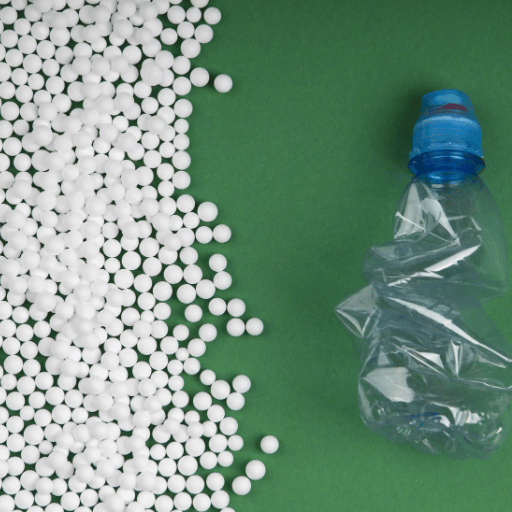
Only about 9% of the plastic ever produced has been mechanically recycled, according to the OECD Global Plastics Outlook. That statistic is the most-cited issue in the recycling discussion, and most explanations attribute it to “contamination” or “too many resins.” Both are true, but they overlook the operational bottleneck: pellet quality. Shredded, washed flake only becomes a product when it exits a recycled plastic extruder as a perfect pellet. If the pellet fails three quality gates, downstream converters reject the load and the recyclate is sent to landfill—even if the collection side was pristine.
📐 Engineering Note — The MFI-Gel-Moisture Triangle
Three numbers accompany every prototype rPellet. If any one of them fails, the entire load is rejected no matter what kind of polymer it is.
- Melt Flow Index (MFI): batch-to-batch variation less than 15%. Typical LDPE film-grade target range 4-8 g/10 min at 190C / 2.16 kg.
- Gel count: below 5 gels per kilogram for film-grade, below 20 per kilogram for injection-grade. Gels are unmelted polymer or phenolic cross-linked polymer fragments that appear as visible specks in thin films.
- Residual moisture: below 200 ppm (0.02%) for polyolefins; below 50 ppm for PET. Beyond 200 ppm, silver streaks form on LDPE film just one hour into extrusion.
Why recycling plastics is more challenging than recycling aluminum relative to chemistry. Aluminum melts into a clean metal of the same grade indefinitely. Plastics degrade with each thermal cycle: polymer chains shift, additive content drops, and color-platform paper additive shifts build up. After three to five cycles of mechanical processing, most polyolefins must be blended with virgin resin or downcycled into a lower-value product. A serial twin-screw extruder with proper melt filtration and venting minimizes this effect; running hot and fast on a single-screw line accelerates it.
And there is a market-structure problem. Virgin resin pricing is tied to crude, which fluctuates independently of collection and processing costs. When the oil price drops, virgin price undercuts recyclate by 20-40%, converters switch back to virgin, and recyclers sit on inventory they can’t move. Regulatory program like the EU and U.S. 30% post-consumer recycled content mandates by 2025 are designed to bust that cycle they are forcing demand to exist even when spot economics tell you it does not. That same systemic pressure is part of what is driving the squeezing of quality expectations for PVC and other engineering grade recycled streams, where downstream OEMs will not accept pellets that fail MFI or gel specs.
From Flakes to Pellets: How Recycled Plastic Extrusion Works
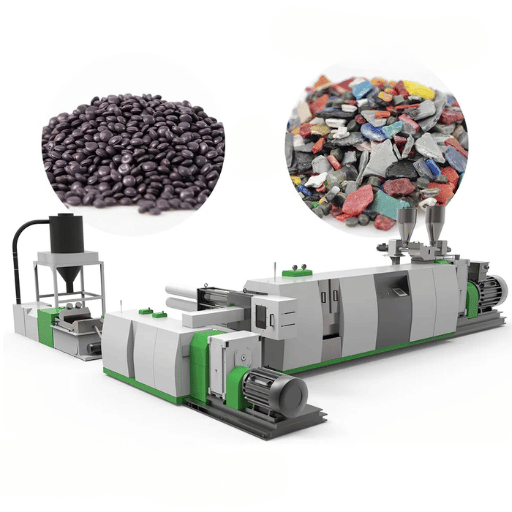
Once sorted and shredded into flake, post-consumer plastic enters a recycling extrusion line. The chain is short in description and long in engineering detail: feeder extruder melt filter degassing die pelletizer. But four choices along that chain determine whether the pellet hits the MFI-Gel-Moisture specs from the last section.
| Decision | Typical Range | What It Controls |
|---|---|---|
| Screw L/D ratio | 36:1 – 44:1 standard; 48:1 – 60:1 for heavy degassing | Residence time, melt homogeneity, volatile removal |
| Degassing vacuum | -0.08 to -0.095 MPa | Moisture, volatile organics, residual ink solvents |
| Melt filtration mesh | 80–120 mesh (post-consumer); 40–60 mesh (post-industrial) | Gel count, fiber and dust removal |
| Pelletizing method | Strand, water-ring, or underwater pelletizing system | Pellet shape uniformity, moisture carry-over |
A U.S. Transportation Research Board study, NCHRP Report 696 Appendix B, shows that post-consumer HDPE needs 120 mesh melt filtration in order to hit break-strain specs for extruded product. That’s the single most under-specified step in a budget recycling system – a coarser 40-60 mesh filter permits fibers and burnt polymer, often including gel particles, to pass and fails downstream. Typical throughput is anywhere from 100 to 2,000 kg/h depending on screw diameter and feedstock specific gravity.
Single-Screw vs. Twin-Screw: Which Extruder Fits Your Feedstock?
Sifting the feedstock when choosing a single screw extruder versus a twin-screw extruder really is next off the engineering chart – and what you see there depends heavily on the feedstock, coming out of the washer.
- Opt for a single-screw line when the feedstock is pre-cleaned, single-polymer post-industrial regrind. Lower upfront capex, simpler process control, better efficiency per unit of electricity for re-melt.
- Opt for a twin-screw line when the feedstock is post-consumer, mixed, requires compounding with additives, fillers, or masterbatches. Co-rotating twin screws are better at better compound melt mixing and conveying in low-bulk flake and more modular degassing zones. If you do not see cellulose on that bag of salad, this is where on the engineering chart a dedicated plastic compounding machine resides.
Industry engineers point out the most common factor in rPellet quality failures is mismatch rather than equipment failure. Running a contamitized post-consumer stream through a single-screw line designed for clean industrial regrind, or running a clean post-industrial stream through an oversize twin-screw compounder that consumes 30% more electricity than what was needed.
Recycling Industry Trends and Outlook (2025–2026)

Three forces are radically changing the face of the recycling industry over the next 18 months.
Demand is being legislated into being. EU laws deliver binding post-consumer recycled content targets for plastic packaging. Leading US CPG brands have pledged toward 30% PCR by 2025 through voluntary publisher commitments being tracked by the Ellen MacArthur Foundation. That means recyclate demand no longer has to sit around waiting for virgin resin price cycles – there are deadlines to meet, and that pulls pellet quality expectations along for the ride.
Next, the capacity isn’t keeping pace. Based on the reports from the Plastics Recycling Association,North America has around 2 billion pounds of surplus plastics recycling capacity available in 2025. That means new extrusion, wash, and pelletizing lines are kicking off at a pace not seen since the 2000s- and many new operators are coming from adjacent industries with less expansion-experience in extrusion processes.
Third, innovations in sorting via AI and chemical recycling are scaling- without balance. Optical near-infrared sorters with machine-learning classifiers are providing significant purity benefit in MRFs. Chemical processes, such as pyrolysis recovery of mixed polyolefins, has seen announcements of new capacity completion- though it is accelerating, most operating units remain pilot-scale, according to the Royal Society of Chemistry’s recent review.
What should you buy in 2026 if you’re taking equipment home? Focus on degassing capacity and finer melt filtration, because your downstream customers will test gel count and MFI r-squared. Inexpensive screws without adequate L/D will perform poorly on the PCR contracts – only part of the market we’ve seen expanding.
Frequently Asked Questions
Q: What is recycling in short answer?
View Answer
Q: What are 10 benefits of recycling?
View Answer
Q: Should recycling be mandatory?
View Answer
Q: Does recycling actually help the environment?
View Answer
Q: What are the challenges of recycling?
View Answer
Q: Why did China stop accepting recycling?
View Answer
Q: How much recycling actually gets recycled?
View Answer
Planning a Recycling Extrusion Line?
UDTECH has designed, sourced, and implemented polymer extrusion and compounding systems for reuse and recycled plastics for clients in more than 100 countries in 15 years of operation. Whatever your recycler appearance is, UDOTED can specialize the proper screw profile, venting design, and pelletizing solution.
Request a Custom Quote →
View Recycled Plastic Extruder Specs
Why UDTECH Writes About Recycling
UDTECH has designed, sourced, and implemented polymer extrusion and compounding systems for reuse and recycled plastics for clients in more than 100 countries in 15 years of operation. This report summarizes the best-practices of the UDOTED team and the everyday operation in the black/gray end of recycling-where scrap, washed flakes can either be turned into saleable rPellet or be rejected by processors. These recycling efficiencies are based upon EPA and OECD s reporting; the MFI, cold gel count, and residual moisture specifications are gathered from our own machine application data sets in film, engineering plastic, and food-contact spheres.
References & Sources
- Recycling Basics and Benefits-U.S. Environmental Protection Agency.
- Facts and Figures about Materials, Waste and Recycling-U.S. Environmental Protection Agency.
- Recycling Economic Information (REI) Report-U.S. Environmental Protection Agency.
- Global Plastics Outlook-Organisation for Economic Co-operation and Development (OECD).
- The Global Commitment 2024 Progress Report-Ellen MacArthur Foundation.
- NCHRP Report 696 Appendix B: Recycled Polyethylene Resins-Transportation Research Board.
- Aluminium Recycling Energy Efficiency Data-International Aluminium Institute.
- U.S. Plastic Recycling Capacity Report 2025-Association of Plastic Recyclers.
- Chemical Recycling Scale-Up Assessment-Royal Society of Chemistry Publishing.