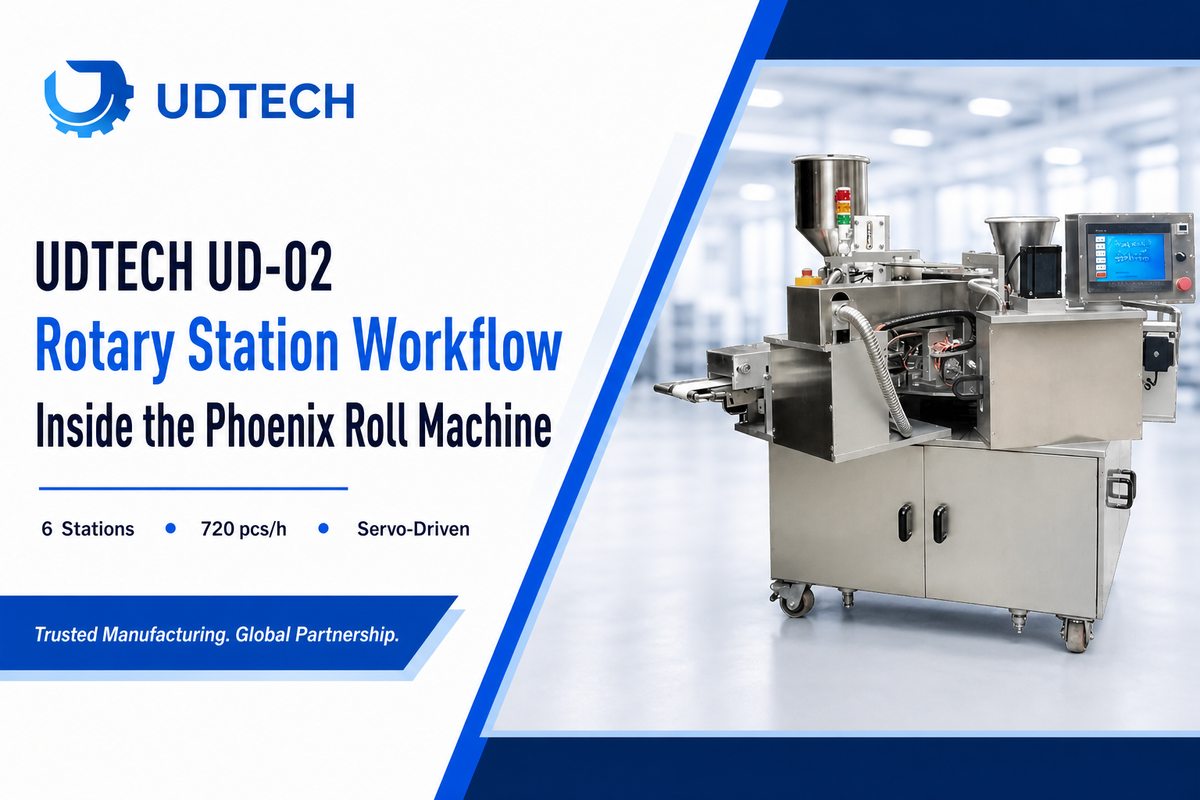
Quick Specs
| Capacity | 720 pcs/h, fully automatic |
| Power | 12 kW, three-phase 380V |
| Compressed air | 0.2 m³/min, ≥0.6 MPa |
| Dimensions | 2300 × 2000 × 1400 mm (compact, small footprint for a 6-station line) |
| Weight | 960 kg |
| Rotary stations | 6, single controller |
| Control | CNC PLC + multi-channel servo + fiber-optic photoelectric sensing. |
The rotary station workflow phoenix roll machines use is a six-station indexing sequence that lets UDTECH’s UD-02 turn seaweed sheets, pork floss, and batter into a finished, filled wafer roll – sometimes called a biscuit roll for its crisp, baked texture – without a single hand touching the product. Six fixed stations sit around one indexing table, each one performing a single operation – laying the seaweed, injecting the paste filling, baking, folding, rolling, and demolding – while a single PLC controller times every station to move in lockstep. That single-table, six-station design is mechanically different from both the generic hinged-mold description you’ll find on most phoenix roll buying guides and from UDTECH’s own linear wafer line, and understanding why it’s built this way is the difference between picking the right machine and picking one that only look similar on a spec sheet.
In short: the UD-02 indexes its rotary table roughly once every 5 seconds – derived from its rated 720 pieces/hour output – so that all six stations are always working on six different rolls in parallel, not waiting on each other in sequence. That parallel-station math is what separates a true rotary-indexing machine from a simpler two-plate hinged mold, and it’s why the paste-injection station (Station 2) has to be engineered specifically for low-density, fibrous fillings like pork floss rather than treated as an afterthought.
What “Rotary-Station Workflow” Means on the UD-02
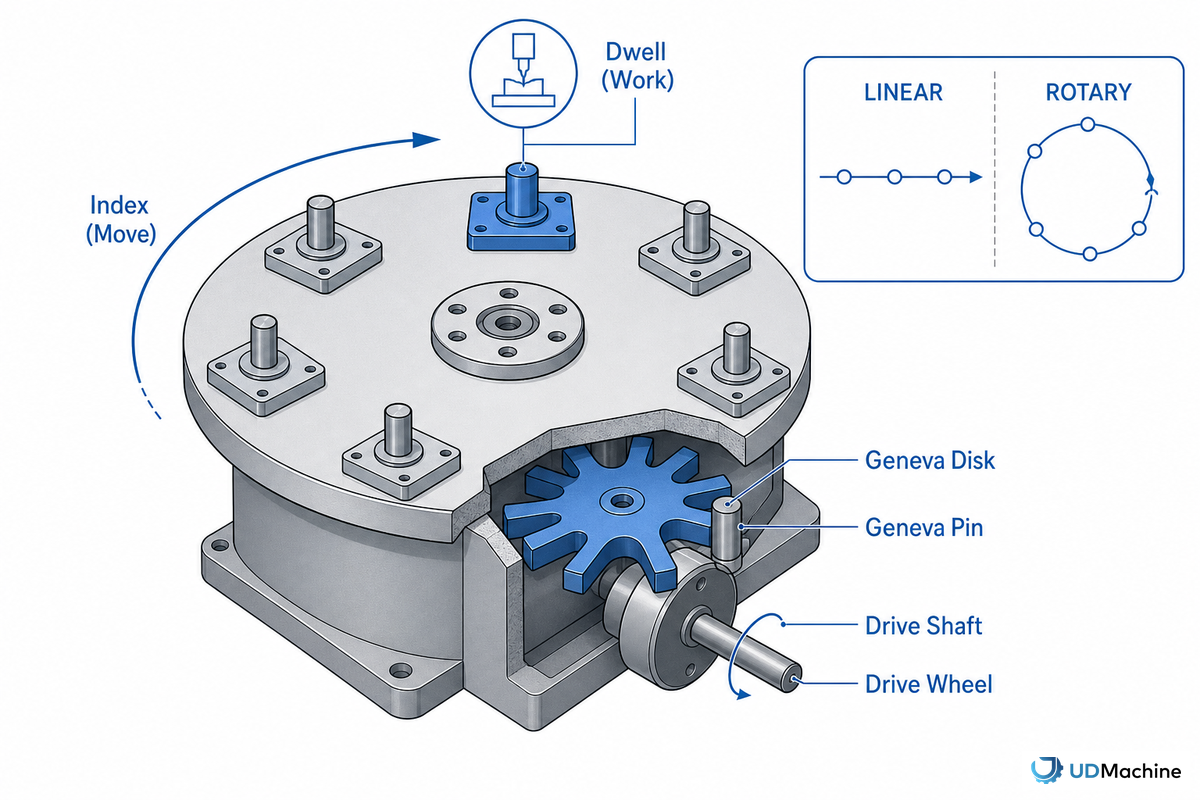
Rotary indexing is an established manufacturing concept borrowed from general industrial automation: a table advances by a fixed angular step, stops (dwells) at each position long enough for a station-mounted tool to do its work, then advances again. It’s the same underlying mechanism used across assembly, welding, and inspection lines.
U.S. Patent 4,512,214 for a station-locking rotary indexing table notes that this class of Geneva-disk table is typically built to carry “from 8 to 24” work stations, so the UD-02’s 6-station layout sits comfortably within that general engineering envelope, just re-purposed for food forming.
That’s a meaningfully different architecture from what most competing “phoenix roll machine” product pages describe. The typical buyer’s-guide explanation is a generic four-stage “Bake-and-Roll Cycle” – batter dosing, hot-plate baking, roll forming, cooling – built around a simple two-plate hinged mold that covers everything from a benchtop unit to a full production line. That description has no rotary table, no seaweed-laying station, and no dedicated filling-injection step, because it’s written to describe the whole market, not one specific machine. The UD-02 isn’t a hinged mold with extra steps bolted on; it’s a single continuous rotary table where six index-locked stations complete a filled, savory wafer roll (seaweed and pork floss being the classic combination, as covered in UDTECH’s guide to what a phoenix roll actually is) in one uninterrupted cycle.
The 6-Station Sequence at a Glance
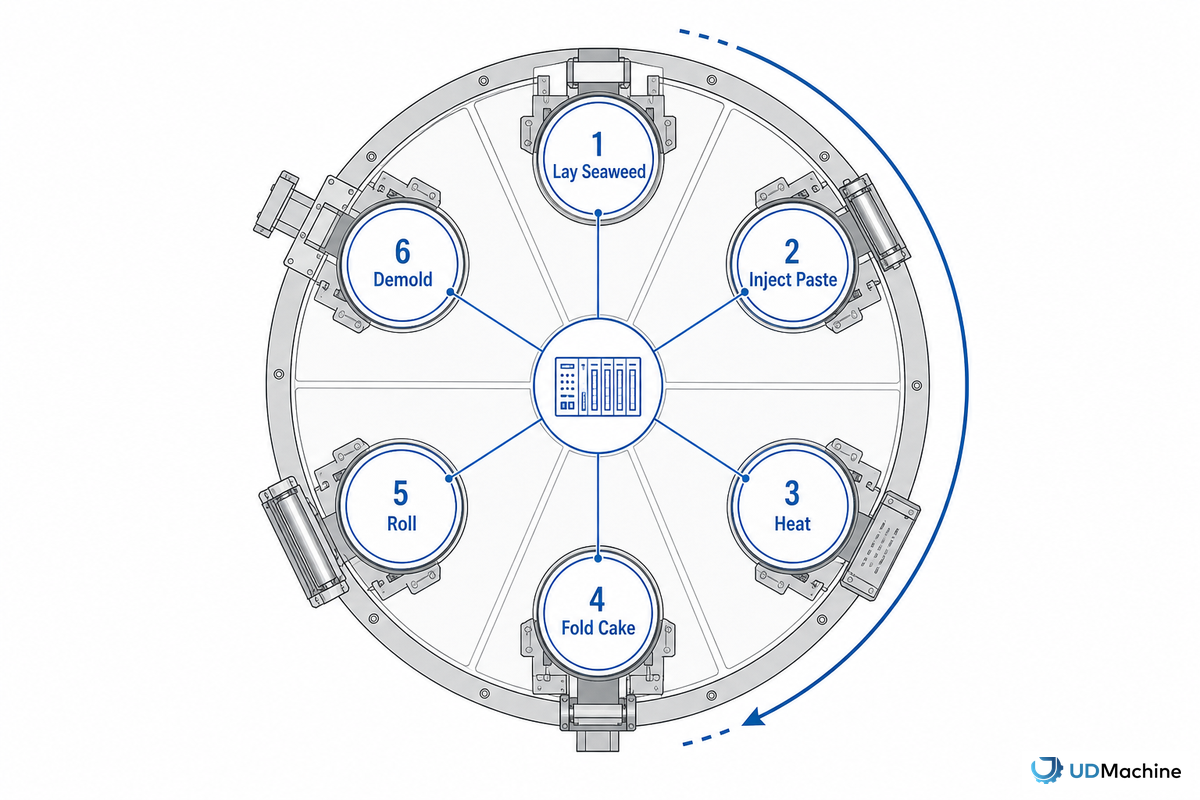
As the UD-02 phoenix roll machine‘s table rotates, all six stations rotate one step at a time. When one station finishes its job, the roll currently at that station move to the next, and an entirely new, unused roll comes in to replace it – the table doesn’t wait for a given roll to cycle through all six stations before starting another.
| Station | Action | Key parameter |
|---|---|---|
| 1 | Lay seaweed | Photoelectric sheet registration |
| 2 | Inject paste | Servo-metered depositor, crush-safe for fibrous floss |
| 3 | Heat | Closed-loop temperature control, forming window |
| 4 | Fold cake | Wafer folded around the filling while warm-pliable |
| 5 | Roll | Tight roll formed without fracture |
| 6 | Demold & convey | Discharge to cooling conveyor |
Because all six stations operate on the same index cycle, no station may be judged in isolation; a failure at the filling station, Station 2, or a plate-temperature variation at Station 3 manifests itself as a rolling or folding failure two stations down. The Station-by-Station Defect Diagnostic Map, immediately below, outlines exactly how to tackle such a cross-station troubleshooting scenario.
Station 1, Lay Seaweed
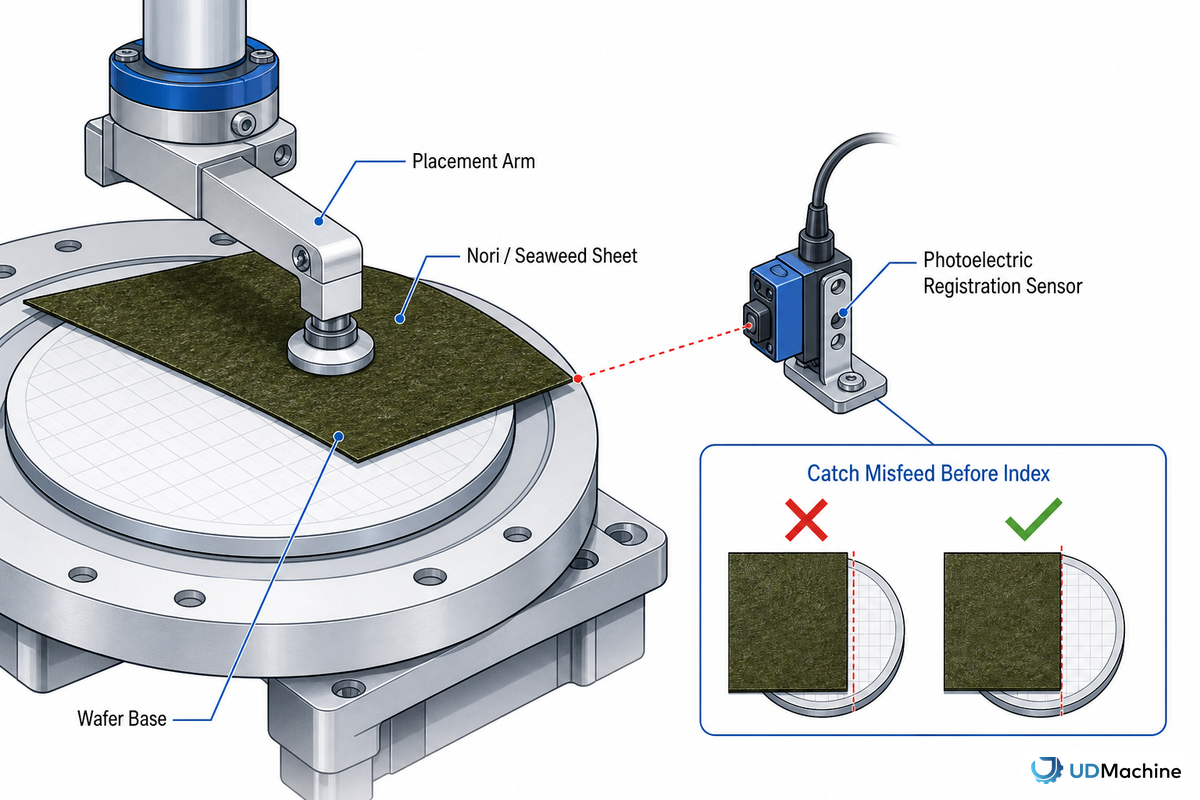
The very first station at Station 1 registers the raw nori-or seaweed wrap-of the roll before the surrounding batter solidifies around it, applying the nori at a particular point to prepare it for subsequent operation. UDTECH’s own documentation on the UD-02 highlights fiber-optic photo sensors registering sheet position at every point around the table to catch an incorrectly fed nori sheet prior to the indexing cycle so it may be removed and thus prevent it from becoming a roll defect two steps down the line.
The need for registration at Station 1 arises because the sheet has to be set at a precise location prior to the filling application of Station 2. If the sheet is laid crooked and not detected by sensors before index, then it could cause a crooked application of filling, leading to an improperly sealed fold in Station 4 and potential cracking of the seam in the roll in Station 5. Hence, not only does Station 1 place the nori, it also controls a downstream sequence of failures should there be any misalignment.
Station 2, Inject Paste: Metering the Filling Without Crushing It
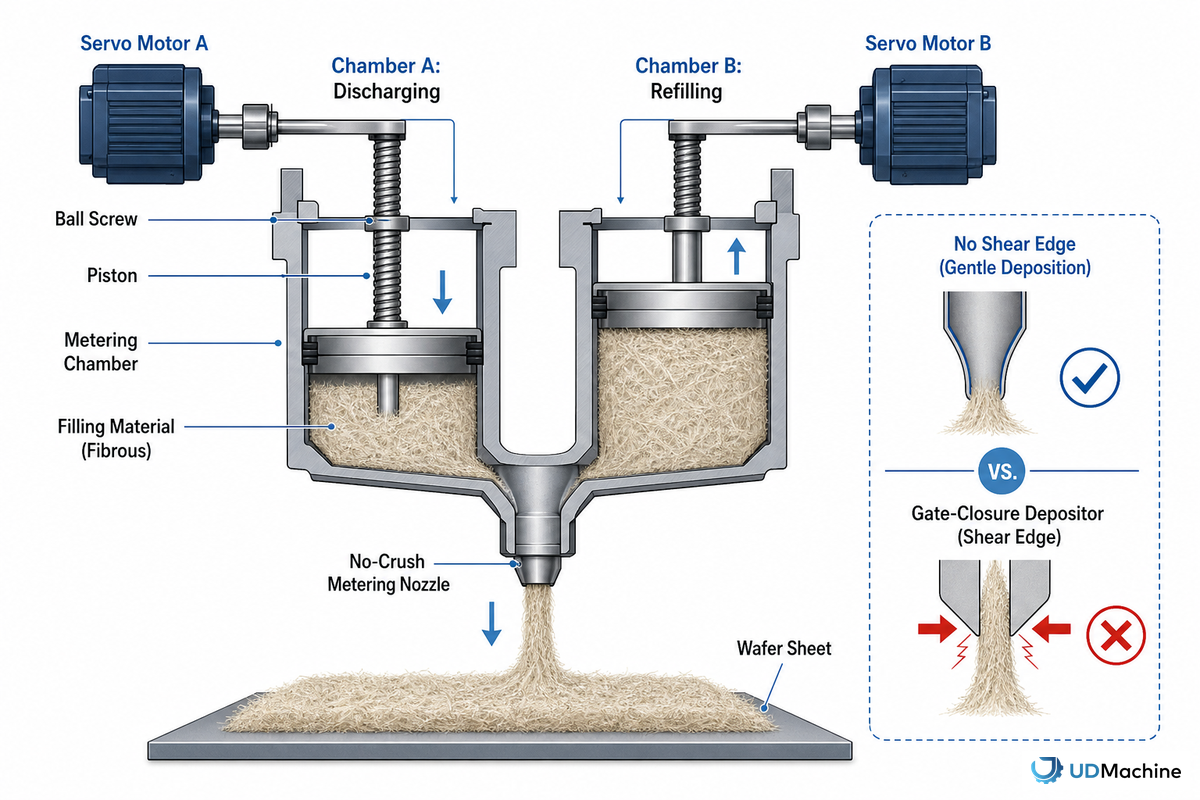
The second station of the UD-02 applies the filling to the nori with a specialty-engineered, servo-controlled depositor designed for use with the loose, fibrous texture that many phoenix roll machine products feature-including the quintessential pork floss filling as well as custom granular and blended fillings. This station is where the most consequential of technical choices are made by the user because, technically, the engineering challenges involved in accurately depositing a fibrous product vary dramatically from those that a user encounters in applying liquids and pastes.
How Is a Phoenix Roll Made?
At their simplest level, phoenix roll machines are fabricated through an automatic, step-by-step, indexed six-station sequence: registering and laying a nori wrapper onto the cookie, adding filling, baking, folding around the filling while the batter is still soft, forming and pressing, and demolding the cooled roll onto a cooling conveyor.
That’s the opposite of an in-hand, individual-at-a-time process that needs a fresh rolling motion at every stage. On the UD-02, that sequence runs automatically at 720 pieces per hour; by hand, a single roller can only complete one wafer at a time, which is the core reason automated rotary-station lines exist for this product category at all.
The engineering problem Station 2 solves is well documented in food-dosing patent literature, even though none of it’s pork-floss-specific: a 1990 patent for volumetric dosing of fragile bulk material states plainly that piston-based dosing of light, low-density food material “is extremely rough on the material, crushing it much more than can be tolerated in a foodstuff”because each stroke shears the material at the point where a slider or gate meets a fixed plate. A related 1995 patent for dosing granulates and low-flowability products makes the same point about conventional gate closures, which “often damage the product, since… a shearing action is unavoidably applied to the product”, and solves it with rotating skimming paddles that level the fill without ever closing a shear edge against it.
“Servo-driven pump fillers can be substantially more accurate than traditional piston depositors, often achieving deposit accuracy within ±0.3% depending on the product.”
That accuracy gap has a real cost attached to it. In the same Baking Business trade-press feature, Peerless Group’s Steve Crocker notes that piston/volumetric depositors commonly scale 2–10% over target weight just to avoid under filling, and the article quantifies what that giveaway costs at scale: a depositor overshooting by just 5 grams per deposit at 500 units/minute wastes more than 330 lb of product per hour. Reiser’s John McIsaac puts his own quality bar even tighter, the company won’t consider a depositor acceptable unless deposit-weight standard deviation stays within 1% of target. These are industry benchmarks from other manufacturers’ depositor lines, not a tested figure for the UD-02 itself, but they explain why servo metering, not a fixed-volume piston, is the right tool for a filling that also happens to be fragile and fibrous.
A dual chamber, dual alternating valve configuration – a depositor component first patented by this manufacturer (US 4,494,920) – is a well-established method to allow volumetric filling without interruption to restock the chamber, which means a servo depositor can keep pace with the product-travel speed set by the filling machine and a table moving at 5-second intervals without becoming the holdup station.
According to UDTECH’s filling-versatility sheet, a change in food type, from nori and sea-weed through powders to blended custom formulas, is a “recipe” change at the depositor control panel, not a physical replacement of a filling head or a different machine configuration. That translates to commercial advantages as well as a technically flexible operation. If a single manufacturer fills some custom rolls with the sea-weed and floss combo and other rolls with custom powders, there’s no need for two separate, expensive, powder-fill capable fillers when a single unit can handle the switch in filling types, making a diverse, high-quality product line of uniform-shape rolls without equipment retooling.
Station 3, Heat
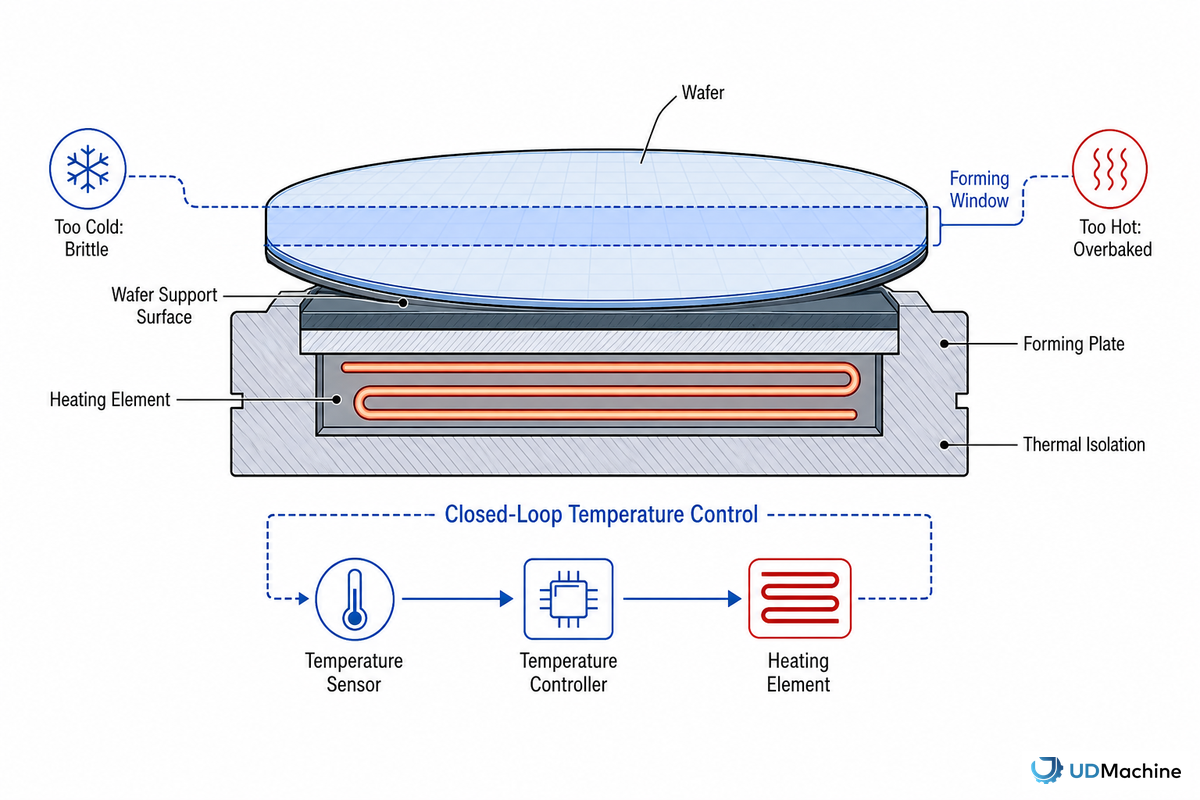
Once the filling is placed at Station 2, the wafer move on to Station 3, where it’s baked through a closed-loop temperature-control cycle tuned to hold the batter in a narrow forming window, hot enough to cook through, but not so long that the wafer stiffens before it reaches the folding station. UDTECH doesn’t publish an exact UD-02 plate-temperature figure, so the precise tolerance band is proprietary to the machine’s controller settings; what’s consistent across wafer-forming equipment generally is that baking is a control-loop problem, not a fixed timer, since ambient humidity and batter viscosity both shift how fast a given plate temperature actually cooks the sheet.
That’s also why Station 3 sits between Station 2 (filling) and Station 4 (folding): the wafer need to still be warm and pliable when it reaches the fold. Get the timing wrong in either direction and the failure show up two stations later as a fold that won’t close cleanly or a roll that cracks. For a sense of how tight this kind of tolerance runs on comparable UDTECH equipment: the company’s related UD05 wafer egg roll line holds its baked wafer skin at roughly 0.8–1.4 mm thick within a plate-temperature band of ±2–3°C, a different machine and a different, unfilled product, but a useful order-of-magnitude reference for how narrow a forming window this equipment class typically runs.
Stations 4–5 — Fold Cake & Roll
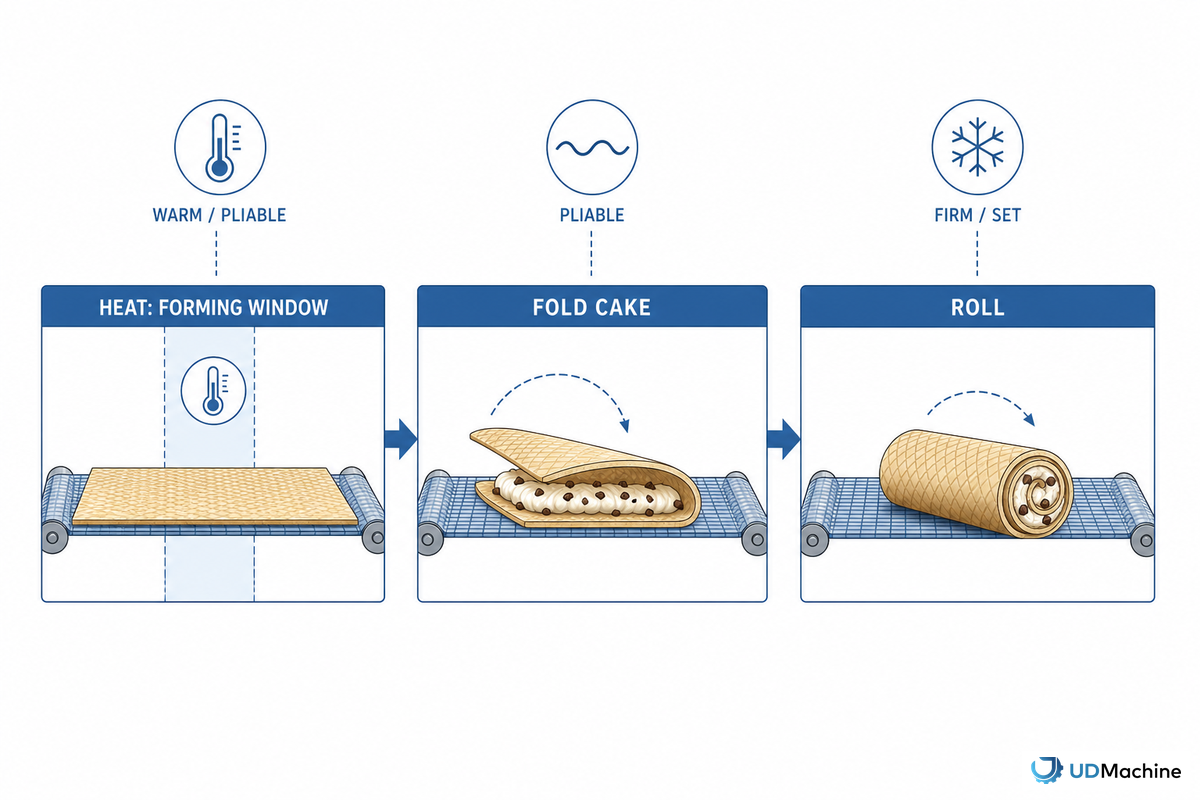
Stations 4 and 5 fold the baked wafer around the filling and then roll it into its final tight, tube-shaped, crispy form while the wafer is still warm enough to bend without cracking. This is mechanically a harder problem for a filled roll than for an empty wafer, because the fold has to close evenly around whatever is sitting inside it, a misaligned seaweed sheet from Station 1 or an uneven filling dose from Station 2 both surface here as a fold that won’t seat cleanly.
The underlying physics is well established in wafer-forming patent literature, even outside the food-machinery space specifically: a patent covering ice-cream cone and wafer indexing apparatus makes inter-station transit time a controlled process variable, specifying that the duration between one station and the next must be “sufficient to allow the [coating] to have substantially set… before reaching the [next] application location”the same principle that governs why a wafer has to be rolled inside a specific warm-pliable window, not before or after it.
- Fold/roll timing is keyed to the index cycle, so it’s consistent shift to shift, unlike manual rolling
- The same photoelectric/servo controls used at earlier stations, not operator discretion, protect the fold/roll window on this filled product
- A filled roll’s fold/roll tolerance is tighter than an unfilled wafer’s, because the fold has to close around whatever Station 2 deposited, upstream dosing or registration errors show up here, not at their own station.
- This warm-pliable window is a physical property of the batter, not something the controller can extend on demand.
Station 6, Demold & Convey
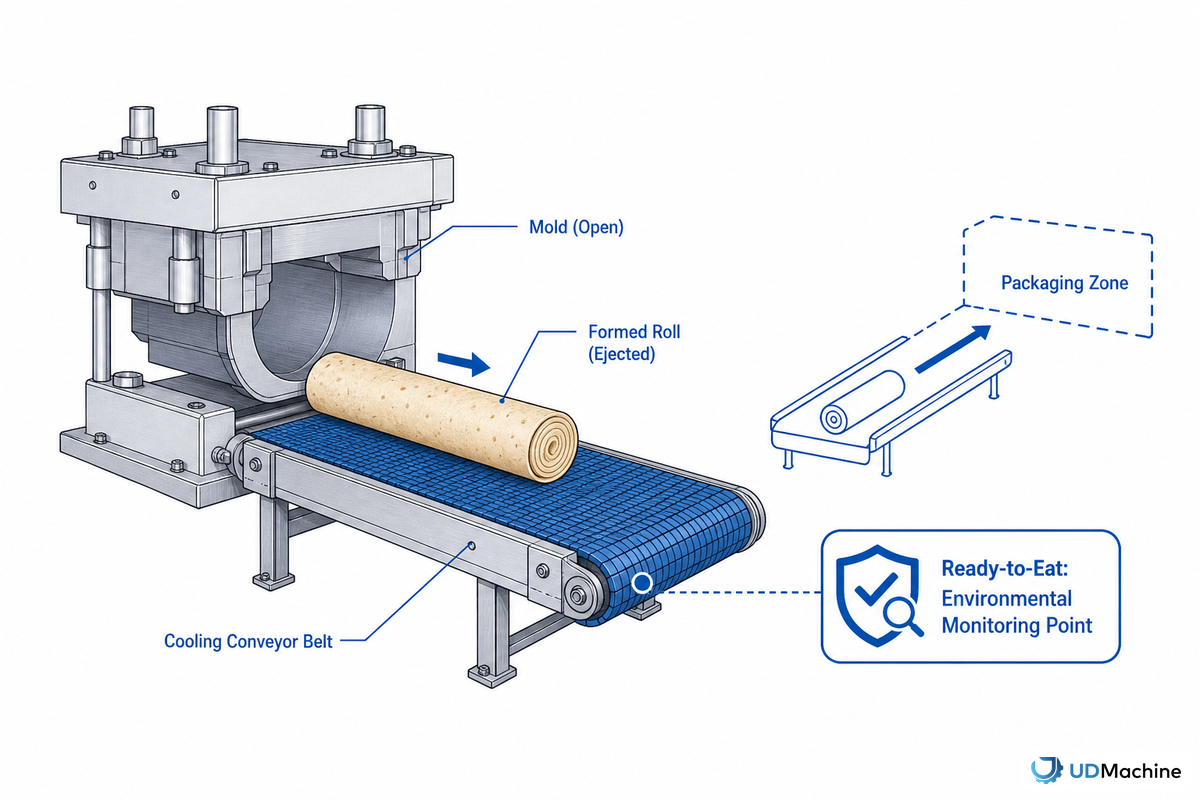
The last station ejects the formed roll out of the mold and deposits it onto a cooling conveyor. At this point, the rolled wafer is ready to eat and exposed to the open environment until packaging; this is a food-safety touchpoint and not simply a mechanical handover. 21 CFR Part 117 Subpart C requires environmental monitoring for an environmental pathogen when contamination of a ready-to-eat food exposed to the environment prior to packaging is a hazard the facility’s own hazard analysis identifies, which puts the risk-assessment obligation for this station’s output at this point in the line, not later.
UDTECH designs the handoff and cooling conveyor integration as part of each UD-02 machine as a complete unit, rather than leaving cooling/packaging integration to the buyer post-machine installation – this integration should be verified at quoting time for integration into existing packaging lines.
The 5-Second Index Window, Why Six Stations Beat One
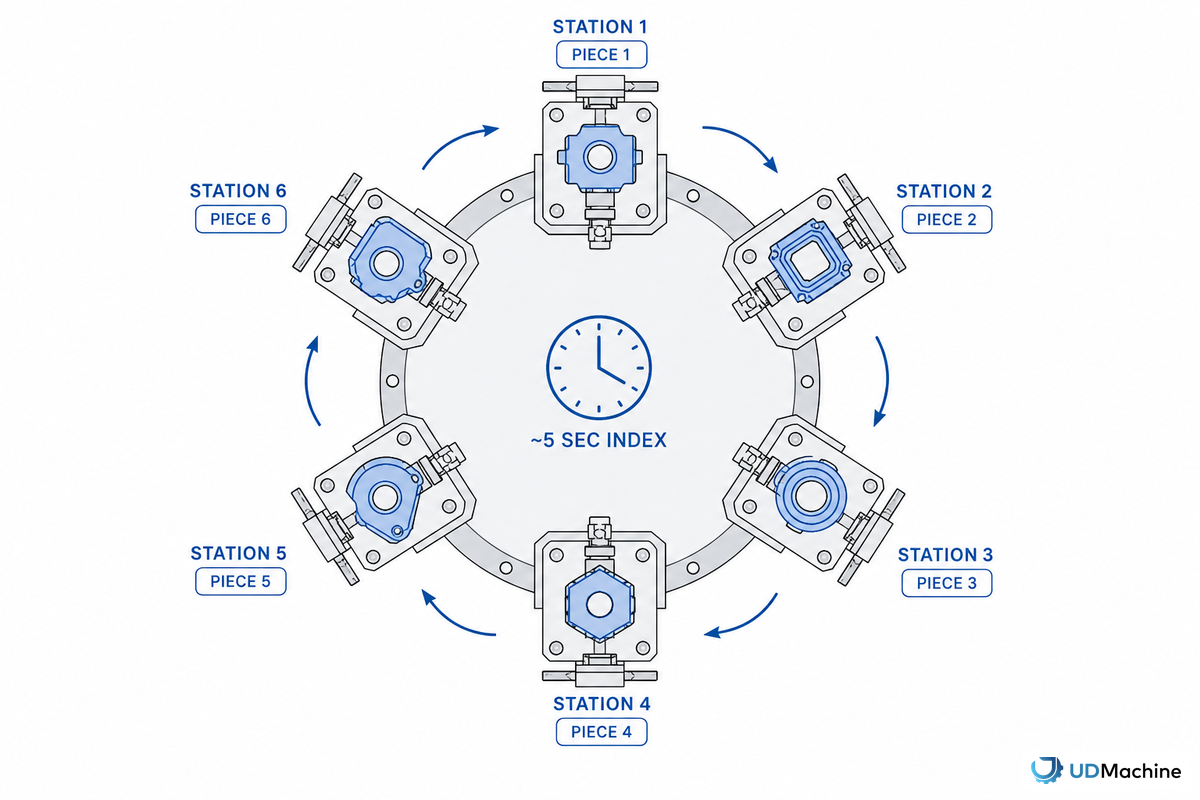
The calculation you probably won’t find on competitor product pages: UDTECH lists the UD-02 as producing 720 pieces per hour. That’s 12 pieces per minute, and with another division by 60, that comes out to 1 finished roll every 5 seconds. That’s remarkably efficient production output from such a compact machine. Because the rotary table advances one station – which demolds one completed roll – per index cycle, that translates to roughly one index per 5 seconds; each of the six stations has that approximately 5-second cycle to complete its operation before the next move.
Why this matters is its implication on parallelism. If it were a single-station process, it would take 6x the amount of time to make a single roll if it were completed in sequence – from placing the seaweed, injecting the filling, baking, folding, rolling, and demolding, before starting the next roll. Instead, each station performs its task simultaneously on 6 different rolls during each index step – by the time station 6 is demolding a roll, station 1 is laying seaweed on a different one, four stations behind. This is why a 6-station rotary table is able to achieve output speeds that a single-head process can’t.
The rotary-indexing engineering literature backs up the general mechanism, even though none of it’s UD-02-specific: a patent for a rotary indexing mechanism describes an index-move actuator pressurized for “a predetermined time period, for example, 0.5 seconds”, empirically tuned to be just longer than the time actually needed to complete the rotary increment, which leaves a plausible multi-second dwell budget for each station’s work once the ~0.5-second move itself is subtracted from a ~5-second cycle. A separate 1995 patent for a Nestlé rotary filling apparatus describes a drum with 3–12 dosage chambers running “up to 80 cups/minute”, confirming that rotary-station throughput in this general range is an established, achievable engineering target for food-forming equipment, not an outlier claim.
Station-by-Station Defect Diagnostic Map
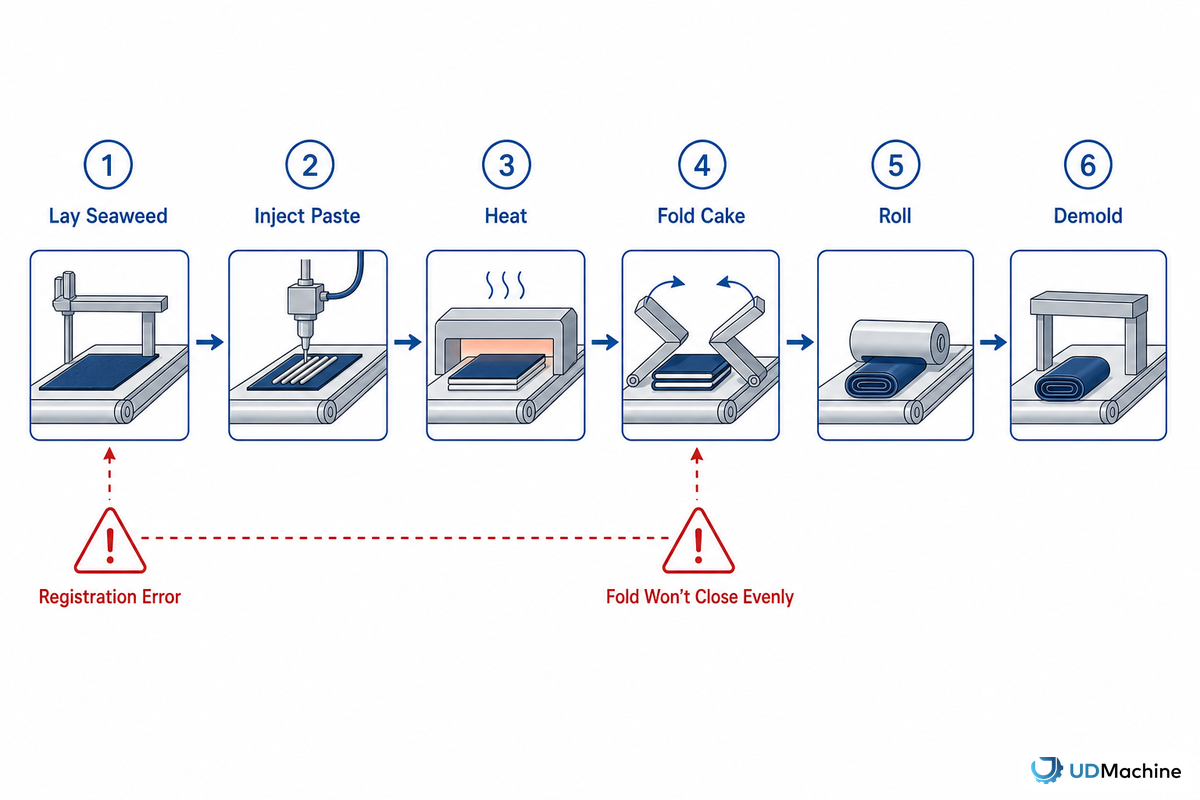
As the six stations all operate within the same cycle, the station that caused a problem generally doesn’t itself reveal the symptom-it’s instead discovered one or two stations downstream as therollhas physically moved away. The following table correlates the most common visible symptoms on finished rolls with the station likely responsible for each based on known physical constraints at each stage:
| Symptom | Most likely station | Fault category | Root cause |
|---|---|---|---|
| Seaweed sheet skewed or hanging off-center | Station 1 | Registration | Photoelectric sensor missed a misregistration before the table indexed |
| Seaweed sheet fails to seat before batter sets | Station 1 | Timing | Sheet-feed cycle lagging the ~5-second index window |
| Filling clumped, crushed, or unevenly distributed | Station 2 | Dosing | Depositor pressure/timing drift on a fibrous, shear-sensitive fill |
| Filling underweight or overweight vs. recipe target | Station 2 | Dosing | Volumetric depositor drift (industry benchmark: 2–10% piston overshoot is common without servo correction) |
| Wafer color uneven or under/over-baked | Station 3 | Thermal | Plate-temperature uniformity drift across the forming window |
| Wafer brittle before it reaches the fold station | Station 3 | Thermal | Bake time overrunning the warm-pliable handoff window |
| Fold won’t close evenly around the filling | Station 4 | Forming | Upstream registration or dosing error surfacing at the fold |
| Roll cracks or fractures along the seam | Station 5 | Forming | Wafer missed its warm-pliable rolling window |
| Roll shape inconsistent piece-to-piece | Station 5 | Forming | Mandrel/roller timing not tracking the sheet’s advance rate |
| Roll tears or deforms at discharge | Station 6 | Discharge | Demold timing drift relative to the roll’s set state |
Such station-specific diagnostic work is much more helpful than simply calling the problem “a jam.” It’s also consistent with what the broader food-equipment reliability literature reports at a general level: a 2026 peer-reviewed study on food-plant depositor and conveyor redesign found that mechanical misalignment and tracking deviation accounts for 70–80% of all conveyor failures in food-processing equipment, a general reliability statistic, not a rotary-indexing-specific one, but a useful reminder that most defects on equipment like this trace back to alignment and timing, not a single catastrophic part failure.
Rotary Table vs Linear Line: The Architecture Split
UDTECH doesn’t produce a single, all-purpose wafer machine: whereas the UD-02 phoenix roll machine incorporates a rotary table, the company’s automatic wafer egg roll machine (UD05 series) is built on a zone-based, linear system. The difference between the two systems, however, has less to do with market tier and more to do with solving a fundamentally different manufacturing problem.
| Trait | UD-02 (rotary table) | UD05 (linear zones) |
|---|---|---|
| Product | Filled phoenix roll (seaweed + pork floss/powder) | Unfilled wafer egg roll |
| Station count | 6 fixed stations, one indexing table | 5 sequential zones (dosing/baking/rolling/cooling/packaging) |
| Filling station | Dedicated (Station 2, pre-bake) | None on the base line |
| Rated throughput | 720 pcs/h | 220–330 pcs/min (higher, unfilled product) |
| Power draw | 12 kW (380V three-phase) | 9.7 kW (UD05-2) or 12 kW (UD05-3) |
A rotary table makes sense when a product require a dedicated station for something a linear line doesn’t need to perform – in this case, a sheet of seaweed and injection of a filling before the bake step. General rotary-indexing engineering explains the tradeoff clearly: cam-driven continuous-mode indexers can run at very high cycle rates but struggle to combine a fast index move with the longer dwell some stations need, which is why servo-driven “cycle-on-demand” tables are preferred when an application needs a quick index followed by an extended per-station dwell, exactly the profile a filling-and-baking sequence need. A linear egg-roll line – one with no filling step, and a much simpler bake-then-roll sequencing – doesn’t require such flexibility, and is therefore built by UDTECH as a more simplified zone-based line. Prospective buyers considering a phoenix roll machine purchase would be better advised to consider “rotary vs. linear” as a filled-vs.-unfilled product fit question first, not one of speed, brand or price-tier – and to consider efficiency over the entire line, not simply per-station output rates.
That tradeoff has a scaling ceiling worth flagging, too. Assembly Magazine’s Robert Zaruba, president of CDS Corp., puts the practical upper bound at around 30 stations before a rotary table becomes “extremely large and unwieldy,” and notes that manufacturers who start on a rotary system for a simple or low-volume product often migrate to a linear line later, once the process picks up more steps or higher volume. The UD-02’s 6-station table sits well inside that rotary-appropriate range; it’s a different question entirely from whether a future, much more complex filled-snack process would eventually outgrow a rotary table and call for a linear line instead – that’s a station-count problem, not a filled-vs-unfilled one.
Compliance Touchpoints Across the 6 Stations

Food-safety and machine-safety compliance aren’t imposed on the phoenix roll machine as a single monolithic entity, but are tied to specific physical zones.UD-02 rotary-station designs happen to align themselves more closely to that division than other possible design strategies.
Stations 1 and 2, the seaweed-laying and filling-injection zones, are food-contact surfaces, which puts them squarely under 21 CFR §117.40: corrosion-resistant surfaces, nontoxic materials able to withstand cleaning and sanitizing agents, and seams smoothly bonded to minimize food-particle accumulation. That same section also requires automated systems handling the product to stay maintainable in a clean, sanitary condition, and temperature-control instruments (relevant directly to Station 3) to be accurate and precise. A companion rule, 21 CFR §117.35, adds the operational half of that requirement: food-contact surfaces must be cleaned as frequently as necessary to protect against contamination, and cleaning/sanitizing procedures specifically have to guard against allergen cross-contact, directly relevant to a line that switches between seaweed/floss and alternative powder fillings at Station 2.
Beyond that, the rotating table itself, the mandrel, and the conveyor transfer points carry a second, separate compliance obligation most phoenix roll buying guides skip entirely: worker machine-guarding, not food safety. In the U.S., OSHA 29 CFR 1910.212 requires point-of-operation guarding on any machine with exposed nip points, rotating parts, or in-running rolls, language that applies directly to a rotary table indexing past a folding/rolling mandrel every ~5 seconds. That’s a distinct requirement from the food-contact rules above: 117.40/117.35 govern what touches the product, while 1910.212 governs what an operator standing next to the machine can physically reach.
But besides food-safety and worker-safety rules applicable in the U.S., there’s a third area of compliance that applies to equipment rotary machines headed to the EU market: the machine safety and control system reliability requirement. For any UD-02 destined for the EU market, that means Regulation (EU) 2023/1230, which repeals the older 2006/42/EC Machinery Directive with effect from 14 January 2027, the date the regulation applies from generally (Articles 26–42, covering conformity-assessment and notified-body procedures, have applied since 14 January 2024). Its Annex III sets specific requirements directly relevant to a multi-station rotary mechanism: under a control-system failure, “no moving part… shall fall or be ejected” and stopping must remain unimpeded, and machine parts subject to repeated cyclic loading must have their expected wear accounted for, with maintenance instructions specifying inspection frequency and wear-part replacement criteria.
Under EU Regulation 2023/1230, an integrator who makes a “substantial modification” to an installed machine — for example, swapping or upgrading the PLC and servo logic that times all six UD-02 stations — legally becomes the “manufacturer of record” for that machine, inheriting CE-marking and risk-assessment responsibility. That liability shift, flagged by Intertek’s Assistant Chief Engineer Paul Yu in a 2025 analysis of the regulation, is worth knowing before any buyer or third-party integrator decides to modify a rotary-station machine’s control system after installation.
Industry Outlook, Rotary-Indexing’s Role in Filled-Snack Automation
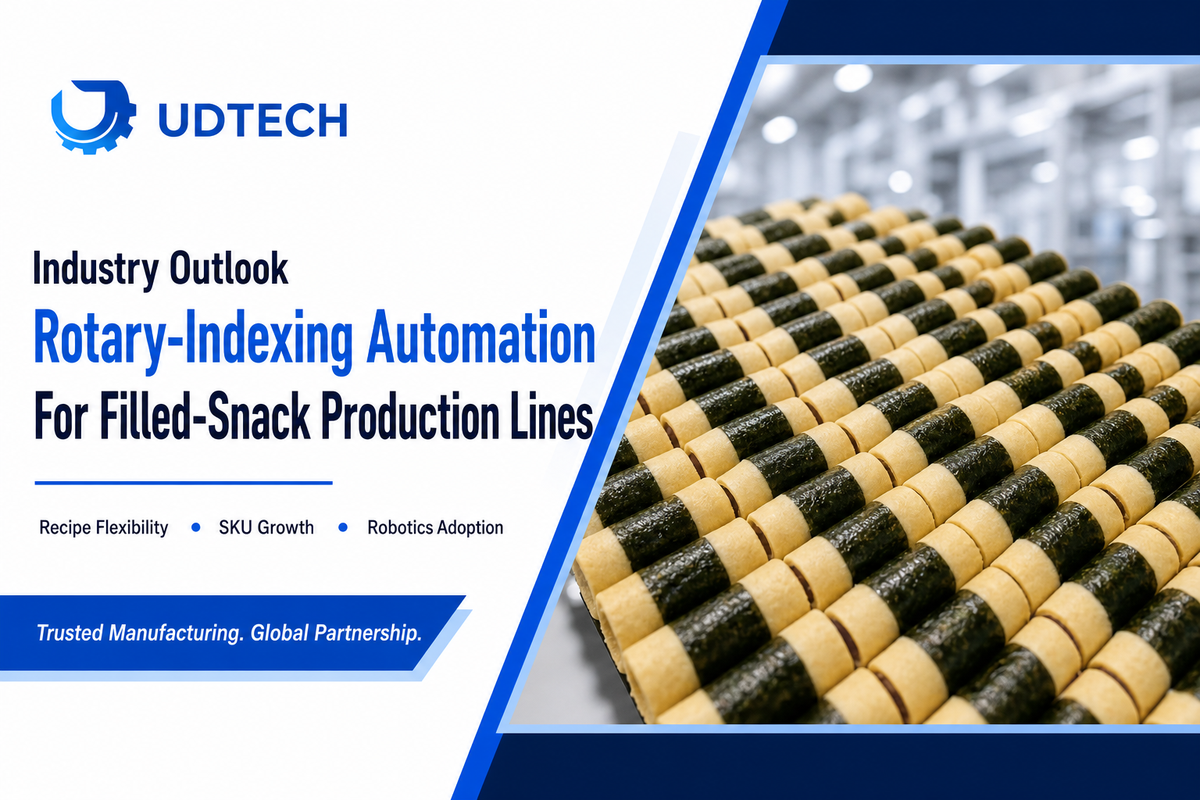
The push toward greater variety within product lines – what’s now commonly being called “SKU rationalization” or “product proliferation,” a result of e-commerce and direct-to-consumer trends – gives a reason to avoid purchasing multiple single-purpose machines. The recipe-based change over enabled by the Station 2 design described earlier supports a rotary line capable of producing multiple filling variations using just a single system that adapts to changing recipes, instead of one where the filling must be physically swapped out or another line purchased. That’s not an attempt to size the market but a consequence of a system that better suits current production demands. A real risk sits on the other side of that equation: a buyer who commits to a single-purpose depositor today can find within a year that a new SKU calls for a fibrous or granular fill the machine simply can’t run, a structural gap that a recipe-flexible Station 2 is built specifically to close. UDTECH’s own manufacturing background bears directly on that design choice — the company’s in-house engineering team draws on more than 15 years of building filling, dosing, and forming equipment for buyers across over 100 export countries, and that cross-market exposure to shifting SKU demand is exactly why Station 2 was engineered around a control-panel recipe change rather than a physical hardware swap.
More solid non-market report evidence for growing food and beverage robotics demand comes from actual installation data, not sales projections. The International Federation of Robotics’ World Robotics 2025 executive summary reports 542,076 industrial robot installations worldwide in 2024; food and beverage remains a small share of that total. However, total U.S. industrial robot installations grew 11% year-over-year in 2025, reaching 38,000 robots, and the food sector is specifically identified as one of the main drivers of this growth. Food and beverage automation still isn’t a huge percentage of the industrial robot market, but it’s a growing percentage based on solid, historical, independently verified data, not future estimates.
Specific rotary-indexers market estimates vary from approximately $690 million up to over $2 billion depending on which reports are consulted-another clue that figures represent directional trends and rough magnitudes rather than precise industry totals. Consult dollar values here only as supporting context.
Even more concrete is where the vendors themselves are building towards. Food-machinery manufacturers have released new servo-driven depositor lines designed for tender, textural fillings in the last few years-a trend that fit right into why UD-02’s Station 2 utilizes servo metering for its fibrous filling, instead of relying on a simpler fixed volume filling method. The takeaway for a customer in the market for a equipment today should be to place the value of recipe flexibility and servo metering accuracy equal to, if not higher than, maximum throughput or company history when considering the purchase of a rotary-table filling machine configured for producing this category of stuffed snack.
FAQ
How fast does the UD-02’s rotary table index?
View Answer
What happens if one station jams, does the whole line stop?
View Answer
Can the injection station handle liquid fillings, or only dry floss and powder?
View Answer
Why does UDTECH use a rotary table for the Phoenix Roll but a linear line for the plain wafer egg roll?
View Answer
Does switching from seaweed to a powder filling change anything at the injection station’s hardware, or only the recipe settings?
View Answer
How is the rotary table different from a simple manual turntable?
View Answer
Why We Write This
Suzhou UDTECH Technology Co., Ltd. designs and manufactures the UD-02 phoenix roll machine covered in this guide. We don’t personally run a phoenix roll production line, but our design process means examining the same trade-offs in sequencing, sensing, and dosing covered here – including where patent literature, design standards, and trade-press benchmarks apply to, or diverge from, this type of stuffed-wafer snack.
We flag which statements are our own description of the UD-02 versus an outside source. Reviewed by the Suzhou UDTECH Technology Co., Ltd. technical team.
References & Sources
- 21 CFR Part 117, Equipment and UtensilsU.S. Food and Drug Administration (eCFR)
- 21 CFR §117.35, Sanitary OperationsU.S. Food and Drug Administration (eCFR)
- 21 CFR Part 117 Subpart C, Hazard Analysis and Risk-Based Preventive ControlsU.S. Food and Drug Administration (eCFR)
- 29 CFR Part 1910, Subpart O, Machinery and Machine GuardingU.S. Occupational Safety and Health Administration (eCFR)
- World Robotics 2025, Industrial Robots, Executive SummaryInternational Federation of Robotics
- Regulation (EU) 2023/1230 on Machinery, Full TextOfficial Journal of the European Union (EUR-Lex)
- Regulation (EU) 2023/1230, Annex IIIOfficial Journal of the European Union
- The New EU Machinery Regulation: What Manufacturers Need to KnowIntertek
- US Patent 4,895,195, Apparatus for Volumetric Dosing of a Fragile Bulk MaterialUSPTO / Google Patents
- US Patent 5,464,126, Volumetric Dosage Machine for Granulates and PowdersUSPTO / Google Patents
- US Patent 4,494,920, Positive-Displacement Volumetric Depositor ApparatusUSPTO / Google Patents
- US Patent 5,405,059, Rotary Filling ApparatusUSPTO / Google Patents
- US Patent 4,890,514, Rotary Indexing MechanismUSPTO
- US Patent 4,512,214, Station Locking Rotary Indexing TableUSPTO
- EP4005396A1, Indexing Apparatus for Wafer/Cone ItemsEuropean Patent Office / Google Patents
- Depositor and Conveyor Reliability in Food-Plant Equipment (2026)MDPI Applied Sciences (peer-reviewed)
- Depositing/Filling With PrecisionBaking Business (Sosland Publishing)
- How to Select a Rotary Indexing TableAssembly Magazine
- Rotary vs. Linear IndexingAssembly Magazine (Jim Camillo, quoting Robert Zaruba, CDS Corp.)
Related Articles
- UDTECH UD-02 Phoenix Roll Machinefull specifications, pricing factors, and procurement guide
- Phoenix Roll Machine: Buyer’s Guidecomparing automation tiers, pricing, and vendor options across the market
- How an Automatic Egg Roll Machine Worksthe linear-zone architecture behind UDTECH’s unfilled wafer line
- What Is a Phoenix Roll? The Seaweed & Pork Floss Snack, Explainedthe food history and consumer side of this product
- Automatic Egg Roll MachineUDTECH’s full wafer-roll equipment category
- Seaweed Egg Roll Machineequipment guide for seaweed-filled wafer roll variants