Reviewer: UD Machine Solution Technology Co., Ltd Technical Team
Food safety certifications for snack machinery are scoped proof documents, not a loose logo collection. One document may describe a factory system, another may describe material evidence, and another may address machine safety. Buyers should check the scope before accepting any certificate as proof for a specific snack line.
Short answer
Proof documents rather than one isolated certificate are the best way to verify snack machine safety. Buyers should ask which model or part is certified, whether it covers materials for food contact, what CE or machine safety file exists, and how it helps support the buyer’s HACCP, GMP, ISO 22000, or other quality system.
| Quick spec | Published UDTECH example | Why it matters in certification review |
|---|---|---|
| UD05-2 output | 220 pcs/min, 600 kg per 8-hour shift | The evidence file should match the exact model and throughput claim. |
| UD05-3 output | 330 pcs/min, 900 kg per 8-hour shift | Higher output raises the value of cleanability and maintenance access checks. |
| Power | 9.7 kW to 12 kW | Electrical acceptance may require a separate product-safety mark or local review. |
| Footprint | 15.5 m2 published footprint | Cleaning access and installation space are part of the acceptance file. |
| Related extruder output | 150-300 kg/h public range | Different snack equipment can need different contact-material and sanitation evidence. |
What Counts as a Food Safety Certification for Snack Machinery?
Sorting certification claims matters. A food handler certificate relates to personnel. HACCP, GMP, ISO 9001 and ISO 22000 generally relate to company or facility systems. Machine safety marking like CE comes from product conformity assessment and machine safety certification. NSF food equipment certification and NSF/ANSI standards may relate to a product or component type, depending on the listing scope.
Distinguishing the terms helps. Searches for wording such as “food equipment certification” often return pages about food-handler training, general food safety, or product certification. When reviewing a snack plant’s file, the better question to ask isn’t “Which certificate appears to be most impressive?” but rather “Which records evidence my target model, food-contact components, safety file, and factory procedures?”
When describing a machine for buyer review, use specific wording in the supplier file. It’s often wrong to say “FDA approved machine.” FDA provides requirements for facilities, equipment, utensils, food-contact materials, and preventive controls. FDA doesn’t normally certify a finished snack machine model.
The risk is treating a certificate name as acceptance criteria. Because a 2026 buyer may need FDA food-contact evidence, CE machine-safety basis, and a 2 mm cleanability check for the same UDTECH model, the safer question is what proof covers which contact zone.
NSF and Food Equipment Certification: When It Matters
NSF Food Equipment certification is appropriate if the buyer requires external verification for food material safety, product performance, design and construction, and compliance with food-contact requirements. It is not the same for every snack machine, as specific components or products get certified to particular NSF/ANSI standards.
Buyer risk appears when a logo creates a gap between a certified component and the installed snack line. Because NSF/ANSI 51 may cover materials and finishes while a 2026 customer audit asks for model scope, UDTECH or any supplier should point to the exact listing, CE or FDA-adjacent material file where relevant, and a 2 mm or other line-specific acceptance criterion.
What equipment needs to be NSF certified?
Any commercial food equipment that handles, stores, or transfers food and that is listed in the buyer’s specifications or in the customer or facility’s regulatory requirements should either have NSF certification or an approved substitute. Never settle for just the logo on snack machinery; instead, look at the exact model or part number, the relevant NSF/ANSI standard, and what that standard guarantees for the specific type of equipment.
| NSF-related proof | What it can prove | What to verify | What it does not prove alone |
|---|---|---|---|
| NSF product listing | A product or system is certified in a listed category | Certificate number, model, standard, current listing | The buyer’s facility HACCP plan |
| NSF/ANSI 51 | Materials and finishes for food equipment | Which materials, gaskets, tubing, valves, or finishes are covered | Whole-machine certification by itself |
| NSF/ANSI 2 | Food equipment sanitation requirements for defined equipment classes | Whether the snack machine category fits the standard scope | Electrical safety or operator training |
| Other NSF product categories | Category-specific sanitation or material evidence | Whether the exact snack machine model is listed in the claimed category | Automatic acceptance by every customer |
FDA Food-Contact and Cleanability Checks Under 21 CFR 117.40
21 CFR 117.40 is a good starting point for U.S. buyers, since it outlines what effective, cleanable equipment must provide: smooth, easily cleanable food-contact surfaces that do not impart flavor or odor, corrosion-resistant and nontoxic materials, sanitary maintenance, adequate ventilation, heating and cooling facilities, and process-flow equipment and utensils that protect food from contamination. It’s not an FDA listing for the machine, but a set of required equipment attributes.
Evidence for food-contact material may not be found under Part 117. FDA 21 CFR 174.5 provides the framework for indirect food additives used in food-contact articles. Likewise, 21 CFR 178.3570 addresses lubricants with incidental contact, specifying limitations and conditions of use. Purchasers of food-contact equipment should request evidence of the food-contact material declaration, the specific brand or technical file of any lubricants, and the intended location of contact, rather than merely accepting a supplier’s statement that the equipment is “FDA compliant.”
Contact-Surface Risk Ladder
| Level | Buyer sees | Risk | Follow-up document |
|---|---|---|---|
| 1 | Certificate logo only | Scope unknown | Current certificate with model scope |
| 2 | “Food grade” material claim | No proof of test or regulation path | Material declaration and supplier data |
| 3 | 304 stainless steel | Material grade only | Contact-surface map and finish statement |
| 4 | Plastic belt or scraper | Migration or composition gap | Regulation (EU) No 10/2011 or equivalent declaration |
| 5 | Rubber or silicone seal | Not covered by plastic only rules | Component-specific food-contact evidence |
| 6 | Lubricated chain or bearing near product | Incidental-contact route missing | Lubricant technical file and intended-use location |
| 7 | Compressed air contacts food zone | Contamination control not stated | Air treatment and filter maintenance record |
| 8 | Clean-in-place claim | No installed validation | Cleaning method, access points, and validation plan |
| 9 | Model-specific tested proof | Lowest review risk | Keep certificate, report, manual, and acceptance checklist together |
CE and EU Machinery Safety Documents for Imported Snack Lines
While CE isn’t synonymous with food safety certification, it has significant relevance in the context of food machinery, particularly in relation to hygienic design. The existing Machinery Directive 2006/42/EC already addresses the specific requirements for hygiene on contact surfaces in contact with foodstuffs in terms of cleanliness, drainage, avoidance of organic buildup, and separation from hazardous ancillary substances. The forthcoming Regulation (EU) 2023/1230 builds upon these requirements and is scheduled to take effect on 14 January 2027 (as per the EUR-Lex text).
CE marking still belongs in the machine-safety file, not in the food-contact material file.
For equipment procured in 2026, buyers should seek a file set that includes: a declaration of conformity, a list of applicable standards, details regarding the risk assessment basis, operating and maintenance manuals, evidence of safety guards and emergency stops, and the relevant section on hygiene from the technical file summary. If a supplier claims “CE certification,” consider this a shorthand term until the declaration and the scope of the technical file have been reviewed. In the U.S., OSHA’s NRTL program is a parallel product safety certification process relevant to electrical safety or workplace safety; it isn’t a food safety certification.
ISO 9001, GMP, HACCP, and ISO 22000 Are Not Machine Proof by Themselves
System-level certificates are valuable in indicating that a supplier has implemented some form of management system or food safety protocol. However, they cannot substitute for machine-specific evidence pertaining to food-contact components, cleanability, electrical safety, guarding, maintenance manuals, or acceptance testing. For example, ISO 22000 is a food safety management system standard designed for entities within the food supply chain, but it does not serve as a product certificate for an egg roll machine.
For a 600 kg per 8-hour line, the risk is a scope gap: a supplier can hold ISO 9001 and GMP while a scraper, lubricant, guard, or 2 mm clearance still fails the buyer’s acceptance criteria. Because UDTECH lists both model specs and system claims, the factory file should separate ISO, HACCP, and GMP certificates from the machine evidence used in the buyer’s customer audit.
Is HACCP a machine certification?
No. HACCP (Hazard Analysis and Critical Control Points) controls hazards at critical points in a food process. Supplier HACCP programs may support facility risk management, but they don’t prove belts, lubricants, electrical systems, guards, contact surfaces, or cleaning access for a specific machine. Treat “HACCP certification” as facility or process evidence unless the supplier ties it to machine-specific records.
Certificate-vs-Evidence Matrix
| Document or claim | Type | What it can support | Buyer follow-up |
|---|---|---|---|
| NSF listing | Product/category proof | Listed equipment or component scope | Verify model, standard, and current listing |
| NSF/ANSI 51 | Material/finish standard | Food equipment materials | Do not treat as whole-machine proof |
| 21 CFR 117.40 | Requirement layer | Cleanability, installation, maintenance, controls | Ask how the model meets the requirement |
| 21 CFR 174.5 | Food-contact component rule | Indirect food additive conditions | Request component material declarations |
| 21 CFR 178.3570 | Lubricant rule | Incidental food-contact lubricant conditions | Request lubricant brand, SDS, and use point |
| CE file | Machine conformity | Machine safety and hygiene clauses for food machinery | Request declaration and technical file summary |
| ISO 9001 | Quality management | Supplier process control | Still ask for model evidence |
| GMP or HACCP | Factory or process system | Food safety management support | Do not accept as machine proof alone |
| NRTL mark | Product/electrical safety | Workplace or electrical acceptance | Keep separate from food safety evidence |
Match Certification Review to Actual Snack Machinery Specs
The proof packet for your specific application should reflect your plant needs. For instance, UDTECH’s UD05-2 model is advertised as capable of 220 pieces/min, 600 kg per 8-hour shift, with a 9.7 kW power rating and a machine weight of 4300 kg. Their UD05-3 model is listed with output rates of 330 pieces/min, 900 kg per 8-hour shift, 12 kW power, and a machine weight of 4500 kg. Additional claims on the same page include “CE-aligned 2006/42/EC,” “FDA 21 CFR 117 food-contact compliant,” “ISO 9001,” “GMP,” and “HACCP.” These claims should be treated as prompts to request supporting files rather than definitive proof in themselves.
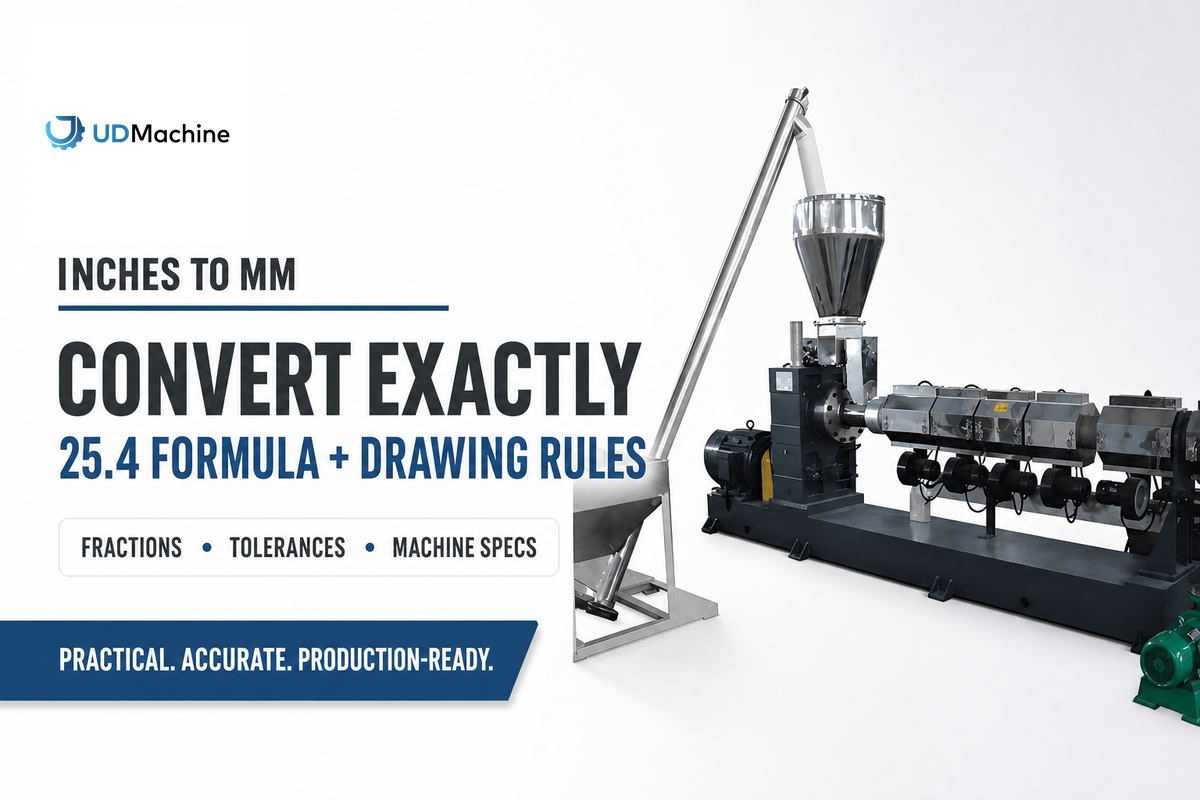
Similarly, UDTECH’s information for a snack food extruder indicates output ranges of 150-200 kg/h and 250-300 kg/h, with installed power listed as 197 kW and 234 kW, and includes certification claims such as CE, SGS, BV, and ISO9001. Since this represents a different machine category, buyers should avoid applying the food-contact surface checklist from another machine directly to the extruder without first examining the specific screw, die, cooling, conveying, and seasoning contact points.
This wider comparison file can show how the same proof-packet logic changes across a snack food extruder machine, kurkure production line, puff snacks processing line, fried snack production line, and corn flakes production line. Each snack line has different contact zones, thermal exposure, and cleaning access points.
Convert loose design language into explicit fields on an RFQ file. For instance, a checklist line in a buyer’s RFQ may ask the supplier to list surface finish such as 0.8 μm Ra, scraper clearance such as 2 mm, compressed-air filtration such as 5 μm, cleaning exposure such as 60 °C for 20 min, and pneumatic pressure such as 6 bar. These aren’t global standards of acceptable quality; they illustrate the level of precision buyers can request before accepting a certificate claim.
Engineering note
Larger output claims often require larger file-review work. Every claim in a certificate should be linked to a model, contact zone, material, control point, manual, and acceptance test before any money is released in the form of a deposit.
Build the 6-Document Snack Machinery Proof Packet
The 6-Document Snack Machinery Proof Packet is a pragmatic set of questions that procurement and quality teams can use. It doesn’t presuppose that every claim will share the same certificate; rather, it compels each line item to demonstrate what proof covers what risk.
What certifies commercial food equipment?
Third-party bodies like NSF certify commercial food equipment when the product fits within a documented standard and product category. Those records also come in forms such as regulatory compliance statements, material declarations, CE files, NRTL marks, and customer audit reports. The buyer’s role is to vet scope rather than simply compile a list of company logos.
| Packet item | Document to request | Scope question | Acceptable answer |
|---|---|---|---|
| 1. Food-contact materials | Material declaration | Which surfaces and parts touch product? | Part-by-part map and documents |
| 2. Plastic components | Regulation (EU) No 10/2011 or equivalent file | Is it plastic, rubber, silicone, adhesive, ink, or coating? | Correct rule path for each material |
| 3. Lubrication points | Lubricant technical data | Can incidental contact occur? | Brand, use point, and condition file |
| 4. Machine safety | CE or local safety file | Which directive, regulation, or standard is used? | Declaration and standards list |
| 5. Electrical/product safety | NRTL, UL, ETL, or local review file | Is the mark required in the destination? | Correct mark or documented local plan |
| 6. Quality system | ISO 9001 or audit evidence | Does it cover the manufacturing site? | Current certificate with site scope |
| 7. Food safety system support | HACCP, GMP, ISO 22000 support evidence | Does it help the buyer’s facility plan? | Process support, not machine certificate wording |
| 8. Cleaning and maintenance | Manual and sanitation instructions | Can operators clean all relevant zones? | Step-by-step instructions and access points |
| 9. Acceptance record | Factory or site acceptance checklist | Was the exact model checked? | Signed model-specific checklist |
Red Flags in Supplier Certification Claims
The most treacherous sentence is rarely an untruth, but an ambiguity. Phrases such as “FDA compliant”, “food grade”, “CE approved”, “NSF standard”, “HACCP machine” or “304 stainless steel” all reference genuine considerations but none are acceptable without scope attached. Even when sourcing stainless steel materials from TiAlloy for fabrication, buyers still need the finished equipment’s food-contact and cleaning documentation.
- A logo appears on a brochure but the vendor is unable to provide a certificate number or listing category.
- A certificate references the company rather than the machine model or specific part.
- A single material declaration addresses the stainless steel components of a machine, but not any accompanying belts, scrapers, seals, adhesives, or lubricants.
- A CE claim lacks a declaration of conformity, standard list, or hygiene-design statement.
- A manual fails to mention cleaning access, lubrication points, compressed air treatment, or maintenance checks.
- A supplier makes a “FDA approved” claim for the entire machine rather than indicating how the materials and machine design meet regulatory requirements.
For a US buyer or EU buyer, the risk is a customer audit gap: a 2 mm scraper clearance, 60 °C cleaning exposure, or CE/NRTL review plan may be missing because a brochure logo is not the same as acceptance criteria. Ask UDTECH or any supplier to tie each red flag to ISO 9001 certified site scope, a certificate number, and the exact model file before RFQ release.
2026-2027 Timing: Why Documentation Review Is Getting Stricter
The true issue is timing related to document review, not market forecasts. Imported snack machinery in 2026 must still present current CE files according to Directive 2006/42/EC and related foodstuffs-machinery hygiene requirements. However, with the upcoming changes dictated by Regulation (EU) 2023/1230 taking effect on 14 January 2027, suppliers need to demonstrate how their documents conform to the future regime.
For private label snack purchases, customer audits tend to precede government questions, so proof packets should be collected during the quote evaluation, not after the deposit is made. Failure to map food-contact parts, machine safety evidence, system certifications, cleaning procedures, and acceptance criteria to a supplier’s files opens the door to audit risk.
Use UDTECH specs as the starting file
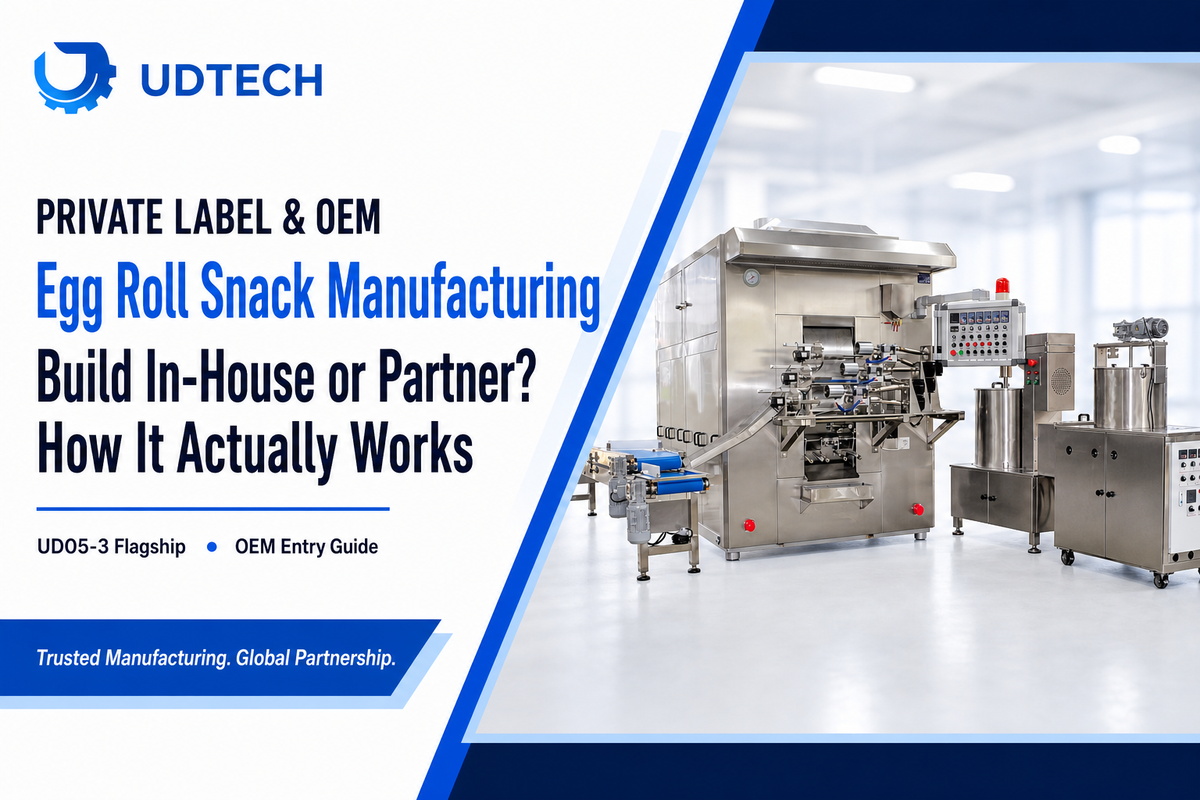
When reviewing a wafer egg roll line, start from the declared UD05-2 and UD05-3 capacity, footprint, power, and certificates. Ask for model-specific verification data for your region before RFQ release.
FAQ
What equipment needs to be NSF certified?
What certifies commercial food equipment?
Is HACCP a machine certification?
Is CE the same as food safety certification?
What documents should I ask a snack machinery supplier for?
References & Sources
- NSF Food Equipment Certification
- 21 CFR 117.40 Equipment and utensils
- 21 CFR 174.5 General provisions applicable to indirect food additives
- 21 CFR 178.3570 Lubricants with incidental food contact
- Directive 2006/42/EC on machinery
- Regulation (EU) 2023/1230 on machinery
- Regulation (EC) No 1935/2004 on food-contact materials
- Regulation (EU) No 10/2011 on plastic food-contact materials
- OSHA NRTL Program
- ISO 22000 Food Safety Management
- FDA list of American National Standards for Food Equipment
- UDTECH Automatic Egg Roll Machine