Polyvinyl chloride — PVC — is present in almost everything you walk past in a building, every wire you connect something to, and a good number of the IV bags you see hanging in hospital wards. Yet when a procurement engineer or product designer asks what is PVC material, the usual response is either a blurb from Wikipedia that says “third-largest synthetic plastic”, or a sales sheet that offers “durability and versatility” with no quantification. Both lack the granularity you need when specifying a wall-thickness, selecting the rigidity of grade, or determining if CPVC carries enough added value over PVC-U.
This document sets out to narrow that knowledge gap. We consider PVC as an engineering material – how much chlorine is needed for a given density, the processing window of a particular heat-stabilizer, the difference in additive requirements between G and H grade, and the cost of using a G over an H grade. The information pools peer-reviewed data, ASTM cell-class specifications, the 2025 VinylPlus Progress Report, and the 2026 industry guide into one easy-to-apply dual-unit paper a design engineer can paste into scope documents.
Quick Specs: PVC Material at a Glance
| Polymer family | Thermoplastic — vinyl chloride monomer (VCM) polymerized |
| Chlorine content | ~56% (standard PVC); ~66% (CPVC) |
| Density (rigid / flexible) | 1.3–1.45 g/cm³ rigid; 1.1–1.35 g/cm³ flexible |
| Tensile strength (rigid) | ~51.7 MPa (7,500 psi); ASTM D1784 cell 12454 min 7,000 psi |
| Heat deflection (1.82 MPa) | ~80°C (176°F) |
| Max continuous service | ~60°C standard PVC; ~95°C CPVC |
| Recycling code | #3 (V or PVC) |
| Global market position | Second or third largest thermoplastic by volume (varies by source year) |
What Is PVC Material? Composition and Definition
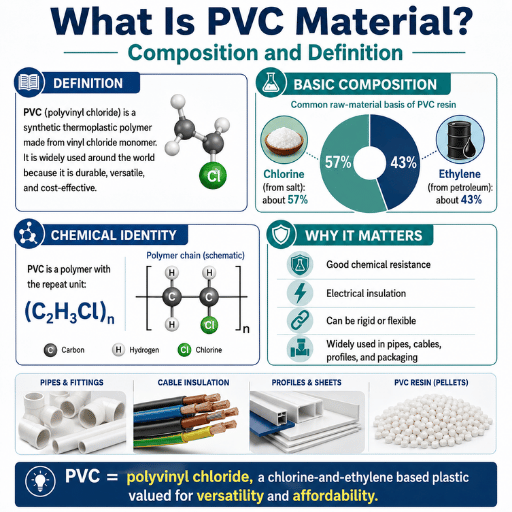
PVC as a material is a synthetic thermoplastic polymer synthesized from chains of vinyl chloride monomer(VCM). VCM production involves two steps: pyrolyzing ethylene dichloride to isolate the initial ethylene; and chlorinating ethylene to make the VCM. Once the vinyl chloride monomer (VCM) has been produced, it can be polymerised (cross-linking of the primacy chains can still occur) to produce the finished PVC (polyvinyl chloride) polymer chain. Average polymer chain length runs to several hundred repeating units, varying with reactor conditions and additive package, depending on grade and additive concentration. Any length of chain can be linked together to form the finished polymer, and each individual chain consists of +56% by element mass (i.e. dry), in the case of PVC, chlorides – an exceptional addition for a commodity plastic and the reason PVC is intrinsically flame retarded when polyethylene or polypropylene isn’t.
That high chlorine content matters for three reasons (per the 2022 peer-reviewed study): Density of the polymer is higher than polyolefins (typically in the 1.3-1.45 g/cm range for rigid grades, vs. in the 0.91-0.97 g/cm range for PE); Flame behaviour (LOI>45) is intrinsically self-extinguishing in air, whereas the general polyolefin behaviour is perpetuated under a typical plastic blowing-bag for incineration; and Long-term stability of the polymer is compromised for grades above ~100°C without multiple additives, as the Cl atoms want to release themselves from the chain as HCl during processing. Every polymer grade therefore starts its life with a heat stabilizer package.
Where does PVC sit in the market? A peer-reviewed study published through the U.S. National Library of Medicine in 2022 ranks PVC as the “2nd-most produced thermoplastic by volume, after polyethylene.” Industry guides such as the SpecialChem 2026 PVC reference book rank it third behind both polyethylene and polypropylene. Depending on year and index, either way the commercial output equivalent annually just shy of 40 million tonnes of plastic is heavily weighted toward the construction sector (pipes, profiles, sheeting), electrical/ electronic (cable insulation), and medical use.
Please see our side-piece on the polyvinyl chloride polymer overview for a historic account of the discovery of polyvinyl chloride and its early industry development. This article explores the engineering detail on what PVC is in the round, what the grades’ characteristics mean in an engineering sense, and how the process parameters of industrial machinery dictate performance.
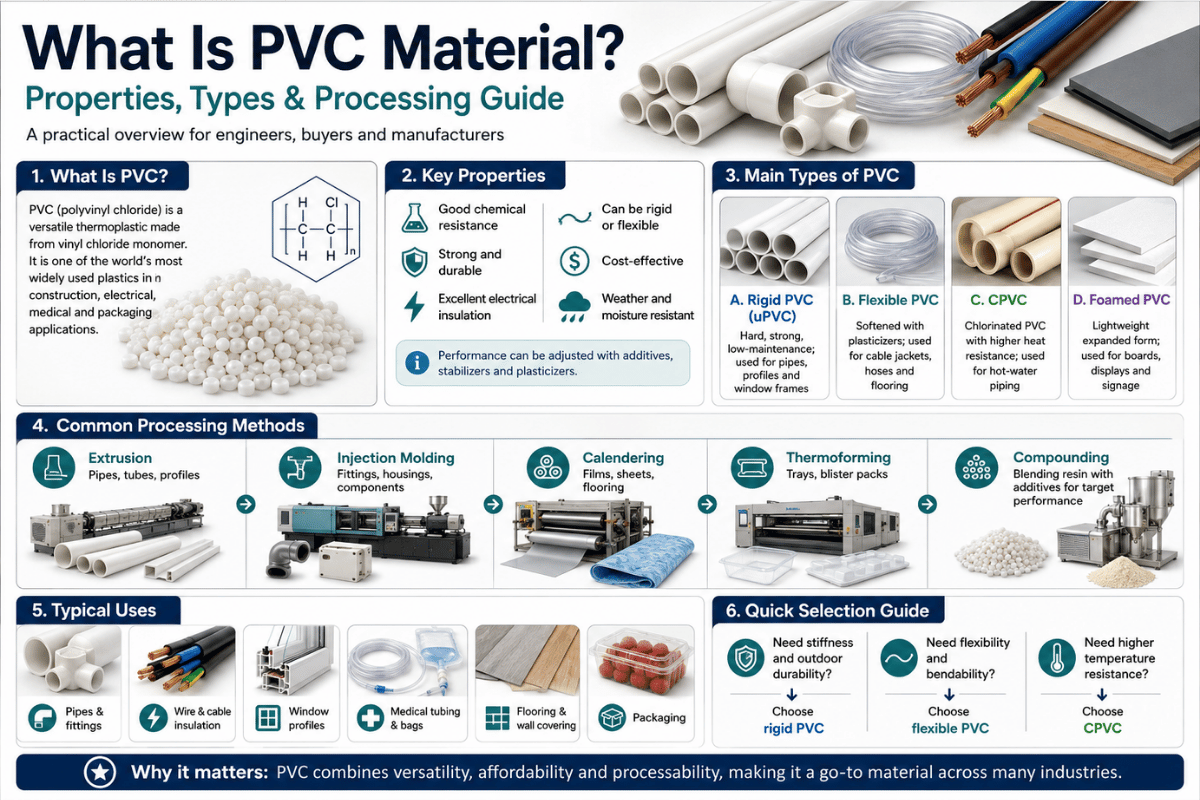
The Five Types of PVC Material (Rigid, Flexible, CPVC, PVC-O, Foam)
Knowing the term “PVC” by itself is a shortcut. Whatever PVC actually arrives on the 25-kilogram bag falls into one of five commercial families and selecting the wrong one is the single-most expensive piece of procurement error for PVC. Each family is characterized by a structural modification — a stabilizer added, the resin chlorinated, the molecules oriented, or the resin expanded — which yields a unique property profile.
| Type | Density (g/cm³) | Key Property | Typical Application | Main Trade-off |
|---|---|---|---|---|
| Rigid PVC (PVC-U / uPVC) | 1.3–1.45 | High stiffness, flame-retardant | Window profiles, drainage pipe, fittings | Brittle below ~5°C unmodified |
| Flexible PVC (PVC-P) | 1.1–1.35 | Bendable, impact-absorbing | Cable jackets, hoses, medical tubing | Plasticizer migrates over years |
| CPVC (Chlorinated PVC) | 1.50–1.58 | Service temp up to ~95°C | Hot water lines, fire sprinklers, chemical handling | ~2× the resin cost of PVC-U |
| PVC-O (Oriented) | 1.4 | Bi-axially stretched, fatigue-resistant | Pressure water pipe (PVC-O class 500) | Requires specialized line |
| Foam PVC (Expanded) | 0.45–0.85 | Lightweight, machinable | Signage, display boards, model-making | Lower mechanical strength |
Rigid PVC (uPVC) — When Stiffness and Cost Matter More Than Heat
PVC-U is carbide-filled, unplasticized resin. Individual polymer chains crystallize for maximum stiffness, static and dynamic properties are analogous to your existing PVC profile, and chemical resistance is excellent against most acids, alkalis, and inorganic solutions. This is why drainage piping is almost exclusively PVC-U. Balance: below 5°C (41°F) the unmodified resin turns brittle, and at above 50°C (122°F) parts will deform over time. Impact modifiers (typically carboxylated polyethylene or methyl methacrylate butadiene styrene) can keep the brittle point down, 12454 cell classification for pipe compounds follow ASTM D1784 cell classifications such as 12454 or 12364, which specify minimum tensile strength, Izod impact, and Young’s Modulus values.
Flexible PVC (PVC-P) — How Plasticizers Change Performance
PVC-P, or flexible, is unplasticized resin customarily compounded with 20-50 parts per hundred resin (phr) of a plasticizer — nearly all historically a phthalate (such as DEHP or DINP), with new, phthalate-free compounds such as DOTP, DINCH entering the market quickly. Plasticizer molecules sit between the resin’s polymer strands and increase the mobility of every polymer molecule, reducing the glass transition temperature from approximately 80°C to a room-temperature material that acts more like a soft elastomer. Over years, plasticizers (even down to worst-case tri-ortho-tolyl phthalate levels) slowly migrate out of the resin matrix. Thermoplasticians recognize the phenomenon immediately: the sticky, yellow surface of PVC garden chairs, the brittle cable jackets of 40-year old wiring looms, and the hardened PVC pitch of containers sat in woodland winter after winter.
What Is the Difference Between Rigid PVC and Flexible PVC?
It comes down to one ingredient: plasticizer. Compound PVC-U has stabilizers, pigments, impact modifiers, but no plasticizer, and stays at a Young’s Modulus of 2.83 gigapascals and a heat deflection temperature of about 80°C. Add 20-50 phr of plasticizer; flexural strength falls an order of magnitude, and room temperature performance becomes resilient. PVC-U and PVC-P have the same resin, and will behave differently until you need neither. For application split: any rigid-silent category; anything that must hold a shape without a strap; make-sure-something-doesn’t-sag category: rigid PVC ( conduit, profile, sheet, plumbing); impede-something-from-stopping category: flexible PVC (furniture, cable, flooring, conduit, upholstery). Read this deeper comparison for performance data on the rigid vs flexible question.
CPVC — When You Need Higher Heat Resistance
Chlorinated PVC is formed by a chemist to raise the chlorine content in PVC from 56% to about 66%. This hinders the crystallization of the polymer, and raises the glass transition temperature to about 90-95°C, making the material suitable for continuous use in residential hot-water plumbing, and industrial chemical handling. Trade-offs: roughly double the resin price and reduce the process window.
The 56-to-66 Percent Rule
Every percentage point of chlorine present in excess of 56% in current PVC increases continuous service temperature by about 40°C. Standard at 56% Cl maxes out at about 60°C; CPVC at 66% Cl itself maxes out at around 95°C. This trend is linear with 40°C/percent over 56% Cl; it allows you to quckly sort supplier hype. If a “high-temp PVC” datasheet boasts 56% chlorine and 95°C service, ask for resin chlorination certificate before approving.
PVC-O and Foam PVC — Specialty Forms
PVC-O takes amorphous PVC-U (Polyvinyl Chloride – unplasticized), and during forming uses biaxial stretching,aligning the molecular chains into a laminar structure. Reorganized chains roughly double the working pressure rating for the same wall thickness, which is why PVC-O class 500 pipe dominates pressurised civil water system in markets where it is available; that and the economic advantages of bold company marketing. Foam PVC introduces a chemical (or physical) blowing agent while melting, producing a closed-cell sheet at densities down to 0.45 g/cm light enough to machine on woodworking tools, stiff enough for signage and prototype enclosures.
PVC Material Properties: Engineer-Grade Specs
The single reason that engineers report for not specifying PVC properly is absent or mismatched property data. SpecialChem publishes in metric units; Essentra and most North American datasheets default to imperial. Our table below consolidates peer-reviewed mechanical data with industry-standard ASTM cell-class minimums in both unit systems; each source traced by footnote.
What Is the Density of PVC Material?
Density of PVC varies by flavor–rigid or flexible–and filler content. Rigid PVC-U is generally 1.3-1.45 g/cm (0.047 0.052 lb/in). Flexible PVC-P, plasticizer-diluted, averages 1.1-1.35 g/cm. CPVC is noticeably denser at 1.50 1.58 g/cm from over chlorination. For perspective, polyethylene clocks in at 0.91 0.97 g/cm, and polypropylene 0.90 0.92 g/cm ; PVC is therefore roughly a factor of 50% heavier for the same volume, which is important either when working out shipping costs per linear meter of pipe, or when buoyancy at the design requirement.
Mechanical Properties at a Glance
| Property | SI Units | Imperial Units | Notes |
|---|---|---|---|
| Density (rigid) | 1.3–1.45 g/cm³ | 0.047–0.052 lb/in³ | Varies with filler load |
| Tensile strength | ~51.7 MPa | 7,500 psi | ASTM D1784 cell 12454 min: 48.3 MPa |
| Tensile modulus | ~2.83 GPa | 411,000 psi | Cell 12454 min: 3.0 GPa (440,000 psi) |
| Flexural strength | ~88.3 MPa | 12,800 psi | At yield, rigid |
| Flexural modulus | ~3.32 GPa | 481,000 psi | 3-point bend, 23°C |
| Heat deflection (1.82 MPa) | ~80°C | 176°F | HDT drops with plasticizer load |
| Continuous service temp | 60°C (rigid) / 95°C (CPVC) | 140°F / 203°F | Long-term, unstressed |
| Glass transition (Tg) | 70–80°C | 158–176°F | Higher in CPVC (~110°C) |
| Brittle point (unmodified rigid) | ~5°C | 41°F | Lower with impact modifiers |
| Water absorption (24 h) | ~0% | ~0% | Rigid PVC, ASTM D570 |
| Limiting Oxygen Index (LOI) | ≥45 | ≥45 | Self-extinguishing in air |
| Dielectric strength | 14–20 kV/mm | 355–510 V/mil | Why PVC dominates cable insulation |
Thermal Behavior — Why PVC Has Three Different Temperatures You Need to Track
Engineers often cite one PVC temperature, and fail to recognize that the polymer reacts to three distinct thresholds. Glass transition (Tg) at 70–80°C is where rigid PVC begins to reduce its stiffness because the polymer softens – critical to any part placed under sustained load above this temperature. Heat deflection (HDT) at 80°C through 1.82 MPa is the temperature at which a standardized specimen visibly bows and deflects, used for comparing datasheets. Continuous service temp at ~60°C is the prudent long-term maximum for un-stressed parts in air; it is half way between Tg and HDT because fuel creep and chemical material breakdown is cumulative, and the HDT test does not include the effects of creep. CPVC shifts all three values roughly 30°C.
Chemical Resistance — Is PVC Material Waterproof?
There is no other resin that absorbs virtually nothing in 24 hours when tested to ASTM D570-00 and that is why PVC pipe, sheet and tank linings are specified for water service. This polymer is also resistant to dilute acids and dilute alkalies, aliphatic hydrocarbons, alcohols and most inorganic chemicals-when you see a PVC-U inside lining used in industry drainage, plating tanks and lab workbenches: you’re seeing this property used to good effect.What attacks PVC: ketones (acetone, MEK), esters, aromatic hydrocarbons (benzene, toluene), chlorinated solvents, aromatic ethers and amines. Flexible PVC exhibits a lower chemical resistance to these solvents than can rigid formulations because the plasticizer is extracted from the resin leaving the polymer backbone in a more rigid and brittle state.
How PVC Is Made: From Vinyl Chloride to Resin
How does this affect your buying decision? In some ways it doesn’t matter, but in others it makes a huge difference. Two dominant production processes — suspension and emulsion polymerization — produce powders with very different particle morphology, and this in turn determines what downstream processing can be achieved. Knowing exactly what process a resin is suitable for is therefore an advantage when consulting your supplier-about eliminating most compatibility issues prior to the extruder; asking, “Suspension or emulsion?” does this for you.
From Ethylene to Vinyl Chloride Monomer (VCM)
Starting with ethylene reacting with chlorine to make ethylene dichloride (EDC). A cracker pyrolyzes EDC to vinyl chloride monomer plus hydrogen chloride. Captured HCl recycles back to the chlorination step, in order to close the chlorine loop. VCM is the feedstock for the polymerization; it is a colorless gas at room temperature which must be handled in pressure vessels under strict OSHA limits of exposure.
Suspension Polymerization (S-PVC) — The 80% Standard
Suspension polymerization accounts for around 80% of the world production of PVC. VCM is kept suspended as droplets in water within a pressure tight reactor with a minor amount of a polymerization initiator and protective colloid to maintain the particles as discrete entities. As they polymerize they get larger and eventually become a solid PVC particle. Typical suspension resin has a mean particle size of 100–150 µm, a mean particle size with a range of 50-250 microns and with excellent flow and plasticizer uptake characteristics- the combination of which make it the standard extrusion and most flexible cable compound resin.
Emulsion Polymerization (E-PVC) — For Coatings and Pastes
Emulsion polymerization is quite different-start by dispersing VCM in water by use of surfactant rather than a mechanical device. Emulsion polymerization yields much finer particles — mean size 40–50 µm, primary particles in the 0.1-1 micron range- and are supplied in the form of pastes for dip-coating, spread coating and rotational molding applications. Paste grade resins normally costs more gram for gram than suspension grade, since the paste resins are suitable for more traditional paste applications- flooring, wallpaper backing, automotive underbody coatings and toys.
📐 Engineering Note
Finally, always ask your supplier for the K-value of the resin under consideration (K-value gives an indication of the molecular weight from measuring the solution viscosity). For rigid pipe, K-65 to K-67 is standard; for cable insulation this is K-70; and for injection-molding fittings this is K-57. Using the wrong K-value for a particular process is the most common cause of the-processing problem so-called, “the resin runs but the part is brittle” and the solution is needed some where before the extruder, not within the screw profile.
Processing PVC: Extrusion, Injection Molding, and Real Shop-Floor Parameters
PVC exhibits the narrowest processing window of any commodity thermoplastic. While it begins to release HCl at about 150°C, once initiated the dehydrochlorination catalyzes itself in a runaway reaction that ultimately results in a charred resid, pitted screws, and a yellow-brown extrudate. A fastidious PVC processor will stay within a cool hothouse about 40°C wide while making record limits and still grow enough shear that the compound is thoroughly homogenized.
Injection Molding Parameters — Plasticized vs Rigid PVC
| Parameter | Plasticized PVC | Rigid PVC |
|---|---|---|
| Melt temperature | 170–210°C | 170–210°C |
| Mold temperature | 20–60°C | 20–60°C |
| Mold shrinkage | 1.0–2.5% | 0.2–0.5% |
| Injection pressure | Up to 150 MPa | Up to 150 MPa |
| Recommended screw L/D | 18–22 | 15–18 |
| Moisture limit (pre-dry) | < 0.3% | < 0.3% |
Extrusion Parameters — Why Run 10–20°C Below Injection Temps
Extrusion residence times are 3-5 times longer than injection molding. That longer dwell time means that PVC experience the hot-zone for a lot longer, and the total thermal dose is more important than maximum. Typical extrusion compounding processes run the melts temperatures 10-20°C below what the injection business considers the range- typically 160-185°C for rigid pipe, a little hotter in the flexible compounds where plasticizers lower the viscosity sufficiently. Compression ratios are different: rigid pipe extrusions somewhat lower shear vis-a-vis polyolefins- 2.0-2.5:1 in the PVC screw vs. 3:1 (or more) in the polyolefins. For a longer discussion of this aspect of PVC, see our reference on compression ratio for PVC processing.
What Temperature Does PVC Melt At?
PVC does not have a ‘sharp’ melting point- its transition range is 100-260°C (212-500°F) because the polymer is mostly amorphous. In practice, the three operating ranges are: glass transition (~70-80°C), in which the polymer softens in a load; the processing temperature (~170-210°C); and the onset of degradation (~210°C), where HCl begins to be the runaway reactant. Locate the barrel temperatures in the 170-210°C corridor, take the melt temperature directly from the thermocouple in the die head, and never let PVC sit in a stopped barrel above 180°C for more than 5-10 min.
Why Thermal Stabilization Matters — The HCl Self-Acceleration Risk
Pure, unstabilized PVC resin will begin to dehydrochlorinate at processing temperatures, releasing HCl. This gas is corrosive to steel, autocatalytic, and slightly acidic, the turning the resin darkening and then charred. Thermal stabilizer packages (calcium-zinc, tin, lead) will neutralize the HCl as rapidly as it is produced, keeping the part ‘colorless’ through processing. Stabilizer choice affects regulatory compliance more than performance- calcium-zinc is now dominant in the European Union and rapidly gaining dominant position in North America; tin is still common in transparent rigid PVC formulations; lead was removed from EU compounds by 2015 and phased out of North American formulations by 2010.
All in our PVC formulation process steps- the complete flow path from stabilizer, plasticizer, filler and lubricant packages into the extruder feeding the die) can be located here: PVC compounding process explained. For selecting an extruder type for your specific PVC product, see dedicated PVC extruder selection.
How Additives Shape PVC: Plasticizers, Stabilizers, Fillers, Lubricants
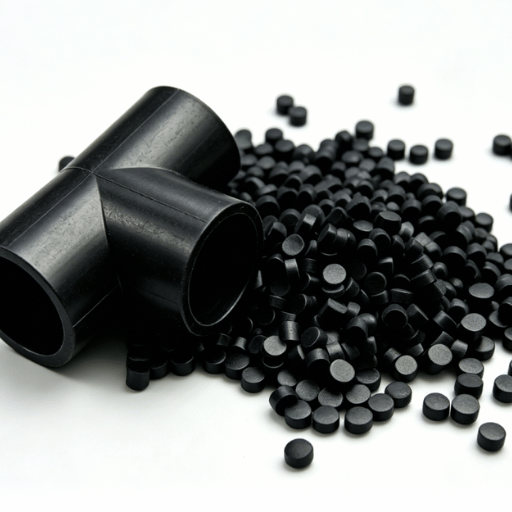
PVC resin directly from the polymerization reactor is not available to you. It is not in any shape or form like a usable resin; the resin is inherently thermally unstable, brittle and viscous past what any extruder can process. A finished compound that reaches your line typically blends four additive classes. Plasticisers, heat stabilizers, fillers, and lubricants packed to a recipe, all with depending on the final application. Once you under stand what each does, one can turn a series of listing percentages for a PVC specification into a picture of the property of the coming compound.
| Additive Class | Function | Common Examples | Selection Driver |
|---|---|---|---|
| Plasticizer | Softens, lowers Tg, increases flexibility | DEHP, DINP, DOTP, DINCH, citrate | End-use regulatory + flexibility target |
| Heat stabilizer | Neutralizes HCl during processing | Calcium-zinc, organotin, lead (phased out EU) | Regulatory region + transparency need |
| Filler | Reduces cost, modulates stiffness, opacity | Calcium carbonate, TiO₂, talc, clay | Cost target + mechanical balance |
| Lubricant | Reduces internal/external friction in melt | Paraffin wax, stearic acid, oxidized PE wax | Process window + die release behavior |
In addition to these four basic classes, ultra modern compounds may include impact modifiers, (CPE, MBS, acrylic), ultraviolet stabilizers, in order to allow products for outdoor use, processing aides to increase the temperature window, and pigments to add the color. Typical rigid PVC pipes and fittings running 100 phr resin plus 4-6 phr stabilizer plus 5-15 phr filler plus 1-2 phr lubricant plus 5-8 phr impact modifier; flexible cable jacket compounds replace most filler with 30-50 phr plasticizer.
Industry practitioners frequently encounter buyers who assume plasticizer simply “makes the plastic softer.” It does — but the plasticizer is not chemically bonded to the polymer. Over the years and including if exposed to heat or contact with absorbent materials, the plasticizer migrates to the surface and into adjacent materials. Visible symptoms include sticky surfaces on aging vinyl articles and embrittlement of several-decades old cable jackets losing the plasticizer. For high-temperature outdoor applications, engineers should opt for low-migration plasticizers such as DINP or DOTP; or switch to a TPE/TPU, if a plasticizer will be used at all.
Is PVC Safe? Toxicity, Phthalates, and Regulatory Status
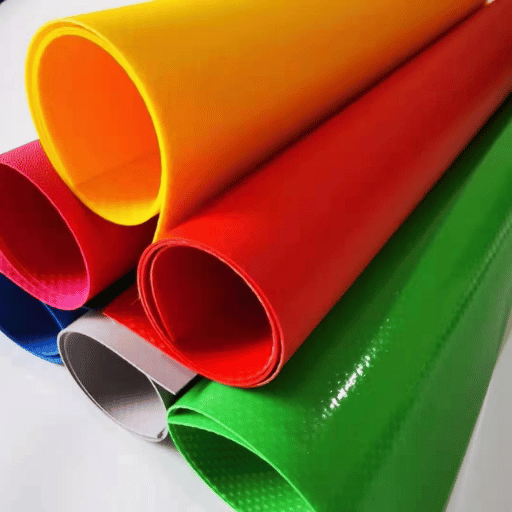
The question of toxicology of PVC is substantive but far less vague in its specifics than often portrayed to the lay person. Polymerized vinyl chloride itself is biologically inert; the same characteristics that make it ideal for use in blood and IV bags also makes it non-aqueous etiology of contaminant toxicology concerns. Concerns center on additives (specifically certain phthalate plasticizers and lead stabilizers) and end-of-life incineration of end-of-life products center on one or more of three elements: vinyl chloride monomer (a known carcinogen but heavily controlled during manufacturing); additives into the final product (specifically phthalate esters and lead stabilizers); and incineration of post-consumer plastics (releasing HCl and dioxins if not done properly).
Is PVC a Good Material? Weighing Benefits Against Concerns
That PVC has held its dominance in construction, medical applications, and electrical wire and cable for so long speaks for the cost-performance advantages it has over competitor materials that cannot match its scale. Its inherently flame-retardant (without added halogen), it’s inexpensive, dimensionally and electrically stable and recyclable in code #3, thermoplastic streams. Valid concerns — phthalate migration out of flexible formula, lead in premier stabilizers, chlorine in post-consumer waste streams, have been solved in the market place through additive substitution and recycling system development rather than through loss of the polymer. It is rule associated with bounded, monitored, phased out (over time) usage rather than outright ban.
The Phthalate Question — DEHP, DINP, and Phthalate-Free Alternatives
In PVC, phthalates are by far the most common class of plasticizers. Several –DEHP, BBP, DBP- are on the EU REACH list of SVHCs and are restricted for use in consumer products. Others –DIMP, DIDP, DINP- are still in use and less tightly regulated.
Non-phthalate alternatives such as DOTP (terephthalate), DINCH (cyclohexanoate), citrate esters are increasingly overwhelming the field of medical, food-contact and toy applications in Europe and North America. A simple rule to buying is to know which plasticizer chemistry to look for on the supplier spec sheet and cross check it with the regulatory list for your market category.
Lead Stabilizers — EU Phase-Out Complete, Asia Transitioning
Lead-based heat stabilizers were the heart of the industry for many years as they provided a high level of thermal protection for an affordable price. Europe’s PVC industry phased out lead-based heat stabilizers under Vinyl 2010, and completed this by the end of 2015 in all 28 EU countries. Asian and other developing markets are still embarking on this route, therefore if you purchase PVC compound outside of Europe but your finished product will be supplied to either EU or North American markets, the stabilizer chemistry must be specified in writing and back-up with Mill Test Certificates.
PVC Recyclability: Mechanical, Chemical, and Feedstock Recycling
Polyvinyl chloride carries recycling code #3 and is recyclable through three distinct routes — mechanical, chemical, and feedstock — each suited to different waste streams. Mechanical recycling dominates by volume: PVC scrap is shredded, washed, ground, and remelted into a new compound, suitable for non-critical applications such as cable conduit, garden hose, or building profile.
Chemical recycling depolymerizes PVC back to monomers or smaller molecules that re-enter the petrochemical value chain. Feedstock recycling thermally treats PVC waste to recover hydrogen chloride and carbon-rich fractions, which return to the chlorine cycle that started the polymerization.
Chemical recycling goes further than mechanical and results in depolymerising the PVC, converting the polymer back to mono/polymeric units for manufacture of new polymers or chemicals which are further along the petrochemical value chain. Feedstock recycling consists of the polyvinyl chloride being thermally recycled, whilst recovering HCl and high calorific value carbonrich fractions, this then puts the released molecules back into the previous cycle of the cycle again, the chlorine cycle used to produce the original polymer (HBH Bock Ltd. 2003).
Recyclers in Europe reported a production of 1.4million of recycled plastics in 2012. PVC was the most predominant recycled polymer at 54.1%, followed by polyethylene and polypropylene which was a consequence of the insulation of the processes of PVC pipe, window profile and flooring waste stream development.
— Adapted from VinylPlus Progress Report 2025
In the European industry, the VinylPlus 2030 Commitment has set itself a goal of 1 million tonne/year of recycled PVC by 2030, with a milestone of 900 000 tonne/year by 2025. According to the 2025 Progress Report, the program is on track. Canada and the United States also have such parallel programs through the Vinyl Institute+Vantage Vinyl certification program, while the Vinyl Council of Australia has its own PVC Stewardship Program.
These programs means traceable recycled-content claims for procurement can be made which can bolster a company’s ESG report.
Industry Outlook 2026: Bio-PVC, Sustainability Pressure, and What’s Changing
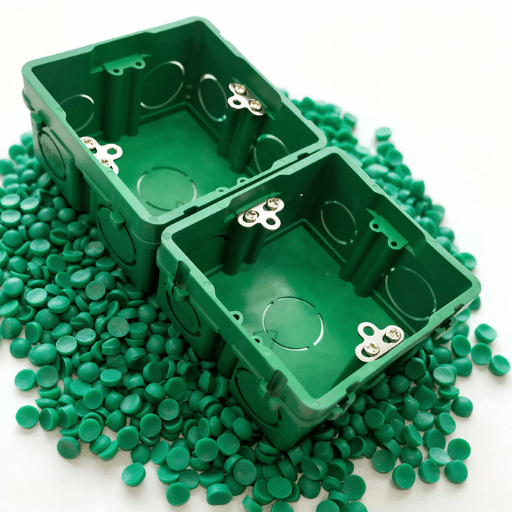
Between now and 2027, three distinct forces are impacting PVC purchasing decisions, and each one has a clear action point that engineers and procurement teams must consider as they specify materials:
Bio-attributed PVC reaches commercial volumes. Through mass-balance certification, several European and Asian PVC producers now supply bio-attributed grades — chemistry-identical PVC where the ethylene feedstock is replaced with bio-naphtha or tall-oil derivatives, allocated through ISCC PLUS certification. Performance is indistinguishable from fossil-derived PVC; price premium runs 15-35% in 2026.
For ESG-focused initiatives, bio-attributed PVC is the lowest-effort decarbonization path for PVC applications without redesigning the part. Worth tracking: Chemson’s 3DVinyl pellet-fed printing material and the bio-attributed grades from Inovyn and Westlake.
Regulatory press remains on phthalate plasticizers. EU has been steadily phasing out DEHP, BBP, DBP and DIBP under REACH Annex XVII, with 2026 being likely to include yet more phthalates for SVHC and PAN tightening. If you are specifying flexible PVC for any product heading into EU or California markets in 2026-7, check plasticizer chemistry against current SVHC list and seek suppliers confirmation that DOTP, DINCH or citrate esters have been substituted for legacy phthalates.
Recycled-content requirements are also spreading past Europe, with indications of it becoming an essential to any purchasing decision. Europe’s revised Packaging and Packaging Waste Regulation (PPWR) sets mandatory recycled-content limits (to be introduced from 2030) on plastic packaging at the manufacturing level, with a number of individual States in the US already enacting similar requirements. For some PVC converted product, including those which exist in same packaging interaction – shrink film, blister packs, label stock – recycled-content qualifications are no longer a marketing tool but a must have for your supply chain.
VinylPlus’s ambitious 1m tpa by 2030 goal offers European converters an audited pool of supplies; North American converters should be developing a recycled-PVC contact list prior to 2027 purchase.
For 2026 planning, if you’re in regulated end-use areas (medical, food contact, toys, EU consumer products), prioritize qualifying phthalate free PVC formulations before it becomes a reactive reformulation challenge when added to SVHC list. Non-regulated industrial end-use areas (pipe, profile, technical sheet) the PVC cost vs performance issue is sustained through the decade, procurement risk is buyer concentration rather than material change.
Frequently Asked Questions
Is PVC rubber or plastic?
View Answer
What is the disadvantage of PVC?
View Answer
What does CPVC stand for and when do I choose it over PVC?
View Answer
How long does PVC last?
View Answer
What is PVC compounding?
View Answer
Can PVC be 3D printed?
View Answer
Designing a PVC extrusion line for pipe, profile, sheet, or compounding?
About This Guide
This guide pulls PVC specification overview originates from SpecialChem 2026 trade documentation, the 2024 and 2025 VinylPlus Progress Reports, ASTM specifications D1784 cell-class, and sabermetric research indexed by the national medical literature database of the U.S. Assembled dual-unit specifications are a compromise of SI and imperial nomenclature experienced by our client base when choosing PVC extrusion tooling and downstream appliances.
References & Sources
- VinylPlus 2030 Commitment — VinylPlus (European PVC Industry)
- VinylPlus Progress Report 2025 — VinylPlus
- VinylPlus Progress Report 2024 — VinylPlus Deutschland
- Classification Standards — ASTM D1784 / D3222 — Plastics Pipe Institute
- Synthesis and Characterization of Polyvinyl Chloride Matrix Composites — U.S. National Library of Medicine (PMC)
- Scientists develop novel method for strengthening PVC products — Ohio State University News
- Polyvinyl Chloride (PVC) Plastic: How to select the right grade — SpecialChem (updated April 2026)
Related Articles
- Rigid PVC vs Flexible PVC — Side-by-Side Property Comparison
- PVC Compounding Process Explained — Recipes and Equipment
- Compression Ratio for PVC Processing — Why Polyolefin Screws Fail
- Dedicated PVC Extruder Selection — Single vs Twin Screw
- Which Extruder Type Is Preferred for PVC Pipe Production
- PVC Applications Across Industries — A Reference Map