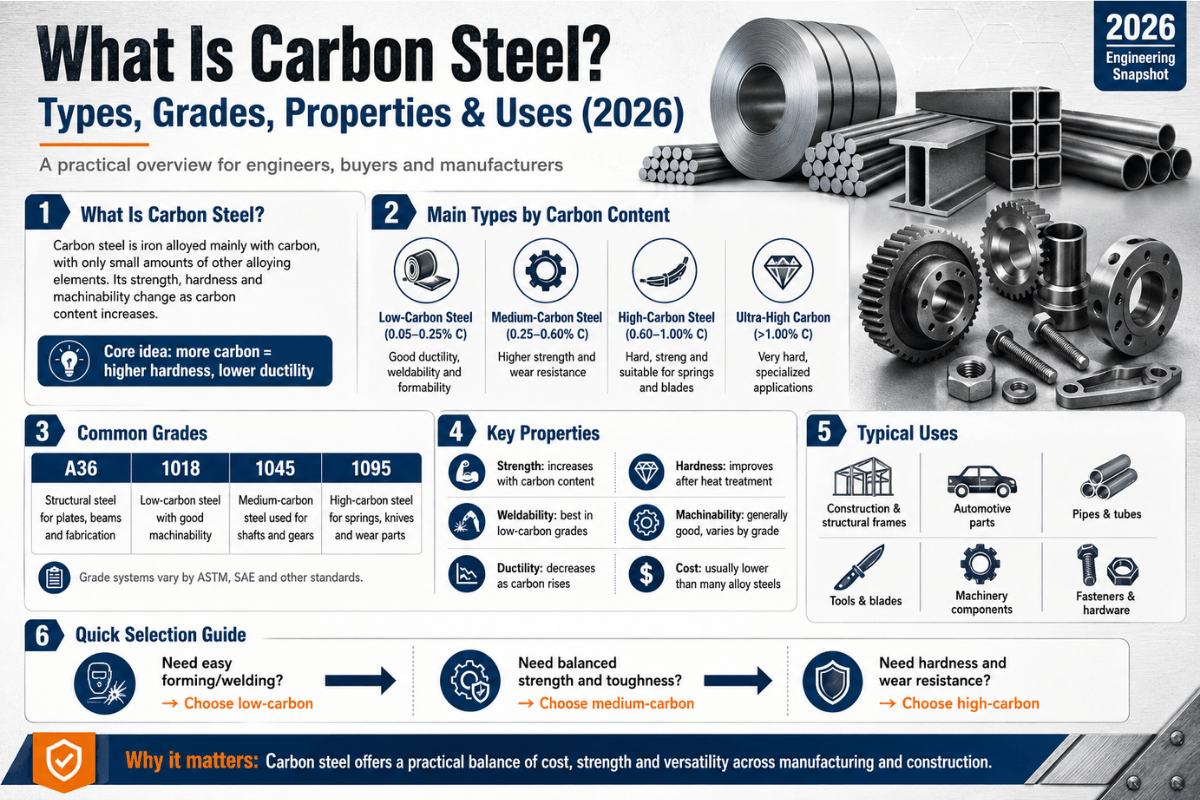
Carbon steel is the steel family carrying a carbon content between 0.05% and 2.10% by weight — and it is the most heavily used structural material on earth. According to AISI, the line between carbon steel and alloy steel is drawn by ceiling values on residual elements: manganese ≤1.65%, silicon ≤0.60%, copper ≤0.60%. Cross any one of those, and the same iron-carbon mixture becomes an alloy steel. This guide walks through the four grades, the engineering numbers that matter, how carbon steel compares against stainless, which ASTM specifications to call out on a drawing, and how modern fiber lasers cut and weld it.
Quick Specs: Carbon Steel at a Glance
| Carbon range (AISI) | 0.05 – 2.10% by weight |
| Density | 7.85 g/cm³ (0.284 lb/in³) |
| Young’s modulus | 200 GPa (29,000 ksi) |
| Melting point | 1,425 – 1,540 °C (2,600 – 2,800 °F) |
| Yield strength range | 36 ksi (A36) up to ~115 ksi (high-carbon spring grades) |
| Magnetic? | Yes — ferritic and martensitic carbon steels are ferromagnetic (BCC crystal structure) |
| Common grades | A36, A53, A572, A500, A106; AISI 1018 / 1045 / 1095 |
| Typical fiber-laser cut limit | ~25 mm at 6 kW, ~40 mm at 12 kW, up to 60 mm at 20 kW (mild steel, O₂ assist) |
What Is Carbon Steel? Definition, Composition & How It’s Made
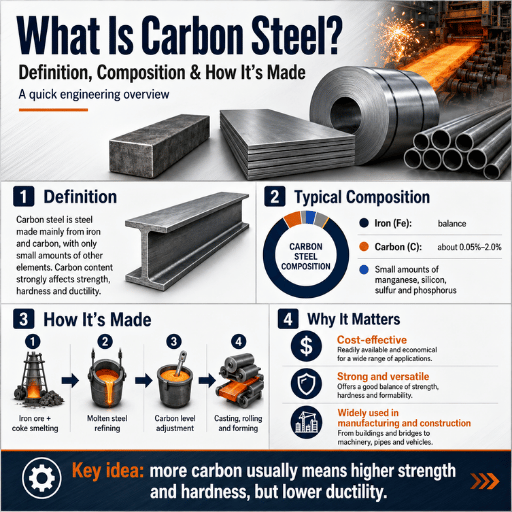
Carbon steel is an iron-based alloy where carbon is the principal strengthening element. Carbon sits between roughly 0.05% and 2.10% by weight; below that range you have wrought iron, and above 2.1% you cross into cast iron territory. The American Iron and Steel Institute (AISI) draws a sharper line: a steel only counts as carbon steel when no minimum chromium, cobalt, molybdenum, nickel, niobium, titanium, tungsten, vanadium or zirconium is specified for alloying effect, copper stays below 0.40% minimum, and manganese, silicon and copper individually do not exceed 1.65%, 0.60% and 0.60% respectively.
That manganese ceiling is the most operationally significant limit. Cross 1.65% manganese – the norm for many contemporary high strength low alloy (HSLA) grades – and the same general ferric carbide mix is an alloy steel by AISI’s criteria, even if there isn’t a trace of chrome or nickel in sight. The European EN 10020 adopts a different strategy of dividing steels into “non-alloy quality” (roughly, carbon steel) and “non-alloy special” grades made in tighter chemistry tolerances for the response to heat-treatment.
Trace amounts of phosphorus, sulfur and silicon are present in every commercial grade. Phosphorus raises strength but also increases brittleness. Sulfur improves machinability but degrades ductility, weldability and impact toughness. Chemistry sits in balance between mechanical response and processability — the entire reason there are dozens of named grades rather than a single “carbon steel.”
How Is Carbon Steel Made? (BOF vs EAF in Two Minutes)
There are two main routes. In a basic oxygen furnace (BOF) an initial pig iron, obtained in a blast furnace, is cast into a vessel containing “scrap” (recovered steel) and “blown” with pure oxygen. This oxidizes the remaining carbon in the pig-iron until the percent concentration needed for a particular product in the steel is achieved.
An electric arc furnace (EAF) is used to remelt “scrap,” or (increasingly) direct-reduction iron (DRI), by arcs using carbon electrodes. Chemistry of the product is then adjusted by pouring it into a special ladle (a furnace within the furnace) where it is agitated with superheated gases to vent off unwanted gases, add/subtract carbon and manganese as needed.
In 2024, EAF supplied more than 70% of US steel output, and the preference is expanding worldwide as availability of scrap feed stock increases and the pressure to decarbonise assumes ever greater urgency. For purchase planning, a clear practical distinction can be made here: BOF electric arc suppliers typically maintain closer chemistry control using virgin feedstock, whereas EAF suppliers accept a wider range of scrap materials and so should have wider tolerances, which explains why (see MTC checklist on following page), a Mill Test Certificate now counts so much more.
The Four Grades of Carbon Steel: Low, Medium, High & Ultra-High
AISI categorizes carbon steel into four classes by carbon content. Each range has its unique strength-ductility compromise, its set of designated grades, and its typical applications. Mastery of four-grade chart is the single most fundamental skill in specifying carbon steel.
| Grade Class | Carbon (% by wt) | Named Grades | Typical Use | Weldability |
|---|---|---|---|---|
| Low / Mild | 0.05 – 0.30% | A36, AISI 1018, 1020, S235 | Structural beams, car body panels, rebar, sheet metal | Excellent |
| Medium | 0.30 – 0.60% | AISI 1040, 1045, 1050 | Axles, gears, crankshafts, large forgings | Good (preheat often required) |
| High | 0.60 – 1.00% | AISI 1075, 1080, 1095 | Springs, edged tools, high-strength wire | Difficult — PWHT required |
| Ultra-high | 1.00 – 2.10% | D2 (~1.5% C), AISI 15xx series | Punches, dies, knives, specialist tooling | Poor — generally not welded |
One trend is true through out: as you go up in carbon, the MPA and tensile strength in the grain goes up but ductility, impact toughness and weldability all go down. Above about 0.30% carbon a steel is process-responsive, meaning that through a carefully controlled quench and temper process it can be furnished with a predictable hardnesses. Below 0.30% the structure is primarily ferrite-and-pearlite and won’t change significantly with quenching.
What Are the Most Common Carbon Steel Grades?
In North American structural fabrication, ASTM A36 (mild steel, ≈0.26% C, 36 ksi yield) dominates volume. In machine-shop repair work, AISI 1018 is the workhorse — low-carbon and easy to weld, but hardenable enough through case-hardening to make pins, shafts and rollers. In springs and edged tools, AISI 1095 (≈0.95% C) is the default high-carbon grade. Outside the US, S235JR (the European equivalent of A36) and SS400 (the Japanese JIS structural grade) cover the same role.
When engineers are told “mild steel,” it always means A36 inside the United States, S235JR inside the European Union and SS400 inside Japan/Korea. Confirm the local default before quoting because mechanical properties vary by about 5% with these “equivalent” grades
Carbon Steel Properties: Strength, Hardness, Magnetism & Density
Physical properties of carbon steel are quite similar across steels grades – the melting point, density and modulus don’t change much with carbon content. What do change considerably with carbon are the load-related properties – yield strength, tensile strength, impact strength, hardness.
| Property | Value | Notes |
|---|---|---|
| Density | 7.85 g/cm³ | Slight drop with rising carbon (≈0.02 g/cm³ across 0–1% C) |
| Young’s modulus | 200 GPa (29 Msi) | Effectively unchanged by carbon content — heat treatment does not alter elastic modulus |
| Shear modulus | ~80 GPa | Derived; useful for torsional design |
| Poisson’s ratio | ~0.29 | Standard across all carbon grades |
| Thermal expansion (20 °C) | 11–13 × 10⁻⁶ /°C | Critical for hot-roll vs cold-roll dimensional planning |
| Yield strength | 36 – 115 ksi | A36 mild = 36 ksi; A572-65 HSLA = 65 ksi; quenched-and-tempered 1095 → 100+ ksi |
| Melting point | 1,425 – 1,540 °C | Drops slightly with higher carbon (eutectoid at 727 °C) |
| Electrical resistivity | 15–20 µΩ·cm | Roughly 7× higher than copper — why steel makes poor electrical conductor |
Numbers in the table that engineers reach for most often are density (for weight calculations on plate, pipe and structural shapes) and Young’s modulus (for deflection and buckling analysis). Both are independent of carbon percentage — a fact that catches new engineers off guard. A 5/8″ A36 plate and a 5/8″ 1095 plate weigh the same and bend under load with the same elastic stiffness. Carbon only changes what happens after you exceed the yield point.
Is Carbon Steel Magnetic?
Yes — almost all carbon steel is ferromagnetic. Reason is structural: at room temperature, iron atoms in carbon steel sit on a body-centred cubic (BCC) lattice when the steel is in its ferritic or martensitic state. BCC iron is ferromagnetic because the nearest-neighbour spacing of iron atoms is exactly the distance needed for the “exchange coupling” that aligns electron spins into magnetic domains. Above the Curie temperature (~770 °C for pure iron, slightly lower for high-carbon grades), the spins decouple and the steel becomes non-magnetic — but in any normal workshop temperature range, a magnet will grab carbon steel.
Contrast with austenitic stainless steels (304, 316) is instructive. Their face-centred cubic (FCC) lattice has a different nearest-neighbour spacing, exchange coupling breaks down and the steel remains non-magnetic in the as-supplied condition. Heavy cold work can locally transform some austenite into martensite so a bent 304 sheet sometimes shows weak magnetism along the bend line – but the bulk material is weakly magnetic at best, still well below carbon-steel response.
Practical consequences: carbon steel parts can be lifted by magnetic chucks, sorted with magnetic separators in scrap yards, and located by inductive sensors. Carbon steel storage tanks hold magnetic stir bars. A 304 sink will not. Pulsed-fiber laser cleaning equipment exploits the same magnetic and absorptive properties to strip rust from carbon steel without touching the substrate.
Carbon Steel vs Stainless Steel: Cost, Corrosion & Weldability
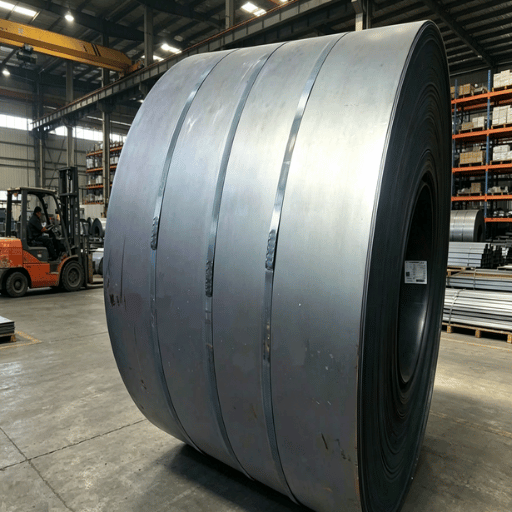
Deciding to specify carbon or stainless is one of the first steps on any fabrication. Both families share the same iron base but behave very differently because stainless contains a minimum of 10.5% chromium, which forms a thin self-repairing chromium-oxide film on the surface. That passive layer is all that prevents stainless from rusting in normal air. Carbon steel has no such film and will develop red iron-oxide rust as soon as it encounters moisture, unless coated.
A useful logical framework: don’t ask “which is better” – ask “which combination of cost, exposure to corrosion, weldability, strength and weight best suits the application.” The matrix below compares the two families in five decision criteria that drive most real-world choices.
| Criterion | Carbon Steel (A36 baseline) | 304 Stainless Steel |
|---|---|---|
| Mill cost (per lb) | ~$0.50 – $0.90/lb (typical 2025 EXW) | ~$1.80 – $2.80/lb (2:1 – 4:1 premium, varies by alloy surcharge — verify with supplier) |
| Corrosion in marine air | Rust within days unless coated | Decades of service without rust |
| Yield strength (annealed) | 36 ksi (A36) → 50–65 ksi (HSLA) | ~30 ksi (304, annealed) |
| Weldability | Excellent (low C); requires preheat at >0.30% C | Good with matched filler (ER308L/316L); risk of sensitisation above 425 °C |
| Density | 7.85 g/cm³ | 7.90 – 8.00 g/cm³ (nearly identical) |
| Magnetic? | Yes — ferromagnetic | No (austenitic 304/316 in as-supplied state) |
✔ Pick Carbon Steel When
- Cost-per-pound is the dominant constraint
- The part will be painted, galvanised, or kept indoors
- You need ≥50 ksi yield (HSLA grades)
- The part will be heat-treated for hardness
- Volumes are large and surface finish doesn’t matter
⚠ Pick Stainless When
- The part contacts food, water, chemicals or marine air
- Long service life without coating is required
- A non-magnetic surface is needed (medical, electronics)
- Hygienic cleaning is part of the operating cycle
- The visual finish (mill #4 or #8) is part of the product
One myth worth correcting: carbon steel always rusts faster than stainless. Correct in bare condition — but a well hot-dip galvanised carbon steel beam outlives most 304 stainless in aggressive industrial atmospheres at one-third the cost. Coatings change the situation. An honest question on every project is not “carbon or stainless?” but “carbon-plus-coating-systems, or stainless?”
Can You Weld Carbon Steel to Stainless Steel?
Yes, dissimilar-metal welding between carbon steel and stainless is routine – but the choice of filler is non-negotiable. Use an over-alloyed filler, usually ER309 / E309L in MIG and TIG, or E309-16 in stick. 309 chemistry adds 23-25% chromium and 12-15% nickel, providing sufficient nickel to make up for dilution by carbon-base metal and end up with a fully austenitic weld with good corrosion resistance. Using a matched stainless filler (308L) is a typical mistake – the dilution drops the chromium below the passivation threshold and the weld bead rusts preferentially .
On laser-welded thin-section dissimilar joints, precision marking equipment for stainless steel shares the same beam-delivery optics used for sealing carbon-to-stainless joints — the difference is in filler-wire feed and shield gas mix (argon + 2–5% nitrogen for the stainless side).
ASTM Grades Every Fabricator Should Know: A36, A53, A572, A500, A106
Each of the following 5 grades are typical of the specification that 90% of structural/mechanical carbon steel work, in the world, is fabricated to. They are the grades most likely to be encountered daily, they have a defined chemistry envelope and guaranteed minimum yield and tensile together with a typical surface finish. For these grades, the prefix A corresponds with ASTM specified.
| ASTM Grade | Yield (min) | Tensile (min) | Typical Form | Primary Use |
|---|---|---|---|---|
| A36 | 36 ksi (250 MPa) | 58 – 80 ksi (400 – 550 MPa) | Hot-rolled plate, bar, structural shapes | General-purpose structural steel |
| A53 Gr B | 35 ksi (240 MPa) | 60 ksi (415 MPa) | Hot-finished or ERW pipe | Water, gas, low-pressure mechanical piping |
| A572 Gr 50 | 50 ksi (345 MPa) | 65 ksi (450 MPa) | Hot-rolled plate, structural shapes (HSLA) | Bridges, heavy structural framing |
| A500 Gr B | 42 – 46 ksi | 58 ksi (400 MPa) | Cold-formed hollow structural sections (HSS) | Square/round tube columns and trusses |
| A106 Gr B | 35 ksi (240 MPa) | 60 ksi (415 MPa) | Hot-finished pipe | High-temperature service (power, refining) |
What Is the Difference Between A36 and A572 Steel?
A36 is a plain low-carbon structural grade of 36 ksi minimum yield. A572 is part of the HSLA family, using the same iron-carbon base and small additions of niobium, vanadium or titanium that refine the grain structure and increase yield strength to 50-65 ksi without increasing carbon content. Practically that means that in any cantilever beam section A572-50 has about 40% more yield strength than A36, the same weight, slightly higher cost and the same welding procedure.
For structural new-builds A572 has now become the default, whereas A36 remains more prevalent for repair and light weight sections.
For permanent grade identification on finished assemblies — important when ASTM A6 traceability is part of the QA cycle — metal laser marking systems are now the modern alternative to vibro-peening or hot-stamped tags.
Heat Treatment: Annealing, Normalizing, Quenching & Tempering
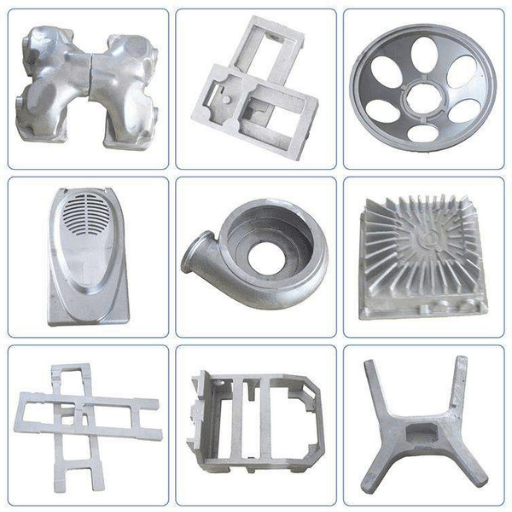
Heat treatment is how the same carbon-steel chemistry produces dramatically different mechanical properties. Physics traces to a single point on the iron-carbon phase diagram: the eutectoid at 727 °C. Below that temperature, carbon steel is a mix of ferrite (α-iron) and cementite (Fe₃C). Above it, the structure transforms into austenite (γ-iron), which dissolves far more carbon. Every heat-treatment recipe boils down to a controlled excursion above 727 °C followed by a chosen cooling path back down.
“In carbon steels, hardenability is governed primarily by carbon content; tempering temperature then dictates the trade-off between hardness and toughness. The smith’s choice is not whether to harden, but where on the hardness-toughness curve the application sits.”
— J. R. Davis, ed., ASM Handbook Vol. 1: Properties and Selection — Irons, Steels, and High-Performance Alloys (ASM International)
| Process | Temperature | Cooling | Resulting Structure | Effect |
|---|---|---|---|---|
| Full annealing | ~30–50 °C above A3 | Furnace cool (~20 °C/hr) | Coarse pearlite + ferrite | Softest state; relieves stress; readies for cold forming |
| Normalising | ~55 °C above A3 | Air cool | Fine pearlite | Refines grain; improves machinability; baseline strength |
| Quenching | Above A3 (~850 °C) | Water, brine or oil | Martensite | Maximum hardness; very brittle; almost always tempered |
| Tempering | 150 – 650 °C (below A1) | Air cool | Tempered martensite | Trades hardness for toughness; final-property tuning |
| Spheroidising | ~700 °C, >30 hours | Slow cool | Spheroidite (Fe₃C globules in ferrite) | Softest possible state for high-carbon stock prep |
📐 Engineering Note4140 alloy steel quenched in oil from 845 °C achieves ~58 HRC. Tempering at 200 °C drops hardness only modestly to ~55 HRC but restores significant impact toughness. Tempering at 540 °C drops hardness to ~32 HRC and produces a tough, fatigue-resistant structure used for axles and high-stress shafts. Every quench-and-temper schedule references this hardness-toughness trade-off curve.
Case-hardening takes a different objective: only the surface is hardened, while the core stays ductile. Carburising (diffusing carbon into the surface of a low-carbon steel at ~900 °C) and nitriding (diffusing nitrogen at lower temperatures) both deliver a hard wear-resistant case 0.5–2 mm deep over a tough core. AISI 1018 carburised to 0.8 mm case depth is the classic recipe for gear teeth, cam followers and pins.
Hot Rolled vs Cold Rolled Carbon Steel: Which to Buy
So hot rolled versus cold rolled hard carbon steel comes down to three separate issues: dimensional tolerance, finish, internal stress state. They are both the same chemistry. Difference shows up after the slab leaves the caster.
| Attribute | Hot Rolled | Cold Rolled |
|---|---|---|
| Rolling temperature | >1,000 °C (above recrystallisation) | Room temperature |
| Thickness tolerance | ±0.3 to ±0.5 mm on sheet | ±0.05 to ±0.1 mm on sheet |
| Surface | Mill scale, slight scaling pits | Smooth, oiled, paint-ready |
| Yield strength | Baseline (A36 = 36 ksi) | 10–20% higher due to strain hardening |
| Cost premium | Baseline | ~20–35% higher per ton |
| Best for | Structural shapes, plates, fabrication where dimensions can be machined | Auto body panels, appliance shells, anything painted or seen |
Hot- and cold-rolled steel: the walk-before-you-run rule: if you are going to paint it, weld to it or have a customer see it, specify cold-rolled. If it’s intended to be machined, cut, hidden inside another shape, hot-rolled is faster and cheaper. The “pickled and oiled” (P&O) hot-rolled provides nearly-CR surface at HR costs since the mill scale is acid washed away and a light machining oil coat keeps it from rusting until you paint it – excellent if you need a clean weld without rust or need to stain the surface for a bright finish.
Welding Carbon Steel: MIG, TIG, Stick and Laser

Almost every welding process in the shop is capable of welding carbon steel – the questions is which process provides the correct deposition rate and joint character at the right cost. Four typical pathways dominate the spectrum: MIG/GMAW (semi-automatic spool wire), TIG/GTAW (precision rod), SMAW/stick (covered electrodes) and laser welding. Each has a defined rightness for certain thickness, fit-up and finished appearance.
| Process | Thickness Range | Default Filler | Edge Quality |
|---|---|---|---|
| MIG / GMAW | 1.5 – 25 mm | ER70S-6 | Good; spatter typical, requires clean-up |
| TIG / GTAW | 0.5 – 6 mm | ER70S-2 or ER70S-6 | Excellent; no spatter, slow deposition |
| Stick / SMAW | 3 – 40 mm | E7018 (low-hydrogen) | Field-tough; slag must be chipped |
| Laser welding | 0.1 – 10 mm (handheld up to 4 mm) | ER70S-6 or autogenous | Excellent; minimal HAZ, very tight fit-up required |
Why ER70S-6 Is the Default Filler for Mild Steel
ER70S-6 is the most-bought MIG wire on the planet for one reason: its chemistry is engineered to weld mill-scaled, rusty, lightly contaminated mild steel and still produce a sound weld. The “6” designates the higher silicon and manganese content (~0.65% Si, ~1.50% Mn) that acts as a deoxidiser, mopping up oxygen pulled in from surface oxides during welding. ER70S-2, by contrast, is a cleaner-chemistry wire intended for pre-cleaned base metal — typically used in TIG work on prepared edges.
A rule fabricators learn quickly: ER70S-6 covers all carbon steel up to A572 Grade 50. Cross into Grade 65 or higher, and you need ER80S-D2 or ER100S-G — using ER70S-6 on a higher-strength HSLA undermatches the joint and the weld becomes the weak link. This is the most common dissimilar-strength welding error in structural fabrication.
The two causes of carbon steel weld failure are weak filler/base-metal strengths – (most common in shop ) and carbon-equivalent (Ceq) over 0.45% combined with no preheat. (Ceq = C+Mn/6 + (Cr+Mo+V)/5 + (Ni+Cu)/15). Performed without Preheat to 150-200 °C (300-400 °F) you will have cold cracks in 24-48 hours – often hidden in the final machining or painting cycles.
For thin-section work where heat input and distortion matter — typical of stainless-steel sinks, EV battery enclosures and precision sheet-metal assemblies — fibre industrial laser welding equipment delivers a narrow heat-affected zone (1–2 mm) at deposition rates competitive with MIG on materials below ~4 mm. Narrow HAZ is the real advantage on carbon steel: it preserves base-metal hardness on heat-treated stock that MIG would over-temper.
Cutting Carbon Steel: Fiber Laser, Plasma, Oxy-Fuel & Waterjet
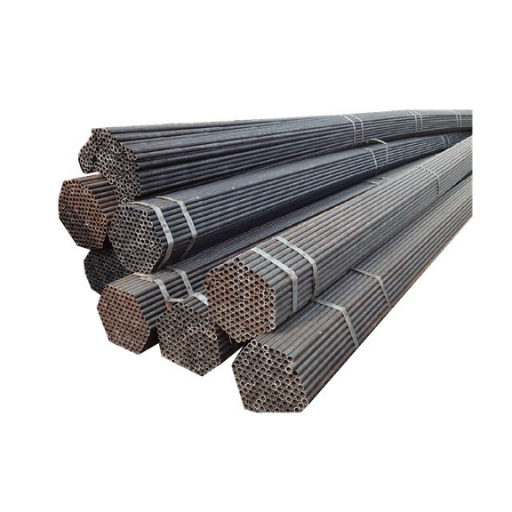
Four cutter types cover most carbon-steel work, each one showing up here as the ideal choice for specific plate thickness, edge tolerance and volume; the perfect choice depends on just these three numbers.
| Process | Practical Thickness | Kerf Width | Edge Quality | HAZ |
|---|---|---|---|---|
| Fiber laser (6 kW) | 0.5 – 25 mm | 0.15 – 0.4 mm | Excellent; near-perpendicular | <0.2 mm |
| Fiber laser (12 kW) | 0.5 – 40 mm | 0.2 – 0.6 mm | Excellent at <25 mm; good at 25–40 mm | <0.4 mm |
| Fiber laser (20 kW) | 1 – 60 mm | 0.3 – 0.8 mm | Excellent at <40 mm | <0.5 mm |
| Plasma (HD) | 3 – 50 mm | ~2.5 mm | Slight bevel; dross common | 1 – 2 mm |
| Oxy-fuel | 6 – 300 mm | ~3 – 5 mm | Coarse; slag/oxide skin | 3 – 6 mm |
| Waterjet | 1 – 150 mm | ~1 mm | Excellent on any thickness; cool process | None (cold cut) |
📐 Engineering NoteAssisting gas choice on a fibre laser: below 12 mm, 100% N2 gives a dross-free paint-ready edge- the N2 creates an inert plume, and the heat flows straight out the kerf. Above 12 mm, 100% O2 burns exothermic from the iron-oxide in the steel: not only does this boost the cut speed, but the excess heat causes a layer of oxide-scale to form on the cut surface, which must later be chipped off to leave a weldable or paintable surface. The N2/ O2 crossover is grade-dependent. For grade 50, A572-50, the practical N2/ O2 boundary is close to 10mm, as the higher Mn content modifies dross behaviour.
One misconception worth retiring is the simple line “fiber laser wins below 8 mm, plasma above.” That was true around 2018, when most installed lasers were 4–6 kW. With 12 kW and 20 kW systems now widely available, fiber laser pushes deep into plasma’s traditional territory — practical 40–60 mm carbon-steel cutting is realistic, with markedly better edge quality and a tenth of the kerf width. Remaining advantages for plasma are capital cost (still ~half that of equivalent laser) and tolerance of warped or scaled stock that would defocus a laser beam.
In shops with mixed thickness work — sheet-metal panels one day, structural plate the next — modern fiber laser cutting machines in the 6–12 kW range now cover the practical 0.5–40 mm carbon-steel range with one machine, displacing the older two-machine plasma-plus-CO₂-laser footprint.
Industry Outlook 2026: Green Steel, Standards Updates & What’s Changing

Two structural shifts are reshaping carbon-steel sourcing in 2025–2027. First comes the rise of hydrogen-based direct reduction (H₂ DRI-EAF), now moving from pilot to commercial scale. The IEA’s Breakthrough Agenda Report 2025 identifies the H₂ DRI-EAF route as “emerging as a preferred low-emissions option in certain regions”, with Sweden’s HYBRIT project (SSAB / LKAB / Vattenfall) as the European flag bearer. An unexpected geographic story: in September 2025, Jindal Steel commissioned a second 2.5 Mtpa hot-briquetted iron plant at Duqm, Oman, using a Tenova DRI line — putting the Middle East on the fast track as a green-steel supply hub, per the IEEFA Nov 2025 report.
A second shift hits the buy side: EAF steelmaking now accounts for over 70% of US steel production, and EAF accepts a far broader chemistry spectrum than its BOF precursor. Net practical impact for customers buying carbon steel: a broader chemistry tolerance. An A36 grade from one mill may be 0.20%C, another 0.28%C. They both meet the heat specification, but the milling and welding characteristics are different.
Fiber-laser displacement continues to bend the cost curve. As 12 kW and 20 kW systems become cost-competitive on capex, plasma’s stronghold above 25 mm is shrinking. Expect more shops to standardise on a single fiber laser covering 0.5–40 mm rather than running parallel plasma and laser cells.
From Q3 2026 onward, request a Mill Test Certificate for any ASTM A36 order over 5 tons — scrap-input variability in EAF mills is widening grade tolerance, and “spec-compliant” no longer means “consistent.” An MTC tells you what is actually in the shipment, not just what the spec allows.
Frequently Asked Questions
Q: What are the disadvantages of carbon steel?
View Answer
Q: Will carbon steel rust?
View Answer
Q: What is the difference between mild steel and carbon steel?
View Answer
Q: Is high-carbon steel stronger than mild steel?
View Answer
Q: How thick of carbon steel can a fiber laser cut?
View Answer
Bonus: Mill Test Certificate Checklist for Carbon Steel Buyers
An MTC is the document that proves the material in front of you actually meets the specification on the drawing. Every serious carbon-steel purchase should be accompanied by one. Six fields below cover the audit-essential elements an ASME pressure-vessel inspector would verify on receipt.
- ✔
Grade designation — full ASTM/ASME/AISI designation matching the purchase order (e.g., “ASTM A36-19” or “ASME SA-106 Gr B”) - ✔
Heat number — unique mill heat identifier, traceable to a single melt and chemistry record - ✔
Chemical composition — ladle analysis: C, Mn, P, S, Si at minimum; alloy elements where the grade requires them - ✔
Mechanical properties — actual measured yield, tensile and elongation values; not just “meets spec” - ✔
Test method reference — ASTM E8 for tension, ASTM A370 for general mechanical, ASTM A578 if UT was performed - ✔
Issuer authentication — mill name, certifying metallurgist signature/stamp, date of issue, and EN 10204 type (typically 3.1 or 3.2 for critical service)
If any of these six fields is missing, ambiguous or hand-edited, treat the certificate as unverified and request a clean reissue from the supplier. For pressure-vessel, structural and aerospace work the MTC is part of the permanent legal record and is audited well after the material is in service.
Explore Industrial Laser Equipment for Carbon Steel Fabrication →
About This Analysis
This guide on what carbon steel is and how to choose between its grades was compiled from AISI definitions, NIST density measurements, ASM MatWeb mechanical data, ASTM specifications for A36/A53/A572/A500/A106, the IEA Breakthrough Agenda Report 2025 on steel decarbonisation, and field-reported welding and laser-cutting practice from fabrication forums. Where 2025 mill-price ranges are quoted for the carbon-versus-stainless cost comparison, no single primary citation was located; ranges are presented as typical and should be confirmed with current suppliers before specification.
References & Sources
- Density of Hot-rolled and Heat-treated Carbon Steels (NBS Scientific Paper 562) — National Institute of Standards and Technology (NIST)
- Breakthrough Agenda Report 2025 — Steel — International Energy Agency
- Global Hydrogen Review 2025 — International Energy Agency
- Oman at the Frontline of the Green Steel Transition — Institute for Energy Economics and Financial Analysis (Nov 2025)
- HYBRIT Development — SSAB / LKAB / Vattenfall joint venture, Sweden
- Carbon Steel — Wikipedia (citing AISI definition via Total Materia)
- AISI 1018 Steel — Material Data Sheet — ASM MatWeb
- ASM Handbook, Volume 1: Properties and Selection — Irons, Steels, and High-Performance Alloys (10th ed.) — ASM International
- AWS D1.1: Structural Welding Code — Steel — American Welding Society
Related Articles
- Top 15 CO₂ Laser Cutting Machine Manufacturers in 2025 — Updated List — companion guide for shops evaluating laser cutters for carbon steel and acrylic
- Laser Cleaning Equipment — Pulse, Fiber, Backpack and Handheld — rust and mill-scale removal from carbon steel without abrasives
- Laser Marking on Stainless Steel – permanent ID and traceability on austenitic grades
- Top 15 CNC Machine Manufacturers in the World You Should Know – broader context for fabrication shops sourcing carbon-steel equipment