PVC Explained: Composition, Properties, and Industrial Applications of Polyvinyl Chloride
Quick Specs
| Full Name | Polyvinyl Chloride (PVC) |
| Chemical Formula | (C₂H₃Cl)ₙ |
| Density | 1.30–1.45 g/cm³ |
| Glass Transition Temp | 80–85 °C (rigid PVC) |
| Tensile Strength | 40–60 MPa (rigid) / 10–25 MPa (flexible) |
| Global Production | ~~50 million tons of PVC/year |
| Resin Identification Code | ⚃ 3 |
PVC, Polyvinyl chloride is one of the most widely produced thermoplastic polymers in the world, third to polyethylene and polypropylene. PVC is the third most produced synthetic plastic polymer worldwide. First discovered in the 19 th century, and commercialized in the 1920s, PVC plastic is one of the most commonly used building materials for construction, electrical wiring, medical applications, and consumer products. It has this widespread use because it possesses unique properties such as chemical resistance, fire retardancy and economical PVC production.
This overview describes the composition (at the molecular level) of PVC, the quantifiable physical and mechanical properties of PVC, the practical differences between rigid and flexible compounds, the applications of PVC in the major industries, and the routes to PVC finishing by means of PVC extrusion and other processes.
What Is PVC Made Of? Chemical Composition and Structure

Polyvinyl chloride or PVC which is a synthetic plastic polymer made from the vinyl chloride monomer (VCM). Every repeating unit in the polymer chain requires 2 carbon atoms, 3 hydrogen atoms and 1 chlorine atom, so has the chemical formula (C₂H₃Cl)ₙ. It consists of 57% chlorine obtained from common salt [NaCl] and 43% ethylene which is a hydrocarbon obtained from oil or natural gas.
Its high chlorine content is the factor which makes PVC naturally flame resistant and differentiates this commodity thermoplastic from other commodity thermoplastics.
Vinyl chloride monomer as a raw material is manufactured by a two stage process; ethylene is reacted with chlorine to form the intermediate ethylene dichloride (EDC), which is cracked at high temperatures forming vinyl chloride gas and hydrogen chloride as a byproduct. According to Plastics Europe, this process has been improved over many years to recover and reuse the hydrogen chloride byproduct.
This polymerization step transforms the VCM into PVC resin. According to industrial figures, about 80% of all the PVC produced worldwide is formed by suspension polymerization, in which the VCM is dispersed in water, polymerized batch-wise at 70 °C and 10 kg/cm², while 12% of the production is performed by emulsion polymerization, and the residual 8 % by bulk (mass) polymerization. Each polymerization method influences the size distribution and porosity of the resin particles which consequently change the resin-supplier additivation and plasticizer attraction/repulsion.
📐 Engineering Note
Suspension grade-pvc resin particles are usually between 100-180 m in diameter having a porosity which permit to absorb from 25 to 45phr of plasticizer. Higher porosity grades are indicated for flexible pvc resins where plasticizer absorption is required to be rapid and homogenous during PVC compounding. Particle size distribution conforms to ASTM D1921 test method.
Key Properties of PVC Material

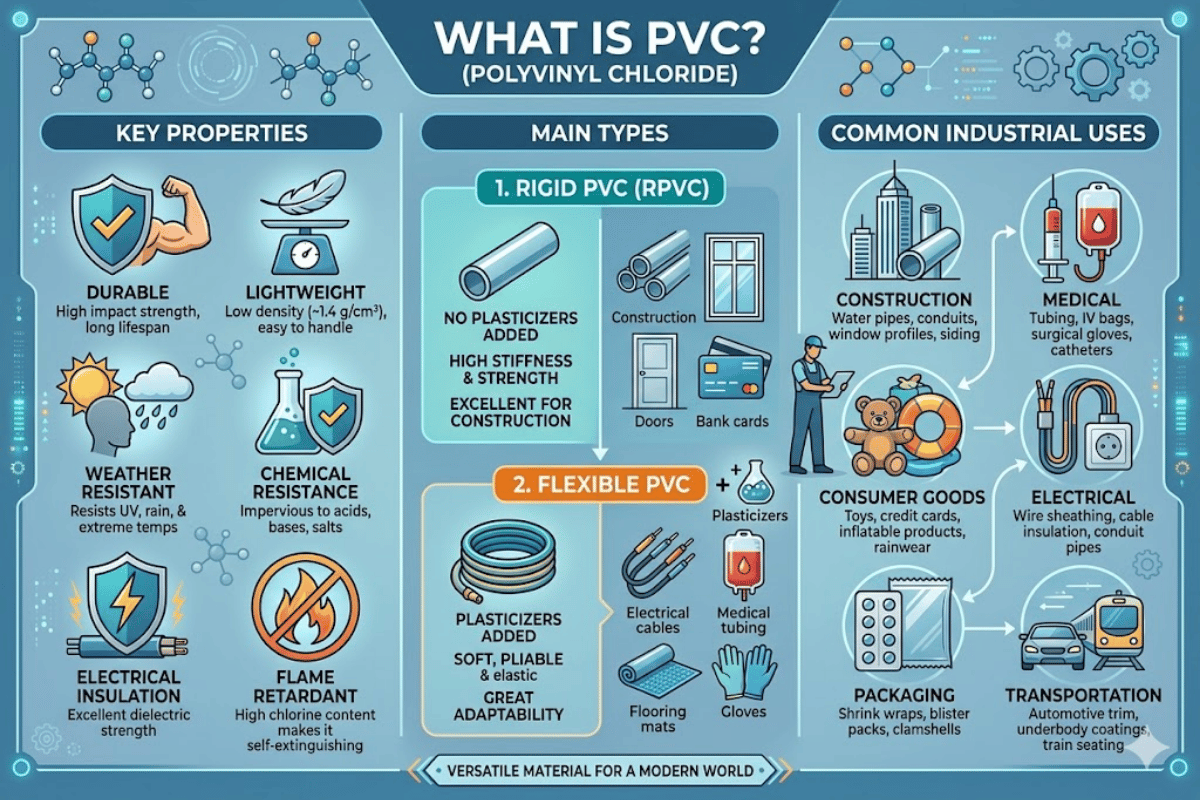
On the other hand, information about PVC properties varies greatly depending on the formulation. However, with unplasticised (rigid) PVC, a unique set of quantifiable properties emerge which provide justification for its area of predominance in construction and infrastructure applications. What they also offer is a material with a high degree of chemical resistance to acids, alkalies and most inorganic chemicals in general coupled with a property inherited from its 57% chlorine content, that of flame retardation.
As a material it is not readily combustible — its limiting oxygen index (the minimum oxygen concentration needed for burning) is around 45-49%, whereas the oxygen content of normal air is about 21%. It will self-extinguish when the ignition source is removed.
| Property | Rigid PVC (uPVC) | HDPE | PP | ABS |
|---|---|---|---|---|
| Density (g/cm³) | 1.30–1.45 | 0.94–0.96 | 0.90–0.91 | 1.03–1.07 |
| Tensile Strength (MPa) | 40–60 | 25–45 | 30–40 | 40–55 |
| Elastic Modulus (MPa) | 1,500–3,000 | 800–1,500 | 1,100–1,600 | 1,700–2,800 |
| LOI (%) | 45–49 | 17 | 17 | 18–20 |
| Max Service Temp (°C) | 60–70 | 80–120 | 100–130 | 80–100 |
| Water Absorption (24h, %) | 0.04–0.4 | <0.01 | 0.01–0.03 | 0.2–0.45 |
Looking at the table above, it becomes clear why PVC material holds its niche. It has comparable or better stiffness and tensile properties than ABS, but also fire retardantness which polyolefins can never achieve without flame retardant additives. The price paid is a lower maximum service temperature – rigid PVC softens at about 60–70 °C, which is why it handles cold-water plumbing but not hot water lines where CPVC or metal piping takes over.
Electrical insulation is another standout property. PVC has a dielectric strength of 20–40 kV/mm and volume resistivity exceeding 10¹⁴ Ω·cm, placing it among the most cost-effective insulation materials available. At 30–50% less per kilogram than engineering plastics, this combination of insulation performance and low cost makes PVC the most common plastic used for electrical cable insulation across the electrical industry.
✔ Advantages
- Self-extinguishing (LOI 45–49%) without added flame retardants
- Chemical resistance to acids, alkalis, and most salts
- Low cost (one of the cheapest thermoplastics per kg)
- Near-zero water absorption in rigid form
- Strong electrical insulation (20–40 kV/mm dielectric strength)
- Durability: buried PVC pipe can last 50–100+ years
⚠️ Limitations
- Low heat resistance — softens at 60–70 °C (rigid PVC)
- UV degradation without stabilizer additives
- Thermal decomposition releases HCl gas above 140 °C
- Requires careful processing (narrow thermal window)
- Flexible PVC formulations may contain regulated phthalate plasticizers
- Recycling complicated by diverse additive packages
Rigid PVC vs Flexible PVC — What Changes and Why

What separates rigid PVC from flexible PVC comes down to one class of additive: plasticizers. Commercial PVC falls into these two categories. Rigid PVC (sometimes known as uPVC or unplasticized PVC) has no plasticizer at all and its well-known physical, mechanical and electrical properties are supported completely by its stiff polymer backbone. Flexible PVC (also known as plasticized PVC or PVC-P) contains 30–50 phr of plasticizer compounds intercalated among the PVC polymer chains, increasing chain mobility and producing a soft, bendable material.
| Parameter | Rigid PVC (uPVC) | Flexible PVC (PVC-P) |
|---|---|---|
| Plasticizer Loading | 0 phr | 30–50 phr |
| Hardness | Shore D 78–85 | Shore A 50–90 |
| Elastic Modulus | 1,500–3,000 MPa | 1.5–15 MPa |
| Typical Applications | PVC pipe, window frames, siding, conduit | Cable insulation, medical tubing, floor coverings, blood bags |
| Common Plasticizer | None | DOTP, DINCH (non-phthalate); DEHP (legacy) |
| Processing Method | Rigid PVC extrusion, injection molding | Soft PVC extrusion, calendering |
The type of plasticizer in addition to the loading level makes a difference. Legacy formulations relied on DEHP (di-2-ethylhexyl phthalate), a phthalate plasticizer that has faced increasing regulatory scrutiny over potential endocrine disruption effects. Modern flexible PVC compounds have largely shifted to non-phthalate alternatives such as DOTP (dioctyl terephthalate) and DINCH (diisononyl cyclohexane-1,2-dicarboxylate). Industry data from 2024 shows that 40% of new capital investment in medical-grade PVC is directed toward non-phthalate formulations.
A common misconception holds that flexible PVC is structurally inferior to rigid PVC. In reality, each type serves entirely different mechanical functions. Flexible PVC trades stiffness for elongation at break, which often exceeds 200–350%.
Choosing between rigid PVC vs flexible PVC is a formulation decision driven by application requirements, not a quality judgment.
In addition to plasticizers, rigid and flexible compositions of PVC also necessitate the use of heat stabilizers in order to stave off thermal degradation through processing. Regulating stabilization systems, such as Ca/Zn stabilization for food contact and medical grade products and organotins for highly-clarity products are also widely used. Other additives, such as lubricants, fillers, colors and pigments, and UV stabilizers, is utilized to satisfy the corresponding targeted attributes of the final product.
PVC Applications Across Industries

PVC shows up in a wide variety of products, from underground water pipes to IV bags in hospitals. The global PVC market was valued at an estimated USD 86.5 billion in 2024 and is projected to expand at a CAGR of 4.51% within the forecast period to 2033, primarily fuelled by building activity in the Asia-Pacific region which consumed over 65% of the total.
Construction and Infrastructure
Construction applications make up the bulk of PVC demand, with building and construction accounting for roughly 60% of total use worldwide. Long-service rigid PVC pipe is dominant for cold-water plumbing, drain-waste-vent (DWV) lines, and sanitary sewer systems. PVC is used in plumbing with corrosion resistance, no internal scaling, and a service life of between 50 and 100+ years when installed in accordance with ASTM D1785 specifications making it the material of choice. Window frames, siding, and vinyl flooring — all made from PVC — plus other products made of PVC such as fencing are additional high-volume subdivisions within the building and construction segment, with weatherability and a maintenance-free profile being key selling points against established materials like wood and aluminum.
Electrical and Electronics
Electrical insulation and components constitute another sizable market, with PVC’s excellent electrical insulation capacity and flame-resistant nature holding a key advantage in this industry. In Asia-Pacific in 2024, between 10 and 20 percent of all cable production was likely to have been PVC-insulated, partly driven by growth in power distribution infrastructure upgrades, including electric vehicle charging networks and smart grid systems. The material is used in every stage of electrical installation from conduit to power junction boxes, electrical wires sheathing, and wiring protection.
Healthcare and Medical Devices
Flexible PVC makes up the lion’s share of single-use applications in healthcare. PVC medical devices include bags and tubing, surgical gloves, dialysis equipment, and blood bags that meet the USP Class VI biocompatibility standard. Strong demand for hospital and other healthcare infrastructure upturns globally has resulted in about 25% greater consumption of the material in the last decade, with non-phthalate chemistries particularly popular in neonate and pediatric care. Vinyl products used in hospitals range from IV tubing to oxygen masks.
Consumer Goods and Other Markets
Automotive (inner and underbody coatings), packaging (clamshells, blister packaging), signage (foam PVC signs and displays), and clothing (synthetic leather, rain gear) are some other industries utilizing PVC in their production processes. Vinyl flooring is one of the fastest-growing segments in domestic interior design, offering the same longevity as solid hardwood or porcelain tiles for a fraction of the price.
After establishing application needs (with three primary considerations in mind: operating temperatures below 60 °C; resistance to moisture, acid, and alkali exposure; and inherent flame resistance) PVC belongs on the shortlist. Where higher temperatures are unavoidable, CPVC which is stable up to 93 °C, or engineering plastics such as PEEK or PES are alternative propositions.
How PVC Is Processed — From Resin to Finished Product

Commissioning raw PVC into a finished article involves two key steps: compounding and processing. Sheer control of processing temperatures becomes critical because PVC is a heat-sensitive resin — thermal degradation begins at around 140 °C, yet enough heat must be supplied to gel the resin mass in the region of 180–200 °C to enable flow, impregnation, and overall melt homogeneity. This process window is relatively narrow and indicates specific equipment considerations.
Stage 1: Compounding
PVC resin, previously dried, is mixed with the stabilizers, lubricants, plasticizers (for flexible compounds), fillers and pigments using a high speed mixer prior to being introduced to a compounding extruder. There are twin screw co- and counter-rotating set ups available but counter-rotating twin-screw extruders are favored in the PVC industry due to their intermeshing screw geometry providing a more efficient conveying force at the lower shear level than its co-rotating counterpart (Fig 1). This is, of course, an advantage when dealing with a shear-viscous-sensitive resin such as PVC.
Stage 2: Forming
Once compounded the PVC material proceeds to the forming stage, which has three principal processes;
- Extrusion—pipe, profile, sheet, cable sheathing. Barrel temperatures usually gradually increase from 150°C at the feed zone through 190 to 210°C at the die. This is by far the most common route of forming PVC and forms the heart of all PVC extrusion lines.
- Injection Molding – Fittings, valve bodies, connectors. Short residence times at melt temperature 170–200 °C to arrest ageing of the polymer.
- Calendering – Vinyl flooring, film, sheet goods. Material is fed in between heated rollers which run at specific gap settings.
📐 Engineering Note
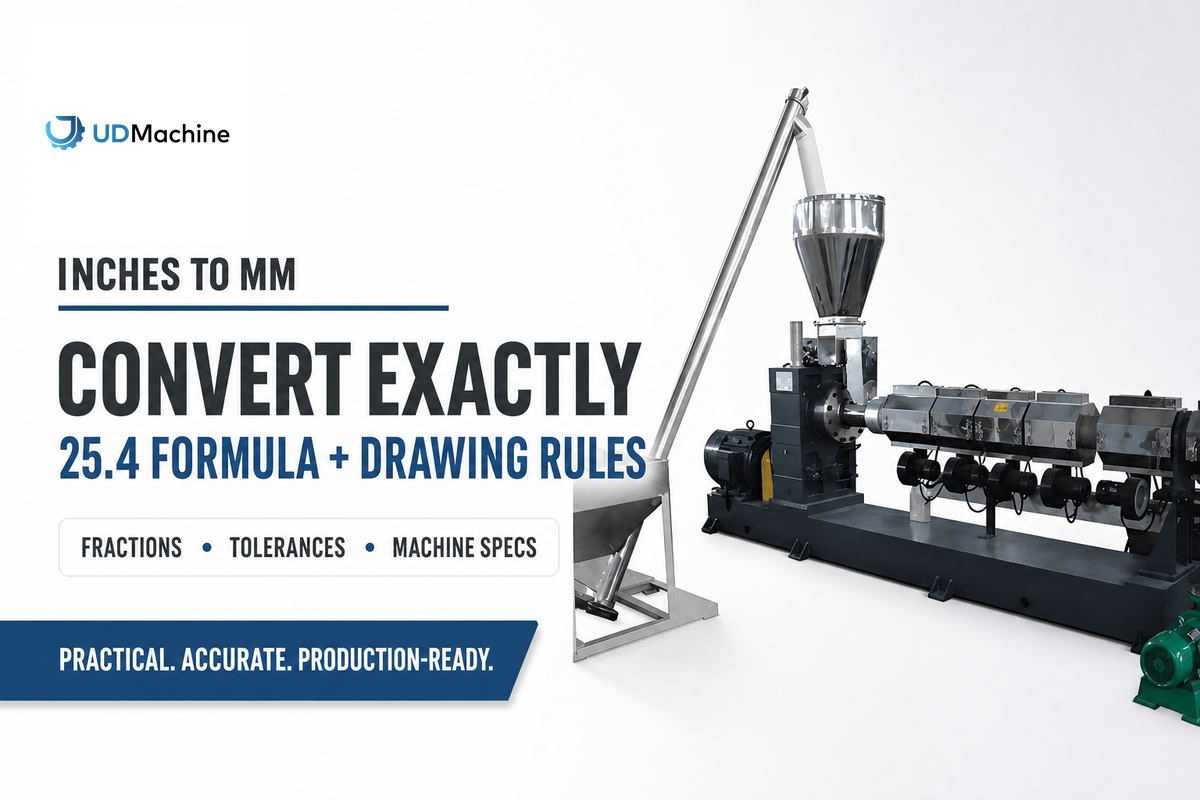
For rigid PVC pipe and profile extrusion, conical twin-screw extruders with a tip angle of 20–30° have been in common use, on account of the tapered screw geometry which imparts gentle compression suitable for PVC quality. Always the screw must be designed with as little shear heating as possible to keep the melt temperature below the degradation point of PVC. Typical screw lengths ranges from 20:1 to 28:1 for PVC twin-screw extruders as opposed to polyolefin extruders (25:1 to 36:1), because much less mixing energy is needed in the process, and a higher thermal control is also required.
For more information about the best extruder for you, refer to our comparison of single vs twin-screw extruder configurations.
The kind of extrusion equipment used very much depends on what the finished product is to be. It is the counter-rotating conical twin-screw extruder which dominates in the production of rigid PVC pipe. Parallel counter-rotating twin-screw extruders are used for the production of rigid PVC profile and sheet, while the simpler single-screw machine with a barrier screw is the most common type of equipment for flexible PVC cable coating, since it has a feeding zone where the pre-plasticized compound can flow with relative ease, and because of the high throughput, the optimum mixing achieved, and it provides good control of the all-important temperature in PVC extrusion processing.
PVC Safety, Health Concerns, and Environmental Impact

PVC safety debates need to distinguish between the finished article and the raw products it is formed from The vinyl chloride monomer (VCM), has been classified as a Group 1 carcinogen by IARC (International Agency for Research on Cancer), it has compelling evidence showing VCM causes cancer in humans — liver angiosarcoma. PVC particles and vinyl chloride gas exposure are the primary human health concerns. Still, residual VCM contents in finished PVC articles are reported to be controlled to very low concentrations (most often less than 1 ppm), and the limits for occupational exposure has been reduced greatly within the last quarter of century.
In December 2024, the U.S. EPA designated vinyl chloride a High-Priority Substance under TSCA. This designation initiates a formal risk evaluation process, and a preliminary scope document was released for comment in January 2025.
That TSCA action follows decades of scientific review of the pathways of vinyl chloride exposure, especially for VCM manufacturing workers and residents living around PVC manufacturing sites.
Its thermal degradation at temperatures above 140 °C releases hydrogen chloride (HCl) gas, and may produce small amounts of dioxin and furan. Responsible usage demands that PVC should be carefully temperature-controlled, which is why PVC machines must have specific temperature zones and vents.
Recycling and End-of-Life
PVC (polyvinyl chloride) is identified (by the resin identification code 3) and is able to be technically mechanically recycled. However, PVC recycling remains marginal. According to environmental audits, less than 3 % of post-consumer PVC waste is recycled in Europe where collection and sorting systems are the most efficient.
The difficulty relies in fact in the presence of numerous different kind of additives inside every PVC product, so that it is difficult to produce recycled PVC resins with homogeneous properties. Most recycled PVC is downcycled for applications such as traffic cones, garden hoses or industrial flooring.
Industry groups, including Plastics Europe and the VinylPlus programme, have developed voluntary recycling targets and invested in advanced sorting technologies. The United States Plastics Pact has proposed addressing problematic packaging, of which PVC has been named as one, and committed to various measures to eliminate this problem material.
Frequently Asked Questions About PVC

Q: Is PVC rubber or plastic?
View Answer
I would like to clarify that PVC is a plastic not a rubber. PVC is a thermoplastic, which means it can be heated to become soft and then cooled to harden, this is what makes it a plastic. Rubber is an elastomer and has a completely different molecular structure, you would find a polyisoprene chain in rubber.
Flexible PVC (if it feels rubbery) may have a plasticizer that gives that feeling but beneath that the polymer backbone is polyvinyl chloride.
Q: Is PVC different from plastic?
View Answer
Q: Is PVC waterproof?
View Answer
Yes. Rigid PVC absorbs very little moisture—only 0.04-0.4% in 24 hours—so it is completely water resistant. It is this fact that makes it the chosen material for plumbing pipe and drainage and stormwater systems.
Flexible PVC shares this moisture barrier property and so is found in raincoats, waterproof sheeting and pond liners etc.
Q: Can PVC be recycled?
View Answer
PVC (coded 3) can be mechanically recycled. However actual recycling is very limited, with less than 3% of post-consumer PVC being recycled even in Europe. This is mainly due to the fact that various PVC objects contain various additive packages, so it is difficult to produce aged resin with uniform properties.
Recycling programs such as VinylPlus in Europe are trying to improve collection and sorting procedures, but the plastic’s recycling technology is however only on a developing stage, compared to PET (coded 1) and HDPE (coded 2).
Q: Is PVC safe for drinking water pipes?
View Answer
Q: What is the difference between PVC and CPVC?
View Answer
Q: How long does PVC pipe last?
View Answer
Need PVC Processing Equipment?
Our twin-screw extruders handle the narrow thermal window and shear sensitivity that PVC resin processing demands.
Our Perspective
This technical guide is written by a team involved in the design and manufacture of PVC forming equipment. The compounding and extrusion processing knowledge presented here is based on practical experience working with the thermal sensitivity of PVC resin, screw geometry optimization, and the operational difficulties experienced when processing PVC compounds on counter-rotating twin-screw extruders. Specific references to industry data and other published research are hyperlinked for easy reference.
References & Sources
- Polyvinyl Chloride (PVC) — Plastics Europe
- Risk Evaluation for Vinyl Chloride — U.S. Environmental Protection Agency
- IARC Monographs — List of Classifications — World Health Organization / IARC
- ASTM D1785: Standard Specification for PVC Pipe — ASTM International
- Polyvinyl Chloride — Wikipedia
- USP Class VI Biocompatibility Standards — United States Pharmacopeia
- PVC: An Updated Review of Properties, Polymerization, Modification, Recycling, and Applications (2024) — Journal of Materials Science / Springer Nature
Related Articles
- Extruder for PVC — Choosing the right extrusion equipment for PVC compounds
- Which Type of Extruder Is Preferred for PVC Pipe?
- What Is PVC Compounding? — Process, additives, and equipment overview
- PVC Cable Extruder Machine — Equipment for cable insulation production
- What Is the Compression Ratio for PVC? — Screw design parameters explained