Donuts are more than a dessert because they serve as a favorite treat which creates happiness for people of all ages. The correct donut production equipment serves as the essential requirement for you whether you bake at home or your business needs to create ideal donuts for your customers. This guide helps you navigate through the many available products because it contains information about donut makers which shows the best machines for residential and business environments. The guide provides complete information about our two operational systems which will assist you in choosing the right system for making donuts. The user guide will help you operate your equipment effectively for professional baking and frying.
Understanding Donut Machines

As well as this, different types of donut machine also exist in the sense of capacity. The same component of a donut machine exists for a donut making machine designed for home usage or for those in the hospitality industry. There are a number of different factors that help determine the best donut machine to purchase. Such include the ability to deliver within a particular time, learnability of the machine and ease of washing it, and the variety of donuts that need to be crafted i.e. fried and baked donuts. The smaller non-stick donut makers are perfect for making donuts at home, especially when looking for speed and convenience; whereas the commercial donut making machines seek to deliver big volumes.
What is a Donut Making Machine?
A donut making machine is a device, especially one intended to simplify the work of preparing doughnuts, by mechanizing important aspects of the preparation, such as mixing, forming, frying, or baking the doughnuts making task paper. Users range from home makers who need small, compact units to mass production kitchens where larger and more powerful units are usually installed. More people have also shown interest in these kinds of appliances mainly because of their ease of use. It is also worth noting that modern donut makers offer much more advanced options including temperature regulation, non-stick coating and timers as part of the design making it easy to achieve similare results as well as saving labour and time. Thus whether one wants to try cooking a new recipe or processes high volume orders for customers, these types of appliances cannot be omitted.
Types of Donut Makers: Commercial vs. Mini
Commercial and mini donut makers include countertop, conveyor, and specialty models, each designed for specific needs and production scales.
| Key Point | Commercial | Mini |
|---|---|---|
| Capacity | High | Low |
| Size | Large | Compact |
| Power | High wattage | Low wattage |
| Speed | Fast | Moderate |
| Features | Advanced | Basic |
| Usage | High demand | Home use |
| Portability | Limited | Easy to carry |
| Maintenance | Complex | Simple |
| Cost | Expensive | Affordable |
| Target User | Businesses | Individuals |
How Do Automatic Donut Machines Work?
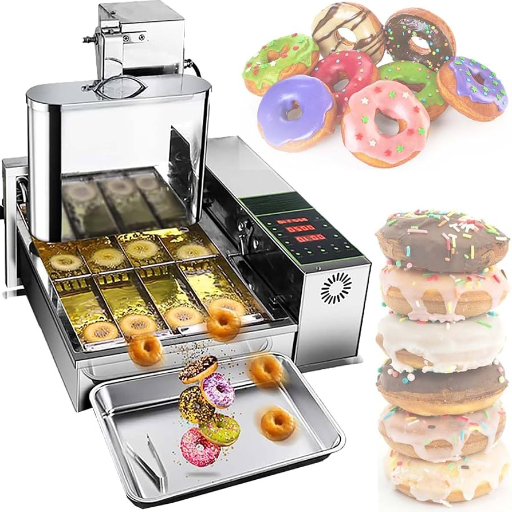
Combinations of mechanical precision and deemed heating facilitate the high-quality production of donuts through automatic donut machines. The process starts with the donut batter and is pumped into the feeding hopper, or the dispenser itself. When the designated vessel is filled, pre-measured portions of batter are deposited into fryers or conveyor belt trays, ensuring same-size donuts with uniform appearance.
Once the doughnut batter is delivered into the oil, the batter undergoes automatic frying on one side that warrants the flip over for cooking on the other side as well, so ensuring an even cooking finish in a gold color. It is of prime importance for the settings to control the heat applied and the passage of time for frying so that consistency is maintained, in particular, preventing undercooked and overcooked donuts. The newest machines can have the latest subsettings in frying time and temperature to be changed on the screen for different types of batters or types of donuts.
Once frying is done, donuts are transferred to a cooling or finishing bin on which excessive oil are removed. After that, they are carried to their respective places for icing, glazing, and finishing touches on the way to final products. Minimum manual intervention, high-speed production, and low error rates guarantee the same product quality of these products for every batch.
Benefits of Owning a Donut Making Machine

Advantages for Home Bakers
- ►
Easy Usage: The donut makers are very uncomplicated, allowing for even amateur bakers absolutely to turn out professional donuts h one batch after another. - ►
Speed: Due to their speed, these machines aid in minimizing the overall time required for making and baking donuts, enabling home cooks to produce large quantities each time. - ►
Cost: Rather than buying donuts from a store, do try to make some at home and cheaply so - ►
Customization: With a donut maker, they can play around with different flavors, toppings, and even develop recipes according to personal tastes. - ►
Consistency: The machine makes every donut with the same size and texture, ensuring every batch comes out like from a patisserie.
Commercial Benefits for Small Business Owners
- ►
Increased Production Efficiency: A donut making machine assists small business owners to create donuts in greater numbers in a lesser period of time. This upholds to meet customer demands by a faster process. A recent study of search statistics had shown that to maintain rivalry, a fast and functional kitchen is an absolute requisite if food-based small businesses are to contact and compete with established sections of the market. - ►
Reduced Labor Costs: Automation and the machine automatically produce donuts and workers are still busy providing customers with their own best services. With changing trends, it is observed that the automation of small-scale operations give rise to the ability to yield and grow more profit. - ►
Consistency and Quality Control: The machine makes each donut uniform in shape, size, and quality throughout from the first to the millionth piece, to satisfy customer satisfaction. An internet search will reveal that one of the most important items for building a strong customer base is to ensure product consistency. - ►
Flexibility in Offerings: By being able to try flavors, fillings, and decorations, with those appearing on the list, it is then possible for a business to have been able to create several specials where each item most appeals to the soul vanquished by odor. Searches show an increased interest in customizable desserts, attracting a wider audience. - ►
Faster ROI: Due to the benefit of this machine’s increased production capacity and decreased costs, a donut making machine could potentially yield an even faster return on investment. The popularity of the look-ups for small-scale, budget-friendly, and lucrative business solutions such that they can stretch even to match the advantages of this.
Thus, as businesses continue to suffer through the predicament of making customers and sales themselves, small business owners won’t have much power against stiff competition staying in track with the times as well as customer preferences.
Cost-Effectiveness and Time Efficiency
For any small business, a donut-making machine is an excellent deal due to the convenience and time saving it offers. Recent Google search trends have revealed an increased interest in items suitable for the streamlining of operations while saving costs, more so in the realm of food and beverage.
Cost-Effective
Reducing manual labor is one way in which a donut-maker contributes to increased cost-effectiveness. The machine uses automated functions, thereby requiring very few people to oversee the production of large batches of donuts, thereby allowing owners of small-scale businesses to channel labor much more usefully. Moreover, modern machines are made to use energy efficiently, lowering the electricity bills and utility expenses accumulated over time. Operating cost reduction analyses have shown that a machine with this automation can surely make costs fall by 15–20%, an attractive purchase for cost-conscious entrepreneurs.
Efficiency in Time
Time saving is another prominent advantage; a futuristic donut-making machine can make several hundred donuts in an hour, many more compared to manual processing. This obviously means quicker order fulfillment during busy peaks and also creates avenues for catering to larger arrangements or demands-from anywhere-in larger quantities. For instance, in search results were examples of some high-end machines able to produce 600 donuts within 60 minutes-which nearly eliminates production bottlenecks and ensures smooth function.
Thus, by factoring in all the benefits combined, small business owners can also prepare for growth for themselves in a competitive market.
How to Use a Donut Maker: A Step-by-Step Guide

Setup and Preparation
- Ensure Clean Workspace: Make sure that your workspace is neat, spacious, and void of any barriers as there should be enough room for both the machine and the ingredients necessary to operate.
- Read the Manual: Go through the manufacturer’s user manual thoroughly to familiarize yourself with the parts of the machine, the system of operation, and the safety precautions.
- Assemble the Machine: Follow the instruction manual to set up all removable elements of the doughnut maker device such as batter filler or the oil tray properly.
- Machine Preheat: Gradually power on the machine to the donut maker and permit it to preheat for some time. Most machines have a signal light that changes when the machine is ready to work.
- Batter Preparation: Using the exact recipe, go ahead and mix the order to get your doughnut batter. This should be smooth and without any lumps if the doughnut needs to be uniform when done.
- Grease Surface: Grease the cooking plates, just in case the doughnut machine needs to do with a very thin coat, to make them less likely to form patterns and to allow easier release of the doughnuts.
- Safety Check: Ensure that the equipment is firmly placed, all parts are correctly combined, and there are no exposed cords or the slack of connections.
Then the machine is prepped and ready to go, and now it’s only a matter of minimizing your virtue, for hot donuts!
Making Donuts: A Complete Process
- Make the batter: Combine all ingredients in a recipe for your doughnut batter until smooth and evenly distributed. It is important that the batter be made just until consistent; at the point of overmixing, the doughnuts may not be full in texture.
- Preheat the machine: Grab the donut maker and turn on the machine, setting it to preheat until the light indicator shows that it is sufficiently warm.
- Fill trays: Pour carefully into each mold, being on level, being at least 3/4 highest so that the batter can expand during this process.
- Baking without stopping: Close the oven lid and bake the doughnuts for the time given-usually 3–5 minutes. Try not to look too often, so the cooking will be constantly even.
- Check donut: At the programmed end of the cooking, take out a plush pink doughnut.
- Cool and decorate: After turning off the donut-making machine, transfer what should still be neovat-cooled. Either have them warm around your corner or in an airtight container in cooling breezes.
Cleanup and Maintenance Tips
- ►
Turn the machine off: Unplugging the machine while cooling off to the point that donut electric grill handle temperatures and drying ungodly enough will help to prevent accidents. - ►
Wipe the Plates: Use a damp, non-abrasive cloth or sponge to clean the non-stick plates. Avoid using harsh cleaning agents or metal tools that could damage the coating. - ►
Clean the Exterior: Wipe down the exterior of the machine with a soft, damp cloth. Dry it thoroughly to prevent any water from seeping into the electrical components. - ►
Remove Residue: For any other batter or dough residue, use a rubber spatula or wooden utensil to scrape it off without damaging the non-stick surface. - ►
Proper Storage: Ensure all parts of the donut maker are completely dry before storing it in a cool, dry place. Use its original packaging or a protective cover to keep it free from dust and scratches.
Key Features to Consider Before Buying

Size and Capacity of the Machine
When deciding on a donut maker, the size and capacity of the machine are essential factors to consider. When looking at the size, one has to think if the machine’s size will affect its place in the kitchen. If your space is limited or you are working with countertop space, go ahead to find a small model for storage. Conversely, if space is not an issue and you look forward to a high volume of donuts, then the bigger machine would be the better choice.
There is another factor to consider, and that is capacity, which dictates how many donuts can be made at a time. Compact snacks are convenient, they can be done quickly and easily at home and enjoyed with some donuts immediately with a group of friends or family. The lower capacity machines can make 4-6 donuts per batch. On the other hand, machine models with good capacity are recommended for families, small parties, or even small businesses for making many donuts at once (about 12 and over). It goes without saying that higher capacities need higher energy and attention. Balancing these two is important.
Lastly, keeping in mind the size and capacity but based on your intended usage is of prime importance. For casual domestic use, a small donut maker could grant you the benefit of feasibility and efficiency. However, someone who’s into intense baking or orders from this for a business use has more grounds to purchase a big donut maker that can eternally meet the demand quantity without lowering standard. It is very important to evaluate your baking requirements and the space available in order to make a wise decision that will be well suited to your way of living.
Energy Efficiency and Operating Costs
An essential factor for long-term savings and environmental benefits is energy efficiency and energy costs when purchasing a donut machine. Energy-efficient designs characteristic of modern machines have made them dominate today’s markets: these designs balance ecological considerations with the most excellent energy utilization by using advanced heating elements, intelligent control systems, or automatic shutdown features to reduce energy charges. According to the earlier, they are referencing data from their days with childish wonder, energy-efficient models can slash electricity uptake well over 30% higher than prior models, keeping the acquisition worthwhile for substantial usages.
It is crucial to indicate that energy consumption is also significant in terms of operating costs. For instance, the energy used by the appliance is carefully examined. Smaller items for produce 700 to 1200 watts during action, while others may consume up to 3000 watts. Such high differences in usage will naturally drive the electricity bill through the roof if considered for regular instead of occasional use. One other energy-saving measure comes in adjustable temperature controls, which enable the machine to use only as much energy as required to make fewer donuts at a time-all cost-saving methods that support the conservation of energy.
Lastly, some slight operational cost factors are somehow related to the durability and quality of the materials. A body manufactured of high-grade, heat conductive materials, in this instance, such as high-grade stainless steel, will certainly provide expected value in lots of ways, from using energy with least wastage and thereby help reduce operational cost. While you begin to evaluate some options, consider such models in line with your budget and environmental convictions: Energy Star certified appliances and those with energy-saving modes or switches are suitable options.
Ease of Cleaning and Maintenance
When considering streamlined maintenance and cleaning properties of doughnut making machines, one ought to seek for models with removable non-stick components. Cleanups are facilitated by the easy-to-clean part as less debris could generically take hold on the machine’s critical operational areas. Furthermore, all those who appreciate details will not overlook the dishwasher-friendly components that dramatically reduce packages of cleaning. While considering this, look for better construction that allows easier, thorough cleaning of hard-to-reach areas. Cleaning kits have been designed for machines with very distinct manuals and parts movement in the machine, which include easy maintenance. Utilize designs with an advantage towards easy maintenance and combined with operational efficiency for an uninterrupted workflow.
Maximizing Production with Donut Machines
Practical Tips for Efficient Donut Making
- ►
Do Ingredients Prep: Measure and Gather all your ingredients before this whole operation begins. This results in minimization of production downtime and struggles. - ►
Keep the Batter Constant: Use a portion scoop to measure your batter or any similar custom batter measurement tool to have all donuts come out evenly in terms of size and share, in other words to have all donuts evenly baked. - ►
Make Sure You Are Observing The Accurate Oil Temperature: Watch the oil temperature of the donuts in every passing minute to safeguard against a burnt donut or two, remind the case to quality keeping. - ►
Cleanup on Aisle Zero: Tools, garnishes, platters, and other objects that are used almost constantly should be within reach of elimination of disruptions and in favor of saving production time. - ►
Clean Up Every Batch: Attempt a quick top wipe on your machine so as to block all sorts of sprees from becoming food hazards after a prolonged period.
How to Optimize Your Donut Mix
The objective is to have the equipment needed to perfectly fulfill dough making. The tiniest amount of each item counts highly in the eventual yield. You should use a digital scale to weigh out formulae, and rather than to err out your ingredients or their storage-sustain with attentiveness and fresh stock that will respond.
Following comes the step in the mixing process; it can either make or break the result. Overmixing and undermixing are a no-no, whether you like it or not. Over mixing would induce dense, hard, bread-like texture, while undermixing might render the donuts go lousy, sandy, and crumbly. Mix only until ingredients are well-coated and have a uniform texture of dough, not really developing too much gluten. For yeast-based donuts, let proofing the dough well enhance its tender center and consistency of the final doughnuts.
Lastly, think about the mix’s hydration level. The distribution of liquid in the dry items, indeed, controls the stickiness and wetness of the dough. Be very synchronized in adjusting the liquid content so as to obtain a smooth malleable dough that is neither too sticky nor too dry. A properly hydrated dough will deliver lighter and fluffier donuts that hold up pretty well every time they are fried or baked.
Scaling Operations with Automated Machines
Investing in automated equipment for donut production can improve the efficiency and scalability of the operations on the whole, as these are designed to streamline the entire donut-making process from mixing and shaping the dough to frying/baking and glazing. Consequently, automation of repetitive tasks will help to enable an increase in the business’ production output and product sameness while reducing the labor cost.
One typical query today is “How does an automated machine help in the making of donuts?” The answer to this is that each and every repetition is done faultlessly and consistently with barely any errors as compared to the much higher randomness of manual methods. More advanced models have programmable settings, which allow operators to readily customize recipes to produce different types of donuts. Further, automation reduces the risk of operator error and guarantees that the same quality characteristics carry throughout large batches, something which is critical for customer satisfaction and brand maintenance.
Reference Sources
-
Impact of Infrared Finishing on the Mechanical and Sensorial Properties of Wheat Donuts: This study explores process parameters for producing donuts, focusing on mechanical and sensory properties, which can be relevant for understanding donut production equipment.
-
Evaluation of Physical Properties of Dough of Donuts During Deep-Fat Frying at Different Temperatures: Examines the effects of frying temperatures and times on donut dough properties, providing insights into the production process.
-
Physical Properties of Gluten-Free Donuts: Investigates the production of gluten-free donuts, including the use of commercial equipment, and its impact on product quality.
- Food Machine and Extruders Provider in China
Frequently Asked Questions (FAQs)
This comprehensive guide provides essential information for selecting and using donut making machines for both home and commercial applications. Whether you’re a hobbyist baker or a business owner, understanding these key factors will help you make an informed decision that meets your specific needs.