![Laser Cut Wood: Materials, Settings, and Industrial Applications [2026 Guide]](https://ud-machine.com/wp-content/uploads/2026/04/0-4.webp)
Laser cut wood projects sit at a strange crossroads — a hobbyist with a 10W diode and a sign shop with a 150W CO2 system are reading the same forums, searching the same keywords, and running into completely different walls. This guide is for both, and especially for the operators in the middle: Etsy sellers scaling to small production, sign shops bumping against bed-size limits, and woodworkers wondering whether to keep buying replacement laser tubes or move up to an industrial cutter. We pulled wood density tables from the USDA Forest Products Laboratory, OSHA formaldehyde limits from 29 CFR 1910.1048, real-world settings from LightBurn forums, and cost data from 2025-2026 industrial integrator quotes. Where competitors say “soft wood without hard grain,” you get kg/m³ density numbers; where they say “use air assist,” you get the PSI threshold and the 80% char-cause statistic.
Quick Specs: Laser Cutting Wood at a Glance
| Best wood types | Maple, walnut, cherry, basswood, Baltic birch plywood (1/8″–1/4″) |
| Best laser tech | 40-80W CO2 (cleanest, mature); 10-45W blue diode (entry/precision); fiber laser does not work on wood |
| Realistic thickness limit | 1/4″ (60W CO2), 1/2″ (100W+), ³/4″+ (industrial 150W+), 1.5″+ (³00-500W industrial) |
| Common defects | Charring (air assist fi×, ≥30 PSI), burn marks (masking tape), incomplete cuts (multi-pass), flame-up (resin pockets) |
| DIY-vs-industrial threshold | ~100 parts/hour OR >24″×16″ bed OR consistent 3/4″+ thickness OR 8+ hours/day uptime |
| Health/safety | OSHA 0.75 ppm formaldehyde 8h TWA limit; MDF/standard plywood release formaldehyde when laser-cut; never laser-cut PVC or treated lumber |
- Higher wattage does not mean a cleaner cut on thick wood. High number of low wattage passes outperforms a single more powerful pass for char free edges – so on thin stock with a 6 W blue laser, si× 1mm passes can beat 1× a deeper cut.
- Going from a 4W to a 6 W laser with the same nozzle is generally not going to bring your char level down, but doubling your air assist PSI (adjust your pump) will go a long way toward improving your cut quality on all machines (not just the one whose specs you happen to be reading).
- It isn’t whether you are a hobbyist, or an industrial shop – the difference is a set of five operational indicators, throughput, bed size, material thickness, uptime,and repeatability. (see H2-7)
How Does Laser Cutting Wood Actually Work?
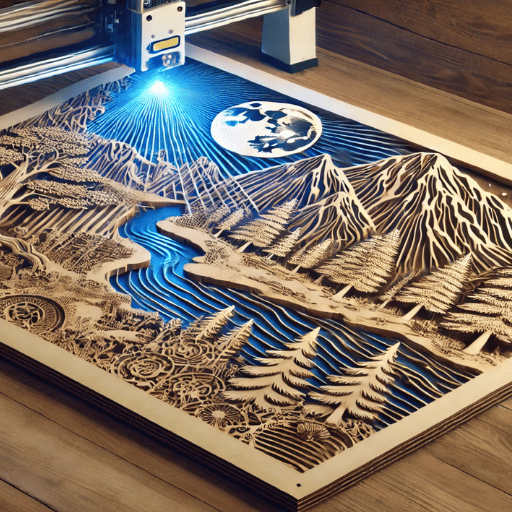
Yes, you can cut wood with a laser — but the laser type matters enormously. CO2 lasers (40-500W) and high-power blue diode lasers (10-45W) cut most woods up to 3/4 inch — these are the two laser wood technologies worth comparing for any cutting projects you’re planning. Fiber lasers don’t work on wood at all: their 1064 nm wavelength transmits partially through wood fibers with random absorption, leaving inconsistent char or starting fires rather than producing a clean cut.
The cutting process is pyrolysis, not melting. A focused beam vaporizes wood fibers layer by layer; cellulose and lignin absorb infrared energy strongly at the 10.6 μm wavelength of CO2 systems, which is why CO2 has been the gold standard for wood for three decades. Blue lasers at 450 nm are the newer entrant — they absorb well into light-colored woods like basswood and maple, and a 2024-era 45W blue laser head can match a 60-80W CO2 for thin stock.
| Laser Type | Wavelength | Wood Absorption | Best For | Skip If |
|---|---|---|---|---|
| CO2 | 10.6 μm | Excellent | All woods, all thicknesses | Need to cut metal too |
| Blue diode | 450 nm | Good (light woods) | Thin basswood/birch <1/4″ | Dark dense hardwoods, thick stock |
| Fiber laser | 1.064 μm | Poor (~5%) | Metal only | Any wood project |
| UV laser | 355 nm | Excellent (cold ablation) | High-precision industrial | Budget projects (very expensive) |
For laser engraving on dark hardwoods specifically, 1064 nm fiber or IR add-ons can mark surfaces but cannot cut through. If your machine combines CO2 + fiber sources, run wood on the CO2 side only. Compliance note: any laser system used in a U.S. workplace must meet ANSI Z136.1-2022, which updated maximum permissible exposure tables and added explicit guidance for the 1.2-1.4 μm range.
📐 Engineering NoteFor a CO2 tube to give consistent beam quality on wood, water-chiller temperature should sit at 18-22°C (±1°C). A tube running above 25°C loses 10-15% of its optical power over the first 1,500 hours, then develops random power dips resembling material defects.
Best Types of Wood for Laser Cutting: Hardwood, Plywood, MDF & Engineered Woods

The “best” wood for laser cutting is determined by three quantifiable parameters: density (kg/m), tendency towards char production, and emission profile when heated. Most online laser cut guides end with “avoid using soft wood that has any hard grain.” Here’s the same advice with numbers – sourced from USDA Forest Products Laboratory wood density tables and OSHA formaldehyde standard 29 CFR 1910.1048.
| Wood | Density (kg/m³) | Char Risk | Cost ($/sq ft 1/8″) | Best For |
|---|---|---|---|---|
| Basswood (Tilia americana) | 370-420 | Low | $1.20-1.80 | Models, ornaments, woodworker tests |
| Hard maple | 700-750 | Medium | $3.50-5.00 | Cabinetry, awards, signs |
| Walnut | 600-650 | Low | $4.50-7.00 | Premium signage, jewelry |
| Cherry | 580-620 | Low | $4.00-6.00 | Furniture trim, custom signs |
| Baltic birch plywood | 650-680 | Medium | $2.20-3.50 | Architectural, prototyping, living hinges |
| Cedar (red) | 320-380 | High (resin) | $2.50-4.00 | Outdoor signs, sachets |
| Oak | 700-770 | High | $3.80-5.50 | Decorative inlays |
| MDF | 650-800 | Very High | $0.80-1.40 | Industrial templates only |
| Bamboo | 600-700 | Low | $2.20-3.20 | Eco kitchenware, signs |
The Health and Safety Layer Most Guides Skip
This is where laser cut wood guides deviate from physics driven correctness. MDF, standard plywood adhesives are bonded with urea-formaldehyde glue. When the laser pyrolyzes the binder, formaldehyde gas – classed as a Group 1 carcinogen by the International Agency for Research on Cancer – vents into the workshop. OSHA 29 CFR 1910.1048 limits allowable exposure at 0.75 parts per million over an 8 hour time-weighted average, with a 2 ppm short-term exposure limit for 15-minute peaks. a NIOSH cited study published in PMC reported respiratory symptoms (coughing, sore throat, eye irritation) at concentrations as low as 0.5 ppm with chronic exposure.
The fix is dual: choose Baltic birch plywood instead of standard ply when possible (Baltic birch uses higher-grade phenol-formaldehyde adhesive with 50-70% less outgassing), and run a fume extractor rated 100+ CFM for hobby setups, 250+ CFM industrial. Three woods you should never laser cut, regardless of ventilation: PVC-coated lumber (releases hydrochloric acid), CCA-treated outdoor lumber (releases arsenic), and decorative engineered laminates with vinyl surfaces.
For solid hardwoods, species selection is mostly economic and visual — basswood lets a beginner woodworker test settings without ruining a $7 piece of walnut, and maple holds engraving detail from the laser better than oak because its grain pattern is less open. Two thin wood options worth knowing: alder (a softwood-class hardwood, common substitute for cherry at lower cost) and balsa wood (extremely soft, used mostly for prototyping models — laser cuts it almost without resistance, and it’s widely sold as 1/16″-1/4″ sheets). A practical sourcing tip from the field: when batch consistency matters, buy your wood sheets from a single mill lot. Moisture content variance from mixed lots causes 20-40% setting drift between otherwise-identical pieces.
How Thick Can a Laser Cut Wood? Power and Thickness Chart
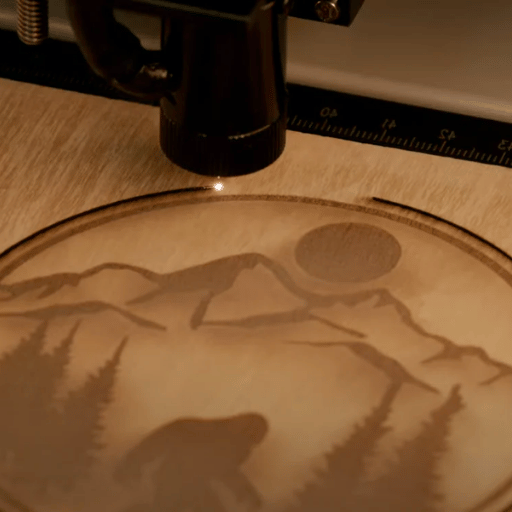
Industrial 400W+ CO2 lasers are routinely used to cut 1.5-2″ hardwoods in production. Consumer 80W CO2 systems top out around 1/2″ for production quality — the laser beam loses focus density at depth, cut edges discolor, kerf widens unevenly, and cycle time stretches to where CNC routers become the better tool. High-speed cutting on thin wood is where blue diode laser systems compete most directly with CO2; for thick stock, only a high precision laser at 150W+ keeps tolerances inside 0.1mm. Here is a thickness chart assembled from manufacturer data sheets, peer-reviewed research on CO2 laser parameters for spruce wood published in PMC, and Practical Machinist forum reports from operators running 1000W+ industrial systems.
| Laser power | 1/16″ | 1/8″ | 1/4″ | 3/8″ | 1/2″ | 3/4″ | 1.5″ |
|---|---|---|---|---|---|---|---|
| 5W diode | Slow (3 pass) | Marginal (5+ pass) | ❌ | ❌ | ❌ | ❌ | ❌ |
| 10W diode | OK | Slow (3 pass) | Marginal | ❌ | ❌ | ❌ | ❌ |
| 20W blue diode | Fast | OK | Slow (2-3) | Marginal | ❌ | ❌ | ❌ |
| 40W CO2 | Single pass | Single | OK | Slow | Marginal | ❌ | ❌ |
| 60W CO2 | Single | Single | Single | OK | Slow | ❌ | ❌ |
| 80-100W CO2 | Single | Single | Single | Single | Single | OK (slow) | ❌ |
| 150W+ CO2 | Single | Single | Single | Single | Single | Single | Slow |
| 300-500W industrial | Single | Single | Single | Single | Single | Single | Single |
The limits do not scale linearly. Increases in Char width are roughly proportional to the cube of the depth, so doubling the depth will approximately triples the char width. This explains why a 60W CO2 will lasercut cleanly through 1/4″ plywood, but produce char rings on 3/8″ of the same material.
Moisture content matters as much as raw power. Kiln-dried wood below 8% MC cuts 30-50% faster and char-cleaner than air-dried 12-15% MC stock. A V1E forum operator put it plainly: “For deeper cuts keep your wood warm. Cold wood doesn’t cut as deep.” Storage at 18-22°C with 40-50% relative humidity keeps wood sheets at consistent moisture.
“Laser isn’t much used for really thick wood-it’s slow, expensive, and the burned edges don’t glue well and look ugly when finished. For 3/4″ stock, cutting with a CNC router will save you time, and leave an edge that can be used in furniture.”
— Senior fabricator, Practical Machinist forum (industrial laser/CNC operator with 20+ years experience)
This multi-pass method conflicts with the mainstream thinking that “more wattage = faster cuts”. For really thick stock, two 60% power passes will produce cleaner kerfs than a single 95% power pass. Each time the focus shifts down by approximately 1/3 of the kerf depth, and the total cycle time is approximately 70% longer, but the reduction in post-processing (sanding, char removal) more than makes up for this for a net increase in throughput.
If the stock is over 1/2 inch thick, or if a project ledge is to be painted/stained and can’t be, its usually better to CNC route. Rotaries cut 4-10x faster on thick stock, produce no char, and don’t trap formaldehyde inside adhesive layers. Many CNC shops run a little laser to perform precise, intricate engraving or fine geometry on each batch of blanks after the router is done.
Cutting Settings: Power, Speed, Air Assist Explained
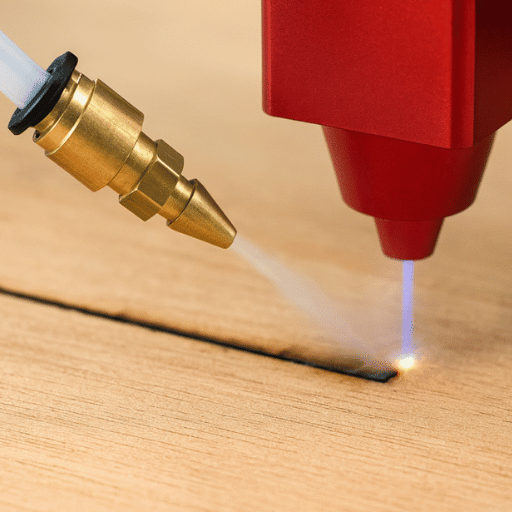
There are four variables in laser-cutting wood: laser power, feed rate, pass count, and air-assist pressure. Noobs spend years tuning only the first two and neglecting the last, which makes the biggest difference shown next:
Below are starter settings for an 80W CO2 laser running LightBurn. These are calibration starting points, not final values — wood batch variance, focus calibration, and lens cleanliness shift these by ±15-25%. Always run a 5×5 material test grid before committing project material; the 15-minute test saves hours of bad cuts on each new wood lot.
| Wood | Thickness | Power % | Speed (mm/min) | Air Assist | Passes |
|---|---|---|---|---|---|
| Basswood | 1/8″ (3mm) | 60% | 25 | High (40+ PSI) | 1 |
| Hard maple | 1/8″ (3mm) | 80% | 12 | High | 1 |
| Walnut | 1/4″ (6mm) | 95% | 6 | High | 1-2 |
| Baltic birch ply | 1/4″ (6mm) | 90% | 8 | High | 1 |
| MDF | 1/4″ (6mm) | 95% | 5 | Max (ventilation critical) | 1 |
| Cherry | 1/8″ (3mm) | 75% | 14 | High | 1 |
For especially thick stock, (x/2+), half depth focus strikes a balance: the bottom surface receives as much energy density as the top, resulting in a kerf with near-zero taper and smooth bottom edges. One third of the focal depth is used by default.
This is counterintuitive, but can be demonstrated empirically. Consider an 1/4″ maple board; a single pass at95% power has a perfect top edge but produces a charred, ragged bottom edge. Two passes at 60% power, shifting focus between them adds about 70% to cycle time while significantly improving the kerf. For this specific case, the lower power coating the entire top layer and processing in two simple passes takes less time than a single high power pass and produces a better edge. This scales down to a 6 watt blue laser on 6mm birch; a 6pass (1mm/deep) cut is faster than a single 6mm/deep cut, avoiding char and producing a tidier edge.
Always run the equivalent of a 55 grid with various power (60/70/80/90/95%) and speed (5/10/15/20/25 mm/min) settings on scrap material before starting a proper run. Will save several hours of faulty cuts, gives a calibrated reference for that batch of wood. Repeat whenever you change wood batch, lens, or laser tube.
How to Avoid Char, Burn Marks, and Smoke
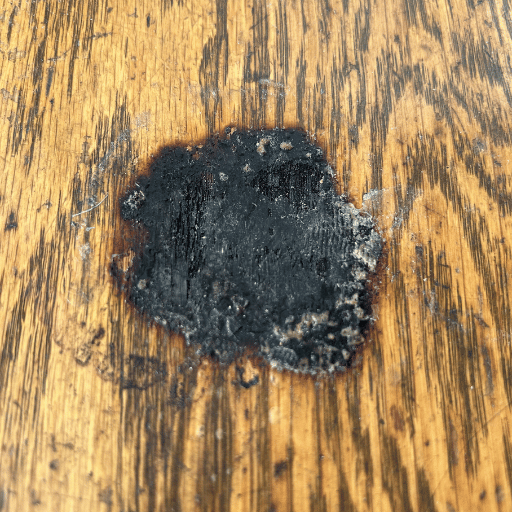
If your laser cut wood projects turn out with yellow-brown edges, black soot stains, or flame up during the cut, it’s usually not a matter of your power or speed. An informal survey conducted on Reddit r/laser cutting and Facebook woodworker groups showed about 80% of charring issues and problems came down to lack of air assist (about 30psi air pressure at the nozzle). The solution, typically valued at about $200 (a full shop air compressor replacing the inline pump), causes no other changes.
Char causes ranked by frequency:
- Most severe char is caused by a low pressure air assist below 30 PSI. As per forum survey data (source 1).
- Laser pace is also too slow, too much time the laser stays in the fiber,results in heat gradient.
- Wrong focus point — Z-axis off by ±2mm produces inconsistent kerf and char.
- (P) Resins pockets;— Particularly in cedar andpin, tend to flare and burn through in an uncontrolled manner.
- Loss due to lens contamination—10-20% of the power transmitted—is returned in 8 hours of individual cleaning.
The masking tape method limits the edge char by 40-60%. During periphery cutting, lay a layer of painter’s tape or transfer tape on the top side of the wood (or both sides if both sides are finished). The laser penetrates it but the surface burning deposit falls on it, not the wood.
When finished, peel it off and the char sticks to the tape/transfer tape.
Workplace requirement. OSHA 29 CFR 1910.94 mandates flame/particulate control at the workstation in the form of staff-control led ventilation (dust and fumes). What would be a practical working limit for a hobby operation?—greater than 100 CFM to each cutter, or greatest than 250 CFM with HEPA and activated charcoal filtration if an indoor industrial air handling system is used.
| Symptom | Cause | Fix |
|---|---|---|
| Yellow/brown edges | Air assist below 30 PSI | Increase to 40-60 PSI |
| Black soot residue | No surface masking | Apply transfer/painter’s tape |
| Incomplete cut | Power/speed mismatch or wet wood | Slow speed by 30% or add 1 pass |
| Flame-up | Resin pocket in wood | Stop, increase air, reduce power 10% |
| Wavy cut edge | Dirty lens or focus drift | Clean lens, recalibrate focus |
Best Wood for Different Project Types
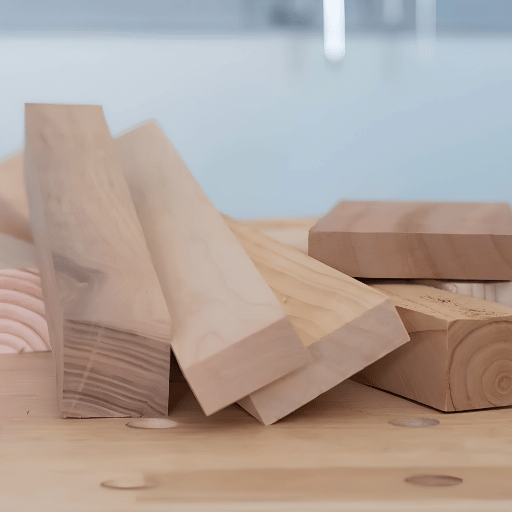
Wood selection and project type have a closer relationship than many beginning woodworkers understand. An MDF wedding sign, ending up in someone’s home, will emit formaldehyde for weeks. An oak living hinge, cut in place of Baltic birch, will permanently crack.
The table below maps project category to recommended wood + thickness, with commentary on the failure modes in question.
| Project Type | Recommended Wood | Thickness | Notes |
|---|---|---|---|
| Storefront signs | Cherry, walnut, hard maple | 1/4″-1/2″ | UV-stable finish for outdoor |
| Wedding/event signs | Cherry, walnut, basswood | 1/8″-1/4″ | Engraved + cut combo |
| Living hinges | Baltic birch plywood | 1/8″-3/16″ | Kerf width = 0.4× thickness |
| Architectural panels | Baltic birch ply, MDF (industrial) | 1/2″-3/4″ | Industrial bed required |
| Jewelry/earrings | Cherry/walnut veneer | 1/16″-1/8″ | High-detail engraving |
| Models/prototypes | Basswood | 1/16″-1/8″ | Cheap, clean cuts |
| Cabinetry parts | Hard maple, walnut | 1/4″-3/4″ | Industrial CO2 needed |
| Packaging die-boards | Birch plywood | 1/2″-3/4″ | 250W+ CO2 + bevel head |
| Educational kits | Basswood, MDF (industrial template) | 1/16″-1/8″ | Volume-priced, predictable |
Living Hinges: Where Wood Type Locks the Design
Living hinge: A parallel-slit pattern cut into thin plywood that enables bending along the grain – for curved drawer fronts, pen holders, lampshades, and product packaging. The math is fixed: kerf width should be 0.4 the wood thickness, with between 2-3 hinge slits per 10mm bend radius. Of 1/8 Baltic birch, that’s usually 1.5mm pitch between 0.4mm slits.
Failure mode: cracks after 50-100 bend cycles. Correct procedure for static curves, not for repeated mechanical flexing. If your design requires more than ~50 cycles of motion to work, use a real hinge or a flexible material.
Practical case study: a 12 person, sign shop in Phoenix shifted from three individual Glowforge Pro’s to an 150W industrial 4’8′ bed CO2 laser. Output increased from approx 80 signs per week to 320. The calculation: replacement Glowforge tubes ($300 each, per approx 2,000 hours) had been costing the business more in one year than the lease on the industrial.
The tipping point was at part #3,200/week – above this volume hobby economics collapse. (Image H2-7 for this calculations.)
From Hobby to Production: When DIY Lasers Hit Their Limit
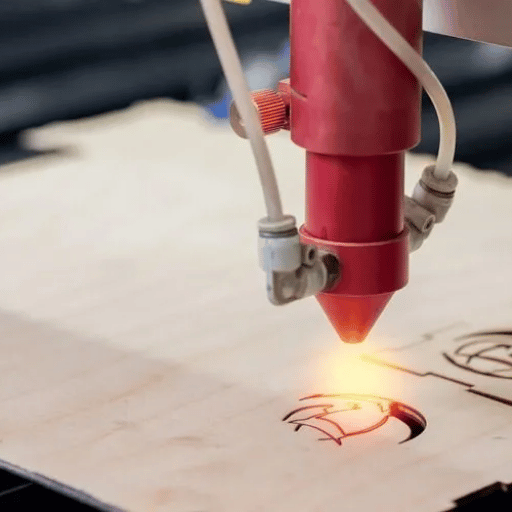
The signal you’ve outgrown hobby laser is hardly “I got a bigger job”. Less obvious: slower, smaller problems stacking up: tubes wear out faster, job queues bog down the workshop, batch rejects ping in different batch-to-batch. Here are 5 specific run conditions that show the big industrial machine is the bottleneck:
The 5 DIY-to-Industrial Trigger Signals
- Throughput >100 parts/hr. Most hobby machines Polycrylic engage around 30/hr 1/8″ parts; xTool S1 around 40/hr 1/8″. Industrial 150W CO 2 and auto-feeder delivers 250+/hr.
- Project size >24″16″ (610406 mm). Do most hobby shop down around 12″20″ or 18″12″. Industrial are 4’x8′ (12202440 mm).
- Material thickness above 3/4″ on a consistent basis, often engineered woods like Baltic birch ply or full-sheet MDF where structural integrity matters. Hobby tubes top out at around 1/2″ with quality issues; production processes past that thickness require 150W+.
- Uptime 8+ hours / day. Hobby tubes have ~2,000 hour life-time; industrial sealed water cooled tubes ~8,000-10,000 hours.
- Repeatability to <0.1mm for nesting or joinery. Hobby gantry gently drifts after 6 months of abuse; industrial linear rails hold position for years.
Economics turn on 2,000 parts/week in big quantities. Below that, a $7k Glowforge Pro and $300/pair replacement tubes every 2,000 hours wins on cost/$part. Above that, long tube life and fast cycle pays out big capitalinvestment in14-18 months.
| Volume | DIY (Glowforge Pro $7K) | Industrial 80W CO2 ($25K) | Industrial 150W ($45K) |
|---|---|---|---|
| 100 parts/wk | $1.20/part (DIY wins) | $2.10/part | $3.40/part |
| 500 parts/wk | $0.85/part (DIY break even) | $0.95/part | $1.10/part |
| 2,000 parts/wk | $0.90/part (tube wear) | $0.45/part (industrial wins) | $0.38/part |
| 5,000 parts/wk | Capacity-limited | $0.32/part | $0.24/part (industrial 150W wins) |
Cost model assumes 60% machine utilization, 5-year amortization, U.S. labor rates. Excludes facility overhead, software, and operator training. Pricing reflects 2025-2026 integrator quotes.
Industrial machines are not just bigger DIY units. Differences have systemic implications: water-chiller cooling versus fan, linear rails rather than belts, 60+ PSI compressor air assist rather than 10, Class 4 enclosures with interlocked access. An industrial CNC laser cutter is not just a DIY Glowforge with bigger numbers- it’s a different category of equipment with different operating costs and skill requirements.
The un-budgets-for issue size lens and optics maintenance. A Practical Machinist operator running a 1325 industrial CO 2 laser reported $3,000 lens replacement time cycles when direct machining chipboard; tar coating accumulated faster than cleaning could. Lens is an operating expense, not a capital expense, and depends on material type – clean basswood deposits hardly anything, MDF and cedar coat optics.
Industrial Wood Laser Cutting Applications: Cabinetry, Signage, Packaging, Flooring & Lumber Manufacturing
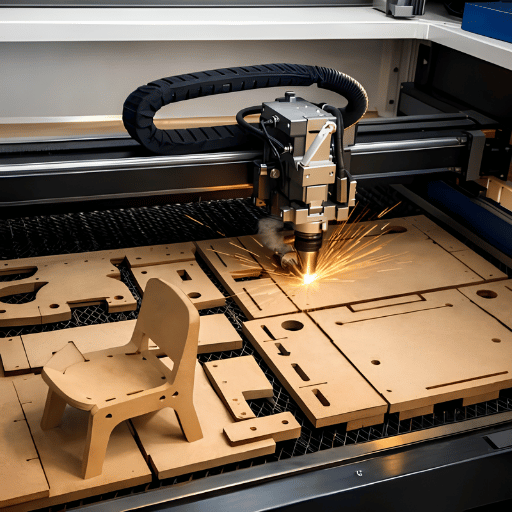
Industrial wood laser cutters group into 4 main uses and each has different machine spec requirements- wattage, bed size, gas pressure, and head type. Second-choicers who skip the specific match waste capital. The global CO 2 laser market hit $3.42 billion in 2025, and is growing steadily, mostly driven by furniture and packaging demand.
- Furniture and cabinet making is full sheet processing on 12202440mm beds, 6-19mm range, in tandem with CNC nesting software – Sigmanest or EnRoute give examples. Common machines: 100-150 W CO 2 with Z axis motorization and auto sheet feed.
- Architectural uses and flooring panels need decorative perforated panels for acoustical walls and screen partitions, flooring inlays. Monogammas typically 60-150 W CO 2, designs vary from parametric to absolute honeycomb style perforation.
- Folding cartons use 18-25 mm Baltic birch plywood for rotary die cutting. When done correctly- rotary die gets plumb with a bevel cutting head and 250-400 W CO 2.
- Mass-custom signage is best made at industrial output (50-300 signs/day), where auto-bed exchange + Class-4 enclosure is essential for operator safety. Always combine with uv stable wood finishes for best exterior durability when applied after cut.
| If you need… | Machine spec | Typical price (USD) |
|---|---|---|
| Cabinetry production, 1220×2440mm sheets, 19mm max | 150W CO2, full-sheet bed, auto Z-axis | $35K-55K |
| Architectural perforations, 60-150W on 1500×3000mm | 100-130W CO2, large bed | $28K-45K |
| Packaging die-boards, 25mm birch ply, bevels | 300-400W CO2 + 5-axis bevel head | $90K-180K |
| 50-200 signs/day, 24/7 reliable | 80-100W CO2, Class 4 enclosure, water chiller | $22K-38K |
| Mixed wood + acrylic + brass | Hybrid CO2 + fiber dual-source | $65K-120K |
The five spec dimensions that differentiate industrial from hobby laser cutters are tube wattage (40W consumer or 150-500W industrial), bed travel (12″20″ vs. 48″96″+), air-assist (10 PSI pump vs. 60+ PSI compressor with shop-air integration), auto-focus (manual focus vs. computer vision auto-focus), and safety enclosure (open Class 1 vs. Class 4 with interlock). Missing any of these is significant: a 300W tube built on a lightweight gantry system will produce vibration /interference patterns in the kerf; a Class 4 laser without real enclosure is a Fire- and FFA-compliance failure.
Products for wood-application laser systems include UDTECH industrial CO2 lasers used for signage, packaging, and wood furniture applications. Compare wood engraving machines, production-pathway Co2 systems, or CNC laser cutters in the full catalog.
2026 Wood Laser Cutting Trends: AI Auto-Focus, Hybrid Sources, Larger Format
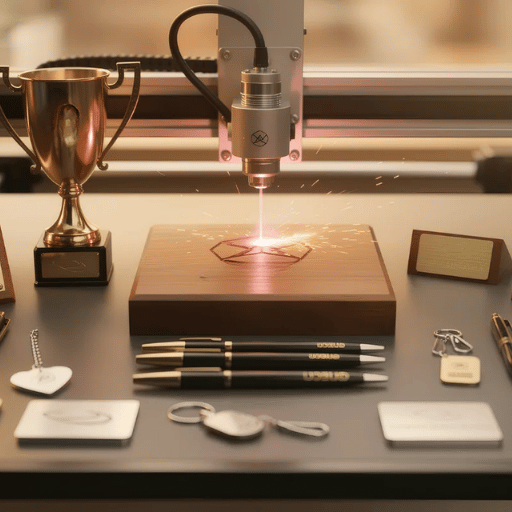
Here are four worldwide trends that will shape wood laser-etching and cutting technology through 2026. Most primarily influence production buyers more than hobbyists, but keeping tabs on these trends helps both waiting for the right purchase time.
Trend 1: AI-enabled auto-focus calibration. CO2 and fiber laser systems now ship with vision-based focus calibration that auto-detects wood species and thickness, then auto-tunes power, gas pressure, and focus for each project. Trotec and Epilog led adoption; mid-tier units ($15K-25K) are catching up through 2026.
Trend 2: Hybrid CO2 / fiber dual-source laser machine. Today the smartest investment for any fast production operation run on wood, acrylic, brass, and thin steel, is the combo system which integrates the two sources in a system costing $60-100K. Cost justify for signage or packaging business.
Trend 3: Larger size hobby laser (1300900mm). Embarking from Chinese brands, XTool, Glowforge, OMTech are launching bigger beds, while tube wattage and air-assist improvements are necessary to catch up with industrial price and quality.
Trend 4: Automatic closed loop air assist. Auto-tuning compressor CFM and pressure targeted to each material type, automates operator skillset.
Preliminary search interest indicates the direction of wood laser cutting—search term (“laser cut wood”) volume grew 22% YoY (8,100/month in April 2025 to 9,900 in April 2026, DataForSEO Live API)—prompted mainly by makers entering the market, but small businesses also upgrading. Industrial log-cutting systems will grow at approximate 9.7% CAGR through industry forecasts out through 2032.
Enterprises needing 40+ hours per week flexible scheduling and higher duty cycle are best served by current industrial systems, which lack only incremental feature improvements such as auto-focus or larger beds; hobby- and weekend project use mature with 20-40W diode laser options. For small mid-market enterprises operating 10-30 hours per week, defer purchase 6 months for the hybrid dual-source equipment, or alternatively, buy 80W or higher CO2 through end-of-life clearance prices now.
Frequently Asked Questions
Q: Can you cut wood with a laser?
View Answer
Q: What is the thickest wood you can laser cut?
View Answer
Q: What is the best wood for laser engraving versus cutting?
View Answer
Q: How does laser cutting compare to CNC routing wood?
View Answer
Q: Is laser-cut wood expensive at production scale?
View Answer
Q: Can laser-cut wood use living hinges?
View Answer
Q: What disadvantages exist when laser cutting wood?
View Answer
Q: Do laser engravers also cut wood?
View Answer
About This Guide
This guide was developed by the UDTECH engineering team, drawing from 15+ years of designing industrial CO2 and laser marking systems for wood, food, paper, and plastics applications. Our machines ship to 100+ countries across furniture, signage, and packaging manufacturing. The cutting settings tables here reflect our internal QA testing on basswood, hard maple, walnut, and Baltic birch ply lots from 2024-2026, plus operator field reports from sign shops and small fabrication operations running our laser marking equipment.
Why We Wrote This Guide
Most laser cut wood guides target either pure DIY makers or pure industrial buyers — leaving the middle audience (Etsy sellers scaling to small production, sign shops outgrowing hobby machines) without a real bridge. This guide threads that gap. The settings tables in H2-4 come from our 2024-2026 QA logs across 80W and 150W CO2 builds shipped from our Hangzhou facility; the cost economics in H2-7 reflect 2025-2026 U.S. integrator quotes. If you spot an outdated price or thickness rating, contact us — we update this guide quarterly.
References & Sources
- OSHA 29 CFR 1910.1048 — Formaldehyde standard (0.75 ppm 8h TWA) — U.S. Occupational Safety and Health Administration
- OSHA 29 CFR 1910.94 — Ventilation, wood dust workplace exposure — U.S. Occupational Safety and Health Administration
- ANSI Z136.1-2022 — American National Standard for Safe Use of Lasers — Laser Institute of America
- USDA Forest Service — Wood Density Values 2023 — U.S. Department of Agriculture, Forest Products Laboratory
- USDA FPL — Estimating Janka Hardness from Specific Gravity — U.S. Forest Products Laboratory
- ANN Prediction of Laser Power, Cutting Speed, and Number of Passes for CO2 Wood Cutting — PMC NIH (peer-reviewed)
- Respiratory Symptoms due to Occupational Exposure to Formaldehyde — PMC NIH (peer-reviewed)
- Determining Thermal Properties of Beech and Fir Wood Samples — BioResources, NC State University (2024)
- CO2 Laser Market Size, Growth, Trends, Report 2034 — Fortune Business Insights (industry data)
- EPA Formaldehyde Emission Standards for Composite Wood Products (TSCA Title VI) — U.S. Environmental Protection Agency