Updated June 2026
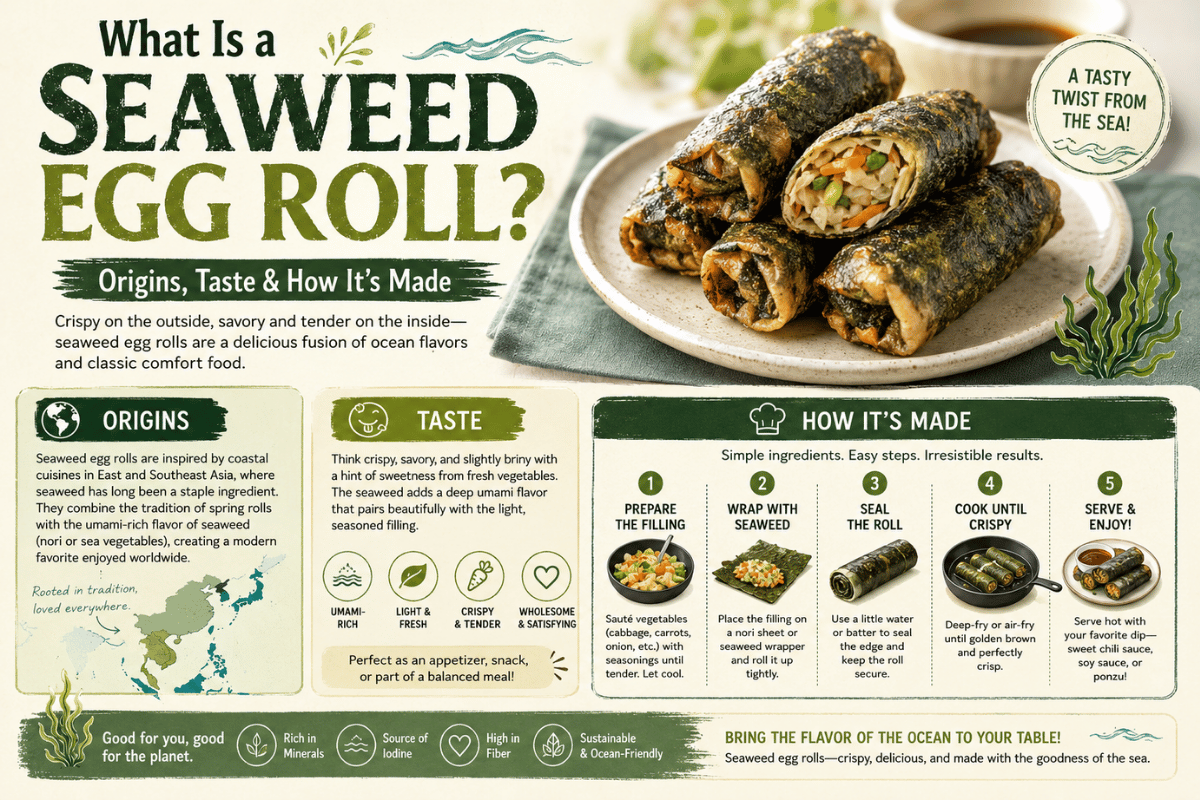
A seaweed egg roll is one name stretched across at least five different East-Asian foods, from a soft Korean rolled omelette to a deep-fried street-food roll to a crackly snack you find in Chinese New Year gift boxes. Search the phrase and you’ll get recipes that look nothing alike, because the people writing them mean different dishes. This guide sorts out which is which, what each one is actually made of, and how the crispy snack version is produced at scale.
Seaweed Egg Roll at a Glance
| What it is | Umbrella name for several savory rolled foods built from egg and seaweed (nori / Korean gim) |
| Core ingredients | Egg, dried seaweed sheet, salt, oil (some versions add a thin wrapper, noodles, or pork floss) |
| Most common meaning | Korean gyeran-mari — a rolled egg omelette folded with seaweed |
| Crispy snack version | A thin egg-and-nori wafer rolled into a crunchy stick — made by hand or on an automatic line |
| Not the same as | The deep-fried, filled “egg roll” (spring-roll family) served at takeout counters |
What Is a Seaweed Egg Roll?
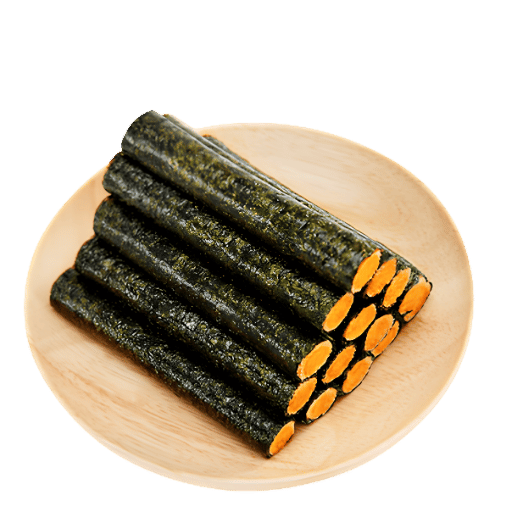
A seaweed egg roll is any of several East-Asian savory foods that combine egg and seaweed in a rolled shape. In its most-searched form it’s the Korean gyeran-mari: beaten egg cooked in thin layers, laid over sheets of dried seaweed, and rolled into a log that’s sliced into bite-size rounds. In other kitchens the same words point to a crispy snack, a wafer-thin egg layer wrapped around nori and rolled tight until it shatters when you bite it.
The reason a single search return clashing pictures is simple: the dish was never standardized across borders. Korea, China, Taiwan, Macau and Japan each built a “seaweed + egg + roll” food, and English flattened them into one phrase. Its base is almost always egg, and the seaweed is structural rather than a garnish, but the cooking method, texture and occasion change completely from one version to the next. The mismatch is a real problem at the grocery shelf: a shopper who searches “seaweed egg roll” might land on a soft 84 kcal Korean omelette or a deep-fried crunchy roll, because the dish was never standardized across the four cuisines that claim it. In practice, the most common mistake is assuming the phrase has one meaning.
The 5 Foods People Call a “Seaweed Egg Roll”
Here’s the disambiguation map. We call it The Seaweed Egg Roll Name Mapthe foods that share the name (plus the three look-alikes people mix them up with), set side by side so you can match a recipe or a product to what you actually want.
The 9-Way Seaweed Egg Roll Decoder
| Food | Category | Origin | Base + form | Cooked how |
|---|---|---|---|---|
| Gyeran-mari (계란말이) | Seaweed egg roll | Korea | Egg layers + gim, soft roll | Pan-rolled, low heat |
| Gimmari (김말이) | Seaweed egg roll | Korea | Glass noodles in gim, crisp roll | Deep-fried |
| Crispy seaweed egg roll | Seaweed egg roll | China / Taiwan | Thin egg wafer + nori, crunchy stick | Baked or fried |
| Macau phoenix egg roll | Seaweed egg roll | Macau | Crisp roll + laver + pork floss | Baked |
| Nori egg roll (tamagoyaki) | Seaweed egg roll | Japan | Sweet-savory egg roll + nori | Pan-rolled |
| Nori maki arare | Adjacent snack | Japan | Rice cracker wrapped in nori | Baked / dried |
| Kimbap | Look-alike (rice) | Korea | Rice + fillings in gim | Raw-rolled |
| Fried “egg roll” (spring roll) | Look-alike (no seaweed) | China / US | Wheat wrapper + filling | Deep-fried |
| Egg roll cookie | Look-alike (sweet) | China / SE Asia | Sweet rolled wafer | Griddle-baked |
Map compiled from Korean, Chinese and Japanese culinary sources, listed at the end of this guide.
Picture a buyer in a Lunar New Year gift aisle holding two tins that both read “seaweed egg roll” — one a 135 g crunchy phoenix roll, the other a soft omelette. They look unrelated because the difference is structural, not a branding gap. If the table is still a lot to hold in your head, use a shortcut. The 3-Question Seaweed Roll Identifier gets you to the right food in three steps:
- Is the base egg or a cracker/noodle? Egg → omelette or crispy wafer family. Rice cracker → nori maki arare. Glass noodles → gimmari.
- Soft or crunchy? Soft and sliceable → Korean gyeran-mari. Crunchy and snappable → the crispy 海苔蛋捲 snack or gimmari.
- Home side dish or packaged snack? Lunchbox side → gyeran-mari. Gift box or snack aisle → the commercial crispy roll.
Korean Seaweed Egg Roll, Gyeran-Mari (Rolled Omelette)
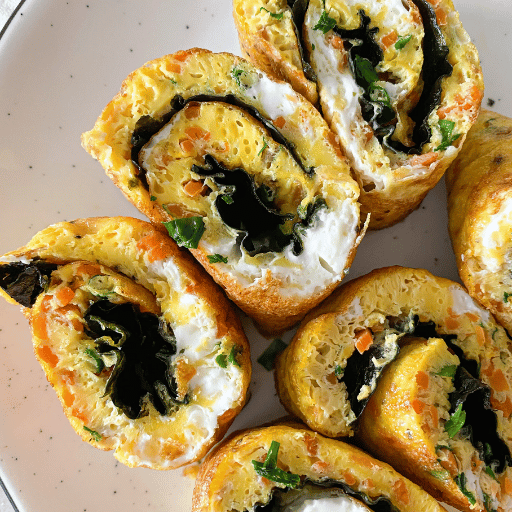
When a recipe site says “seaweed egg roll,” nine times out of ten it means gyeran-mari (계란말이) — a Korean rolled egg side dish, or banchan, made with gim (the Korean word for laver, the same sheet sold as nori). Beaten egg is poured in thin layers, a sheet of seaweed is laid on top while the egg is about 80–85% set, and the whole thing is rolled, layer over layer, into a log that gets sliced into rounds. A typical serving run about 84 kcal with roughly 6 g of protein, and the standard recipe uses just five things: egg, dried seaweed, a splash of rice wine, salt and oil.
“Gyeran mari (Korean rolled egg) made with gim, also known as nori, is a family favorite, wonderfully soft, fluffy, savory and mild.”
Hyosun Ro, Korean Bapsang
What is a Korean egg roll?
A Korean egg roll is gyeran-mari: a rolled omelette eaten as a side dish or packed into a lunchbox, not a fried, filled roll. Sliced open, it shows the seaweed as a dark ribbon, adding a faint briny note and a clean visual stripe. Home cooks treat it as a beginner-friendly dish that’s secretly hard to make pretty. You’ve to roll the egg at the exact moment it sets, too early and it slides apart, too late and it tears or browns. The reason home cooks struggle is timing, not skill: the egg set in seconds, so a delay of even 5 to 10 seconds means it tears. Korean food forums are full of the same advice: keep the heat low, let the first layer cook through, and roll with chopsticks or a flat spatula. Many people use a rectangular tamagoyaki pan for neat edges, though a round skillet work fine. In practice, a few rounds of trial and error fixes the timing.
This is easy Korean cooking that has found a second life on TikTok and Instagram. It’s naturally paleo-friendly and protein-packed, which is part of the appeal: people who love eggs keep the pantry staples on hand and make it on a whim. It’s a delicious Korean side dish warm and still tasty to eat at room temperature, which makes it great for breakfast, a quick lunch, a packed lunch box, or a picnic. Its base is endlessly customizable, stir in chopped vegetables, a little onion, or even tuna or ham, and add cheese for a richer egg wrap. The Korean spelling you’ll see is gyeranmari (and on US recipe sites, “Korean egg omelet”).
How to make a seaweed egg roll at home
You don’t need special gear to make Korean rolled omelet at home, this is one of the easy-to-make dishes in any beginner’s repertoire. Here’s the short method that the popular omelette recipes all follow:
- Beat or whip the eggs lightly in a bowl, then season the egg mixture with a pinch of salt (some cooks add a splash of rice wine).
- Set a non-stick pan or cast iron skillet on medium heat; once warm, reduce to a steady medium low heat so the egg doesn’t brown.
- Add a little cooking oil and swirl to coat, then pour a thin layer of egg and tilt the pan so it spreads lightly.
- When the edge of the egg set, lay a sheet of seaweed on top and start rolling with a spatula or chopsticks; brush oil on the empty pan, pour another thin layer, and repeat until the egg mixture is used.
- Rest the roll for a few minutes, then slice into bite-size pieces with a spoon-and-knife or your spatula edge.
That same rolling logic, pour, set, lay the seaweed, roll, repeat, is what an automatic line reproduces mechanically, which is the bridge to the commercial version below. (The wrap is closer to a folded sushi-style egg than to sushi rolls, since there’s no rice inside.)
Gimmari, The Deep-Fried Korean Seaweed Roll
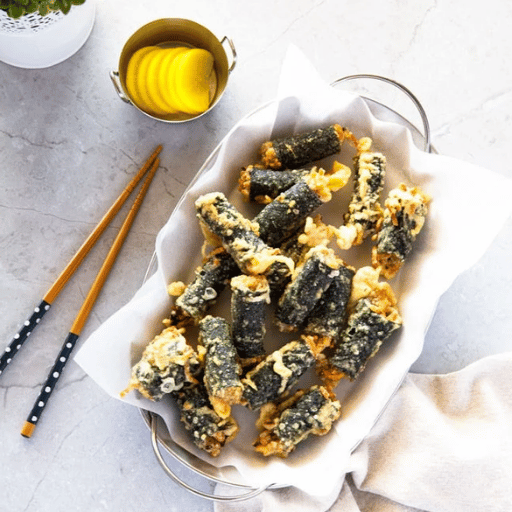
The second Korean food in the family look similar on a menu but is built differently. Gimmari (김말이) wraps cooked glass noodles (dangmyeon) and vegetables in a sheet of gim, then deep-fries the roll until the outside is crisp and the inside stays chewy. There’s no rolled egg here at all, the egg association come only from the shared “seaweed roll” name and the rolled shape. Gimmari is street food and a near-default partner for tteokbokki, the spicy rice cakes; the fried roll is dunked into the leftover sauce. The reason it confuses shoppers is the shared name: order “seaweed rolls” at a 2 a.m. street stall and you get the fried noodle version, not the omelette. In practice, a vendor fries these to order in under 3 min, which is why gimmari is a fast-food problem and gyeran-mari is a home-cooking one.
It’s worth flagging this one because it causes the most confusion. People who grew up with gimmari picture a hot, crunchy fried stick, while people who grew up with gyeran-mari picture a soft sliced omelette. Both are honest answers to “what’s a seaweed egg roll” — they’re just different dishes. As food writer site Maangchi puts it, gimmari is simply glass noodles rolled in seaweed paper and deep-fried.
Gimmari has no egg in the roll; gyeran-mari is mostly egg. If a “seaweed egg roll” recipe calls for sweet-potato glass noodles and a deep-fry, you are looking at gimmari, not the omelette.
The Crispy Seaweed Egg Roll Snack
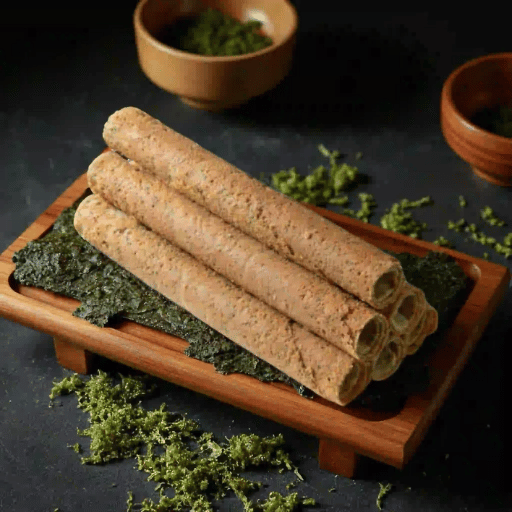
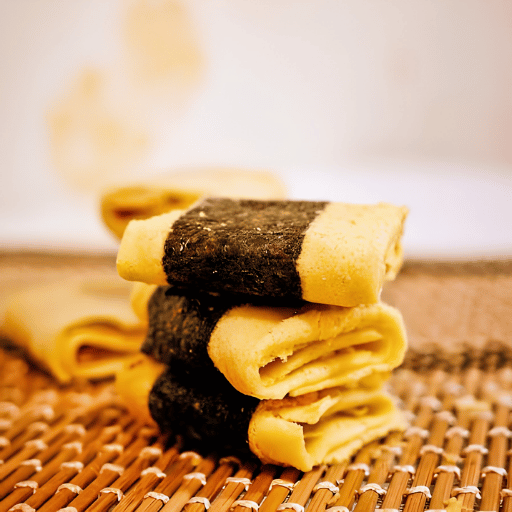
The version that bring most people to a snack aisle, and the one made on production lines, is the crispy seaweed egg roll. This is a thin batter of egg, flour and sugar (or a spring-roll / popiah wrapper brushed with egg) layered with a sheet of laver, then rolled tight and baked or pan-fried until it snaps. In Macau the bakery version is sold as the “phoenix egg roll,” often filled with pork floss and sesame alongside the seaweed, and packed into gift tins. It’s a fixture of Chinese New Year snacking, where home cooks roll trays of them and brands ship them by the case.
What is a seaweed roll snack made of?
At its simplest, the crispy snack need four things: egg, a thin wrapper or batter, a sheet of nori or laver, and a little oil and salt. The reason this version scales into a packaged snack, while the omelette doesn’t, is shelf life: a baked egg-and-nori roll stays crisp for weeks, so it survives shipping and a gift tin. From there it splits into styles. A plain crunchy roll keeps to egg and seaweed for a clean savory-sweet bite. The Macau-style phoenix roll adds pork floss and sesame for a richer, meatier snack. Some Taiwanese versions skip the separate wrapper entirely and roll a baked egg wafer around the nori, which is the form closest to what an automatic line produce. What they share is texture: these are made to be crisp and shelf-stable, not soft like the omelette. The problem the omelette can never solve is packaging, because it spoils within a day; the crispy roll hold its crunch for weeks, which is why makers like UDTECH build a production line for it, the food-grade UD-HT runs about 500 pieces per hour. In practice, this is the only version that moves from a home kitchen into industrial production. If you enjoy this style, the sweet cousin is the rolled wafer cookie, see our guide to Chinese egg roll cookies.
Seaweed Egg Roll vs Spring Roll, Sushi and Rice Crackers
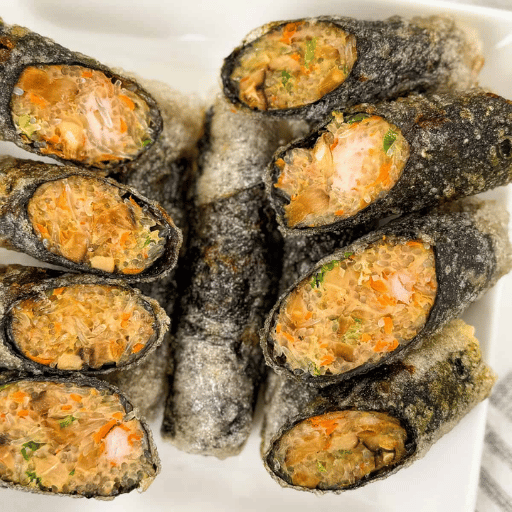
The biggest misconception is that a seaweed egg roll is a kind of takeout egg roll. It isn’t. The deep-fried, filled “egg roll” belongs to the spring-roll family: a thick, egg-enriched wheat wrapper packed with cabbage and pork, then deep-fried. The seaweed egg roll’s “egg” is the body of the food, not the wrapper. The table below lines up the near neighbors so the differences are clear.
| Food | Base | Role of seaweed | Sweet / savory | Eaten as |
|---|---|---|---|---|
| Seaweed egg roll | Egg | Structural layer | Savory | Side dish or snack |
| Fried “egg roll” (spring roll) | Wheat wrapper | None | Savory | Appetizer |
| Kimbap / sushi roll | Rice | Outer wrap | Savory | Meal |
| Nori maki arare | Rice cracker | Outer wrap | Savory | Snack |
| Egg roll cookie | Sweet wafer | None | Sweet | Snack |
The trouble is that all four look like rolled cylinders on a plate, so the eye fail you. The quick test: if seaweed is the wrapper and the inside is rice, it’s kimbap or sushi. If seaweed runs through an egg body, it’s a seaweed egg roll. If there’s no seaweed and the shell is a sweet rolled wafer, it’s an egg roll cookie.
How Seaweed Egg Rolls Are Made, Kitchen to Production Line
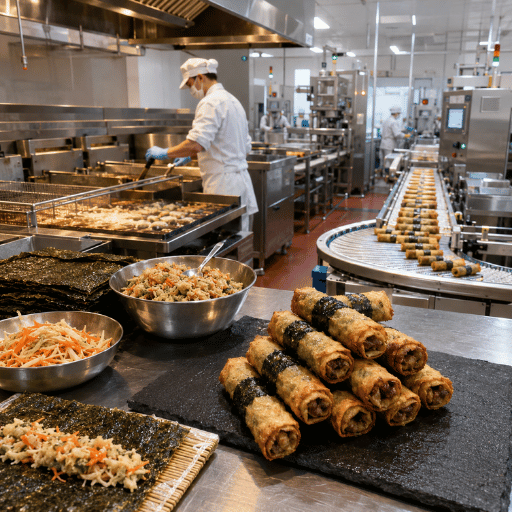
At home, every version start the same way: cook a thin egg layer, add the seaweed, and roll before it sets hard. A soft omelette is rolled warm and sliced; the crispy snack is rolled thin and held on heat until it crisps, then cut to length. The hard part is consistency. Hand-rolling is judged by eye, so color, crispness and length drift from piece to piece and from one cook to the next.
That’s exactly the wall snack producers hit when a seasonal order scales up. A skilled worker rolls somewhere around 30–60 pieces an hour, and quality slips as the shift wears on. To turn the snack into a packaged SKU with a fixed cost per piece, the work move to a dedicated automatic seaweed egg roll machine . On UDTECH’s UD-HT line, batter metering, nori feeding, three-stage wrapping and slitting run as one timed sequence at roughly 500 pieces per hour, with four 2.5 kW zones held under intelligent temperature control so every roll leaves with the same bake and the same seaweed coverage.
Here’s the math that push a kitchen toward a line. If hand-rolling tops out near 30–60 pieces per hour per worker, then a single target of ~500 pieces per hour takes roughly 8 to 16 people rolling in parallel, before you count the seaweed-wrapping step they each do by hand.
An automatic line reach that same ~500/hour with one operator feeding the machine and a couple of people on inspection and packing. That crossover point, where adding rollers stops being cheaper than running a line, is what producers model before peak-season orders double.
UD-HT key specs: ~500 pcs/hr, 4 × 2.5 kW (10 kW) heating on 380V 3-phase (~11.1 kW total connected load), footprint 2200 × 1450 × 1560 mm, compressed air 0.2 m³/min at ≥0.6 MPa, food-contact parts in SUS304 stainless steel with non-stick coated moulds.
For producers weighing a line that also handle plain crispy rolls, the same baking-and-forming approach appears on an automatic egg roll machine, and broader crispy-snack formats run on a snack food production line.
Are Seaweed Egg Rolls Healthy?
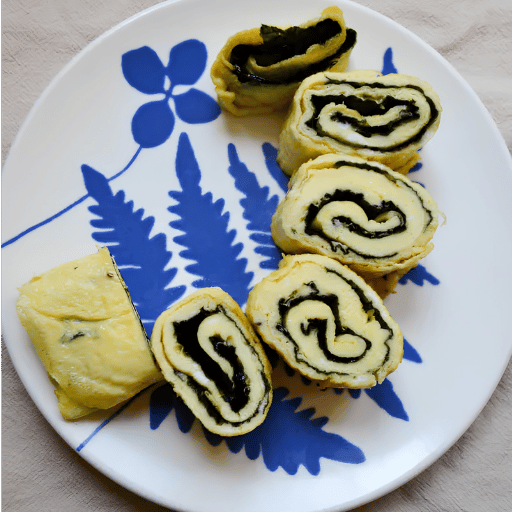
The honest answer is “it depends on which one and how it’s cooked.” The Korean omelette is the lightest: built from egg and a sheet of seaweed, a serving lands near 84 kcal with about 6 g of protein and little added sugar. The deep-fried gimmari and the sweeter crispy snack carry more oil and refined carbohydrate, so they sit closer to a treat than a side dish.
Seaweed adds one nutrient worth a note: iodine. The NIH Office of Dietary Supplements lists seaweed as one of the best food sources of iodine, but the amount swings hugely by type. Research finds nori in the 29–46 mg/kg rangefar lower than kombu or kelp, so the few grams of nori in a seaweed egg roll give a moderate, useful dose rather than a megadose. For context, the adult tolerable upper intake level is 1,100 µg per day, and kelp-based snacks are the ones that can push past it, not a normal nori roll.
Are seaweed egg rolls ok for diabetics?
The egg-and-seaweed omelette is a reasonable choice: it’s protein-forward with very little added sugar, and the seaweed adds fiber and minerals without much carbohydrate. Gimmari and the crispy snack are the ones to watch, because a thin sweet wafer or a deep-fry adds refined carbs and fat that affect blood sugar more. As always, portion and preparation matter more than the name, a baked omelette slice and a sugar-glazed snack roll are very different foods on a plate. Anyone managing blood sugar should treat the packaged crispy version as an occasional snack and check the label for added sugar. In practice, the real risk is the cooking, not the seaweed: a deep-fried gimmari can carry several times the fat of a baked 84 kcal omelette slice, because frying adds oil the egg never had.
Where to Buy Seaweed Egg Rolls (and What to Look For)
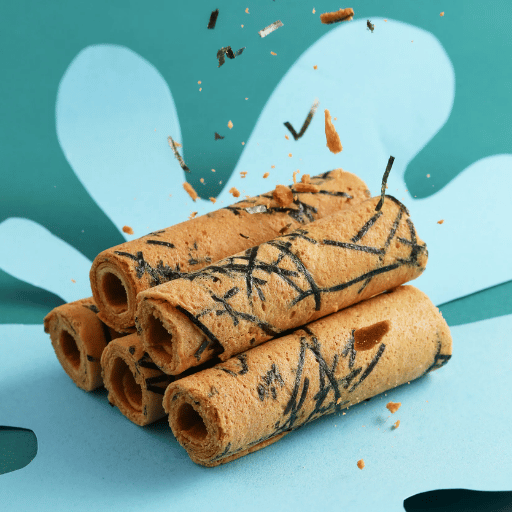
For the Korean omelette, you make it, it’s a fresh dish, not a packaged one. For the crispy snack, head to an Asian grocer or an online market like a pan-Asian delivery service, where you’ll find products labeled as seaweed rolls, phoenix rolls, or pork-floss-and-seaweed rolls in gift tins, especially around Lunar New Year. Want Want and similar brands also sell seaweed-wrapped rice crackers in the same aisle, which are a different (rice-based) snack.
A shopper who grabs the wrong tin, a 135 g sweet wafer roll instead of the savory laver snack, learns the hard way that “seaweed roll” can mean three different products on one shelf, because brands don’t standardize the term. Two label cues help. First, check baked versus fried: baked rolls are lighter and keep longer, fried ones are richer. Second, read what the seaweed is, laver/nori for the savory snack, versus a seaweed-flavored seasoning, which isn’t the same thing. For a producer rather than a shopper, the sourcing problem flips: buying at volume means specifying a production line, not a tin. In practice, OEM and private-label buyers start from UDTECH’s broader catalog of food processing machinery and match a line to a target output such as 500 pieces per hour rather than chasing a single SKU.
What’s Driving Seaweed Snack Demand in 2026
The real shift isn’t a market-size headline; it’s that a labour-bound, hand-rolled specialty is being turned into a packaged product. Three forces push that along. First, seaweed snacking has crossed from Asian grocers into Western retail on the back of umami and “better-for-you” snacking, which gives the crispy roll a year-round shelf rather than a seasonal one. Second, Chinese New Year demand still spikes in January, February, and that seasonal surge is exactly when hand production breaks down, orders double but a kitchen can’t add skilled rollers fast enough. Third, automation now makes a schedulable line rate possible, so a roll that used to be a once-a-year homemade item can be a standing SKU.
The production problem is concrete: when Lunar New Year orders double inside a 6-week window, a kitchen can’t hire skilled rollers fast enough, so output stalls. In practice, UDTECH sees the crossover land when steady demand passes roughly 500 pieces per hour. The takeaway for a producer is practical: the moment your seaweed egg roll orders show a repeatable seasonal double, model the hand-to-line tipping point before the next peak, not during it. Treat any market-growth figure as background, the decision that matter is your own labour-versus-line crossover.
Frequently Asked Questions
Q: What is a seaweed egg roll made of?
View Answer
Q: Is a seaweed egg roll the same as a spring roll?
View Answer
Q: What is the Korean seaweed egg roll called?
View Answer
Q: Are seaweed egg rolls healthy?
View Answer
Q: Where can I buy seaweed egg rolls?
View Answer
Q: How are seaweed egg rolls made commercially?
View Answer
Q: Is a seaweed egg roll fried or baked?
View Answer
References & Sources
- Iodine, Health Professional Fact SheetNIH Office of Dietary Supplements
- Analysis of iodine content in seaweedPMC, National Library of Medicine
- Iodine in SeaweedNew York Sea Grant
- Gyeran-mariWikipedia
- GimmariWikipedia
- Egg Roll vs Spring RollFood Network
Why We Wrote This Guide
We build automatic seaweed egg roll and snack lines, so we spend a lot of time explaining the difference between the soft Korean gyeran-mari, the fried gimmari, and the crispy 海苔蛋捲 snack our UD-HT line actually produces. This guide pull those threads apart using culinary sources and our own production data. Reviewed by the UD Machine Solution Technology technical team.
Related Articles
Turning a hand-rolled seaweed egg roll into a packaged SKU? Put it on a production schedule.