There are certain characteristics that are required of conventional packaging solutions such as effectiveness and accuracy as well as flexibility. Embracing a radical shift in the world of horizontal packaging, the flow packing machine has been introduced to the market, a conceptualization redefining all industrial processes worldwide. Such machines include food, medical, and every single consumer product individually wrap by doing it at speeds and efficiency that never compensates quality for anything. This article will look at flow packing machines while highlighting its most modern technology, the principal components and the positive aspects for the users. At the conclusion of this article, you will understand why such machines are called the Horizontal Flow packing machines of the future. Continue reading to find out how integrating this advancement can expand the outputs and business of your operations.
Understanding Flow Wrap Technology
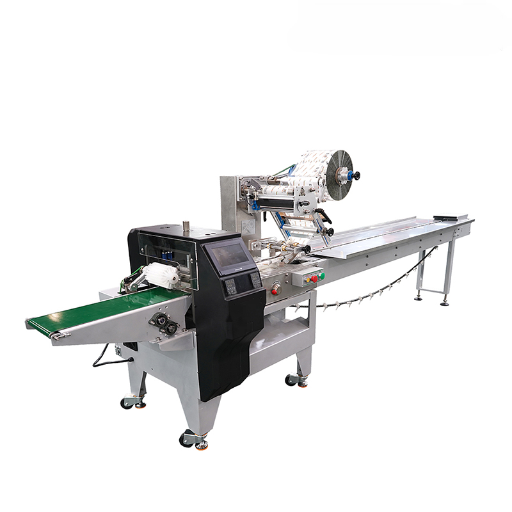
Flow-wrap technology is a way of enclosing a product with a horizontally placed clear plastic sheet around it, often with a print. Firstly, a plastic film is wrapped around a product to form an endless tube, which is subsequently sealed on both ends, and finally cut into different units. Since it allows very rapid, exact and flexible operations, this flow packing machine has found application in a wide range of both food and non-food sectors including pharmaceuticals and non-consumable products. Flow wrapping is useful because it secures the product from dirt, creates an immaculate look for consumers and even provides protection against leakage.
What is Flow Wrapping?
Flow wrapping, also known as horizontal FFS packaging, is a rapid packaging practice that is typically applied in wrapping single units of products with a waterproof material such as a polymer membrane. The mechanism works by passing the product through a film folded on a flow packing machine where each product is wrapped under the film, and formed and sealed over the product.
Based on new available statistics, flow wrapping is seen as one of the most flexible and advanced methods of packing, especially in such areas as the food, pharmaceutical and retail industries. Its flexibility makes it possible for manufacturers to package different types and sizes of products in a sealing that protects the contents against moisture, dust or any interacting agents that might otherwise reduce the shelf life. Moreover, with the rise of technology, modern flow packing machines have the capability of performing tasks such as positioning the labels accurately, consuming the least amount of packaging materials and adopting eco-friendly packs to either protect the environment or satisfy the green customers.
How a Flow Wrap Machine Operates
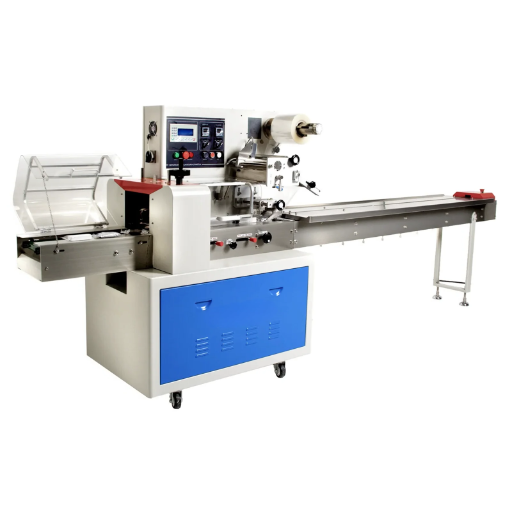
The term of flow packing machine includes the stages through which automatic operation has been provided to the machine for the seamless packaging of goods. The move of the products to the conveyor can be done in two ways: manually or automatically with the feeder. Upon an appropriate position of the merchandise on the conveyor, a tent of wrapping material in most cases polyethylene is pulled from a roll and wrapped around the item. For closure, the film is folded longitudinally underneath the commodity and sealed employing a method of heat or pressure converting into a wrap around the object.
At the same time, the horizontal edge seals are formed on both sides of the package, sealing the product completely with minimum excess material. Such seals can be produced carefully as they can be designed to meet various requirements like easy tear and anticoagulant. Today’s flow packing machine is driven by servo motors and utilises advanced sensors for precise sealing, positioning and improved productivity. Quite a number of machines are integrated with features such as label, barcode and shelf life printing, all of which are done in real time, making work much easier.
Key Components of a Horizontal Flow Wrapper
- Roll Film Insert: Keeps the packaging film in position around the machine.
- Former of Film Folding: Transforms the flat film into a round tube that would contain the product.
- Product Feeding Unit: Feeds items to the wrapping section in a regular and cyclic manner.
- Sealers: Respectively, there are horizonal and vertical sealing jaws that help make the pack’s seams and ensure sufficient tightness.
- Operator Panel: Allows the user to control the operation of the flow packing machine, including but not limited to speed, temperature, and sealing modes.
- Cutter: Contains several cutting blades to cut the film in accurate sizes to form packs.
- Out-feed Conveyor: Moves the wrapped product from the machine for the subsequent operations or packing.
To sum up, all aforementioned devices are implemented in one flow packing machine to perform the operation of quality packing.
Applications of Flow Packing Machines

A flow packing machine is a revolutionary unit that is used in different fields due to its multi-functionality and the ability. It is primarily utilized within the food sector to package products chocolate. In non-food sectors, such devices are applicable to pack products like medical supplies, electronics, and cosmetics. The fact that such devices allow keeping products fresh yet hygienically and nicely packed renders them indispensable in mass production.
Food Industry: Efficiency and Preservation
Within the food industry, there is a lot of importance placed on the use of the flow packing machine since it enhances efficiency and preserves the product. Many food items, such as bread, snacks, candy, and fruits and vegetables can be packed. The use of a flow machine also assures accuracy in terms of placing the foods while reducing waste. Modern sealing techniques are airtight, eliminating contamination and increasing the lifespan of products, as well as maintaining their taste and freshness over a long time. In addition, the high speed of these types of flow wrapping machines makes it possible for the manufacturers to achieve their objectives of mass production thus decreasing the time one has to be idle and also reducing expenses.
There is a growing trend towards the use of eco-friendly food containers and wraps. Some of the existing flow packing machines have features that allow either recyclable or biodegradable films to be used. These are satisfying the consumers and authorities who are calling for greener solutions. The flow packing machine with such combined characteristics has proven an unbeatable tool to satisfy the requirements of current food markets.
Pharmaceuticals: Ensuring Product Integrity
The significance of flow packing machines is crucial in the pharmaceutical sector as these ensure the product strength and safety. These are specifically meant for packaging within sterile conditions to avoid or minimize the contamination risk of the products like tableting, encapsulation or medical preparation/medicine itself. The easy and tamperproof flow packing machine designs and packaging techniques comply with the package solutions and therefore consumer in this case health. They are difficult to substitute as pharmaceutical companies need to provide good quality and their duty is to abide by the relevant hinders.
Other Industries Utilizing Flow Wrap Technology
The technology of flow wrapping is employed in numerous areas and is not limited to pharmaceuticals only. Flow wrap technology is an integral part of packaging in the food sector. This encompasses the packaging of embossed bread, in-vitro formed products and snacks which do not leak or get scuffed. The applying of flow packing machine in the personal care industry finds soaps, toothbrushes, or cosmetic items covered and makes these products more hygienic and more eye appealing. In the electronics industry as well this technology is practiced to wrap the electronic components tightly in protective film from the effects of dust and moisture. Its multifunctional characteristics and effectiveness make flow wrap technology an advantageous means of packaging for various purposes across multiple industries.
Benefits of Using Flow Pack Machines
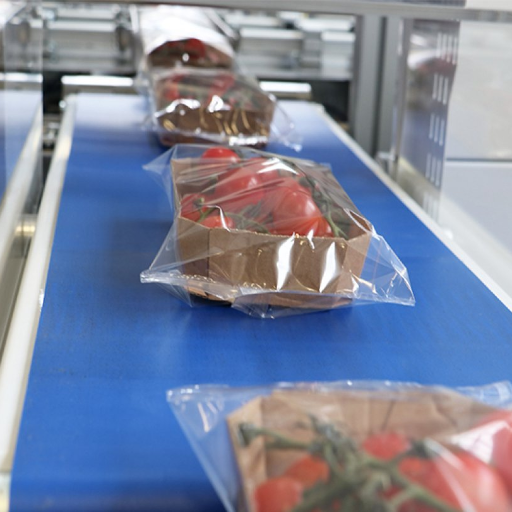
Any flow packing machine is efficient as it can pack even faster which means a greater number of packs per minute which also means fewer personnel required. Additionally, they are efficient: a proper sealant prevents spoilage, and an efficient film ensures products are wrapped without leakage. The flow rollers can pack any product shape thanks to customized forming collars, reducing excess packaging costs. Moreover, such machines operate across industries, adapting to diverse application demands, demonstrating their versatility.
Production Efficiency and Speed
It is a well-known fact that in most enterprises, manufacturers take advantage of flow packing machine because of their production efficiency and speed. Manufacturers use this kind of equipment, which ensures that any given machine will automatically pack products, thus enabling a quicker production rate. The design of these machines is usually very smooth and mechanical, which makes them easy to operate and hard to make any mistakes since there is no need to employ people to package products. Based on current available industry data, there is clearly an increase of 40% in the case of flow wrapping within industries, as opposed to the older methodology. Such enhanced output in the end satisfies the increasing demand while lowering the costs. Because they simplify processes, flow packing machines allow companies to stay competitive with today’s demanding market tactics.
Cost-Effectiveness in Packaging
A flow wrapping machine is one of the most effective machines for packaging. This advantage enables considerable wastage to be averted. Moreover, due to their high precision, every action is performed to its best, and therefore, there is no wastage of materials that could be used excessively. In addition to the above, the high rates of the machines reduce costs associated with workforce as they mostly perform repetitive actions. therefore, towards the end, a lot of monetary savings are generated by the entities however high packaging quality levels are maintained.
Enhanced Product Preservation Techniques
A flow packing machine is a type of equipment used to wrap food and non-food products using a closed wrap system. This equipment allows for the products to be packaged without excessive moisture, air, dust, and oxygen that may deteriorate their property. This is especially important for food and pharmaceutical products where prolonged exposure of the product to such conditions should be avoided. Moreover, the developing flow pack machinery offers features such as MAP or modified atmosphere packaging where the air inside the package is replaced with a different composition to help prolong shelf life. That considerably increases the shelf life of the food and other materials, thereby enhancing profits for firms which employ these machines due to minimization of spoilage.
Choosing the Right Flow Wrap Machine

Choosing an appropriate flow packing machine involves taking into account a number of factors, including the type of product being wrapped, the required speed of operation, and the available resources. Examining the dimensions, form, and delicacy of the object would make sure that it is suitable for the machine. Consider adjustable speed bearings, the implications of introducing MAP technologies, and some other protection measures to the product that need proper explanation. Similarly, analyze the machine’s lifespan, its maintenance requirements, and energy consumption in order to ensure optimal utility over an extended duration. Being in a partnership with a dependable vendor helps in procurement of a machine that fits best.
Assessing Product Size and Weight
Selecting the appropriate flow packing machine is highly important for effective use, especially considering the physical size and weight of the item. This is because those two dimensions affect the machine requirement as very often the latter is made to fit within certain size and weight constraints. For example, product and machine relations are given in such a facile manner that small and lightweight products require relatively small and fast packaging machines while robust products don’t fit in such machines. Recent research has shown that the more precise the match is between the product and the machine, the lesser the need for repairs and maintenance, faster packages, and material reduction are. It is imperative that businesses scrutinize the products in question and, if necessary, fall back on manufacturers or technical personnel for advice as to which flow wrapping machine will be perfectly compatible with their products.
Selecting the Appropriate Film Type
Selecting the appropriate type of film is very important for the optimization of the flow packing machine in terms of performance as well as product protection. Polyethylene (PE), polypropylene (PP), and laminated films are the three most commonly used. Each of these serves some particular function as per the product’s specifications. For items that do not spoil or are light in weight, PE is a cheaper and more adaptable alternative. PP has transparency and mechanical properties which makes it applicable for the visible products which needs more physical protection. Laminating films are used for products that require superior barriers like food and pharmaceuticals. Businesses have to factor in the dimensions of the products, their expiration periods and the conditions of packaging before making this choice. It is also important to discuss with your film providers or equipment manufacturers whether the material suits your machine and product.
Evaluating Production Speed Requirements
When buying a flow packing machine, speed of production is one of the aspects that need to be focused on since it has an effect on other things like efficiency and productivity. Companies will have to make a comparison between the production goals set and the size of each batch so as to know what speed can be accommodated. If these machines are fast in operation, they are designed for use in big production facilities where they can package thousands in under an hour. In contrast however in most small enterprises or even some limited production lines there might be a need for a user friendly machine which would cut on the time wasted by using the good old fashioned customizations like change parts.
One should also note whether or not the speed of the machine is conducive to the type of film to be used. Films may vary in seal time and therefore determine the capacity as well. In addition, the dimension of products also affects the settings of whether the machine is placed at the optimum speed or otherwise since some shapes are likely to cause clogging or skewing of the re-structured materials.
The choice of the appropriate flow packing machine should be guided by the speed that the machine can achieve and the peculiar nature of your production line. More information on the best option to take can be derived from consulting the various producers of the machines or suppliers of the equipment and studying the current production trend. In this way, businesses can decide on machine configurations that would meet their present and future production needs.
Comparative Analysis: Flow Packing vs. Alternative Methods
Flow packing is a process that is similar to other packaging techniques, such as vacuum packing, shrink wrapping, blister packs, and clamshells.
| Parameter | Flow Pack | Vacuum Seal | Shrink Wrap | Blister | Clamshell |
|---|---|---|---|---|---|
| Cost | Moderate | High | Low | Moderate | High |
| Speed | Fast | Moderate | Fast | Moderate | Slow |
| Durability | Medium | High | Low | High | High |
| Flexibility | High | Low | High | Low | Low |
| Appearance | Clear | Opaque | Clear | Clear | Clear |
| Seal Strength | Medium | High | Low | High | High |
| Use Cases | Broad | Niche | Broad | Niche | Niche |
This chart will provide an unmistakable comparison of aspects like cost, rate, application concepts, which will guide the process of selecting an appropriate packaging method for the given specific use.
Flow Packing vs. Shrink Wrapping
If the analogy is made of layers, flow packing and shrinking can be likened to the covering films. However, precise roles and efficiencies of these films must be understood. Blister technically involve flow packing machine has often been used for convenience in trans-loading purposes among others, especially for goods which require fitting cylinders tightly but which might be impossible because of bull bubbled roll. Such an approach is preferred with products, whose form and size is regular, including baked items, medicines, implements.
In contrast, single surface shrink wrap is also a popular option as the surface wrap provides a very thin clear membrane and is used to remain in a retail environment to see the contents. Goods like CD’s, DVDs, perfumed products and even home appliances mostly use shrink wrap for the aesthetics and increasing dust and dirt hectares.
It seems that firms resort to shrink wrapping as a priority when it comes to retail applications, because the client’s preferences are determined by the quality of display and its attractiveness. Nonetheless, the use of flow packing machine is more common in the industrial and manufacturing sectors where the tool is expected to endure and highly modifiable. At last, the judgment of decision varies with the variety of product, the storage conditions, and commercialization preferences.
Flow Packing vs. Manual Packaging
Manual and flow packing have significantly different rates of performance and reliability in large volume production.
| Key Point | Flow Packing | Manual Packaging |
|---|---|---|
| Speed | High, automated process | Slow, reliant on labor |
| Consistency | Uniform packaging output | Can vary between workers |
| Labor Requirements | Minimal | Labor-intensive |
| Cost Efficiency | Ideal for large volumes | Better for small-scale |
| Suitability | Standardized products | Custom or unique items |
For businesses looking for speed, efficiency, and scale, using a mechanical flow packer is advisable. On the other hand, it is better to do it manually for small scale or special activities.
Flow Packing vs. Vertical Form-Fill-Seal (VFFS)
| Aspect | Flow Packing | Vertical Form-Fill-Seal (VFFS) |
|---|---|---|
| Speed | High-speed, efficient for horizontal packing | High-speed, tailored for vertical packing |
| Product Types | Best for uniform, solid products | Versatile, suitable for solids, powders, and liquids |
| Material Usage | Optimized for minimal material wastage | Can lead to slightly more material usage |
| Flexibility | Limited to specific shapes and orientations | Highly adaptable to different packaging styles |
| Setup Complexity | Relatively simpler to operate and maintain | More complex setup and adjustments |
Most commonly associated with speedy horizontal wrapping of the products of specific shape, a flow packing machine works well, for instance, with candy bars or other sweets. With Vertical Form-Fill-Seal (VFFS), however, versatility is second nature and enables effortless packaging of different types of products in any orientation, be it powder or liquid. The most appropriate way of manufacturing should be selected by businesses taking into account the type of product, preferred type of packaging, and other considerations.
Reference Sources
-
Study and Optimization of Flow Packing Unit: Famifarm Oy: Focuses on optimizing the efficiency of flow packing machines and conveyor systems, providing insights into practical applications and improvements.
-
Study on Various Types of Packaging Machines: Provides an overview of packaging machines, including horizontal flow packing systems, and their operational differences and applications.
-
Design and Development of a Transfer System for an Automated Packaging Machine: Discusses the design and automation of packaging systems, including horizontal transfer mechanisms, relevant to flow packing machines.
- Food Machine and Extruders Provider in China
Frequently Asked Questions (FAQs)
What is meant by a flow wrap double confectionery packer and how does this packaging machine work?
Flow wrapping, referred to as hotizontal flow overwrap or flow wrap, is a basic package wrapping peration where the product orients a film transported continuously into a wrapper form for several types of emitting or sealing heads. While the automatic flow wrap provides the product by timing it around the film and creating a tubular form, it uses heat sealing to the seal its sides, with electro-weld forming seels cutting across and separating the bunch of goods. Flow wrapping can be used in packaging a big range of goods running from confectionery groups up to ultra-sensitive products, ensuring high-performing automatic capabilities with unwavering quality of output.
What benefits do horizontal flow wrap machines provide when compared to other packaging applications?
Horizontal flow wrap machines offer speed, versatility, and automation-applicable for products conducive to being put through packaging lying on their side. Incoming are a variety of machines ideal for high-speed automatic production. They may deal with large speeds with an output of packages per minute-advantages include repetitive format changeability due to modular design while being quite comfortable with all sorts of flow wrap plastic films while being able to handle a wide variety of products that could lie side by side with boxing or continuously moving on box motion or continuous motion configurations.
Can a flow wrapping machine perform Modified Atmosphere Packaging (MAP)?
Yes, Flow wrappers do offer MAP integration through MAP systems, which are responsible for removing oxygen before introducing gases; they do so by injection during packaging before sealing systems. Seal layers are combined with low invasive atmosphere machines as an extended-stage operation on food manufacturers or sensitive products. In the full complement, machinery manufacturers also offer MAP as a part of fully automated lines to boost shelf life while still ensuring good energy efficiency and reliability.
Which packaging material are accepted by the automated flow wrapping machines?
Some of the flexible packaging materials that can flow wrap with automatic flow wrapping machines are laminated films, single films, and heat-sealable materials for pillow bags and flow wrap packaging. The film can be determined based on the product weight, barrier requirements, and sealing technology. Machines are designed considering the product accommodation and can be configured to meet the individual packaging formats and film types to achieve specific product quality and shelf life targets.
How does one select the ideal packaging machine manufacturing company coupled with the appropriate flow wrapping packer to suit the needs of production?
Flow wrapping materials experience, the required back-up service, and whether the machine is compatible with your product types and pack sizes are some of the criteria with which to select machine manufacturer. Once they are compatible with packaging materials, the technology of sealing, modular design for future expansion, optimal CAS incorporation, and box motion are must-consider areas. Efficiency and reliability matrix values have to be evaluated. For the machine to be considered fit for the job, references need to be checked with similar food manufacturers or operations thats can make sure your machine can achieve the necessary benchmark value.