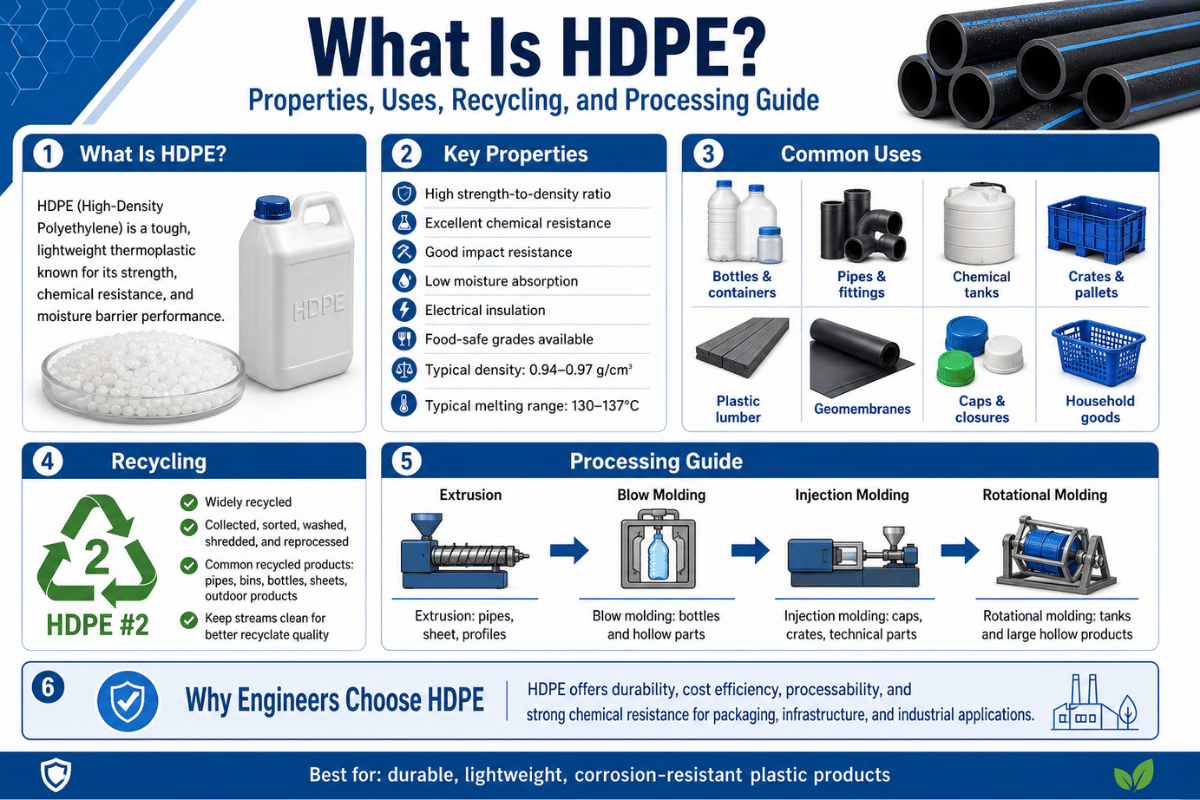
What is HDPE? HDPE is high-density polyethylene, a durable thermoplastic polymer manufactured from ethylene. It is the #2 plastic resin found in plastic bottles, milk jugs, detergent bottles, pipe, sheet, cutting boards, and many recycled plastic uses.
For the individual buyer, processor, or recycling operator, the simple definition is only the beginning. A more practical working question is can a given grade, feedstock stream, or recycled pellet perform the task: chemical-resistance, stiffness, UV, food-contact rules, melt flow, color, odor, contamination, and downstream extrudability are matters of concern.
Quick Specs: HDPE at a Glance
| Full name | High-density polyethylene |
| Plastic code | #2 HDPE in the resin identification code system |
| Typical density | About 0.94-0.97 g/cm3 for the FSRI HDPE material record; grade databases show wider ranges by formulation |
| Melting behavior | FSRI reports a 139.1 C peak melting temperature for its sample; MatWeb lists 118-137 C across many injection-molded HDPE grades |
| Tensile strength range | MatWeb aggregate: 7.60-43.0 MPa across listed grades, so purchase specs must use the selected resin datasheet |
| Water absorption | MatWeb aggregate: 0.000-0.0700%, depending on grade and test context |
| Common process routes | Blow molding, injection molding, rotational molding, sheet extrusion, pipe extrusion, recycling extrusion, and pelletizing |
| Main limits | Heat exposure, UV exposure without stabilizers, poor adhesive bonding, mixed-polymer contamination, odor, and grade variation |
| Best recycling bridge | Sorted HDPE flakes or regrind become more useful after washing, extrusion, melt filtration, degassing, pelletizing, and pellet testing |
What Is HDPE? Definition, Full Form, and #2 Plastic Label
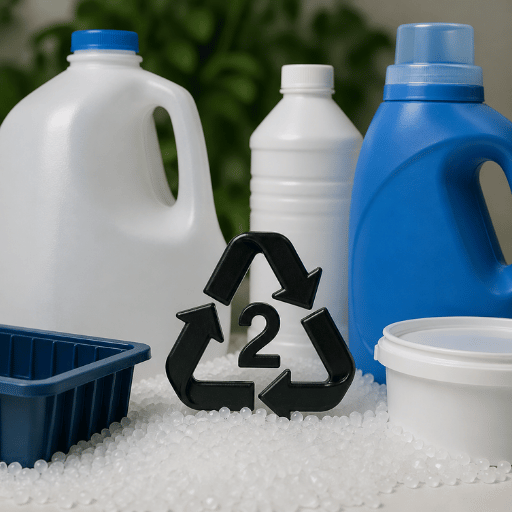
In material terms, high-density polyethylene refers to a family of more linear polyethylene grades with higher density than low-density polyethylene. That structure gives the material its familiar balance of stiffness, toughness, chemical resistance, and low moisture absorption.
The plastic resin code only begins defining HDPE as used in packaging or other products. The US Department of Energy recycling-code guide says #2 HDPE is a non-transparent plastic that is widely accepted in municipal recycling programs and often found in household cleaner bottles, some food containers, and cutting boards.
What does HDPE stand for?
The acronyms refer to high-density polyethylene. “High-density” does not refer to weight in a comparative sense, such as versus metals. It refers to the way the polymer chains are packed together relatively tightly compared with other types of resin like LDPE or LLDPE. This has a profound effect on properties like stiffness.
Code number 2 indicates the resin family, but it does not specify melt flow index, whether the resin is encapsulated for food-contact use, the presence of UV packages, contaminants and additives in the resin, or other variables an end use or recycler might need to evaluate in detail.
HDPE Quick Specs: Density, Melting Point, Strength, and Resistance
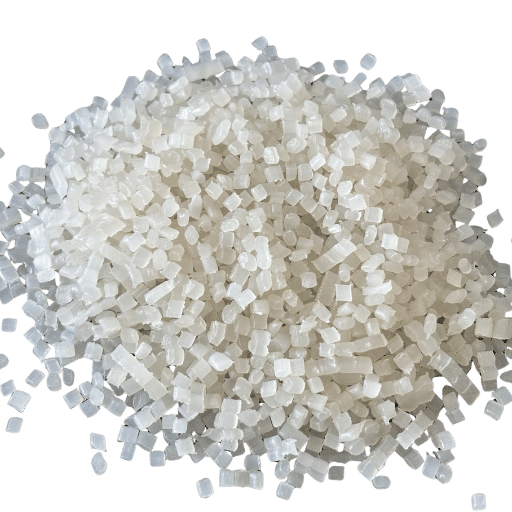
Polymer properties vary by grade, but several values are useful for early screening. FSRI’s HDPE material record gives density of 0.94-0.97 g/cm3 and a 139.1 C peak melting temperature for its tested sample. MatWeb lists 0.924-0.995 g/cc density, 118-137 C melting point, and 7.60-43.0 MPa tensile strength across many grades.
When buyers compare the properties of HDPE, they usually check physical properties such as crystallinity, molecular weight, strength-to-density ratio, moisture resistance, and whether the grade came from a Ziegler-Natta or other catalyst route.
| Spec | Useful Range or Rule | Why It Matters |
|---|---|---|
| Density | 0.94-0.97 g/cm3 in FSRI record | Helps separate HDPE from lighter films, fillers, and mixed streams. |
| Melting behavior | Roughly 118-139 C across the sources used here | Sets heater-zone planning, but processing temperature is higher than melting temperature. |
| Tensile strength | 7.60-43.0 MPa in MatWeb aggregate | Shows why grade selection matters for pipe, sheet, molded parts, and recycled pellets. |
| Water absorption | 0.000-0.0700% in MatWeb aggregate | Low moisture uptake helps, but washed flakes still need drying and venting discipline. |
| Recycling melt index target | APR guidance references 0.20-1.61 g/10 min for HDPE in its design context | Melt flow affects extrusion stability, filtration pressure, and pellet uniformity. |
What is the melting point of HDPE?
When asked to describe HDPE, the broad-range answer to melt behavior is that additional data is called for between 120 C and 140 C, then the best choice is to refer to the datasheet for the particular grade. Use this range as a broad indicator for processing set points, not one value.-look toward melt flow, screw configuration, residence time, temperature, any additives, and the resin food contact data to determine prime operating condition set points.
Why HDPE Behaves Differently Than LDPE and Other Polyethylene Grades

To compare both polyethylene grades, the structural difference must be noted. In high-density polyethylene, a larger number of linear chains are packed tightly enough to create a stiffer, albeit more brittle, material than the more branched low-density polyethylene.
That structural characteristic makes the difference clear in finished parts. Rigid bottles retain their shape longer than soft film bags. Pipe made from high-density polyethylene can withstand many chemicals and still handle impact. HDPE sheet stock can be machined into cutting boards or industrial liners, though gluing is hit-or-miss because of the low surface energy.
To “screen” when early material assessment rules in the HDPE list, do not generically classify “polyethylene” as a single material. Prompt yourself to ask whether the application demands stiffness, film conformity, impact resistance, food-contact allowance, weldability, UV exposure, or recycled content; that often guides the choice between HDPE, LDPE, UHMWPE, PP, PVC, and other plastics.
Where HDPE Is Used: Bottles, Pipe, Sheet, Film, and Industrial Parts
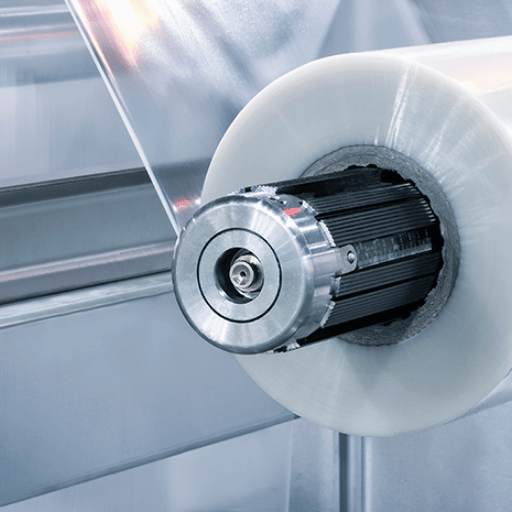
Manufacturers choose HDPE when the application needs a practical mix of chemical resistance, stiffness, and processability: blow molded bottles, extruded pipe or sheet, molded caps and crates, machined boards, plastic lumber, and pellets for selected non-food applications.
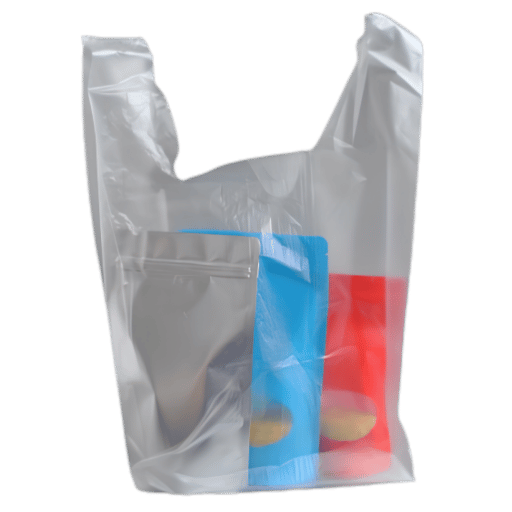
Other HDPE products include plastic bags, HDPE packaging, food storage containers, bleach bottles, motor oil containers, recycling bins, geomembranes, and plastic lumber; those applications for HDPE are usually chosen when a durable plastic must stay chemical resistant.
The advantages of HDPE are easiest to see in industrial applications that need a petroleum-derived thermoplastic to resist water, many chemicals, and rough handling. Manufacturing HDPE parts still requires grade control, because bottle resin, pipe resin, sheet stock, and recycled pellets are not interchangeable.
| Use Case | Why HDPE Fits | Selection Caution |
|---|---|---|
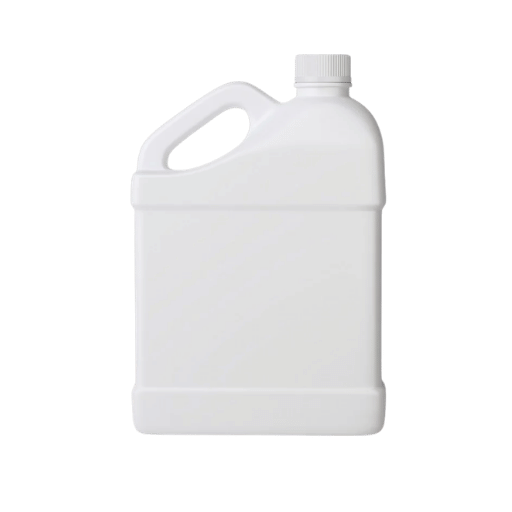
| Milk jugs and detergent bottles | Blow molding, stiffness, chemical resistance, code #2 sorting | Natural, colored, food-contact, and chemical-container streams should not be mixed blindly. |
| HDPE pipe | Toughness, corrosion resistance, weldable joints | Pressure, SDR, installation standard, and resin grade must be specified. |
| Cutting boards and sheet | Low moisture absorption, machinability, impact resistance | Food contact requires the right grade and regulatory status. |
| Geomembranes and liners | Chemical resistance and weldability | UV package, thickness, seam testing, and project standard matter. |
| Recycled pellets and plastic lumber | Works well when the stream is sorted, washed, filtered, and tested | Color, odor, PP contamination, ash, moisture, and melt flow can limit resale value. |
If a more in-depth polyethylene foundation is required to evaluate HDPE vs. LDPE, consult UDTECH’s polyethylene guide.
Advantages and Limitations of HDPE Plastic

Use the above selection guide when the design emphasizes moisture resistance and chemical resistance, but not when the application must provide high heat resistance, strong adhesive bonding, optical transparency, or a guaranteed outdoor-aging result. The benefits of HDPE plastic are strongest in chemical resistance and impact use, while outdoor applications and food and beverage containers require grade, UV, NSF or food-contact, and additive checks.
- Resists many household and industrial chemicals.
- Absorbs little water compared with many plastics.
- Works in bottles, pipe, sheet, molding, and extrusion.
- Combined with repeated bodily (or other) forces, sold in single stream for possible reuse.
- Used in above-average number of products partly because it welds more comfortably than using adhesives in many structural/frame component builds.
- Heat resistance is limited compared with engineering plastics.
- Untreated outdoor grades will fade and chalk; some may embrittle with UV exposure.
- Normal adhesives often fail on HDPE’s low-energy surface.
- Recycled streams sometimes carry residual colors, labels, or PP, as well as other plastics or dirt.
- Food-contact approval is closely tied to grade, litmus tablet contributions, previous use history, and local regulation.
An anecdotal bit of common shop-floor or forum wisdom: if the HDPE bonding needs for an attachment are structural or safetycontributing, design the attachment for wet-welding (how-to still in progress) or mechanical fastening instead of handicapping yourself with a general adhesive. While not a current codified principle, the numbers do line up to point toward the bonding problem’s own solution.
HDPE vs LDPE vs PP vs PVC: Which Material Fits Which Job?
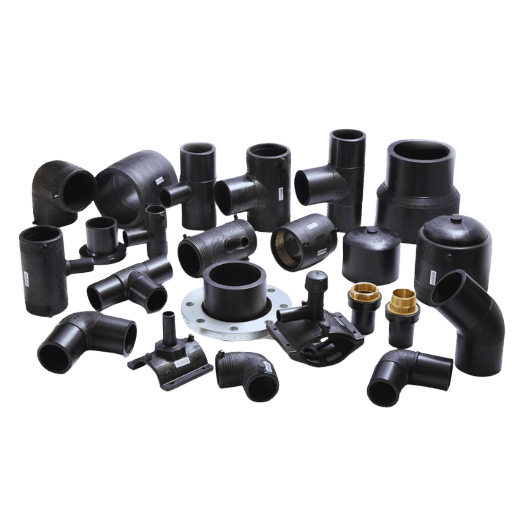
Do not assume HDPE is “better” than LDPE, PP, PVC, polycarbonate, or engineering thermoplastics. Each material wins in different functions. Use this guide as a screening aid, not an authoritative safety datasheet or a replacement for production trials.
| Scenario | HDPE Fit | Material to Compare | Decision Point |
|---|---|---|---|
| Rigid bottle or container | Strong candidate | PP, PET | Chemical, clarity, heat, and food-contact requirements decide final grade. |
| Flexible film or bag | Limited unless blended or made as HDPE film | LDPE, LLDPE | Flexibility and seal behavior often favor lower-density polyethylene. |
| Pipe or corrosion-resistant duct | Strong candidate | PVC, PP | Pressure rating, joint method, chemical exposure, and code requirements decide. |
| Higher-temperature molded part | Check carefully | PP, nylon, PC, POM | Heat deflection and long-term load matter more than the basic HDPE definition. |
| Recycled pellet production | Strong when stream is sorted | Mixed polyolefin, PP, LDPE | MFI, density, color, odor, ash, moisture, and contamination decide resale use. |
If you are screening the polyolefin family, check UDTECH’s polypropylene material guide. For PET packaging context, use the PET plastic material guide.
Can HDPE Be Recycled? Code #2, Recycled HDPE, and Quality Limits
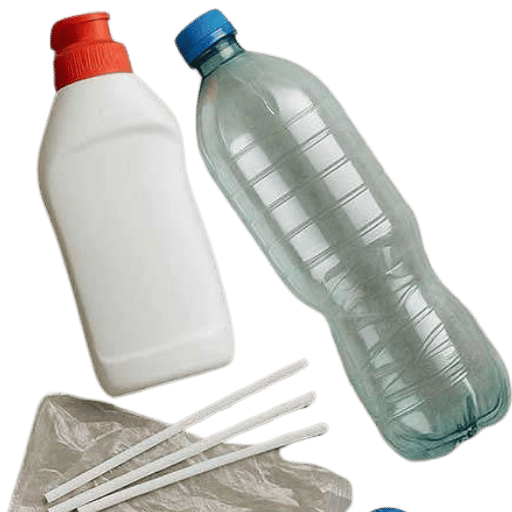
Recycling is possible, and #2 HDPE is one of the more common plastic recycling classifications. The more conservative view is that plastic recycling success hinges on collection, sorting, designing for recyclability, avoiding contamination, and having a dependable buyer for the output.
HDPE is commonly recycled from containers for milk, detergent, and other rigid packaging, but landfill still captures a large share of plastic material when collection or sorting fails.
According to EPA 2018 data on container and packaging recycling, 220,000 tons of natural HDPE bottles were estimated to have been recycled, equal to a 29.3% recycling rate. EPA also states that 13.6% of plastic containers and packaging were recycled and more than 69% went to landfill.
Can HDPE be recycled?
Technically yes, but a “recyclable” indicator only implies the item is technically sourced- and market-ready; not that every item will hit the target. Separate streams of clean natural bottles look very different from mixed streams of pre-printed, pigmented, PP-jar-lid-caps, paperboard, soil, or residues.
APR guidance for HDPE cites density as 0.941-0.970 g/cm3 and melt index as 0.20-1.61 g/10 min in its packaging-design context. Labels, closures, optical brighteners, and sink/float behavior are also flagged as indicators of HDPE material suitability for recycling.
For broader process context, UDTECH’s guide on how plastic is recycled step by step explains sorting, washing, crushing, melting, and pelletizing.
From HDPE Flakes to Pellets: Extrusion, Degassing, and Melt Filtration

Recycled HDPE gets added value as a converted form rather than raw material. The physical forms— bottles, film, or regrind— arrive as loose resin, then journey through a series of processes as a controlled stream of reprocessed pellets. Typical industrial lines: receive sorted HDPE, reduce it to flakes or regrind, wash and dry the stream, melt it in an extruder, feed the melt through filtration, remove any necessary volatiles in a vent port, and form pellets.
A 2025 MDPI paper on PE-HD bottle recycling reported that two sorted fractions were processed under industrial conditions using hot washing, extrusion, and deodorisation. It also noted that a mixed stream contained about 2.5% PP contamination and showed weaker material outcomes than the more homogeneous opaque stream.
HDPE Processing Readiness Ladder
- Identified resin stream: confirmed #2 HDPE, not an untested mixed-polyolefin pile.
- Sorted form: bottles, pipe, sheet, film, crates, or regrind separated by use case.
- Contamination screen: labels, metal, paper, dirt, liquid, and incompatible polymers removed.
- Moisture control: washed flakes dry enough for stable melting and lower vent load.
- Additive and color check: natural, black, colored, food-grade, and UV-stabilized streams tracked separately.
- Melt filtration plan: screen pack or continuous filtration chosen by contamination level.
- Degassing need: odor, volatile, or washed-film streams routed to vacuum venting where needed.
- Pelletizing route: strand, water-ring, or underwater pelletizing selected by output and polymer behavior.
- End-use proof: pellet MFI, density, ash, moisture, color, odor, and contamination tested before sale or reuse.
Here’s where UDTECH’s equipment angle fits the HDPE topic. A recycled plastic extruder handles melting and conveying; a twin screw extruder or plastic compounding machine can help when mixing, additives, or devolatilization are required. Pellet shape and output stability may point the line toward an underwater pelletizing system.
When a recycling business has two HDPE offers to compare, and both offer “recycled HDPE pellets,” it is easy to overlook key differences. One stream may come from sorted natural bottle flakes, with low variation in melt flow and no contamination issues; another may come from mixed colored bottles and closure bits, with a strong odor, occasional dirt particles, and higher melt flow requirements. Resin code cannot be used alone to filter those offers. The checklist of the questions not asked—that must be clarified—before converting to an order: source form, contamination, drying, filtration, venting, pelletizing, and result confirmation.
How to Choose HDPE for Manufacturing or Recycling Projects
The first step is simply asking the right questions: what type of product will the HDPE go in? Bottles, pressure pipe, cutting boards, recycled pellets, molded crates, or outdoor siding? They will all work with HDPE, but they do not all need the same validation package.
- Pick the grade: virgin HDPE, PCR HDPE, PIR HDPE, food-contact grade, pipe grade, sheet grade, or compounding grade.
- Require the resin datasheet or pellet test report: density, MFI, tensile properties, ash, moisture, color, and contamination.
- Confirm the exposure risk: chemicals, heat, weather, outdoor life, food contact, pressure, or mechanical load.
- Determine the joining method: welding, mechanical fasteners, or selected surface treatment and adhesive agents.
- In recycling especially, check the supply chain: form, size, volume, color, washing process, label type, closure collection, odor presence.
- On extrusion lines, adapt screw design, filtration, degassing, pelletizing, and downstream cooling to the actual stream.
If the project is a recycling or pelletizing line, start with the feedstock before the equipment quote. Washed bottle flakes, pipe regrind, film scrap, and mixed rigid HDPE can require different screw setups, filtration area, venting, and pelletizing options.
When selecting equipment, compare UDTECH’s plastic extrusion machinery choices or review this primer on what is extrusion.
Are you planning a recycled HDPE pellet line or PE compounding project?
HDPE Outlook: PCR Demand, Recycled Content, and Processing Quality
Search trend data for ‘what is HDPE’ do not support a growth claim by itself. For this particular workflow, DFS data indicated a stable-to-softening six month window. The more bullish 2026 planning approach hinges on recycled-content demand, mechanical-recycling capacity, and quality control for HDPE buyers.
On APR’s 2025 recycling capacity report page, US and Canadian recyclers are identified as having capacity for 2 billion more pounds of plastic, with HDPE listed at a +35% capacity-change scenario under full use of existing infrastructure. Better collection and stronger market demand are named as necessary conditions.
In recycled HDPE, more capacity does not remove the requirement for clean streams. Food Packaging Forum summarized studies that found odor and chemical-migration issues in recycled HDPE, particularly for food-contact articles. Those findings do not make recycled HDPE unusable; they make pellet testing, application separation, and specific PCR HDPE specifications more relevant.
HDPE FAQ
Q: What does HDPE mean on plastic?
View Answer
Q: Is HDPE food safe?
View Answer
Q: Is HDPE toxic?
View Answer
Q: What is the disadvantage of HDPE?
View Answer
Q: Can HDPE be welded?
View Answer
Q: Can HDPE be glued?
View Answer
Q: Will HDPE warp in the sun?
View Answer
Q: What can HDPE be recycled into?
View Answer
About This HDPE Guide
UDTECH supplies equipment for plastic extrusion, compounding, recycling and pelletising. This guide separates HDPE general education topics from extrusion-line application decision guides because a #2 mark cannot by itself provide a recycling plant with enough information to determine if a given feedstream is suitable for stable pellet output.
Related Articles
- Is HDPE an engineering plastic? – more in-depth material positioning information for HDPE.
- What is polyethylene? – basic information on PE, LDPE and HDPE.
- What is extrusion in plastic recycling? – basic guide to how recycling extrusion machines work.
- What can recycled plastic be made into? – overview of recycled products and applications.
- Plastic extrusion machinery – types of equipment used for polymer processing.
References & Sources
- High Density Polyethylene (HDPE) – FSRI Materials and Products Database
- Overview of Materials for High Density Polyethylene – MatWeb
- Consumer Guide to Recycling Codes – US Department of Energy
- Containers and Packaging: Product-Specific Data – US EPA
- HDPE Design Guidance – Association of Plastic Recyclers
- 2025 Plastic Recycling Capacity in the US and Canada – Association of Plastic Recyclers
- Rethinking PE-HD Bottle Recycling – Recycling, MDPI, 2025
- Inventory of Food Contact Substances Listed in 21 CFR – FDA
- FDA Letter on Fluorinated Polyethylene Food Contact Containers – FDA
- Studies Assess Composition and Safety of Chemicals in Recycled HDPE – Food Packaging Forum