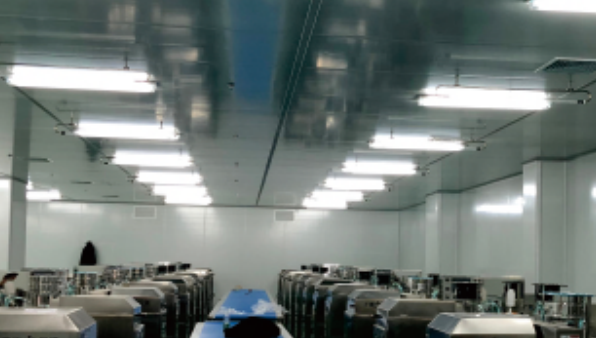
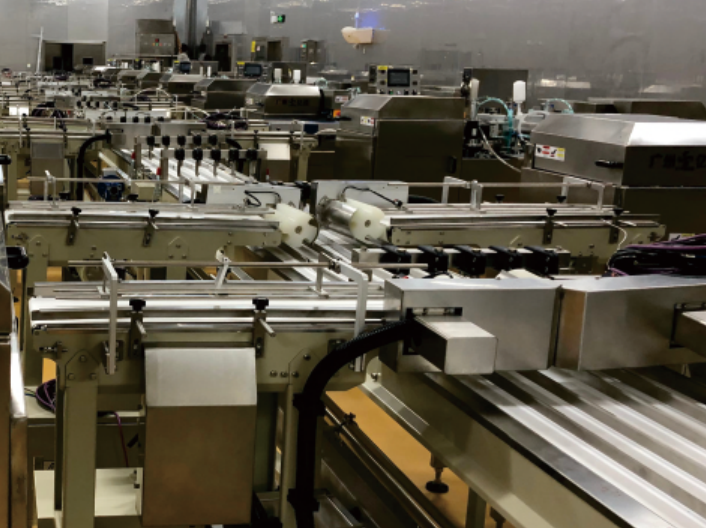
Seaweed Egg Roll Machine — UDTECH UD-HT Automatic Production Line
The UD-HT is a single line that bakes the egg roll and fits the seaweed in one synchronized pass — turning a slow, hand-rolled snack into a repeatable ~500 pieces-per-hour process for snack plants and chain bakeries.
Get a Quote
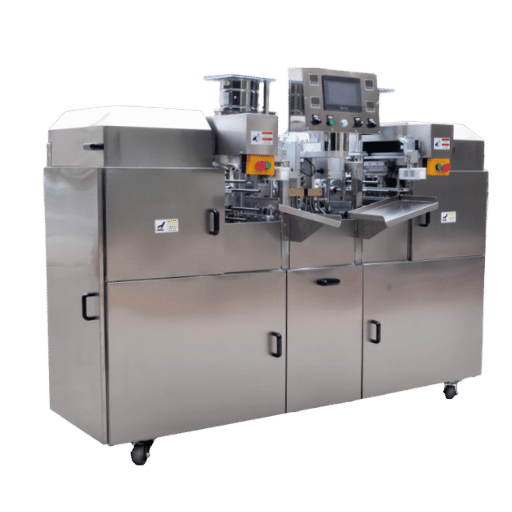
Why Hand-Rolled Seaweed Egg Rolls Don't Scale — and How the UD-HT Fixes It
The Bottleneck: Manual Production
A seaweed egg roll machine bakes a thin egg-roll wafer and wraps it with a nori sheet, then forms and cuts it into a finished savory roll — work that a kitchen team does one roll at a time. That manual route is where margins leak: output swings with operator skill, the seaweed sheet tears or slips out of alignment, and the heating is judged by eye, so colour and crispness drift batch to batch. When a chain order doubles, you add people, not throughput.
The Automation: UD-HT Synchronous Molding
On the UD-HT, that bottleneck disappears into synchronous molding. Automatic batter metering, nori sheet feeding, three-stage wrapping, and automatic slitting run as one timed sequence, so every roll leaves the line with the same length, the same seaweed coverage, and the same bake. You move from "how many rolls can the team finish today" to a fixed line rate you can put on a production schedule — and the operators who used to roll by hand move to feeding, inspection, and packing.
The UDTECH UD-HT Seaweed Egg Roll Machine: Specifications & Configuration
UD-HT Seaweed Egg Roll Machine — Technical Specifications
| Output capacity | ~500 pcs / hour |
| Overall dimensions (L × W × H) | 2200 × 1450 × 1560 mm |
| Heating power | 4 × 2.5 kW (10 kW) / 380V |
| Transmission power | 1.1 kW |
| Total connected load | ~11.1 kW |
| Power supply | 3-phase R/S/T/N, 380V ±10% |
| Compressed air | 0.2 m³/min, ≥0.6 MPa |
| Contact materials | Food-grade stainless steel + non-stick (Teflon) |
| Control | Intelligent temperature + synchronous molding |
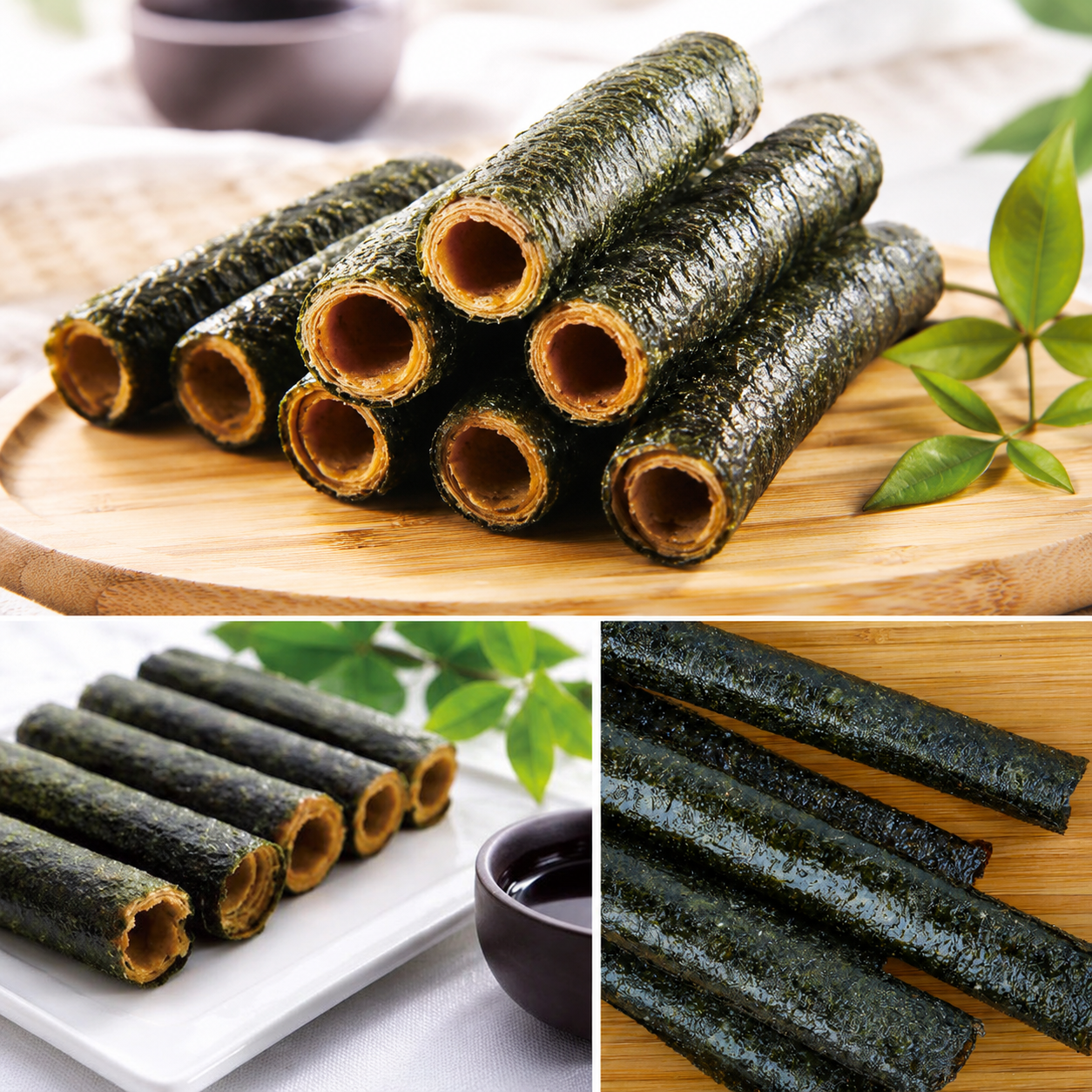
Configuration & selection
The standard UD-HT is built around the four heating zones above and is sized for the ~500 pcs/hr role on an automatic production line. Mould count and zone configuration can be adjusted on build; because throughput then depends on roll size, weight, and whether the recipe is batter- or rice-based, we confirm the rate against your target product at quotation rather than quote a generic number. If you need a general (non-seaweed) line instead, see our automatic egg roll machine.
| Configuration | Heating zones | Output | Best-fit operation |
|---|---|---|---|
| UD-HT Standard | 4 zones | ~500 pcs/hr | Snack plants & chain bakeries |
| UD-HT Compact build | reduced | by quote | Pilot lines, R&D, small workshops |
| UD-HT High-capacity | extended | by quote | Large-scale / OEM co-packers |
Output for non-standard builds is configuration-dependent and confirmed per product at quotation.
HOW THE LINE WORKS
PRE-FORMING → CONVEYING → 3-STAGE WRAPPING → SLITTING
A pre-forming unit meters the batter and feeds the nori sheet, shaping the egg-roll strip against temperature-controlled moulds. A conveyor belt then carries each strip in precise alignment into the forming unit, where the seaweed is applied in three stages — a first single-sided wrap, a second reverse wrap for full coverage, and a third compaction pass that sets the final roll shape. A high-precision slitting unit with twin conveyor knives cuts the continuous roll to a set length. Four 2.5 kW heating zones are held under intelligent temperature control, which is what keeps crispness and colour consistent across a full shift rather than drifting with operator judgement.
Request Quotation for UD-HT →Seaweed Egg Roll Machine vs Manual Rolling vs a Single-Function Wafer Maker
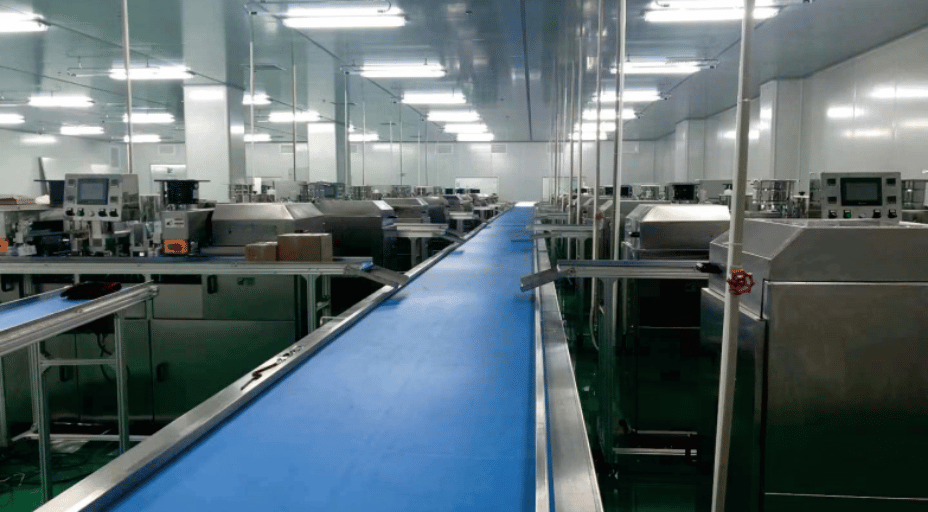
An honest comparison isn't against another seaweed line — almost no one builds one — but against the three routes a snack producer actually weighs: rolling by hand, buying a plain crispy egg-roll/wafer maker and wrapping seaweed in a second manual step, or running the UD-HT as one integrated line. Columns use the UD-HT's published figures; the hand-rolling and two-step routes use industry-typical ranges, not measured claims.
| Factor | Manual rolling | Wafer maker + manual seaweed | UD-HT integrated line |
|---|---|---|---|
| Output per line | ~30–60 pcs/hr per worker | limited by hand-wrap step | ~500 pcs/hr |
| Seaweed application | by hand, varies | separate manual step | In-line, 3-stage, synchronized |
| Roll-to-roll consistency | operator-dependent | two points of variation | Mould + timed sequence |
| Bake control | by eye | basic thermostat | Intelligent temp, 4 zones |
| Labour to scale | add people linearly | add people at wrap step | Feed + inspect + pack only |
| Length accuracy | manual cut | manual cut | High-precision slitting |
Comparison columns for manual and two-step routes reflect industry-typical operation, not UDTECH measurements. One detail matters for your cost model: the seaweed step stops being a second manual station — which is what we break down next.
From Snack Plants to Chain Bakeries: Output, Yield & Payback
Where the UD-HT earns its place is the line rate set against labour. A fixed ~500 pcs/hr throughput means the seaweed egg roll becomes a planned SKU on a commercial production line with a predictable cost per piece, instead of a labour-bound specialty that caps how many a site can ship in a shift.
A fixed, schedulable line rate that holds across a full shift — replacing the linear "add another roller" model of hand production.
Source: UD-HT specification sheet. Per-site payback depends on your labour rate, uptime, and yield — model it with the calculator above the quote form.
Because the bake is held under intelligent temperature control and the seaweed is applied in-line, yield loss from torn nori sheets and over-baked wafers — the two most common scrap sources in hand production — drops to what the recipe and material set, not what the operator had time for that hour.
Snack food processing plants
Run seaweed egg rolls as a continuous SKU alongside other crispy snacks; in-line slitting feeds straight to packing.
Chain baking enterprises
Hold one recipe and one bake profile across sites, so a roll made for one branch matches every other.
Co-packers & OEM
Adjustable mould and zone builds let you take on private-label seaweed-roll volume without a bespoke machine.
Certifications, Materials & Compliance
Food-contact surfaces are built in food-grade stainless steel with non-stick coated moulds; the supply voltage is three-phase 380V and the electrical build follows machine-safety practice. Confirm the exact certificate scope for your destination market at order — marks are issued against the configuration shipped.
Food-grade contact parts
Machinery conformity (on request)
Electrical safety of machinery
Registered appearance design
EU 1935/2004 / FDA-aligned materials
Buying Guide: Price, Lead Time and After-Sales
Price on a seaweed egg roll machine moves with mould count, number of heating zones, and the level of automation on feeding and packing — so a single sticker number would be misleading. Send your target output, roll size, and seaweed format and we quote against that build rather than a catalogue average.
Information we need for an accurate quote
Target pcs/hr · finished roll length and weight · seaweed sheet dimensions · available power (confirm 380V 3-phase) · floor space against the 2200×1450×1560 mm footprint · compressed-air availability (0.2 m³/min ≥0.6 MPa) · destination market for the certificate scope.
On delivery, factor in lead time for a built-to-configuration line, commissioning and operator training on the temperature and timing settings, and the spare-parts list for wear items — moulds, non-stick surfaces, and the slitting knives. We supply installation guidance and after-sales support against those wear parts so a coating or knife change does not stop the line.
Seaweed Egg Roll Machine — FAQ
Inside the UD-HT, a pre-forming unit meters batter and feeds a nori sheet, conveys the egg-roll strip into a three-stage forming unit (single-sided wrap → reverse wrap → compaction), then cuts each roll to length with a high-precision slitting unit. Four heating zones under intelligent temperature control set the bake.
A standard UD-HT runs at approximately 500 pieces per hour. Compact and high-capacity builds change that rate; because throughput depends on roll size and recipe, we confirm it against your product at quotation.
It is built around integrated seaweed wrapping, but the bake and forming stages handle plain crispy egg rolls as well. Send your recipe and we confirm fit for your product mix.
Three-phase 380V ±10% with a total connected load near 11.1 kW, compressed air at 0.2 m³/min ≥0.6 MPa, and a footprint of 2200 × 1450 × 1560 mm.
No. This makes the crispy rolled-wafer seaweed egg roll — a baked savory snack — not the deep-fried, filled spring-roll-style egg roll. The forming method and the seaweed step are different.
Price scales with mould count, heating zones, and automation level. Send your target output and roll format for a quote against the actual build rather than a catalogue figure.
Lead time reflects the built-to-configuration nature of the line. We provide installation guidance, operator training on temperature and timing, and after-sales support for wear parts — moulds, non-stick surfaces, and slitting knives.
Seaweed Egg Roll Line: Production & Assessment Toolkits
Access our suite of calculators and checkers to model your labour savings, plan capacity, and verify facility readiness for the UD-HT line.
Put your seaweed egg roll on a production schedule
Send your target output, roll format, and power supply — we'll quote a UD-HT build matched to your line and confirm the rate against your product.
Request a Quote