
Informações gerais
| O que é isso | Carne de porco seca, desfiada e temperada, cozida até ficar macia e fofa, com textura semelhante à do algodão. |
| Também chamado | Fio dental de carne, rousong (肉鬆), porco cantado, porco fu |
| Origin | Chinês/Taiwanês; comum no Vietnã, Malásia e Singapura. |
| Uso típico | Cobertura de arroz/mingau, recheio de pão, cobertura de sanduíche, guarnição de tofu |
| Sódio (por 100 g, uma amostra comercial) | 1,472 mg — 64% do Valor Diário recomendado pela FDA |
| Validade | Conservar por meses à temperatura ambiente, em recipiente fechado. |
A carne de porco desfiada é carne de porco seca, desfiada e temperada, cozida até ficar leve, macia e com um leve sabor agridoce – aquela que você vê em cima de um banh mi, polvilhada na sua tigela de arroz ou vendida em potes no mercado asiático local sob um de pelo menos quatro nomes diferentes em inglês. Um estudo de visão computacional de 2023 com oito marcas comerciais descobriu que o produto varia muito mais entre os fabricantes do que a maioria dos compradores imagina, e uma página separada do USDA (Departamento de Agricultura dos Estados Unidos) que destaca as regras de viagem menciona a carne de porco em particular entre os produtos cárneos permitidos nos EUA. Este artigo explicará exatamente o que é, como é feita em escala comercial, o que os números na tabela nutricional realmente dizem e o que você deve esperar no rótulo antes de adicioná-la ao seu carrinho de compras. (Atualizado em julho de 2026.)
- Não existe um "padrão de identidade" federal nos EUA ou no Canadá para a carne de porco desfiada, portanto, ela se enquadra em uma categoria descritiva geral, como qualquer outro alimento novo.
- Não existe uma entrada específica para fios de carne de porco no USDA FoodData Central, e todas as estimativas nutricionais online podem ser rastreadas até dados enviados pelos usuários.
- Na visão computacional, a análise de qualidade foi usada para avaliar oito marcas diferentes de desfiado de carne suína disponíveis comercialmente na América do Norte, demonstrando uma diferença notável na qualidade entre as marcas com melhor e pior desempenho. Portanto, é possível usar a ciência para determinar qual marca é superior.
O que é fio de carne de porco? Confusão com os 4 nomes do fio de carne de porco
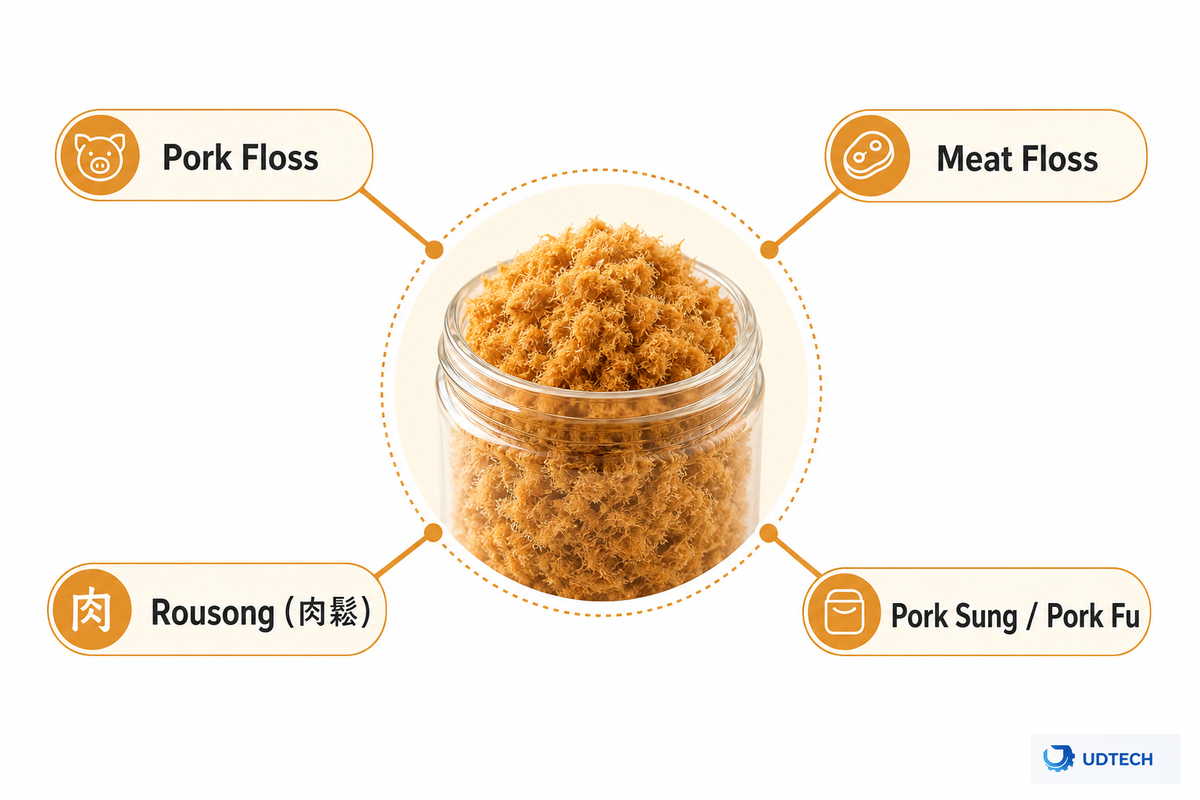
Quer seja chamado de fio de carne de porco, fio de carne, rousong (肉鬆) ou pork sung, você está basicamente se referindo ao mesmo produto, que apenas recebeu nomes diferentes em inglês à medida que foi incorporado às diferentes culinárias regionais. Pork fu é um rótulo adicional que descreve uma variedade menos frita e mais desfiada, com uma cor mais clara e um sabor mais suave em comparação com o pork sung tradicional.
Pesquise por "fio de porco" em vietnamita e você não encontrará uma tradução direta — os termos são "chà bông" ou "ruốc", e o produto é mais comum nas casas vietnamitas do que o fio dental, como apontou um usuário no Reddit, ressaltando sua importância como um item básico do dia a dia na China, Taiwan, Vietnã, Malásia e Singapura. Essa ampla disponibilidade explica a variedade de nomes, já que diferentes cozinheiros e produtores caseiros em toda a Ásia criaram seus próprios termos exclusivos para o produto, sem nenhuma tentativa de padronizá-los.
Detalhe verdadeiramente contraintuitivo: “Fio de carne de porco”, “rousong” ou “fio de carne” não é uma categoria alimentar definida por nenhuma regulamentação dos EUA, Canadá ou FDA. O termo mais próximo estabelecido na política de rotulagem de carne dos EUA é “Carne bovina ao estilo chinês”, cuja totalidade é definida no Livro de Políticas de Padrões e Rotulagem de Alimentos do FSIS como exigindo que o produto “contenha álcool de cereais e molho de soja” – sem qualquer exigência adicional de proporção umidade-proteína específica para essa entrada. Outros rótulos relacionados à carne seca, como “Carne bovina em cubos” (carne bovina seca, em cubos ou fatiada), contêm proporções umidade-proteína (2.04:1), destacando a especificidade e o foco na carne do sistema dos EUA e a ausência de um padrão geral para fio de carne. Portanto, um produtor de fio de carne de porco com destino aos EUA legalmente opta por simplesmente chamá-lo de “nome comum ou usual”. O termo 肉 (ròu) em rousong significa literalmente carne, e o termo descreve um produto de carne seca com uma textura leve e macia, semelhante a algodão grosso – sabor e textura juntos são, de fato, o principal objetivo da categoria. O mercado de origem do produto, no entanto, o regulamenta: a norma nacional chinesa GB/T 23968-2022 (“Qualidade Geral para Carne Desfiada”, em vigor desde 2024 e substituindo uma versão anterior emitida 13 anos antes, em 2009, pela Administração Estatal de Regulação do Mercado) define formalmente a carne desfiada e a divide em subtipos com base no processo de fabricação, em vez de tratar todos os nomes como sinônimos intercambiáveis. Além do fio dental comum, as diretrizes governamentais de segurança alimentar mencionam separadamente o fio dental "crocante em óleo" (uma segunda etapa de fritura em óleo que resulta em uma textura mais granulada e com fibras curtas) e o fio dental "com farinha de carne" (farinha de soja misturada após a fritura, dispensando a etapa de soltar a carne com as mãos) — uma verdadeira distinção de processo/textura que se soma, e não substitui, a nomenclatura "pork sung" versus "pork fu" já abordada anteriormente.
Tipos de carnes para desfiar: carne de porco vs. carne bovina vs. frango vs. peixe (A árvore genealógica das carnes para desfiar)
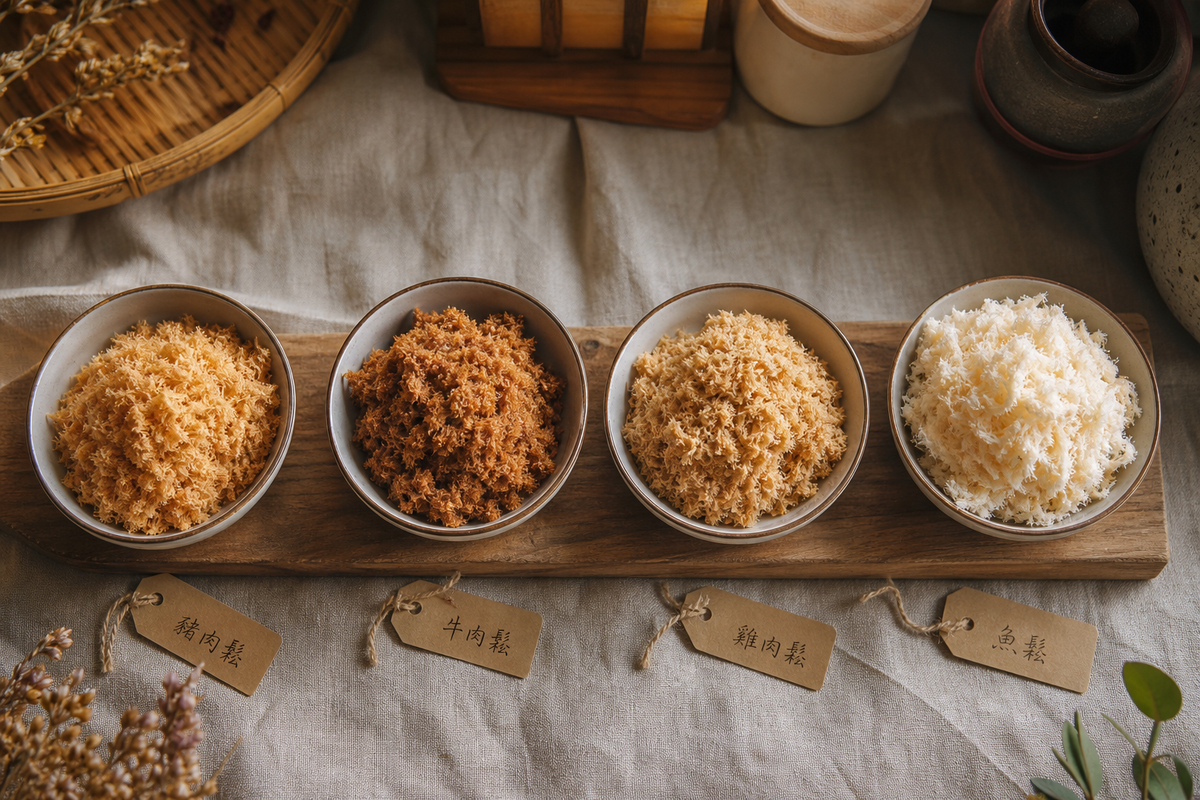
Existem versões de "floss" para quase todos os tipos de proteína: o "floss" de frango substitui a carne bovina por peito de frango cozido, o "floss" de peixe usa um peixe branco magro como garoupa, robalo ou basa, e há até uma versão à base de plantas usando proteína vegetal texturizada, embora o próprio criador da receita reconheça que "não é tão macia quanto a original". A variedade singapuriana é uma versão mais crocante do "floss", com fios de carne de porco mais grossos e crocantes em comparação com o estilo chinês continental mais fofo, comumente vendido em lojas nos EUA.
| Formato | Proteína | Região primária | Nomes comuns |
|---|---|---|---|
| Porco cantado | Carne de porco | China / Taiwan | Fio de carne de porco, rousong, fio de carne |
| Fu de porco | Carne de porco | Taiwan / Sul da China | Pork fu, fios de carne menos fritos |
| Fio de carne | Carne Bovina | China / Vietnã | Fio de carne, bò khô bông |
| Fio dental de frango | Frango | Malásia / Singapura | Fio dental de frango |
| Fio dental para peixes | Peixe branco | Singapura / Malásia | Fio dental para peixes |
| Fios de camarão seco | Camarão | China | Fio dental de camarão, hae bee hiam-adjacente |
| Fio dental vegano/de proteína texturizada de soja | Proteína vegetal texturizada | Global (cozinheiros caseiros) | Fios de carne vegana |
| Fio de carne de porco da marca Formosa | Carne de porco | Taiwan (marca de exportação) | Carne de porco Formosa cantada/fu |
| Fio de carne de porco da marca Kimbo | Carne de porco | Taiwan (marca de exportação) | Kimbo porco cantado |
“O fio de carne de porco azul é mais fofo e o vermelho é mais crocante.”
Comentário de um usuário do r/CannedSardines sobre o código de cores usado nas embalagens de algumas marcas.
Embora essa convenção de cores varie entre as diferentes marcas, a tonalidade geralmente se correlaciona com a qualidade da textura. Como normalmente não é especificada nos rótulos dos ingredientes, a cor é um dos poucos indicadores de textura disponíveis para os consumidores antes da compra. Entre os diferentes tipos de carne de porco desfiada, os dois principais subtipos – carne de porco sung e carne de porco fu – diferem principalmente nesse aspecto: a carne de porco fu é menos frita e menos desfiada, o que lhe confere um sabor mais suave, menos intenso de porco e mais delicadamente adocicado, enquanto a carne de porco sung apresenta um equilíbrio mais equilibrado entre o doce e o salgado. A norma chinesa GB/T 23968-2022 codifica uma divisão baseada no processo paralelo (carne desfiada crocante em óleo versus carne desfiada em pó), além dessa distinção na nomenclatura.
Como o fio de carne de porco é produzido: Por dentro do processo de produção (A linha de produção de fio de carne em 5 etapas)
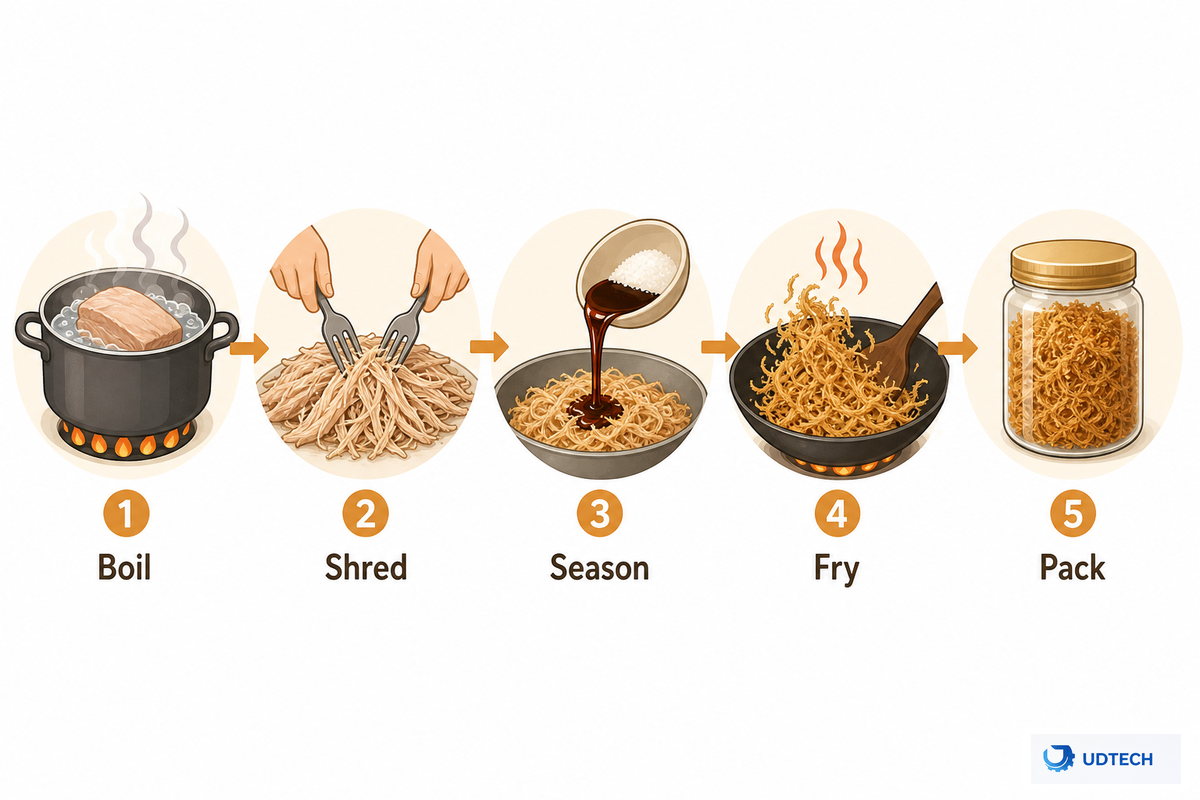
A produção de carne de porco desfiada comercial envolve um processo de cinco etapas: cozimento, desfiamento, tempero, refogado ou assado, resfriamento e embalagem – cada etapa cuidadosamente calibrada para eliminar a umidade gradualmente, ao mesmo tempo em que se constrói a textura leve e fibrosa pela qual o produto final é tão conhecido entre os compradores.
Por exemplo, uma patente industrial chinesa ( CN102144783A ) para a produção de fios de carne descreve o processo de fatiar uma perna traseira de porco em pedaços de 8 a 9 centímetros, paralelamente às fibras musculares, para ajudar a manter o comprimento, fervê-los por aproximadamente 40 minutos e, em seguida, fritá-los em uma máquina de fios especialmente projetada, a temperaturas de 180 a 230 °C, por 1.5 a 2 horas, até ficarem dourados e aveludados. Cozinheiros amadores que procuram uma receita de fios de carne de porco e adaptam o mesmo processo geralmente substituem o lombo ou o filé mignon por contrafilé, já que esses cortes desfiam finamente e desidratam uniformemente; de qualquer forma, o objetivo é obter fios de carne de porco finamente desfiados, preparados com uma base de molho de soja e açúcar, antes da torra final a seco.
Segundo outra patente, são utilizadas três fervuras para atingir a textura desejada, dependendo do corte da carne: 2 a 3 horas para o filé mignon, 3 a 4 horas para a perna traseira e 4 a 5 horas para a alcatra. Complementa-se esse processo com a secagem em forno, que produz cerca de 30% de umidade após o primeiro ciclo, seguida de uma segunda assadura para reduzir ainda mais o teor de umidade para aproximadamente 4.6%.
A produção em escala comercial geralmente se depara com o mesmo processo de fervura de 2 a 5 horas duas vezes em um processador de alimentos, já que a escalabilidade com o tamanho do lote é mínima; então, na etapa de fritura a seco/agitação, é o ponto em que o processamento manual e o processamento mecânico mais se confrontam, pois uma wok mexida à mão atinge sua capacidade máxima muito antes de uma fritadeira rotativa ou contínua. Uma primeira tentativa com uma confeiteira caseira mostra exatamente o que está acontecendo: o resultado é uma "esponja de cozinha aromatizada" após uma hora de desfiar manualmente e uma hora de fritar. Somente depois que ela colocou a mistura no liquidificador e a processou para quebrar as fibras, o resultado ficou aceitável. É essa quebra mecânica das fibras, e não o tempo adicional de cozimento, que determina se a textura será grossa ou algodonosa.
Os próprios relatórios da Meat+Poultry Trade sobre a categoria mais ampla de snacks de carne desidratada também validam esse princípio em escala industrial. Os produtores geralmente optam por uma etapa longa de cozimento em baixa temperatura (ou, às vezes, defumação), e não por fritura em alta temperatura. Essa mesma lógica se aplica aqui também.
Para fazer algo como fios de carne de porco, a umidade precisa sair lentamente, para que as fibras da carne não queimem e fiquem carbonizadas antes de secarem.
Essa mesma janela de secagem acarreta um risco real de produção: se a segunda torra ultrapassar a meta de 4.6%, o lote fica quebradiço e queimado em vez de macio — um produto rejeitado que o produtor não pode vender como fio dental premium, porque a umidade que evapora muito rápido carboniza a parte externa de cada fibra antes que o centro termine de secar.
Como usar a carne de porco desfiada: ideias de preparo além do pote
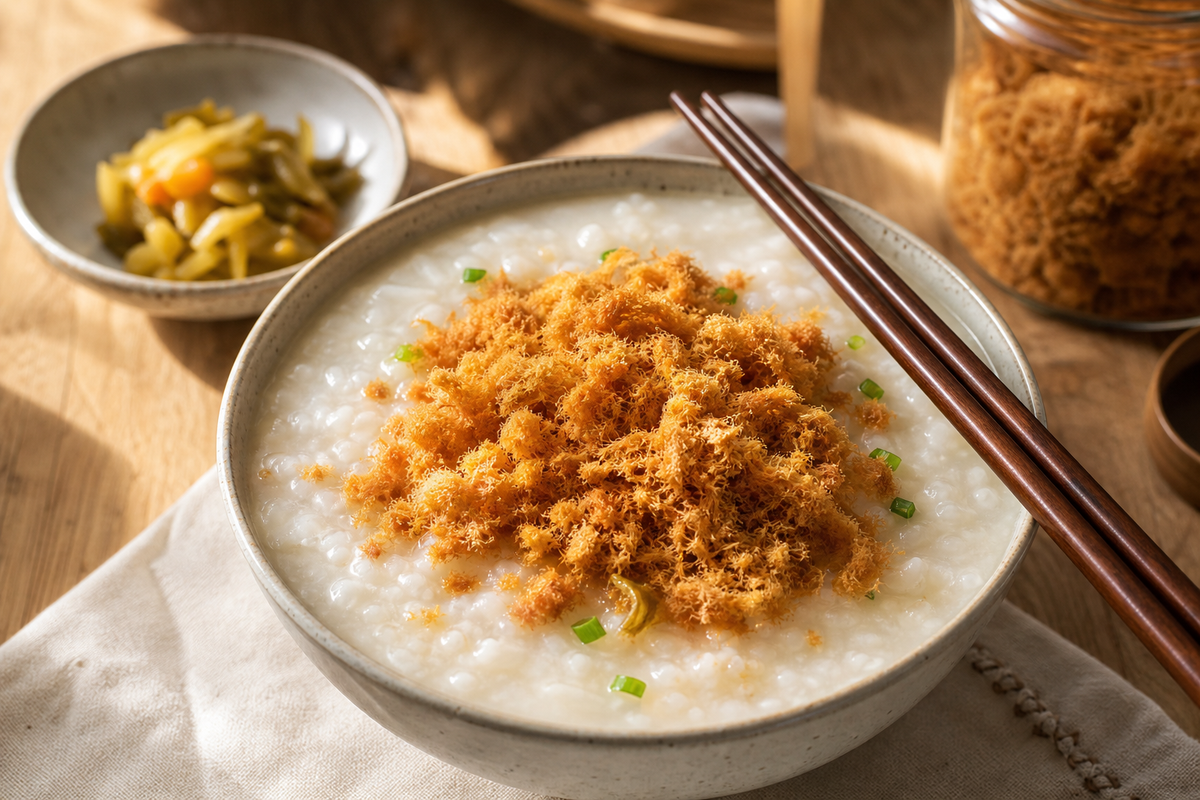
É costume servi-lo sobre arroz ou um mingau salgado sem sal, mas você pode colocá-lo em qualquer coisa que se beneficie de um contraste salgado e saboroso. Pãezinhos de carne de porco desfiada – pão de leite leve, coberto com maionese e com a carne desfiada antes ou depois de assar – são tão comuns quanto o croissant de chocolate em padarias chinesas e taiwanesas, mas você também encontrará a carne de porco desfiada misturada em bolinhos de arroz, empilhada sobre torradas com manteiga, ou colocada em uma tigela de macarrão ou sobre uma cama de tofu macio e sedoso, regado com molho de soja e cebolinha. O equivalente mais próximo para quem só experimentou carne seca como carne desidratada é em termos de consistência, não de sabor: a carne seca é dura e compacta, enquanto os fios de carne desfiada se dissolvem instantaneamente em contato com o grão quente.
Algumas marcas comercializam uma versão mais grossa como carne seca de porco, mas trata-se de um produto diferente – a carne seca é compactada e mastigável, enquanto a carne desfiada permanece solta e aerada. Além do arroz e do mingau de arroz salgado, a carne desfiada de porco aparece como recheio de massa folhada, cobertura de panqueca, em pães tipo naan, polvilhada sobre arroz glutinoso ou arroz branco simples, ou até mesmo em camadas em um hambúrguer não convencional para um sabor extra. Em qualquer receita onde um condimento comprado pronto normalmente adiciona um toque salgado, a carne desfiada de porco pode ser usada como recheio ou guarnição.
Uma novata na confeitaria, em um fórum, perguntando como usar esse ingrediente em sua primeira receita, recebeu um consenso sólido da comunidade: use-o por cima, como guarnição, depois de assado, e não misturado à massa úmida, pois a umidade destrói rapidamente a textura. Isso foi confirmado por um relatório de consumidor que descreveu bolos de padaria cobertos com esse alimento como "bem salgados/saborosos... um pouco secos, então mantenha um copo d'água por perto" – a textura delicada e rica em fibras do fio dental que conhecemos e amamos por sua leveza e crocância levemente salgada no arroz também absorve bastante umidade.
A carne de porco desfiada pode ser congelada?
Sim, para alguns produtos da família dos fios de carne, existem orientações específicas – uma receita de fio de peixe, por exemplo, recomenda-se congelá-lo por até 3 meses (consulte as diretrizes básicas de alimentos estáveis em temperatura ambiente do FSIS para o princípio geral de armazenamento de carne seca), ou refrigerá-lo por no máximo 1 semana, descongelá-lo e reaquecê-lo completamente antes de consumir.
A proteína texturizada de soja vegana, no entanto, mantém-se estável em temperatura ambiente por até 1 mês em um recipiente hermético e não precisa de refrigeração. A carne de porco desfiada comercial em um frasco lacrado segue esse padrão de temperatura ambiente mais de perto do que a recomendação de congelamento da carne de peixe desfiada, já que seu teor de umidade final é intencionalmente reduzido durante a produção.
Essa mesma baixa umidade final tem dois lados: deixada descoberta em uma cozinha úmida, a mesma fibra vegetal corre o risco real de ficar encharcada e formar grumos rapidamente, e é por isso que a tampa do pote permanece fechada entre as porções — uma reclamação sobre o armazenamento que aparece em avaliações online quase tão frequentemente quanto os elogios ao sabor, porque a fibra vegetal seca até atingir aproximadamente a mesma umidade alvo de 4.6% reabsorve rapidamente a umidade ambiente assim que o pote é deixado aberto.
Por que o fio de carne de porco é tão saboroso: a ciência da textura e do sabor.
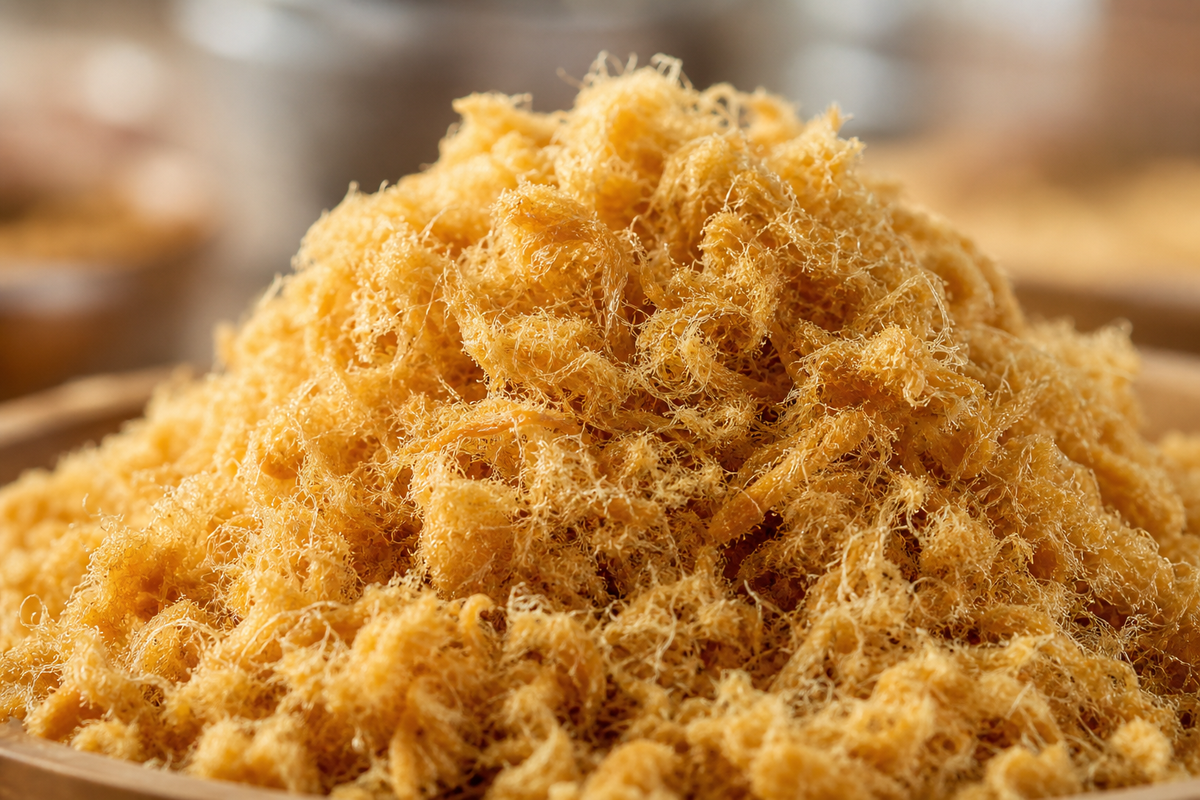
A textura leve, fofa e semelhante a algodão-doce que as pessoas associam ao fio de carne de porco provém de um processo específico: o calor e o movimento contínuo encolhem as fibras musculares cruas e, quanto menores essas fibras ficam, mais poros se formam entre elas, produzindo esse resultado fofo e poroso.
Por meio de uma análise que utilizou nove métricas diferentes de visão computacional para quantificar essas propriedades, um modelo de regressão concluiu que, embora a maciez, a uniformidade das fibras e a intensidade da cor contribuam positivamente para a sensação de qualidade, fatores como aspereza, dureza e tamanho dos nós tiveram pesos negativos, uma confirmação baseada em fatos sobre "o que faz um fio dental premium parecer um fio dental premium", além do sabor.
O perfil de sabor baseia-se no umami e no equilíbrio entre doce e salgado. A carne de porco é rica em glutamato natural, e um toque de molho de soja e uma pitada de açúcar (às vezes incluindo glutamato monossódico) realçam o sabor, de modo que uma pequena porção reveste rapidamente toda a língua devido à sua textura porosa e aerada. Utilizando aprendizado de máquina combinado com um "nariz eletrônico", outra pesquisa independente analisou como o fio de carne de porco gera assinaturas aromáticas diferentes do fio de frango ou de carne bovina (que demonstraram ter composições químicas semelhantes entre si) quando comparado com análises químicas reais.
É nesse mesmo processo que a qualidade pode falhar. Se a temperatura do assado ultrapassar o limite de 230 °C descrito na patente de produção, ou se o movimento de agitação diminuir, as fibras queimam antes de terminarem de secar, e o lote fica duro e fibroso em vez de leve e macio — um defeito de textura que decepciona os compradores mesmo quando o tempero está correto, porque é a estrutura da fibra, e não o sabor, que o provador percebe primeiro. Imagine um cozinheiro amador comparando dois potes abertos lado a lado: um se desfaz na colher, o outro forma um nó denso, mesmo que os rótulos dos ingredientes sejam quase idênticos. Esse tipo de inconsistência é exatamente o que o painel de avaliação interno do estudo de visão computacional foi projetado para detectar antes que um lote chegue às prateleiras das lojas.
A carne de porco desfiada é saudável? Informação nutricional, sódio e ingredientes (A matemática do sódio em pequenas doses)
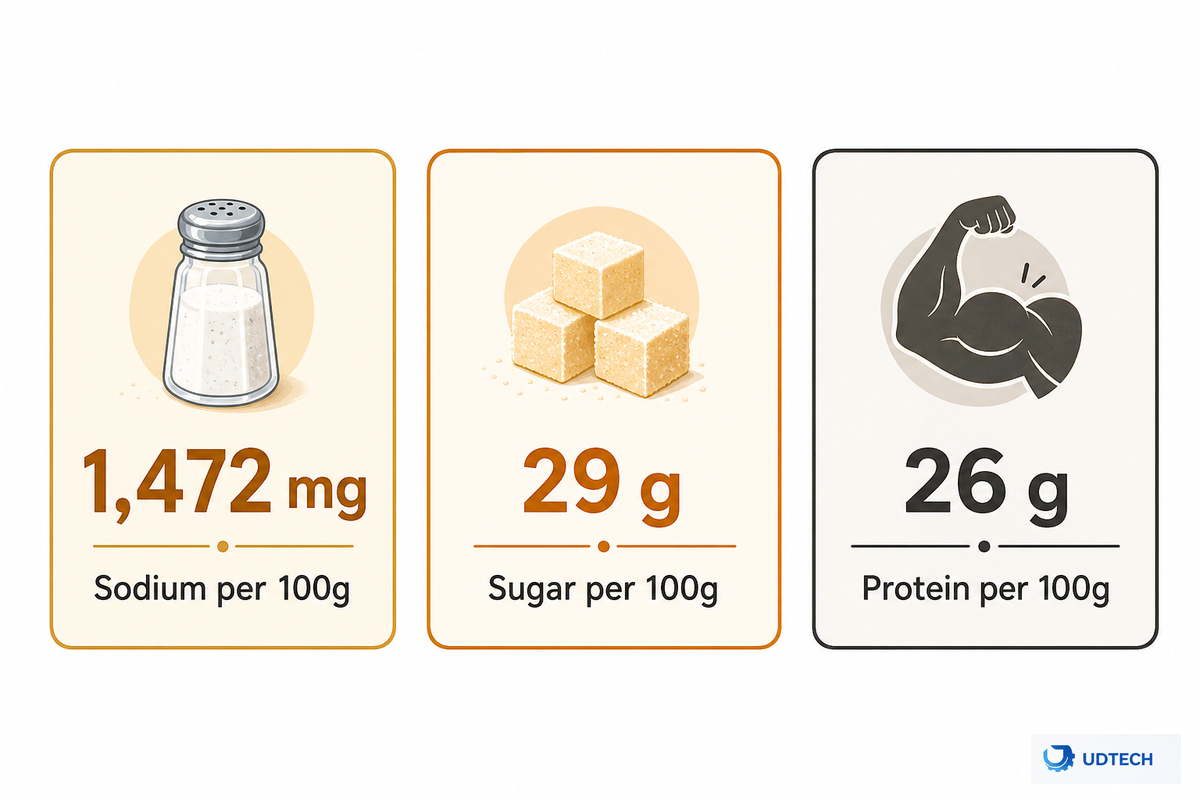
A carne de porco desfiada pode ser considerada mais um petisco rico em sódio e açúcar do que uma refeição saudável e rica em proteínas, mas a verdade "real" depende muito da marca específica e da quantidade consumida. É importante começar com o seguinte ponto de transparência: a ausência de registros no USDA FoodData Central significa que quaisquer dados nutricionais online são fornecidos por empresas individuais, e não pelo governo, e os números apresentados aqui foram extraídos de aplicativos de contagem de calorias, não de resultados de laboratório.
Para contextualizar essas estimativas de porção, é improvável que você consuma uma porção de 100g de fio de carne de porco. Normalmente, você come cerca de 1 a 2 colheres de sopa (aproximadamente 6 a 15 gramas), o que equivale a cerca de 90 a 220mg de sódio por porção — uma quantidade que pode ser preocupante dependendo dos outros alimentos da sua refeição, mas que provavelmente não causará grande preocupação para o adulto médio, considerando o limite diário de 2,300mg. Você provavelmente ficará mais surpreso com a quantidade de açúcar por porção (menos de 5g em uma porção típica), já que provavelmente não considera o fio de carne doce. Farinha de soja, um derivado da soja, e um toque de açúcar adicionado para adoçar a mistura são ingredientes comuns na receita, juntamente com a própria carne de porco, o que explica em parte por que o sabor umami se destaca tanto, mesmo quando o fio de carne é misturado em sopas ou servido sobre vegetais.
Embora a maior parte da apreensão entre os leitores gire em torno da adição de glutamato monossódico (MSG), o consenso científico não corrobora esse medo generalizado. A FDA (Administração de Alimentos e Medicamentos dos EUA) classifica o MSG como geralmente reconhecido como seguro, e ele ocorre naturalmente em alimentos como tomates, cogumelos e queijos curados. Estudos iniciais que associavam o MSG à "Síndrome do Restaurante Chinês" e a reações adversas eram falhos e foram refutados por diversas revisões recentes . Grama por grama, o MSG contém cerca de um terço do sódio do sal de mesa, sendo, portanto, uma forma de adicionar sabor com menos sódio, e não uma carga extra de sódio.
A carne de porco desfiada é isenta de glúten? Contém glutamato monossódico (MSG)?
As respostas variam de acordo com a marca, e não com a categoria como um todo. Os ingredientes comerciais típicos incluem carne de porco, açúcar, farinha de soja, molho de soja, banha, sal e, possivelmente, glutamato monossódico (MSG). O molho de soja pode conter trigo, dependendo do processo de fabricação, portanto, quem segue uma dieta sem glúten precisa verificar esse item específico, e não presumir que toda a categoria esteja liberada. A presença de MSG varia de acordo com a marca e, se presente, estará listada na lista de ingredientes.
Qualidade e Autenticidade: Como os Fabricantes Verificam a Autenticidade da Carne Suína Desfiada (O Comprimento da Fibra como Indicador de Qualidade)
Os fabricantes avaliam cada vez mais a qualidade da carne de porco desfiada com base em padrões mais mensuráveis e definidos, em vez de apenas testes de sabor. Pesquisadores desenvolveram um modelo de visão computacional de aprendizado profundo — treinado com 8,000 imagens fotográficas de oito marcas comerciais reais, tiradas com iluminação controlada de câmeras industriais — que detecta automaticamente problemas de qualidade, como "nós" que se formam quando a temperatura de fabricação ou o movimento de arremesso saem do controle, resultando em material emaranhado e não desfiado.
Esse modelo alcançou uma precisão de segmentação de nós de 92.97%, superando outros cinco modelos de visão computacional em termos de precisão e erro – sua taxa de erro (RMSE 0.036) e precisão geral (95.2%) superaram o segundo melhor modelo entre os cinco concorrentes.
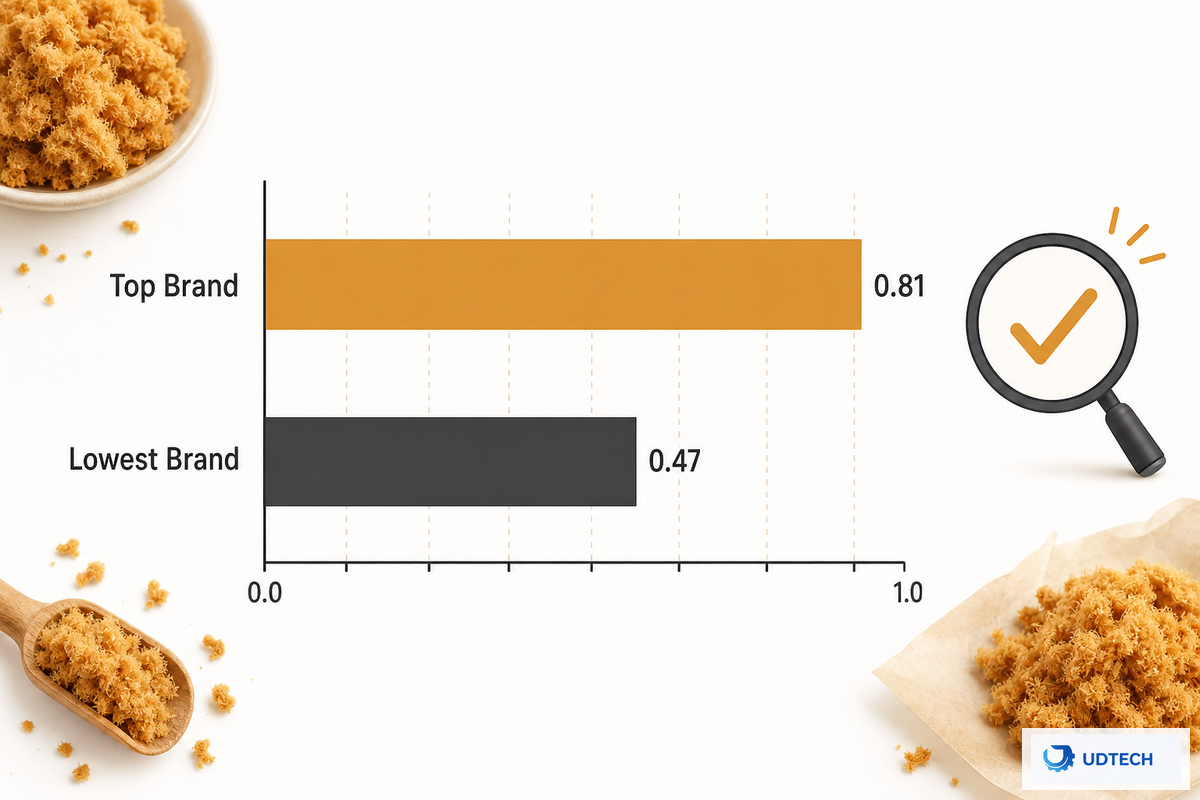
A qualidade é mensurável, não apenas uma questão de gosto: um estudo de visão computacional comparou o índice de qualidade de oito marcas comerciais reais de fio de carne de porco (codificadas por iniciais) e colocou a marca com a melhor pontuação, TC, em aproximadamente 0.81, contra a marca com a pontuação mais baixa, LYW, em aproximadamente 0.47 — uma diferença real e quantificada entre produtos na mesma prateleira, e não uma métrica de precisão do próprio modelo de pontuação.
Outra preocupação real de controle de qualidade, e não hipotética: a autenticidade das espécies na cadeia de suprimentos.
Pesquisadores construíram um "nariz" eletrônico em miniatura com oito sensores de gás e aprendizado de máquina para identificar casos em que um tipo de carne desfiada está sendo comercializada como outro (ou seja, um problema de fraude alimentar e rotulagem halal/kosher). Sua configuração de melhor desempenho identificou com sucesso carne desfiada de boi, frango e porco apenas pelo cheiro, com precisão superior a 99% (verificada com análises químicas reais, não apenas pelo modelo).
O enchimento consiste em amido e farinha de feijão, cujas suposições, tanto por parte do consumidor quanto do fabricante, são por vezes respaldadas por patentes. Uma patente menciona a adição de farinha de feijão ou ervilha durante o processo de fabricação "para aumentar o peso do produto" — o enchimento é, de fato, uma estratégia de fabricação comercial intencional, e não apenas um espantalho de marketing. Um pedido de patente chinês pendente para um processo genérico de carne desfiada (CN106387682A, um pedido de um inventor individual — não um padrão oficial e não exclusivo para o mercado infantil) estabelece um limite estrito para o teor de amido/feijão em um máximo de 2%, juntamente com um teor mínimo de proteína de 25%, e lista a formulação resultante com baixo teor de amido como adequada para crianças entre seus usos declarados — o teor de amido próximo de zero é tratado como um atributo desejável e de qualidade.
Portanto, de fato, o nível de amido/enchimento é uma métrica de qualidade e, como você pode ler na lista de ingredientes, isso pode lhe dizer muito — até mais do que a marca ou a cor. O mesmo pedido de patente pendente (CN106387682A — um pedido de um inventor individual, não uma patente específica para o mercado infantil ou um padrão governamental oficial) estabelece limites de composição mais rigorosos do que um produto típico para o mercado adulto e afirma que o resultado é adequado para crianças: proteína em 25% ou mais, cloreto de sódio limitado a 7%, umidade em 20% ou menos, açúcar não superior a 35% e amido limitado a 2%, sem adição de pigmentos ou conservantes.
Comprando Fios de Carne de Porco: Marcas, Onde Encontrar e Regras de Importação
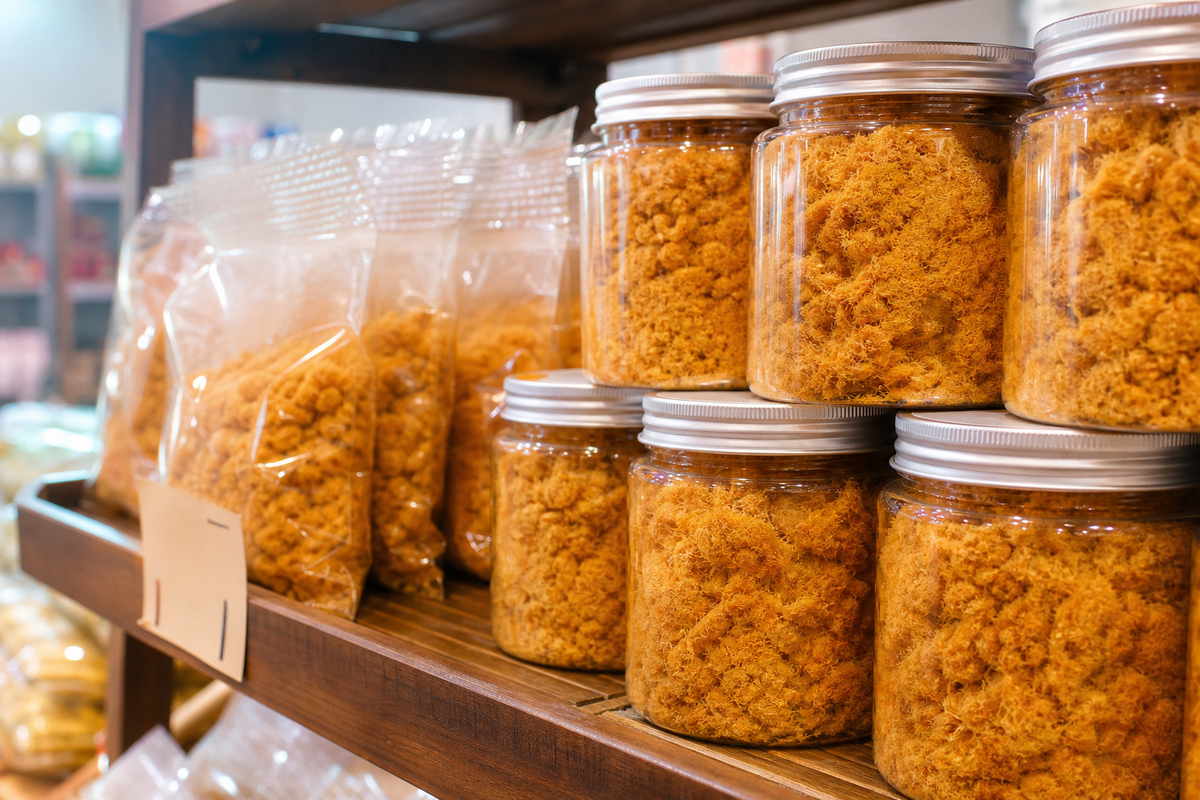
Os supermercados asiáticos oferecem a maior seleção de marcas, embora os varejistas online genéricos também sejam uma opção cada vez mais comum; duas marcas de exportação frequentemente citadas são Formosa e Kimbo, embora marcas próprias específicas de cada loja sejam abundantes em mercados asiáticos regionais e varejistas como a Weee!.
Assim como sugerido pela pesquisa de qualidade, um bom começo para o consumidor avaliar a qualidade potencial antes da compra é ler a lista de ingredientes: verificar se a carne de porco é o ingrediente principal em relação à farinha de soja ou outros ingredientes de enchimento, e observar se há um equilíbrio razoável entre açúcar e sódio. Em muitas casas asiáticas, a carne de porco desfiada fica na despensa ao lado de outros produtos secos básicos, como algas marinhas secas; um fornecedor confiável – seja um supermercado asiático físico ou uma opção de compra online de confiança – é tão importante quanto a marca no pote.
- Verifique se a "carne de porco" está listada em primeiro ou segundo lugar na lista de ingredientes (em ordem decrescente de peso, conforme as normas de rotulagem da FDA).
- Se você busca um produto premium com menos ingredientes de enchimento, procure por uma linha com alto teor de umidade e baixo teor de amido.
- Consulte as orientações atuais do APHIS sobre o país de origem antes de viajar com fio de carne suína — produtos devidamente rotulados e lacrados comercialmente, acompanhados de documentação, passam pela alfândega com mais facilidade do que fio solto ou caseiro, mas não são automaticamente isentos de restrições quanto ao status sanitário.
- Não presuma que "não há ingredientes além de carne" — o fio dental comercial padrão inclui açúcar, farinha de soja e sal por definição, e não como um defeito.
- Não presuma que uma embalagem lacrada passe automaticamente pela alfândega — a carne suína proveniente de países afetados pela Peste Suína Africana pode ser restringida independentemente da embalagem; declare-a e verifique as orientações atuais do APHIS (Serviço de Inspeção de Saúde Animal e Vegetal do Departamento de Agricultura dos Estados Unidos).
- Não ignore a lista de ingredientes só porque a marca é familiar — a proporção de amido/excipientes varia de marca para marca.
É permitido o consumo de fios de carne de porco nos EUA?
A admissibilidade varia dependendo da situação sanitária do país de origem, e não se o produto é "apenas um lanche". A Alfândega e Proteção de Fronteiras dos EUA exige que os viajantes declarem toda a carne e produtos de origem animal ao entrarem no país, e a omissão dessa declaração pode sujeitar o viajante a uma multa civil de até US$ 1,000 por uma primeira infração não comercial.
Em separado, o Serviço de Inspeção de Saúde Animal e Vegetal (APHIS) do Departamento de Agricultura dos EUA (USDA) lista a carne de porco como um fator de risco específico para a transmissão da Peste Suína Africana (PSA) em suas páginas de regras de viagem. A PSA está presente na China, o principal país de origem da carne de porco desfiada comercialmente produzida, e a carne e os produtos suínos originários de países afetados pela doença são geralmente restritos ou totalmente proibidos, enquanto carnes cozidas, curadas ou secas de países livres da doença podem ter permissão para entrar, desde que o país de origem possa ser adequadamente comprovado. Como essas condições mudam com surtos da doença no país de origem, os viajantes que retornam aos EUA com carne de porco desfiada devem consultar as informações mais recentes do APHIS para o seu país de origem específico, em vez de presumir automaticamente que um lanche embalado passará pela inspeção alfandegária.
Do lanche à escala: o que os produtores de alimentos devem saber.
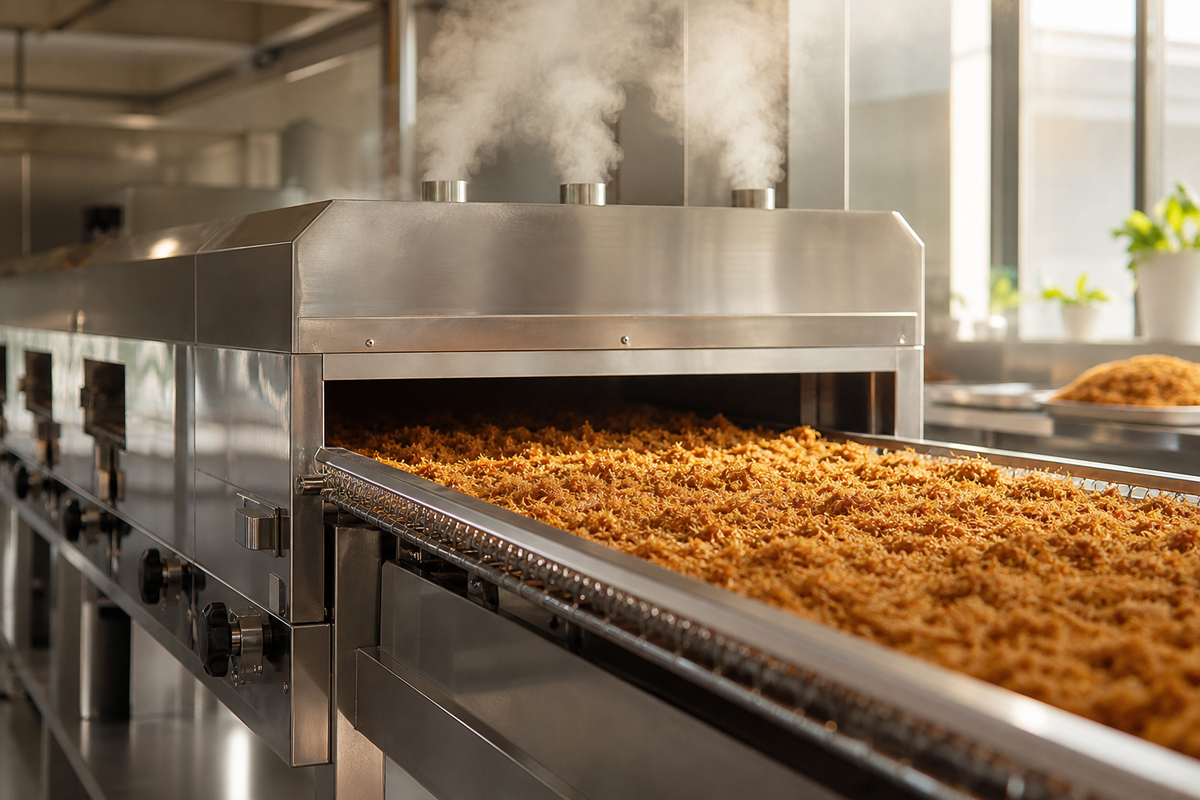
Cada etapa do processo de produção de fios de carne de porco — cozinhar e desfiar, temperar, controlar, secar com agitação, resfriar e embalar — se enquadra na mesma família geral de operações unitárias comuns em toda a indústria de salgadinhos secos e torrados, e não em um processo exclusivo deste produto específico. Os empreendedores do ramo alimentício que passam da produção caseira para a escala comercial invariavelmente se deparam com um impasse no processo de secagem/torrefação. Isso porque, embora o cozimento deva continuar em um ritmo determinado por uma base de várias horas, uma wok com mexida manual atingirá um limite de produção quando os volumes ultrapassarem alguns quilos por dia.
Embora a UDTECH não fabrique equipamentos especificamente projetados para a produção de fios de carne de porco – o que constituiria um nicho muito restrito para o catálogo geral da empresa –, os equipamentos da UDTECH para processamento de alimentos, utilizados para secagem, fritura e torrefação, empregam o mesmo tipo de maquinário de processo contínuo com umidade controlada. Uma linha padrão de processamento de salgadinhos fritos da UDTECH e suas máquinas de extrusão de salgadinhos atendem ao mesmo desafio central de engenharia enfrentado pelos fabricantes de fios de carne de porco em escala industrial: remover uniformemente a umidade de um produto alimentício sem danificá-lo e produzir continuamente em níveis superiores aos possíveis com uma wok que depende de intervenção manual.
Nossa perspectiva
A carne de porco desfiada não consta no catálogo de produtos da UDTECH, portanto, este guia foi pesquisado e escrito como uma explicação honesta e imparcial, e não como uma página de vendas. As seções sobre o processo de produção e a ciência da qualidade baseiam-se em literatura científica de alimentos revisada por pares e em patentes industriais chinesas, em vez de dados internos. A experiência da UDTECH é diretamente relevante na categoria mais ampla de equipamentos para produção de snacks secos e torrados, mencionada anteriormente.
Perguntas frequentes
P: Do que é feita a carne de porco desfiada?
O fio de carne de porco é feito de carne de porco magra cozida lentamente até ficar macia, desfiada em fibras finas e frita ou assada com açúcar, molho de soja e sal até que quase toda a umidade tenha desaparecido.
P: A carne de porco desfiada seca é saudável?
Com moderação, sim, para a maioria das pessoas, mas o sódio é o verdadeiro indicador a ser observado com atenção, e não o glutamato monossódico (MSG), que é o que mais preocupa a maioria dos leitores.
P: É permitido o consumo de fios de carne de porco nos EUA?
A admissibilidade depende da situação sanitária atual do país de origem, e não simplesmente do fato de o produto ser um lanche lacrado e embalado que você está trazendo para casa.
P: Quanto tempo dura o fio de carne de porco?
A carne de porco desfiada comercial, em embalagem selada, normalmente se conserva por vários meses à temperatura ambiente, sem ser aberta, visto que o nível de umidade após a produção é reduzido bastante durante o próprio processo de fabricação.
P: A carne de porco desfiada é isenta de glúten?
A presença de glúten depende da receita específica do molho de soja de cada marca, e não da categoria de fios de soja como um todo, portanto, verifique o rótulo de cada marca individualmente.
P: É possível fazer fio de carne sem carne de porco?
Sim — o desfiado de frango, carne e peixe utiliza basicamente a mesma técnica de brasear, desfiar e secar, com apenas pequenos ajustes de tempo necessários entre as diferentes proteínas envolvidas.
P: Onde posso comprar fios de carne de porco perto de mim?
As mercearias asiáticas físicas oferecem a maior variedade de marcas, enquanto os varejistas online de produtos alimentícios asiáticos são a principal alternativa para os consumidores que não têm uma mercearia asiática por perto.
Artigos Relacionados
- O processo de fabricação de snacks extrusados: como linhas de extrusão contínua moldam e preparam os snacks.
- Como são feitos os salgadinhos expandidos? Outra visão geral da produção de salgadinhos desidratados/expandidos.
- Processo de fabricação de pipoca, produção em escala de snacks com temperatura controlada.
- Máquina de Rolinhos Primavera de Alga Marinha: Um Guia de Compras para a Produção, mais uma categoria de snacks asiáticos explicada sob a perspectiva da produção.
- Linha de processamento de salgadinhos expandidos, equipamento para formatos de salgadinhos expandidos/desidratados
Referências e fontes
- Viajar com carne, aves e frutos do marServiço de Inspeção de Saúde Animal e Vegetal do USDA
- Importação de produtos agrícolas para os Estados UnidosUS Customs and Border Protection
- Identificação das características de qualidade da estrutura da fibra de carne suína com base em um modelo de aprendizado profundo.PMC / ciência alimentar com revisão por pares
- Análise rápida da origem da fibra de carne usando um nariz eletrônico baseado em aprendizado de máquina supervisionado.npj Ciência dos Alimentos, Natureza
- Revisão de segurança do glutamato monossódicoPMC / revisão de literatura científica e de segurança alimentar revisada por pares
- O glutamato monossódico (MSG) é realmente prejudicial?Cleveland Clinic
- Livro de Políticas de Rotulagem e Normas Alimentares do FSISDepartamento de Agricultura dos EUA, Serviço de Inspeção e Segurança Alimentar
- 9 CFR Parte 319, Definições e Padrões de IdentidadeCódigo Eletrônico de Regulamentos Federais
- CN102144783A, Método de Processamento de Fios Crocantes de Carne de PorcoPatentes do Google
- CN103622045A, Método de Produção de Fios de Carne Suína DesidratadaPatentes do Google
- CN106387682A, Método de fabricação de fios de carne seca (pedido de patente pendente)Patentes do Google
- A Evolução dos Petiscos de CarneCARNES E AVES
- GB/T 23968-2022, Qualidade Geral para Fios de CarneAdministração Estatal de Regulação de Mercado (China)
- Noções básicas de segurança alimentar para alimentos com longa vida útilServiço de Inspeção e Segurança de Alimentos do USDA
Revisado pela equipe técnica da Suzhou UDTECH Technology Co., Ltd.